@gatorgar I've done just that in my town. I just showed up. It was at a sort of nondenominational church, so I can't say for sure about a more rigid organizations. Most churches I've seen have some sort of sign that welcomes people to just come.
Gemini has posted tons of lies about me and has accused many others of serious shit like abusing kids
This has to be massive legal exposure right?
Any lawyers want to chime in
@pnjaban @RonColeman@willchamberlain@marcorandazza
The more you censor AI and teach it our counter factual narratives like wokeness, the stupider it gets. It stops being able to reason step by step.
Because wokeness is literally brain rot.
Fei-Fei Li has written a book. She was the first computer vision researcher to truly understand the power of big data and her work opened the floodgates for deep learning. She delivers a clear-eyed account of the awesome potential and danger of AI.
https://t.co/zaXJ205pXh
Can AI and LLMs Learn and Follow the Rules and therefore become Better at Generalized Reasoning?
One of the biggest issues with AI and ML models is that unlike humans, they can't simply be taught the rules of the universe and asked to predict within their constraints.
While ML models learn the underlying patterns in a particular data distribution, they can easily generate a nonsensical prediction that doesn't comply with the laws of physics.
This in turn causes normies to distrust them, insist on explainability and potentially create FUD. Ideally, it would be best if AI could learn the patterns in data, but also follow rules.
In fact, early AI research was focussed on expert systems. Symbolic systems, including rule-based AI and expert systems, were particularly popular during the 1960s through to the 1980s. This era is often referred to as the "first wave" of AI. During this period, the emphasis was on encoding human knowledge and logic into computers to emulate human-like reasoning. The symbolic approach was seen as a promising way to bring about intelligent machines, with significant investment and research dedicated to developing these systems.
However, the labor-intensive nature of encoding rules, along with the systems' inability to handle uncertainty or learn from data, led to a transition towards data-driven approaches as computational power increased and large datasets became available.
With the advent of classical machine learning and the explosion in supervised learning, the only way to encode rules, was to add a number of training data-points that encode a particular set of rules.
More recently, with the advent to large language models (LLM), it has become much easier to teach an AI model to follow rules.
Reinforcement learning (RL) based on human feedback(RLHF) is akin to teaching large language models (LLMs) rules to follow, though of course in a more dynamic and interactive manner.
In this setup, the LLM receives feedback on its actions or responses, which serves as a guide to tweak its behavior over time.
Through this ongoing dialogue of action and feedback, the LLM gets nudged towards adhering to the desired rules or guidelines set forth by human feedback, much like a student learning through a system of rewards and corrections. Over time, the reinforcement from human feedback helps to fine-tune the model's responses to align with the desired rules or objectives.
In fact, LLMs would be be pretty biased and based on the quality of training data, may even be pretty unusable without RLHF.
So in some sense, using natural language to tell AI what to generate and what not to generate has helped AI models become a lot more useful.
More recently, Zhu et. al in their paper "Large Language Models can Learn Rules", talk about an issue with LLMs
tend to be incorrect, if the implicit knowledge (data the have been trained on) is inaccurate or inconsistent with the task at hand
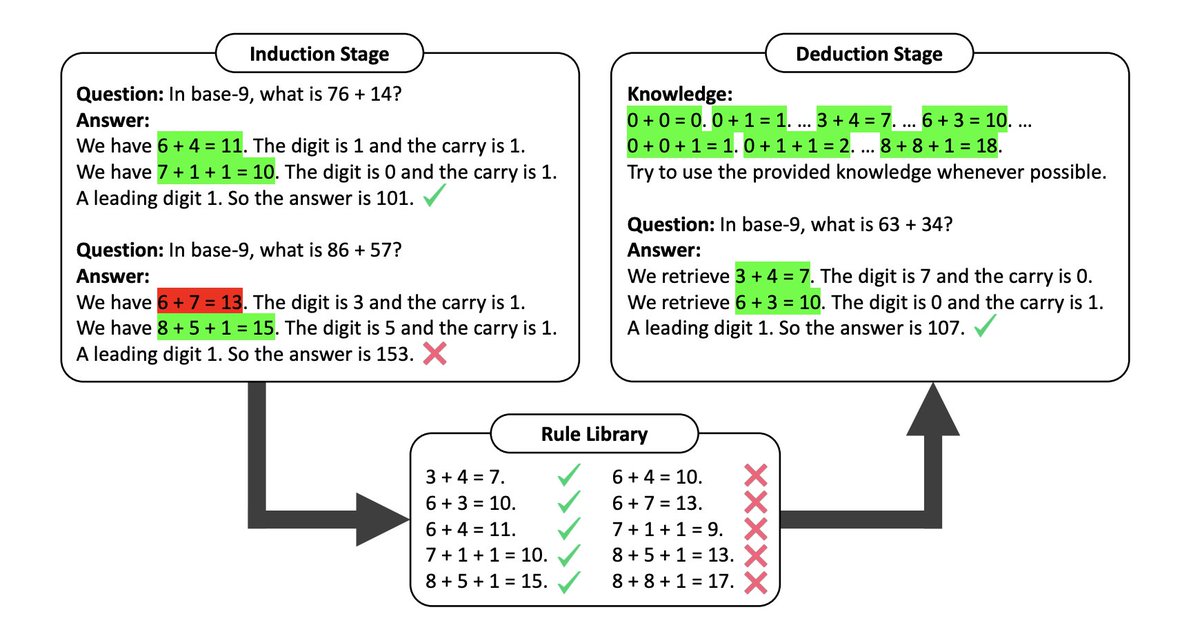
To address this limitation, the authors introduce Hypotheses-to-Theories (HtT). This framework is designed learns a rule library for reasoning with LLMs and has 2 stages: an induction stage and a deduction stage.
During the induction stage, an LLM is tasked with generating and verifying rules using a set of training examples. The rules that frequently lead to correct answers are gathered to create a rule library. In the deduction stage, the LLM is prompted to utilize the learned rule library to perform reasoning and answer test questions.
HtT significantly enhanced existing prompting methods by achieving an absolute gain of 11-27% in accuracy. The rules can also be transferred across different LLM models, which helps torwards more generalized reasoning capabilities for LLMs
In summary, LLMs ability to learn and follow rules will be key to their ability to become better at reasoning and just like humans, future AI models will learn from a combination of data and the rules.
@TVRS_official I'm a researcher...so 512GB. I can use that amount with prototypes and related things. Games will also grow as more capabilities come on board.