🧵¿Por qué la inflación sigue subiendo en Bolivia?
Los bloqueos, la especulación y hasta la "avaricia de los ganaderos" han sido señalados como culpables. Pero la verdadera causa está en otro lado. Aquí te lo explico con datos. ⬇️
Me acabo de percatar de que el antiguo blog de @juanrallo ya no está disponible. Fue una fuente invaluable de economía y liberalismo para muchos. Ojalá algún día se recupere y organice ese material. Con la IA, hoy debería ser mucho más sencillo y barato. Me ofrezco a intentarlo.
¿Cómo estabilizar Bolivia sin consignas políticas? No se pierdan la entrevista de Maggy Talavera sobre nuestro libro a Solange Sardán Matijaševic y Carlos Augusto Aranda Herrera
https://t.co/ieIgUGK1Kb
¿Se viene el retiro del subsidio a la gasolina? Con un Gobierno ante el reto de asumir medidas impopulares y políticas sociales “ciegas”, el economista Carlos Aranda cree que en Bolivia no habrá “milagro económico”.
Sigue el programa completo en: https://t.co/wcxJXpNLEe
@Ari_el_777@SofiRojas99 Siempre puede pagar sus obligaciones en terminos nominales, pero no en terminos reales, si imprime para cumplir sus obligaciones, generando inflación, te pagará con moneda devaluada
@SmmUrban1764 Recomiendo poner la tasa de fecundidad global de Bolivia con dos decimales, ya que la misma es de 1,59 en 2026 según el Censo de Población y Vivienda y las Revisiones Poblacionales de 2025, publicados recientemente por el Instituto Nacional de Estadística. https://t.co/RDWAjqPXJx
Introducing Claude Opus 5.5, the first model in our new Claude 5.5 family.
It performs at the level of Claude Fable 5.1 for most tasks, and costs 40% less to run than Opus 5.
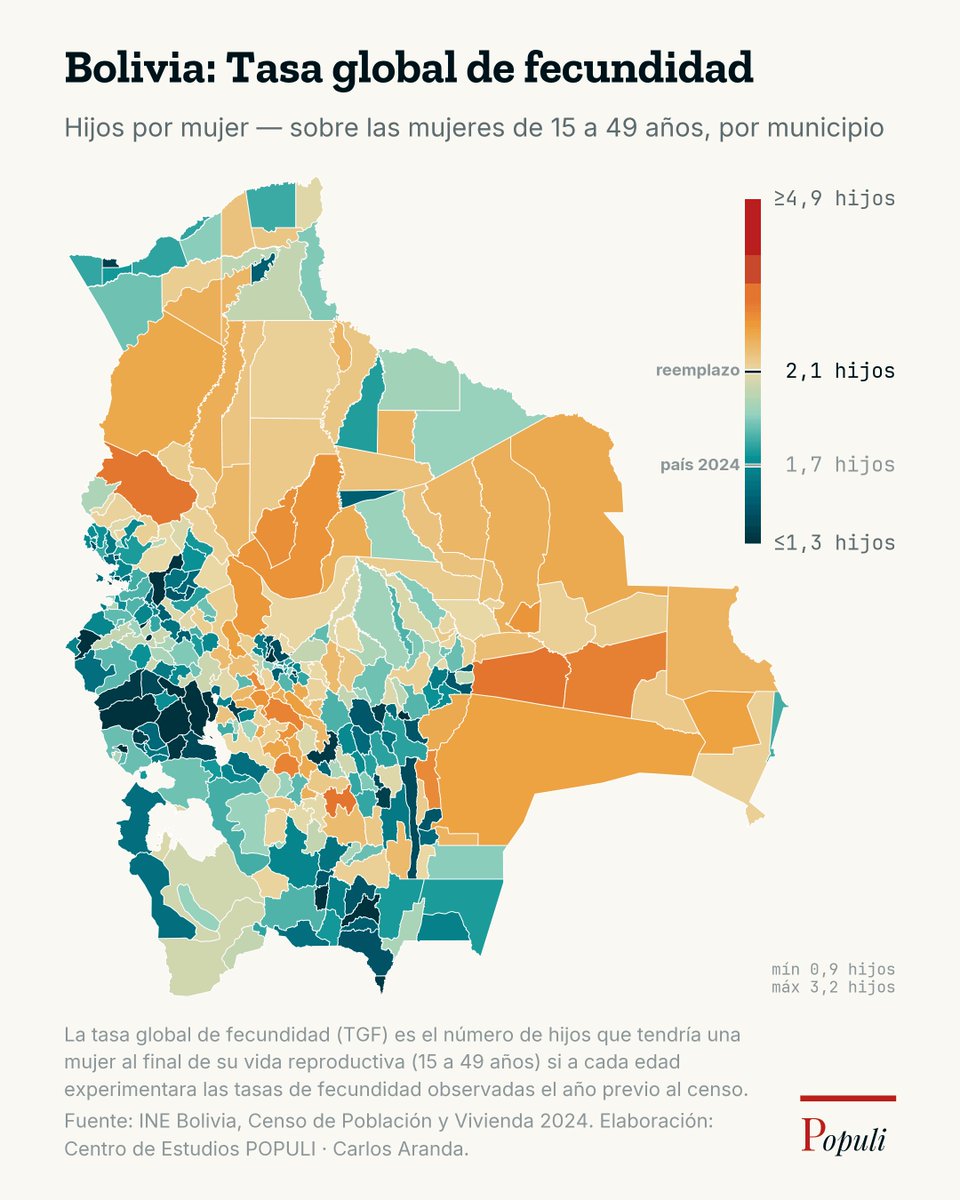
Solo 101municipios (de 343) están hoy por encima del reemplazo, a lo dicho por el profesor @JesusFerna7026 sumenos la migración masiva a las ciudades (que ofreceran lo que un munucipio extenso y despoblado jamás ofrecerá) ¿Somos conscientes de las implicancias de todo esto?
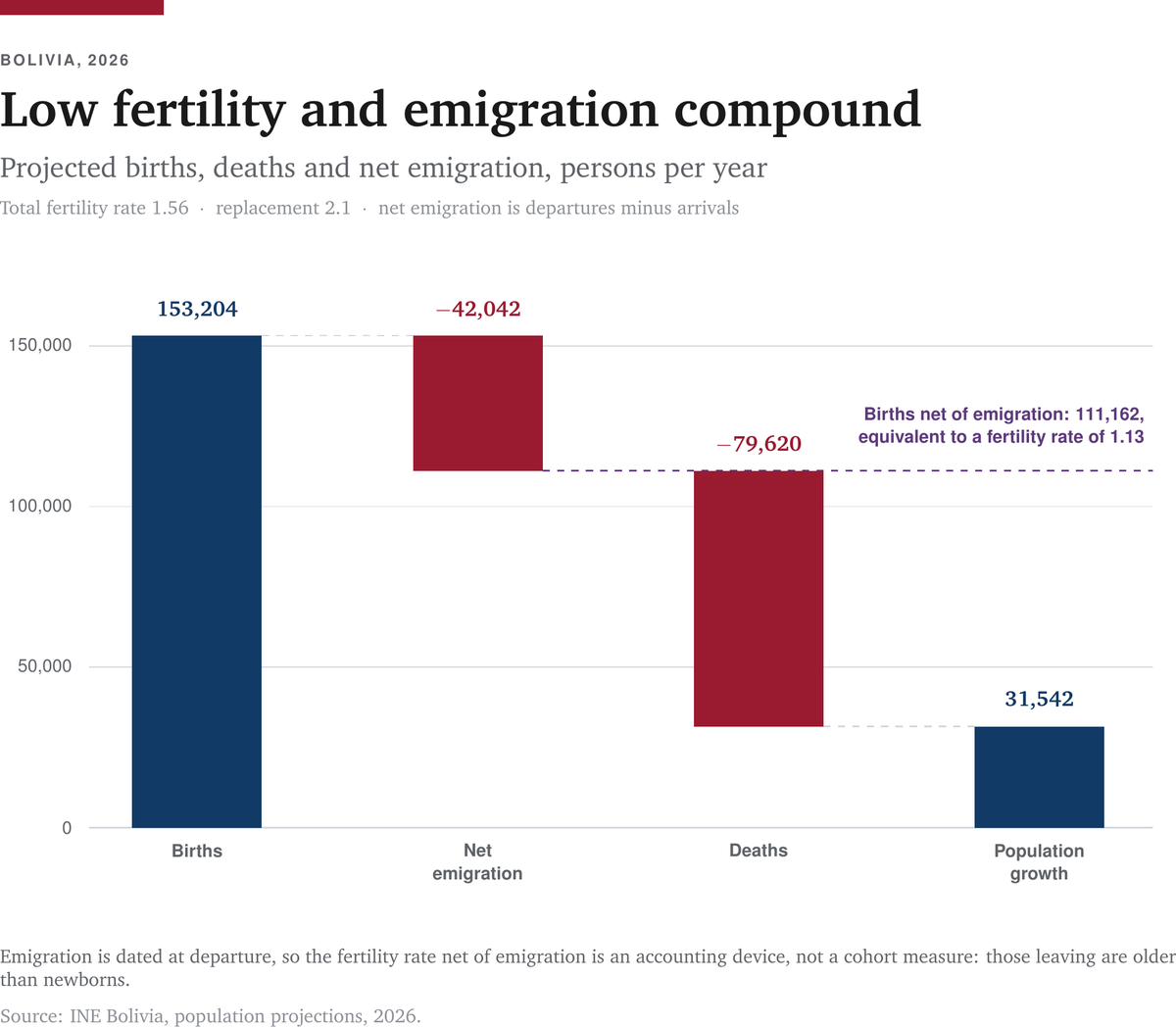
Many countries with low fertility are also countries with considerable net emigration, a compounding effect that many overlook in advanced economies, where net immigration is the norm.
Take the case of Bolivia. According to the Bolivian National Institute of Statistics, in 2026 there will be 153,204 births in Bolivia, with an estimated total fertility rate of 1.56, well below the replacement level. But Bolivia has an estimated net emigration of 42,042 persons a year. So, in a loose sense, the “effective” births are only 111,162, or roughly the equivalent of a total fertility rate of 1.13 (yes, there is a timing component I am skipping since this is a post on X: those emigrating are older). Also, deaths will be 79,620. So net population growth will be only 31,542.
The Bolivian National Institute of Statistics forecasts that fertility will stabilize at 1.47. Given current trends, I do not quite see this stabilization. If fertility drops instead to something around 1.40, not much lower, Bolivia will be losing population by 2034 or so.
I am often asked in my talks: “What about immigration?” I am actually quite skeptical, for many reasons, that immigration is the solution to demographic problems, but for countries like Bolivia the answer is straightforward: Bolivia has positive and relatively large net emigration.
@tome_anticic@JesusFerna7026 Yes. While there are no data specifically for Mennonites, Pailón — where many of these communities are concentrated — saw its TFR fall from 4.6 (2012) to 3.0 (2024). Pailón is not exclusively Mennonite, so this may lower the average. https://t.co/6xoSgFtDnt
@JesusFerna7026 Thanks for the mention, Professor. Honestly, I’m still surprised by these numbers. After following your posts on this topic for at least the past three years, I don’t understand why this isn’t on the front page of every newspaper.
USA tiene una renta per capita 8 veces la de Bolivia, no estamos dimensionando las consecuencias económicas y políticas de ser, casi con seguridad, el país con el colapso de la natalidad más acelerado de la historia moderna.
Aquí por qué esto importa: https://t.co/ng4Je0ctir
Is Bolivia’s total fertility rate below the U.S. rate?
In a new data release, the National Institute of Statistics of Bolivia reports the country’s total fertility rate at 1.56 in 2026. The U.S. will be around 1.57.
This is NOT my estimate. I am just copying and pasting a table from https://t.co/9mfk2R2Eec (Appendix 1, page 68). Can I say it again? This is the official data.
If I had been told 10 years ago that, by 2026, Bolivia’s total fertility rate would be below the U.S. rate, I would not have believed it. I would have happily bet $1 against $1 million that it would not happen. In fact, I look at the table, and I still need to pinch myself. Bolivia was around 6.5 in the mid-1980s and around 3 in 2010 or so.
I don’t know. Sometimes I wish I were a better writer, so I could express what I am feeling right now. More than anything, the sense that ten years ago I missed a fundamental change in humanity. What else can I be missing now?
Thanks to @LibCarlos for the link and the information..
@JesusFerna7026 Here is the INE document where the figure of 1.69 is reported. I also wonder if the discrepancy could simply be due to some error in the Census data or in the estimation process. I have some reservations about the official figures
https://t.co/BcylFUr8YX
@JesusFerna7026 Prof., your BID slides report Bolivia’s TFR at 2.06 in 2024, while INE, based on the 2024 Census, arrives at 1.69. I also get 1.69 using the Brass P/F method. This is even more surprising considering EDSA 2023 reported 2.1. Are the differences mainly a matter of methodology?
@andreags@SofiRojas99 Sobre el punto de la distribución de la carga en el núcleo familiar, no dimos nuestra posición, personalmente si creo que esa carga debe ser más equitativa, pero desde luego no me metería a legislar sobre la organización familiar de las personas. Es un cambio cultural.
@andreags@SofiRojas99 No se han comprendido los argumentos, cuando hablamos de esas distorsiones, nos referimos a quienes proponen remunerar socialmente la crianza, mi punto es que la crianza es valiosa, por eso, los padres, generalmente las madres, son quienes asumen el costo de la misma.
𝟭 𝗨𝗦𝗗𝗧 = 𝗕𝘀. 𝟭𝟭,𝟳𝟴
Es normal.
Hay que acostumbrarse.
Unas veces subirá, otras bajará.
Hay que aprender a flotar y navegar.
No va a cambiar prácticamente nada.
No podíamos seguir viviendo con esta mentira.
Sube solo 10 centavitos y ustedes se escandalizan.
El dato es bueno, pero se debe fundamentalemente a un efecto precio de los minerales (oro y plata) y en menor medida, por una caída en las importaciones de combustible por el retiro parcial del subsidio a los combustibles.
Más aquí:
https://t.co/ASPoEgbYJP
Los dos primeros meses de este año exportamos más (2.221 millones de dólares) que lo que importamos (1.420 millones de dólares). A diferencia de lo ocurrido en mucho tiempo, tuvimos un superávit comercial de 801 millones de dólares.
Esto se debió a la acción combinada de la liberación de exportaciones y una menor importación de combustibles.
Suponiendo que la guerra en Irán se acabará pronto, creo que podremos extender este superávit comercial a todo el año. Tener exportaciones por unos 11.000 millones y unas importaciones de unos 9.000 millones, con lo que el superávit de 2026 ascendería a unos 2.000 millones de dólares, que podrían servir para pagar deuda externa y acumular reservas internacionales.
Es decir, bien encaminado, el comercio exterior servirá para estabilizar al país. https://t.co/GQUbonUPQx