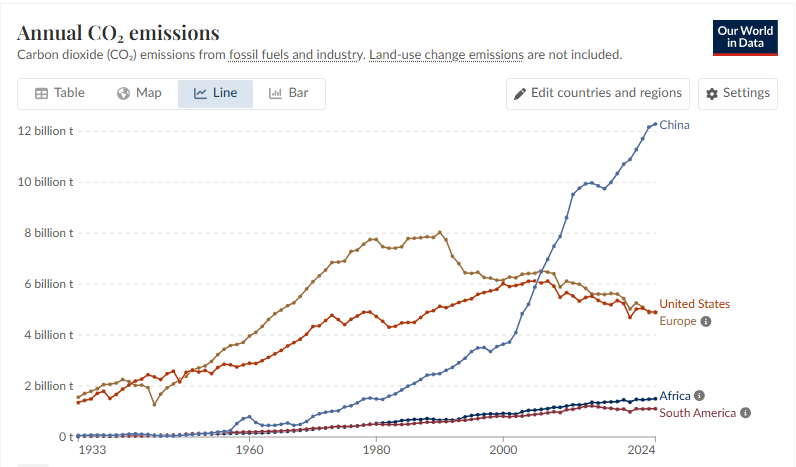
Siccome in tantissimi se ne escono con questa frase ho pensato di rispondere con due modelli (uno semplificato e uno accurato)
Trovate tutto qua: https://t.co/hj5xWrQfBo
It’s downstream from culture. Contemporary Western culture.
China 🇨🇳 is not devastating the West. The West is devastating itself.
Western business schools have spent decades teaching generations of executives that the purpose of a company is to maximise short-term shareholder value and wealth extraction, largely because that also maximises their own compensation.
It is the triumph of tactical spreadsheetism over strategy.
The more that MBA mindset fills executive suites, the more predictable the outcome becomes.
Long-term capital investment, in-house manufacturing, engineering capability, apprenticeships, resilience, even a modest degree of strategic redundancy – all are treated as costs to be cut rather than assets to be cultivated. If an investment won’t improve next quarter’s numbers, it struggles to survive the boardroom.
Complex industrial systems carry decades of accumulated capital: factories, skills, supplier networks, institutional knowledge, and productive capacity. They also carry a great deal of inertia. For a while, consuming that accumulated capital looks like genius. Margins improve, return on invested capital rises, analysts applaud, executives collect bonuses.
Then the inertia runs out.
The fat is gone, yet the incentives remain. The acroparasites, having exhausted the surplus built by previous generations, move on to muscle and bone. They continue doing the only thing they have ever been taught: extracting rather than building.
Meanwhile China spent those same decades methodically investing in factories, supply chains, technical know-how, engineering capability, and industrial scale.
And our elites call them the devastators.
What we’re seeing in Germany – and, in truth, across much of the West – is not simply a failure of industrial policy. It is the logical outcome of a managerial culture that long ago confused financial engineering with economic production.
Just one more observable suggesting that something is deeply rotten in the West.
@StefanoFassina Il superamento della lettura della Russia “minaccia esistenziale”? Intendi superata, come minaccia, dalla Cina mercantilista in economia ed espansionista in politica estera?
Democracy was never designed to consistently produce great leaders. Its function is letting a society remove bad ones without violence, which across recorded history is the only governance test that has actually mattered. Every alternative, monarchy, theocracy, single party rule, military junta, socialism, communism, comes with a body count that dwarfs anything democracies have produced.
WSJ: "Germany’s famously open economy was its greatest economic asset, delivering almost 20 years of uninterrupted growth and turning it into one of the biggest winners of globalization."
I think I would have framed this differently.
Germany's trade competitiveness for a long time was based on its ability both to suppress household income growth relative to productivity growth (as it did, for example, after the 2003-5 Hartz reforms), and to keep its currency cheap (as it did, for example, through adoption of the euro).
Under our current form of globalization, in other words, we experience an example of the Kalecki paradox, in which wage-suppression policies that allow one country to grow faster than its trade partners are actually bad for overall global growth – to the extent, anyway, that consumer demand drives investment among its trade partners.
In this system, all countries are under pressure to suppress wage growth in order to expand manufacturing and retain manufacturing employment, but the "winner" is the one who is able to do it most effectively.
For many years, when much of China's high saving was directed into domestic investment, Germany was one of the main winners from this system. But as Chinese investment became increasingly unproductive, Beijing began trying to rein in the debt needed to fund so much unproductive investment.
This process, of course, took off after the 2021-22 property crash, and once that happened, Germany's ability to benefit from the Kalecki paradox evaporated, as it quickly became one of the main losers of the system.
The point is that the problem isn't China. The real problem is a system that rewards countries for implementing policies that undermine overall global growth. The good news is that for many years, when Germany was able to exploit the global trade regime, it was also one of the greatest defenders of this system. Now that it is on the losing side, German policymakers are increasingly recognizing how damaging a system it is.
There is nothing new about this. If you read the economic debates between the UK and the US in the 1920s, a period when US productivity soared even as wages remained stagnant, it was the UK that complained about the trade imbalances. The US insisted that its huge trade surplus was simply the consequence of more efficient manufacturing techniques and harder-working people. The US of course abandoned that argument in the 1970s, when it lost its trade surplus.
In the economic debates of the 1980s, it was the US who complained about trade imbalances, and Japan who insisted (what else?) that its huge trade surplus was the result of more efficient manufacturing techniques and harder-working people. No one in Japan makes such a silly claim anymore.
In the 2000s, of course, Germany rather patronizingly explained to the rest of Europe that if only they could become as efficient in manufacturing and as hard-working as the Germans, they too would be in just as good a shape. So much for that claim.
Meanwhile our trading system continues to reward policies that depress global growth by putting downward pressure on wage growth, or that, alternatively, force the world to encourage rapid increases in debt in order to counter the impact of lower wage growth.
That is why the real solution isn't a global alliance against China. While this may help defuse current tensions, it won't change a system that will continue to reward bad behavior – i.e. household income-suppressing policies – by allowing countries to externalize the costs of this bad behavior through large, persistent trade surpluses. And this means that it will continue to support increases in income inequality within countries.
https://t.co/9g6zh3ET99
After acquisitions, target firms saw returns on assets fall by about a quarter and patenting flatline, while their Chinese parent firms sharply increased granted patents – trebling overall and quadrupling for state-owned enterprises.
3/
Financial Times: "Beijing now sees AI-enabled machines as a way out of the demographic trap. Last year the country installed more industrial robots than the rest of the world put together."
This very interesting FT article claims that because its aging population "is China’s biggest economic headwind" (I am a little skeptical about this claim), and that because its declining population makes a bad debt problem even worse (I agree), Beijing wants to increase worker productivity by investing heavily in automation and robot technology.
This sets off at least three, perhaps unrelated, points. First and most obviously, mainstream economists have long argued that manufacturing jobs are no better than service jobs, and because the former are declining anyway, we should avoid a manufacturing "fetish".
But this might only show just how poorly they understand the economy. It is precisely because manufacturing productivity can rise so rapidly (which also explains most of the decline in manufacturing employment) that countries like the US and the EU should do all they can do encourage domestic manufacturing.
Second, China has among the lowest unit labor costs in the world, i.e. wages are lower relative to productivity than they are in most of its trade partners. It also has a very high underemployment as gig work absorbs a huge number of workers who would otherwise be unemployed. With such low labor costs, you would expect Chinese growth to be very labor intensive at this stage.
But it is instead very capital-intensive, as demonstrated by the extraordinarily high investment share of GDP, and illustrated by the huge push into the labor-saving automation described in this article. This is pretty strong evidence than in China labor may be cheap, but capital is even cheaper.
Third, many analysts worry that automation and robot technology will lead to a rise in unemployment. This is only true, however, if overall demand fails to keep pace with overall supply, in which case production facilities would have to close down and workers fired.
But this may be a misplaced concern. In an economy in which investment growth depends on growth in consumption, overall demand will fail to keep pace with overall supply only if household income fails to keep pace with productivity growth.
This returns us to China's original problem. while Chinese productivity has been rising, especially until the late 2000s and early 2010s, wages haven't kept pace with productivity growth.
So what really matters to overall Chinese and global growth, at least in the medium term, is not the rate at which China automates and expands robot technology, but whether or not wage growth is able to keep pace with the resulting increases in productivity.
Given the extent of unemployment and underemployment in the economy, however, this seems pretty unlikely, at least in the next few years, in which case the impact of automation in Chinese manufacturing is likely to be even bigger domestic imbalances and trade surpluses.
The key, as I see it, is whether China can continue to subsidize the cost of capital to such an extent that, even with very low labor costs Chinese businesses still prefer capital-intensive growth over labor-intensive growth. This in turn probably depends on how much longer Chinese debt can grow faster than China's real debt-servicing capacity. With debt so high and rising so rapidly, I suspect we will only get a few more years of this at best.
https://t.co/Uli4JS7ZKA
CONTE E IL SUPERBONUS, UNA STRADA SENZA RITORNO
Giuseppe Conte dice che non rifarebbe il Superbonus, anche se ha prodotto ottimi risultati economici. “La Banca d’Italia dice che dal 2019 al 2023 il pil è cresciuto del 5,8%, senza il Superbonus sarebbe cresciuto del 2,2 %”, ha detto al direttore della Verità, Maurizio Belpietro. L’ex premier ha aggiunto: “Quando si dice ‘è costato la somma X’, lasciamo stare, perché i dati li faremo a consuntivo. Guardare al costo non ha senso, essendo un investimento. Quando andremo al governo e spero tra poco, chiamerò i tecnici del Mef che sanno far di conto e farò tirare fuori dal cassetto quali sono i ritorni del Superbonus”.
Non c’è bisogno che il M5s torni al governo per “fare i conti”. Quei dati sono già pubblici, frutto delle analisi di varie istituzioni. E tutte confermano che il Superbonus è stato un disastro.
Partiamo dall’analisi della Banca d’Italia citata da Conte (dal titolo “Le recenti dinamiche della produttività e le trasformazioni del sistema produttivo”). Nello studio, in effetti, si segnala che “senza gli incentivi fiscali alle ristrutturazioni edilizie la crescita del valore aggiunto tra il 2019 e il 2023 (pari a 5,8 punti di pil) si sarebbe sostanzialmente dimezzata”. Il dettaglio non marginale è che, in quello stesso periodo, la spesa complessiva di Superbonus e Bonus facciate è stata pari a 170 miliardi di euro, oltre 8 punti di pil. E infatti nella frase successiva Bankitalia scrive: “I benefici per il complesso dell’economia in termini di valore aggiunto sono stati più bassi rispetto ai costi sostenuti per le agevolazioni, implicando un moltiplicatore fiscale inferiore all’unità”. In sostanza “il ritorno” di cui parla Conte è negativo: ogni euro speso ha prodotto meno di un euro di pil.
Non si tratta dell’unica valutazione negativa sul Superbonus. In un altro studio sul tema, dal titolo “L’impatto economico degli incentivi fiscali alle ristrutturazioni edilizie”, Bankitalia stima che dei 170 miliardi di spesa nel periodo 2021-2023 tra Superbonus e Bonus facciate il 27% è una “perdita secca”: lo stato ha speso 45 miliardi di euro per finanziare investimenti che i privati avrebbero fatto con i denari propri. Nello stesso studio, si stimano anche l’impatto sul pil e il costo finale della misura (al netto del gettito fiscale). Nel periodo 2021-2023 i bonus edilizi hanno prodotto una crescita tra 2,6 e 3,4 punti di pil su 13,5 punti totali. Che è sicuramente una spinta forte, ma solo se non si considera il costo. Perché vuol dire che lo stato ha speso in bonus edilizi 3 punti di pil ogni anno per ottenere 1 punto di pil di crescita. Non un grande “ritorno”, si direbbe. “Il costo netto del programma, al netto dell’extragettito causato dalla crescita, è di circa 100 miliardi – conclude la Banca d’Italia –. La misura è lontana dal ripagarsi da sola”.
Ma Conte i numeri li vuole dal Mef che, a suo dire, li terrebbe nascosti “nel cassetto”. In realtà i conti del Mef sono pubblici, perché presentati in audizione parlamentare nel 2023, e più recentemente in un working paper dal titolo “The effects of tax incentives for dwelling renovations: the case of Italy”. Lo studio, pubblicato l’anno scorso dal dipartimento del Tesoro, è più severo dell’analisi della Banca d’Italia. Gli autori prendono in considerazione il Superbonus e il Bonus facciate nel periodo che va dal 2020 al 2023 (un anno in più rispetto al periodo considerato da Bankitalia), il cui costo complessivo è stato di 186 miliardi di euro (circa 9 punti di pil). Il Mef stima che la “Perdita secca” è stata di 70 miliardi di euro, pari al 38% del totale (per Bankitalia è il 27%). “La nostra analisi solleva seri dubbi sull’efficienza degli incentivi”, scrive eufemisticamente il Mef.
Non c’è quindi bisogno che Conte torni al Mef per cercare nei cassetti i conti del “ritorno”. Soprattutto se pensa ancora che il Superbonus sia un’ottima idea: il costo del “ritorno” potrebbe solo aumentare.
https://t.co/pXvHImsZDT
Few things seem to confuse economists more than the concept of "comparative advantage". Comparative advantage exists only for those sectors of the economy that are relatively more efficient than other sectors of that same economy, and this comparative advantage remains in place whatever the level of the currency (adjusting for import prices).
This means by definition that a country cannot have a comparative production advantage in "almost everything". Instead, a country can only have a comparative advantage in producing roughly half of what it consumes and invests, and a comparative disadvantage in producing the rest.
This is why trade is supposed to maximize output – a country produces more of those goods in which it has a comparative production advantage than it can consume domestically. It does this so that it can export the excess in order to pay for imports of those goods in which it has a comparative production disadvantage. That is arithmetically the only way to maximize production.
But if a country exports not in order to pay for imports but in order to acquire foreign assets, this is the classic definition of mercantilism, under which the benefits of comparative advantage do not exist. In that case what the county has is "competitive" advantage, and this competitive advantage can be eliminated simply by allowing the currency to appreciate to its fundamental level.
Note that in Ricardo's famous example, Portugal had a competitive advantage in producing both wine and textiles, but a comparative advantage only in producing wine. That is why Ricardo was able to prove that total production would rise if Portugal produced only wine and England only textiles, with each selling part of what it produced to the other in order to acquire what it didn't produce.
Had Portugal instead done what surplus countries do – suppress domestic consumption in order to sell both wine and textiles to England, while getting paid in the form of a net acquisition of English assets – total production would have declined, not risen.
There are many problems with the concept of a country specializing in its area of comparative advantage, but in general it results in a rise in global production and global demand. When a country specializes in gaining across-the-board competitive advantage, however, it reduces global production by suppressing domestic demand and externalizing the consequences. Keynes explained how this happens perfectly well at Bretton Woods.
For those who are interested, I explain this further here: https://t.co/RzK2vyDlhY
Found research from May that shows e. coli "remember" environmental conditions their ancestors lived through and behave differently because of it, all without a brain, neurons, or a nervous system. Inherited proteins handle the memory.
The mechanism is what's so cool. Different cellular components relax on different timescales, so the cell integrates its history as a power law instead of a single decay constant.
This is an extremely elegant expression of memory as a biochemical hidden state, emergent from ribosome dynamics, that lets a granddaughter cell respond to stress it never personally experienced.
It is also oddly close to the logic behind recurrent neural networks.
My main takeaways are that memory might predate minds and a growing belief that AI is convergent with biological intelligence.
paper: https://t.co/FyHpn76xWT
Sharing my article published by China Leadership Monitor : "#China's Dual Economy: When Strategic Ambition Hollows Out the Foundation“.
China’s dual economy—combining world‑class technology and exports with stagnant household incomes and weak consumption—is not a temporary imbalance but a deliberate design to win strategic competition with the United States and achieve global hegemony. It depends on financially repressed households funding state-led investment in advanced manufacturing, backed by a closed capital account that traps cheap savings. But the model is cracking: corporate involution is eroding profits, wage stagnation is crushing demand, AI threatens job losses, and post‑2008 debt limits fiscal tools. Rising global protectionism clouds export prospects. Without structural reform, the system’s internal contradictions will intensify.
https://t.co/BuWUGAb3zi
“The EU could well conclude that it can’t act (against China) because the short-term costs are too high. In which case it will have given in to coercion both now and later.”
Great piece by Soumaya Keynes. With a shoutout to Brad and my work.
1/