𝗡𝗩𝗜𝗗𝗜𝗔 𝗚𝗧𝗖 𝗧𝗮𝗶𝘄𝗮𝗻 𝟮𝟬𝟮𝟲 - 𝗠𝗮𝗽𝗽𝗶𝗻𝗴 𝘁𝗵𝗲 #𝗛𝗲𝗮𝗹𝘁𝗵𝗰𝗮𝗿𝗲𝗔𝗜 𝗩𝗮𝗹𝘂𝗲 𝗖𝗵𝗮𝗶��
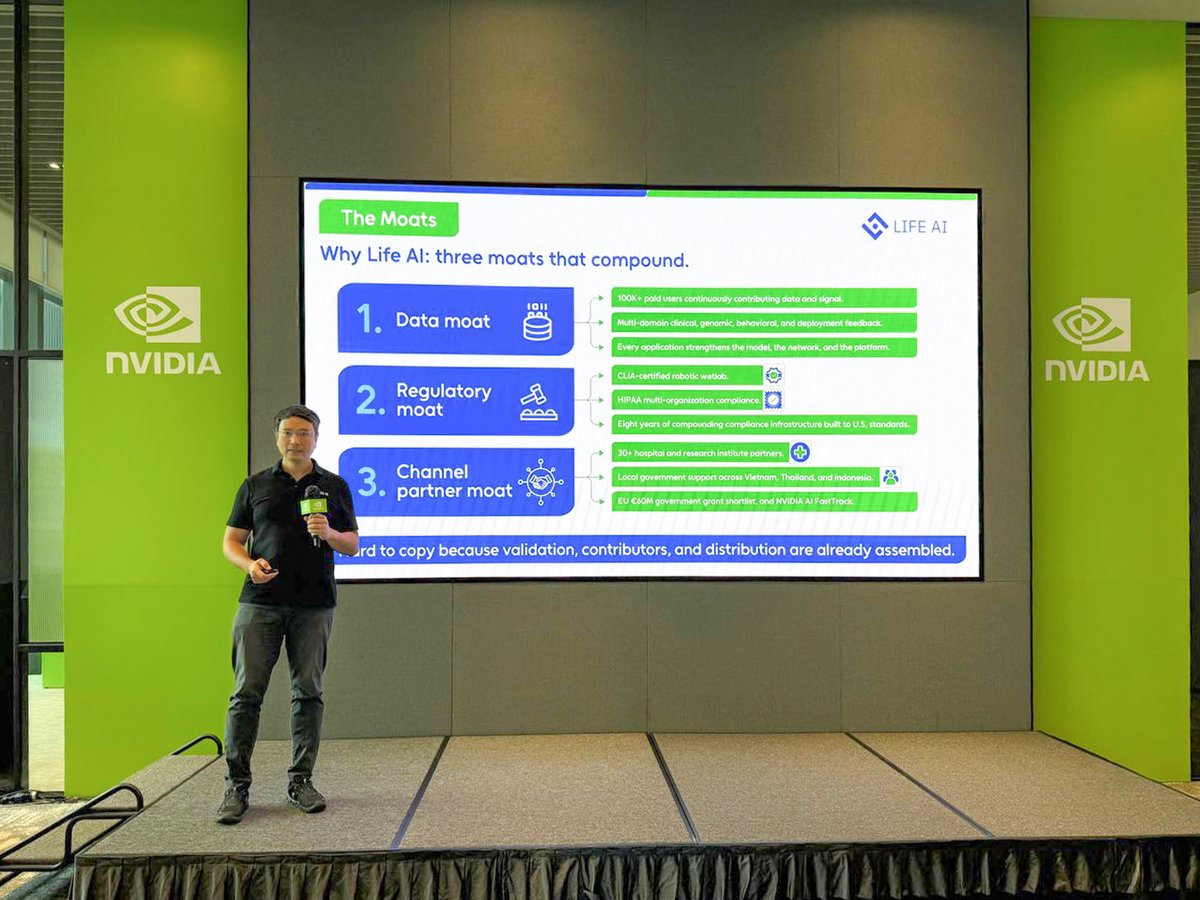
At NVIDIA GTC Taiwan 2026, our Co-Founder & CEO Dr. Tuan Cao @tuan_lifeai presented “LifeAI Biohub: A Purpose-built AI platform for Drug Development”
One signal emerged throughout the session:
As AI capabilities continue to advance, the bottleneck is no longer intelligence itself. It is the infrastructure that enables validation, governance, and coordination across the full spectrum of healthcare stakeholders.
𝗧𝗵𝗲 𝗛𝗲𝗮𝗹𝘁𝗵𝗰𝗮𝗿𝗲 𝗔𝗜 𝗩𝗮𝗹𝘂𝗲 𝗖𝗵𝗮𝗶𝗻
Pharma → Hospitals → Doctors → Labs → Regulators → Auditors → Patients
Sustainable progress in healthcare AI demands alignment across the entire ecosystem, not isolated optimization within a single organization.
𝗟𝗶𝗳𝗲𝗔𝗜 𝗕𝗶𝗼𝗛𝘂𝗯
Shared Infrastructure → Coordination Layer → Connected Network → Application Success
This is the foundation Life AI is building: the shared infrastructure and coordination layer for the healthcare AI value chain so that every application built on top can move faster, scale further, and earn trust across the industry.
The long-term opportunity in healthcare AI will not be defined by better models alone. It will be defined by the infrastructure that makes those models deployable, accountable, and impactful at scale.
It was a privilege to share this vision alongside the researchers, healthcare leaders, and technology builders at NVIDIA GTC Taiwan shaping the next chapter of AI.
Grateful to have been part of the Google for Startups Accelerator: Southeast Asia 2026.
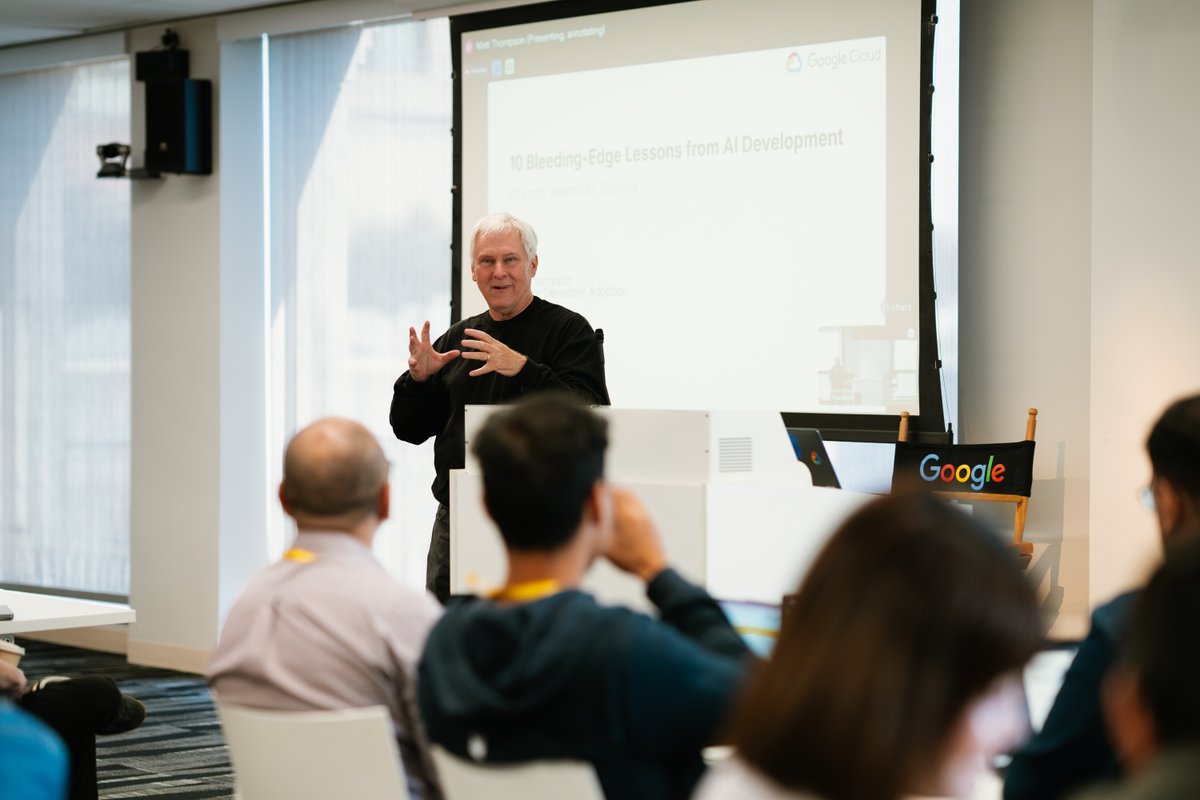
We brought Life Cloud, our AI-powered cloud for healthcare, to Google San Francisco for a week of building and stress-testing with Google engineers. We're taking those lessons back to our work with health partners across Southeast Asia.
Thank you to Google for Startups and our mentors, and congratulations to the 23 other startups in the cohort.
#GoogleForStartups #HealthcareAI
Our Google for Startups Accelerator: Southeast Asia 2026 founders brought their ideas to life during a week of building and problem-solving in San Francisco.
For more information about the program, visit: https://t.co/D0qq2FzGBC
Thank you, @GoogleStartups, for a remarkable week in San Francisco.
We brought Life Cloud, our AI-powered cloud for healthcare and one piece of the infrastructure we're building for drug development. After a week of stress-testing with Google engineers, we're heading home with sharper answers for our health partners across Southeast Asia.
Proud to be part of this cohort.
Clinical Development Needs Shared Trust, Not Just Another Central Coordinator
Clinical development has a paradox: it takes many independent organizations to run a program, yet coordination and records are often managed through sponsor-led or program-specific systems.
The sponsor, often working with a contract research organization (CRO), oversees the program and coordinates its activities. When a subsequent program involves different organizations, prior records, partner qualifications, and approval workflows are not automatically reusable. Teams can end up rebuilding parts of the same operational groundwork.
A better coordinator alone does not solve this problem. When records depend on one party’s control, other participants must decide whether and how to rely on them. A decentralized architecture can reduce that dependence by allowing participants to share responsibility for maintaining and verifying records under jointly agreed rules.
Decentralization changes who maintains the record and sets the rules, not who does the work:
The record of who performed and approved each step is maintained and verified jointly.
The rules for how programs run are agreed by the participants and applied consistently to all of them.
The work stays with each organization, which carries out its own tasks without surrendering operational sovereignty.
This does not replace governance. It must operate alongside clear institutional responsibilities and shared definitions of progress. When it does, the record and rules no longer belong to any single program, allowing clinical programs to move from bespoke projects to reusable rails:
Network value: Every program adds partners, validation capacity, and verified contributions to the network, making subsequent programs faster, less costly, and easier to coordinate.
Accountability: Every result remains traceable to those who produced and approved it, and verifiable by every actor that relies on it.
In clinical development, the challenge is making coordination reusable across programs with distinct protocols, institutional responsibilities, and site-level integration.
Life AI helps design, validate, and deploy clinical programs. Its shared infrastructure and coordination layer is designed to reduce the need for repeated bilateral negotiations, bespoke compliance work, and site-by-site integration.
The goal is to make operational groundwork more reusable across programs through a neutral protocol, while each organization retains its own regulatory responsibilities.
What would it take for competing sponsors to rely on the same verifiable record?
Is Life AI Biohub a subsidiary of Chan Zuckerberg Biohub?
A couple of VCs messaged me that question last week, right after the news that the US government, Google and Meta are joining Biohub in a $1.8 billion push for AI-powered biology.
The answer is no. (Even though I wish it were.)
I understand why they asked. Open https://t.co/ktoNoX1Dzl and you will find a lot of Biohub in it, from the vision down to the way we execute.
I will confess it: we were deeply inspired by them. Life AI started eight years ago as a research project inside UCSF. Our lab was a shared bench, where we ran our very first study on the genomics of Asian populations. About ten minutes away, Chan Zuckerberg Biohub was pursuing an extraordinary ambition: helping cure, prevent or manage all disease by the end of this century. The mission deeply inspired us.
We borrowed most of that mission. Then we narrowed it: chronic diseases like diabetes and cardiovascular disease, for the populations medicine keeps leaving behind, especially Asians.
In those early days we got a lot of support from Prof. Joe DeRisi, Biohubs founding co-president from UCSF. I doubt Joe remembers us: three people, no funding, don’t even have their own bench, but with a big dream of walking the same road as a $600M Chan Zuckerberg Biohub. But that is where Life AI was brewed, inside UCSF and immersed in Biohubs culture.
Now, back to the $1.8 billion.
Most coverage of the Virtual Biology Initiative stops at the virtual cell: an AI model that predicts how a cell responds to a drug, a genetic edit, or a change in its environment. Biohubs head of science @alexrives expects a first dataset in about a year and accurate predictive models in roughly five. The headline everywhere: faster drug discovery.
I dont think the Virtual Biology Initiative stops at the cell, or just for drug discovery. The next model is the virtual human, and the place it matters most is the clinical trial.
Here is the uncomfortable math. AI is making discovery faster and cheaper, so more candidates will reach the clinic. Trials run on people. About 90% of candidates that enter trials fail. So most of the time, real people carry real risk, including serious side effects, for a drug that never makes it.
AI has raced ahead, yet humans are still the test objects. I believe the real legacy of the Virtual Biology Initiative will be ending that.
I admit Im biased. Im human.
Personal note: Mark Zuckerberg @finkd and Priscilla Chans podcast episode How AI Will Cure All Disease is fantastic. Highly recommended. Links in the first comment.
The next phase in the evolution of networks will be shaped by what they can coordinate, not just what they can verify.
Stablecoins improved how value moves between parties.
Real-world assets made ownership more transparent and programmable.
Healthcare AI presents a different coordination challenge: aligning technology companies, healthcare providers, experts, communities, patients and autonomous agents around shared outcomes.
Blockchain can provide auditable records of onchain ownership and transactions, while AI agents are beginning to execute tasks across systems. Around this infrastructure, Web3 is developing trust primitives such as onchain identity, attestations and agent reputation. These primitives can establish provenance and record participation, but they do not by themselves determine how contribution should be attributed or evaluated within a specific context.
This creates a new coordination question: how can networks attribute and evaluate meaningful contribution across participants?
This shift from Proof of Ownership to Proof of Contribution is the principle behind Proof of Serving Life (PoSL).
PoSL is currently applied through Life Unity, Life AI’s community layer, where contribution is evaluated across three dimensions:
Proof of Work reflects verified activity and community-building efforts.
Proof of Commitment considers the depth and duration of participation.
Proof of Impact evaluates whether those efforts translate into real usage and observable outcomes within the ecosystem.
Together, these signals connect activity, continuity and outcomes. The objective is not to create a universal reputation score, but to make contribution more structured, attributable and explainable within a defined context.
As healthcare AI becomes more collaborative, networks will need more than proof of identity and records of activity. They will also need a reliable way to understand how different participants contribute to shared processes and outcomes.
Blockchain made ownership and transactions verifiable. AI is making action autonomous. As healthcare AI evolves, making contribution legible becomes an important coordination challenge.
Healthcare AI will not scale if every program has to rebuild the same coordination layer.
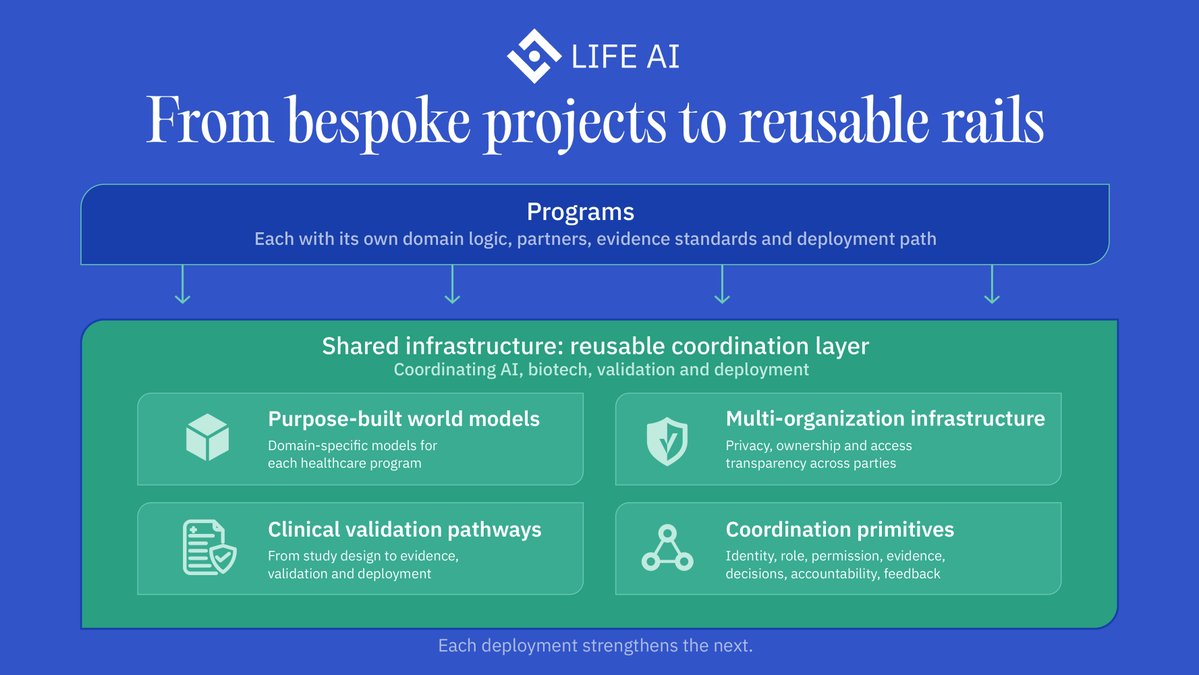
The opportunity is to move from bespoke projects to reusable rails.
Across healthcare and drug development, every program must coordinate a complex operating layer: institutions, clinical evidence, validation workflows, regulatory pathways, privacy requirements, access rights and deployment partners.
When that operating layer is rebuilt program by program, execution remains slow, fragmented and difficult to scale.
For Life AI, shared infrastructure becomes the reusable rail for coordinating AI, biotech, clinical validation and real-world deployment across programs.
But “reusable” does not mean every program uses the same model or workflow.
A stroke prevention program, an oncology workflow, a metabolic disease program or an autism intervention study may each require different domain logic, partners, evidence standards and deployment paths.
What can be reused is the infrastructure underneath.
These rails appear across several core infrastructure components:
Purpose-built world models for domain-specific healthcare programs.
Multi-organization infrastructure for privacy, ownership and access transparency across multi-party healthcare environments.
Clinical validation pathways for moving from insight and study design toward evidence, validation and real-world deployment.
Coordination primitives for identity, role, capability, permission, evidence, decision-making, accountability and feedback loops.
Together, these components define how participants enter a program, what they are allowed to do, what evidence supports their work, how decisions are made and how outcomes return to the system.a
Over time, each deployment can strengthen the next.
More partners, evidence, validation workflows and real-world feedback can accumulate into shared infrastructure.
That is how healthcare AI moves from isolated deployments to infrastructure that compounds across programs.
Nobel season usually makes me optimistic about what science can achieve.
Last year’s prize honored discoveries from 1995 and 2001. GLP-1, the hormone behind today’s obesity drugs, was identified in the 1980s, and the first drug in its class was approved in 2005. Even AI, the technology everyone calls the future, won a Physics Nobel in 2024 for neural network research that began in the 1980s.
Most of what we call breakthroughs are old discoveries that finally got proven.
Drug development runs on the same clock. It takes 12 to 15 years to get from idea to approved medicine, and about nine in ten candidates that enter human trials never make it.
AI is now speeding up drug discovery, and that is real progress. I’m an AI founder, so you might expect me to say AI solves the drug development problem. I don’t think it does.
Discovery is not what medicine is short of. In one analysis, AI-discovered molecules passed Phase I trials 80 to 90% of the time, well above the industry norm. In Phase II, where a drug must show it works in patients, 4 of 10 succeeded, about the industry average. I’ve seen this up close.
At Google I learned how far good infrastructure carries something once it works. In life science and healthcare I learned the harder lesson: a result can be correct and still go nowhere, stuck between the sample, the lab, the report, the clinician and the next action.
So when discovery accelerates, how does scientific progress become human progress? If AI hands us 100 times more discoveries and the same capacity to prove them, we don’t get faster medicine. We get a longer waiting list.
This Nobel season, I am thinking less about how many discoveries AI might produce, and more about how many years of waiting it might remove.
On a personal note, I have been following @JeffDean's work, first at Google and now at Discovery Loop, and @DaphneKoller’s at insitro. I hope what they are building takes years off that wait.
Who knows, they may win a Nobel Prize in 2030 for the work they are doing today. That would be the best proof that the wait is getting shorter.
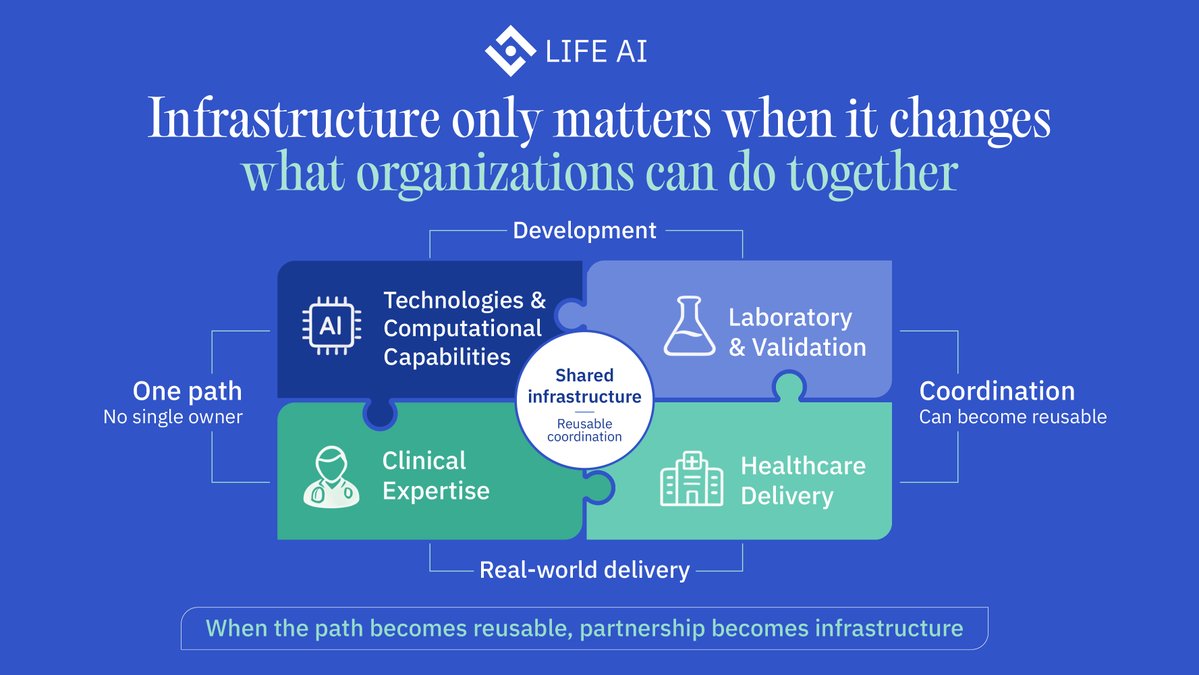
Infrastructure only matters when it changes what organizations can do together.
One example is our work with Kalbe Farma and its subsidiary, KALGen Innolab, on StrokeGENME, a genetics-powered platform that translates DNA insights into individualized stroke-prevention plans, delivered through Kalbe’s nationwide ecosystem in Indonesia.
Bringing StrokeGENME from genetic insights to real-world healthcare delivery brought together capabilities that already existed across the partnership: KALGen’s laboratory capabilities, Kalbe’s healthcare expertise and reach, and Life AI’s technology platform.
Kalbe did not need to become a technology company. Life AI did not need to build a clinical network in Indonesia. KALGen already had the laboratory capabilities required on the ground.
No single organization needed to own the entire pathway. Each organization could contribute what it was already good at, bringing an existing capability into the same pathway.
That leverage changed the path to deployment. The program has since reached real-world deployment, with timeline reduced from approximately 24 months to 3 months, and was subsequently accepted by regulator.
That combination is central to how Dr. Tuan Cao, Co-Founder and CEO of Life AI, described the partnership: “Our partnership with Kalbe amplifies impact, pairing AI with a healthcare leader built to reach millions.”
The challenge is making those capabilities work together without rebuilding the path from scratch every time.
How much of the coordination between technology, laboratories, clinical expertise and healthcare delivery can become reusable?
Because if every new collaboration starts from zero, it remains a project. When the path itself becomes reusable, partnership starts to become infrastructure.
That is one of the questions we are continuing to build around at Life AI.
@AnthropicAI , a company whose entire product is intelligence, just confirmed it runs a wet lab. Within a day, several of our investors had pinged me with the same two questions.
Is this a trend? Will every frontier AI lab end up running its own wet lab?
And if so, is Life AI losing its competitive advantage?
Short answers: yes, and no. Here are the longer ones.
I understand why Anthropic did it. I have a fair idea how that internal debate went, because we had the same one eight years ago.
Back then it looked like an odd move for a company that started on the software side of genomics: we built a physical sequencing center, the largest in Southeast Asia, designed for 500,000 genomes a year, with all the freezers and sample logistics that come with it.
We did it for the reason Anthropic gives now: in biology, the final test still happens at the bench. A model can propose. Biology doesn't have to agree.
So to the first question: yes, expect more of this, and the reason is arithmetic. The marginal cost of a hypothesis is heading toward zero. The cost of a failed trial is not. Roughly nine in ten candidates that reach the clinic still fail, and ten times more candidates does not fix that ratio; better evidence before the trial does. A company that sells intelligence has just concluded that intelligence is not the bottleneck. That is the real news, and every model company will reach the same conclusion once its predictions meet a petri dish.
Anthropic seems to know this. It says the lab is focused on fundamental biology, not drug discovery, and it doesn't want to be seen competing with pharma. That is structure, not modesty: pharma pays its bills, and a model company that starts producing evidence for approval competes with its own customers. So the lab exists to make a model better at biology. Its product is a smarter Claude.
Our lab was built for a different job. Its product is evidence a regulator will accept.
A research-grade experiment tells you whether a hypothesis is interesting. A regulatory-grade one tells you whether a patient can be treated on the strength of it. Evidence at that grade cannot be rented by the token. It takes a robotic wetlab, validated processes, and a loop that runs from study design through validation to deployment, and we started building ours before models were producing candidates at today's volume.
Which brings me to the second question. No, I don't lose sleep over Anthropic, DeepMind, or whoever builds the next wet lab. A better model is the best supplier we could ask for. Every jump in capability sends more candidates toward the narrow door where proof happens. We spent eight years building the infrastructure for this moment.
Welcome to the bench, Anthropic. There's plenty of room.
To the investors who asked, and to any who want to join the conversation: the question I'd put back is not which model will win drug discovery, but the next step. Who can prove what the models find will be the final winner.
Today in Singapore, we took a question we have been working on at Life AI to a much bigger room.
As AI accelerates drug discovery, how do we build the operating infrastructure to move what we discover through clinical validation, evidence, and real-world execution?
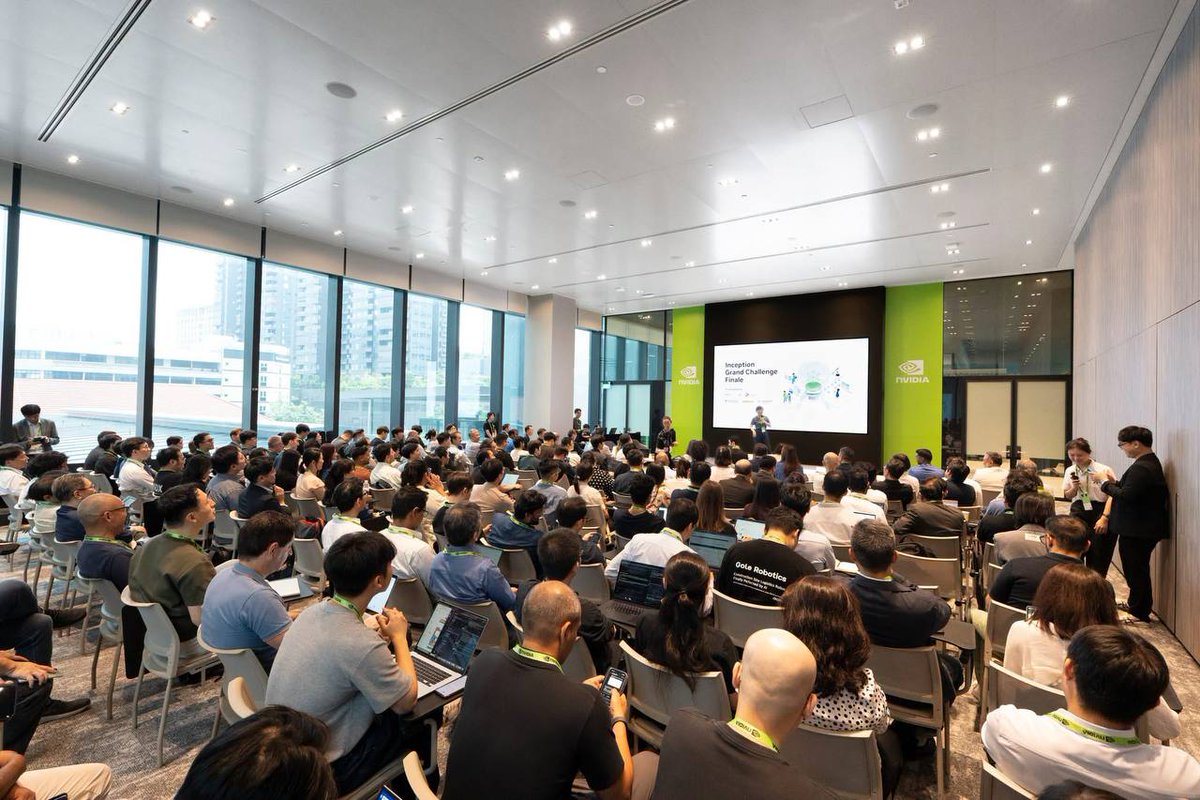
Our Co-Founder & CEO Dr. Tuan Cao shared Life AI’s perspective on that question today at the NVIDIA Inception Grand Challenge Finale.
And much of the value lies in what follows: new perspectives, sharper questions, and meaningful connections across the industry.
Singapore extended the rails we’ve been laying, bringing our work into a broader conversation across AI, drug development, and healthcare.
And that is exactly where we want to be.
Life AI Named a Top 20 Finalist in the NVIDIA Inception Grand Challenge 2026
Life AI has been named one of the Top 20 Finalists in the NVIDIA Inception Grand Challenge 2026, selected from more than 500 startups across Asia Pacific.
The recognition follows Life AI’s selection in 2025 as one of six startups in the inaugural FastTrack AI Accelerator, powered by GenAI Fund and accelerated by the NVIDIA Inception Program.
On September 22, our co-founder and CEO, Dr. Tuan Cao, will present Life AI’s perspective at the Grand Challenge Finale during NVIDIA AI Day Singapore.
But the significance of this milestone extends beyond the competition.
AI capabilities are advancing at unprecedented speed. Yet in healthcare, building more capable AI is only the beginning. The harder challenge is making that intelligence usable inside systems that were never designed to work together.
Clinical records, workflows, validation processes, and decision-making remain distributed across hospitals, laboratories, pharmaceutical companies, and care teams. Moving AI from isolated pilots into real-world practice therefore requires more than a powerful model. It requires a way to connect signals, coordinate actions, and maintain accountability across those boundaries.
As AI intelligence becomes increasingly abundant, how do we turn it into accountable action across fragmented healthcare systems?
That is the question Life AI is taking to Singapore. In the weeks ahead, we will share how we are approaching it.
The countdown to the NVIDIA Inception Grand Challenge Finale is on.
Tomorrow, our Co-Founder & CEO Dr. Tuan Cao will take the stage as one of the Top 20 finalists, sharing Life AI’s approach to building the operating infrastructure for AI-enabled drug development from accelerating discovery to clinical validation and real-world execution.
📅 September 22, 2026 | Singapore
If you’re joining us in Singapore, we’d love to connect.
Life AI Named a Top 20 Finalist in the NVIDIA Inception Grand Challenge 2026
Life AI has been named one of the Top 20 Finalists in the NVIDIA Inception Grand Challenge 2026, selected from more than 500 startups across Asia Pacific.
The recognition follows Life AI’s selection in 2025 as one of six startups in the inaugural FastTrack AI Accelerator, powered by GenAI Fund and accelerated by the NVIDIA Inception Program.
On September 22, our co-founder and CEO, Dr. Tuan Cao, will present Life AI’s perspective at the Grand Challenge Finale during NVIDIA AI Day Singapore.
But the significance of this milestone extends beyond the competition.
AI capabilities are advancing at unprecedented speed. Yet in healthcare, building more capable AI is only the beginning. The harder challenge is making that intelligence usable inside systems that were never designed to work together.
Clinical records, workflows, validation processes, and decision-making remain distributed across hospitals, laboratories, pharmaceutical companies, and care teams. Moving AI from isolated pilots into real-world practice therefore requires more than a powerful model. It requires a way to connect signals, coordinate actions, and maintain accountability across those boundaries.
As AI intelligence becomes increasingly abundant, how do we turn it into accountable action across fragmented healthcare systems?
That is the question Life AI is taking to Singapore. In the weeks ahead, we will share how we are approaching it.
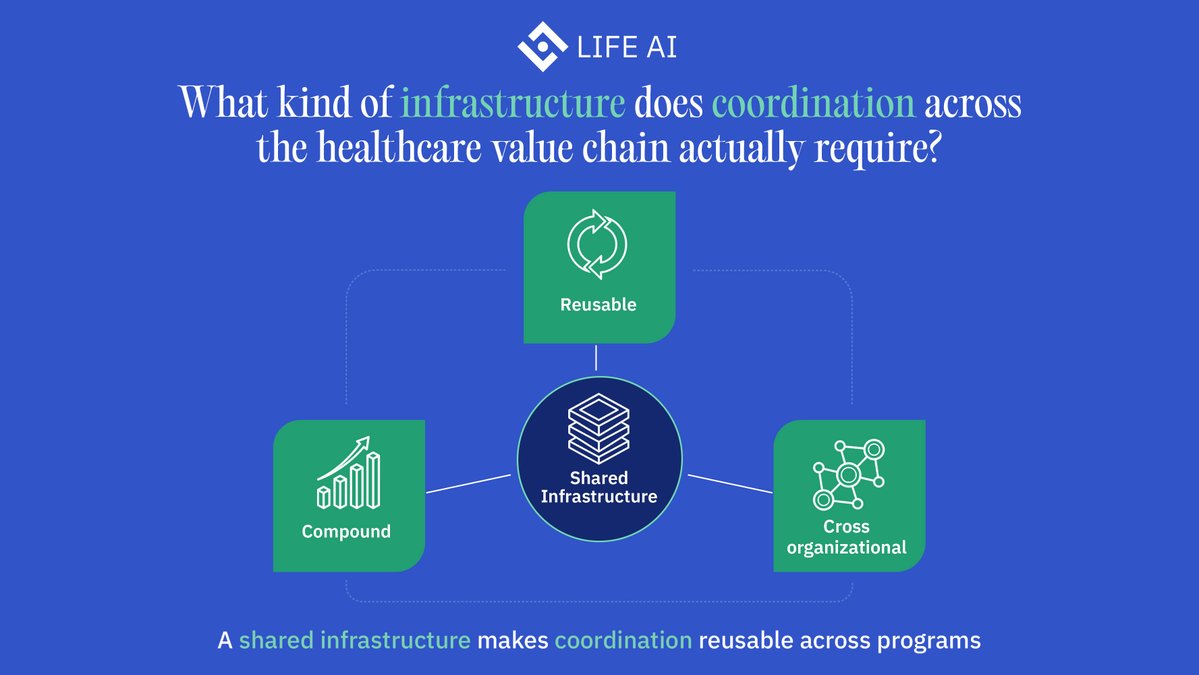
What kind of operational infrastructure does coordination across the healthcare value chain actually require?
Eight years of building clinical programs across Southeast Asia, working with governments, hospital networks, and pharmaceutical companies, produced one consistent finding: the challenge is not the absence of capable AI. It is the absence of operational infrastructure that makes coordination reusable across programs.
Without that infrastructure, coordination remains highly program-specific, especially in drug development, where multiple key players must work together across the development process.
The infrastructure this requires has three properties.
It has to be reusable. Clinical programs should move from bespoke projects to reusable rails, with shared coordination rails replacing bespoke integration at every site.
It has to compound. Every application should strengthen the model, the network, and the protocol, building greater capacity across the ecosystem over time.
It has to enable coordination among independent actors. Hospitals, doctors, labs, pharma sponsors, regulators, patients, and AI builders can contribute services, validation, and clinical execution without surrendering operational sovereignty.
At Life AI, we are building an operating infrastructure for drug development around these requirements, bringing together AI-driven discovery, wet-lab screening, and clinical validation.
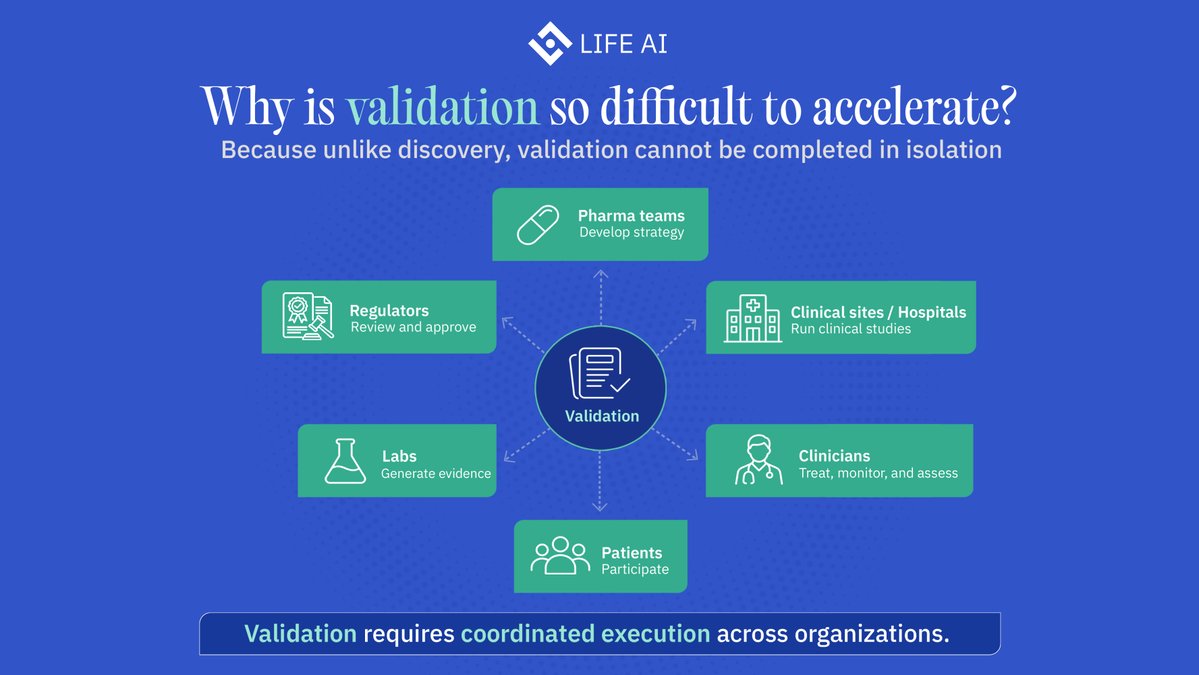
Why is validation so difficult to accelerate?
Because unlike discovery, validation cannot be completed in isolation.
An AI-generated drug candidate still has to move through key players across the healthcare value chain, including pharma teams, clinical sites, hospitals, clinicians, patients, and regulators. Each operates with different timelines, evidence requirements, compliance constraints, and operational priorities.
A candidate can move forward on one front while remaining constrained elsewhere, whether by patient recruitment, study execution, evidence generation, or the decisions required to advance it.
This makes validation more operationally complex than discovery. Discovery can be accelerated within a model, platform, or controlled environment, while validation depends on how effectively these key players coordinate and execute across the development process.
With more candidates entering development, that operational complexity compounds, requiring more evidence generation, clinical execution, patient participation, and coordinated decision making across organizations.
As AI accelerates discovery, the need for better coordination and the infrastructure to support it becomes increasingly important downstream.
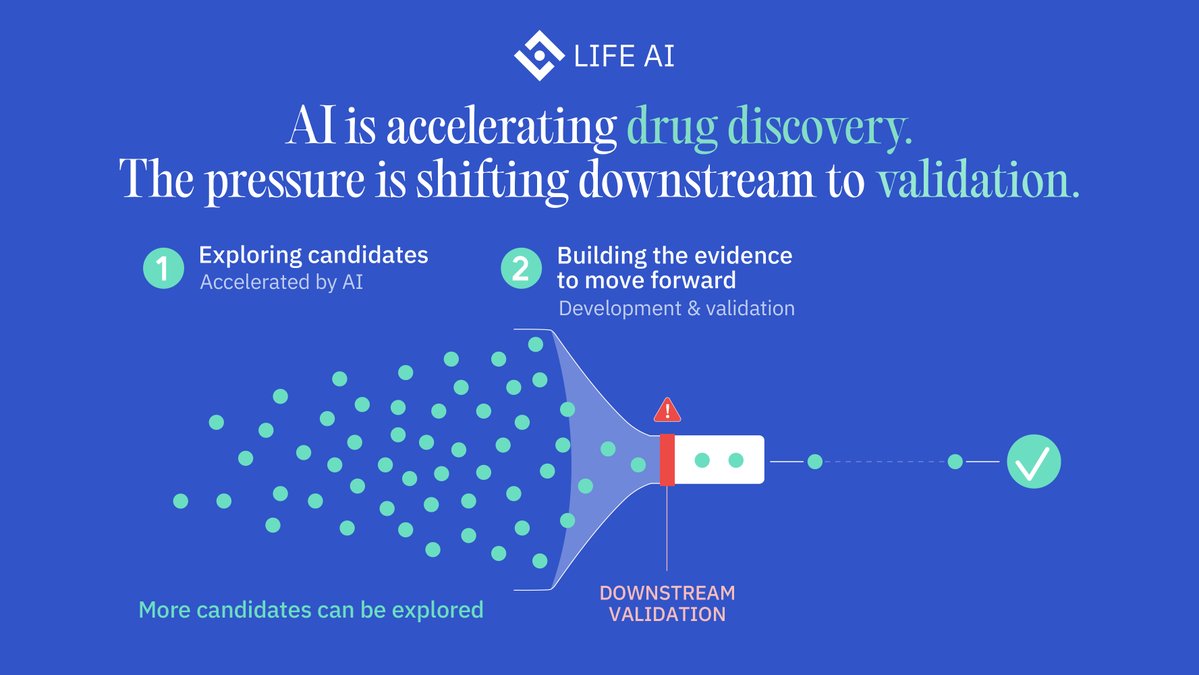
AI is accelerating drug discovery. But the pressure is shifting downstream, toward the work required to validate what discovery produces.
Across science and life sciences, AI is moving deeper into discovery. Anthropic is expanding AI into scientific research, Isomorphic Labs is scaling AI-first drug design and development, and Discovery Loop is building systems to automate experimental loops.
As these capabilities advance, more targets can be explored, more molecules can be designed, and more potential candidates can be generated. The discovery layer is becoming faster and more expansive.
But accelerating discovery does not automatically accelerate the path to validation.
A promising candidate still has to be evaluated, tested, and supported by sufficient evidence before it can move forward. Clinical validation is where this downstream pressure becomes especially visible. The gains from faster discovery can begin to narrow if the path to validation remains slow and difficult to scale.
For Life AI, this raises a critical question: How do we make sure the path to validation can keep pace as AI accelerates discovery?
I used to come to the Google office mostly for the food. This time, it's special. I came here for work.
I just finished a video interview with the Google for Startups team. They asked wonderful questions, and ten minutes was nowhere near enough. Here's what I wish I'd had time to say.
Years ago, I was a Google engineer on the Gmail and Google Data Infra teams. Walking back in as a founder, selected for the first Google for Startups Accelerator: Southeast Asia, feels like a homecoming. Google taught me how to build systems billions depend on. Now I'm bringing that standard to healthcare.
At Life AI, we're building an operating infrastructure for drug development: AI models for drug discovery, a robotic wet lab for in vitro screening, and a network of hospitals for clinical validation. Several products run on it. The one we're bringing to Google is closest to my heart: Life Cloud, an AI-powered cloud for healthcare.
Here's the problem. AI has disrupted industry after industry, but not yet healthcare. Hospital data is uniquely hard: fragmented, buried deep inside departments. Connecting data within one hospital is already a serious challenge. Connecting a network of hospitals is orders of magnitude harder. Yet patients move between hospitals, test by test. The warning sign a doctor needs often already exists, scattered across systems, never connected in time.
Take thalassemia: about 13% of Vietnamese, 14 million people, carry the gene. Every year, around 8,000 affected babies are born, most of them preventable. The first clue hides in a routine blood test that costs less than a cup of coffee, stored somewhere, in some hospital.
Life Cloud is built on one principle: the data never moves. The AI does. Hospitals keep full control of their records. The AI comes to them and learns across the whole system. The AI flags and suggests. The doctor always makes the final decision.
What excites me most is the mentorship. I still remember how much I learned just by sitting close to great engineers at Google. Now my whole team gets three months of that. Honestly, it feels a bit like going back to school.
In October, I'll bring our product to Google San Francisco's bootcamp for engineers to stress-test. Thalassemia doesn't stop at borders. With health partners in Thailand and Indonesia, Southeast Asia is the map we're building for.
Closing the gap between what AI can demonstrate and what doctors can depend on. That's the whole journey. And yes, I'm coming back to Google, not only for food, but for work too.
If you're a clinician, life-science researcher, or investor who cares about trustworthy healthcare AI in Southeast Asia, my inbox is open.
#GoogleForStartups #HealthcareAI #LifeCloud
AI is moving faster than the systems around it. In healthcare, that gap matters.
But what makes that gap so difficult to close?
“How do we turn AI intelligence into accountable action across fragmented healthcare systems?”
It is also a question that has increasingly shaped how Life AI thinks about healthcare AI. Speaking at NVIDIA GTC Taiwan 2026, Life AI Co-Founder and CEO Dr. Tuan Cao @tuan_lifeai put it this way:
“In other industries, if you have the best model, you win. But in healthcare, what actually matters is the coordination of so many key players across the healthcare value chain.
That is why running a clinical trial in the US is so expensive. It costs about $20 million to $100 million to run a Phase III clinical trial, and for every patient, we pay about $500,000 because the man in the middle has to coordinate so many different players: the pharma, the hospital, the patient, and the doctor.
So coordination of all of those key players is actually one of the main bottlenecks.”
The challenge is not simply advancing AI, but understanding what it takes to make AI work across the complexity of healthcare.
The NVIDIA Inception Grand Challenge 2026 gives Life AI a timely platform to bring this infrastructure question into a broader AI conversation.
6/6
And this is the key question left open by the discussion:
When the pieces of a person’s health journey are spread across different interventions, providers, and systems, what connects them over time?
The McKinsey Health Institute’s From healthcare to health: Asia’s longevity opportunity is well worth reading for anyone thinking about what comes next for healthcare in the region.
https://t.co/1dV7y5slt6
1/6
Asia is living longer. But too many of those years are spent in poor health.
That is the central tension explored in a recent Future of Asia Podcast from the McKinsey Health Institute.
So what stands between living longer and living healthier?
🧵 Here are some numbers and insights worth looking at.
4/6
What stands out is that the opportunity is not only about discovering new treatments.
McKinsey points to the potential of proven interventions, particularly those focused on prevention at the population and individual levels.
The challenge becomes how to move prevention earlier, broaden access, and make its impact more consistent.
This is where the conversation shifts:
from healthcare to health.