📈 Hunting India’s next multibaggers
🔍 Deep dives | Small & Midcaps | Hidden Value
💰 Growth • Moats • Capital Allocation • Valuation
📚 Research, not tips. DYOR.
I resigned from Anthropic today. I spent the last three years doing pretraining research at both OpenAI and Anthropic. Neither company is acting responsibly. They are racing straight to self-improving superintelligence and gambling with our lives. More thoughts below.
I keep reading and reading : The more we read the more opportunities we get.
Ultimately its about just a little bit more alignment with the mkts.
We need not be
The smartest
The luckiest
The wealthiest
The fastest data getter
The best analyst
The best strategist
All is needed is a bit more of an alingnment with mkts , remove the non perforners and add the performers( those executing well and mkts rewarding them)
Do that every qtr thats it.
If I can do it, everyone can.
@MithunSarkari Parameters I used (learned from you
1. Niche moat
2. Great market share, less competitors , sector leader
3. Margin, operating leverage
4. Aggressive early capex, capex completed, near completion
5. High Ebita, PAT
6. Excellent Mx
7. strong orderbook with timely execution
@MithunSarkari Why not others.
Im learning Great from you.
Why syrma and avalon.
Using your parameters I'm getting kaynes , dixon and PG electro as well in top 5 along with syrma and avalon.
Im not contradicting but want to understand more.
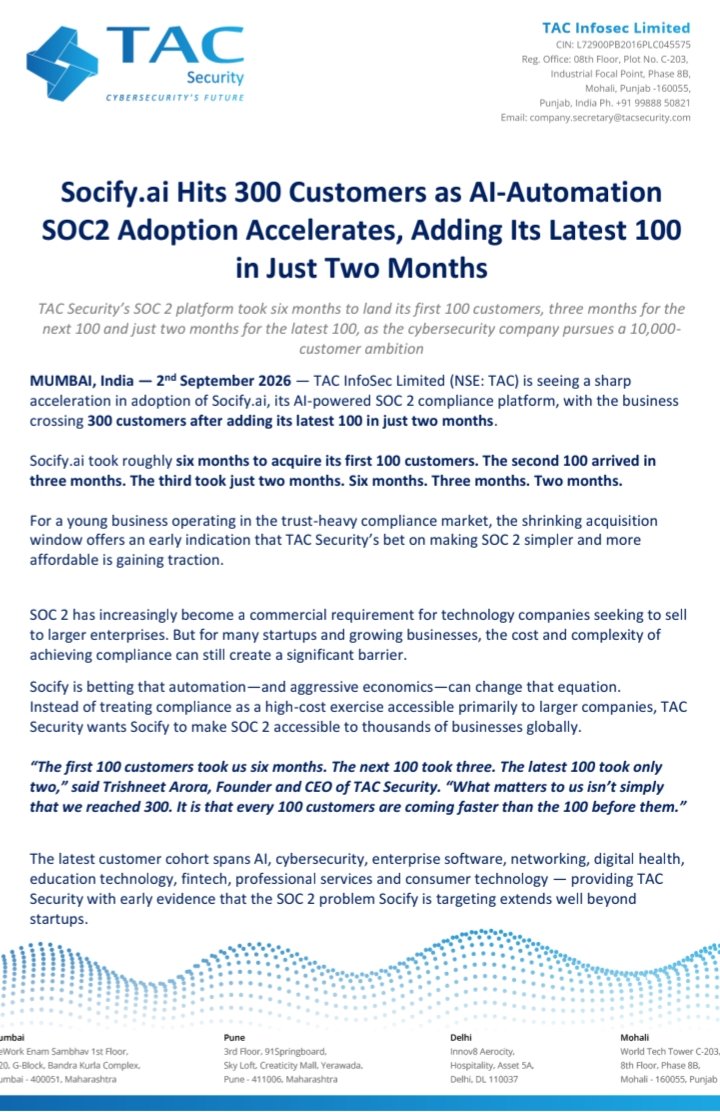
Tac infosec
TAC Security’s https://t.co/dcgV1QaIyP reached 300 customers, adding the latest 100 in just two months, accelerating from six and three months for prior 100-customer milestones. Targeting 10,000 clients by 2030
#tac#tacinfo#tacinfosec#stockmarket#india
@MithunSarkari Can I add few more criteria...
Along with Capex completion
1.. Capacity utilisation headroom
2.Order book/customer visibility
3. Incremental EBITDA margin potential
4. Balance-sheet/FCF inflection
Aequs vs Azad Engineering vs Rossell Techsys
Three aerospace companies with very different manufacturing models and paths to growth.
A Detailed Comparison...🧵👇
How to Win After Losing?
(a) This guy has been holding onto a loser stock (b) RULE # 1: You don’t have to make money back the way you lost it (c) Billionaires worship this rule (d) Retail investors become prisoners of their purchase price.
Your Past Is Your Enemy
a. If you can see that the investment thesis is broken, the business moat has weakened, or the management is incompetent or untrustworthy, stop hoping for a reversal. Hope is the worst trade.
b. If your stock is down from ₹75L to ₹30L, forget the original figure of ₹75L. Your stock does not know you paid ₹75L for it. That past is only in your mind. Your stock does not give a damn about your past.
c. Invert the Problem (Munger’s Inversion Model): The current value of your holding is ₹30L. Now ask yourself: Would you buy Zee “OR” some other stock if you had a fresh capital of ₹30L to deploy (with no link to the past)?
d. Ask yourself: Is there any other stock in the entire world with a stronger business model than Zee and a fair (not cheap) valuation? Keep researching a thousand stocks. Human enterprise is endless. If you miss one company today, 10 new companies will be born tomorrow.
e. Game of Patience: Keep waiting until the right stock at a fair valuation presents itself. This is not 20/20 cricket where you have to swing at every ball. Here you can leave a 1,000 balls until the sweetest delivery comes along, and then swing at it with all your might.
How Billionaires Think
a. Billionaires are able to change their mind when facts change. They have the humility to accept a mistake. They don’t keep fighting to prove that they are right, and the market is wrong.
b. At the 1995 Berkshire AGM, Charlie Munger said: “Gamblers are ruined because when they get behind, they feel they have to get it back the way they lost it. It’s human nature. It’s very smart just to be willing to take a wound and lick it.”
c. Stop Digging Your Grave: The guy in the screenshot who bought Zee kept on averaging down, throwing more money at it. Warren Buffett said at the 1995 AGM: “When you find yourself in a hole, the most important thing to do is to stop digging. Just get out of the hole.”
d. Billionaires don’t get super-excited about profits, so they don’t feel the pain when they face losses. “Success and failure are both impostors,” Robert Frost wrote in his iconic poem “IF.” Billionaires know it instinctively.
e. Average people cannot take the pain of loss. They keep hanging on to a toxic job or a negative relationship or a wrong stock because they don’t want to confront the pain of reality. By staying on with it, the pain remains buried underneath.
f. Small investors average down. Billionaires average up. Rakesh Jhunjhunwala bought his first lot of Titan at ₹32. Then at 80, then at 140, then at 240, then at ₹900. His final buying was 30x of his first purchase price.
It looks easy in hindsight because now you know Titan's value. When the future is unknown, averaging up is the hardest act in the world.
g. Money is finite. Billionaires respect money. At any given point, they will park their money in their best investment ideas only. So why would you put your money into your second-best or third-best or worst idea?
Prune Your Garden (Portfolio)
On a Saturday in 1989, legendary investor Peter Lynch received a phone-call from Warren Buffett.
Buffett: “I want to use one line from your new book ‘One Upon Wall Street’ in my annual report. I have to have it.”
Lynch: “Sure. What’s the line?”
Buffett: “Selling your winners and holding your losers is like cutting the flowers and watering the weeds.”
Lynch recounted the story on stage: “Buffett chose that one line from my book, which I had myself found extremely hard to practice in real life.”
@arabicatrader
Gujarat Fluorochemicals Ltd: Q1 FY27 Concall Updates 💡
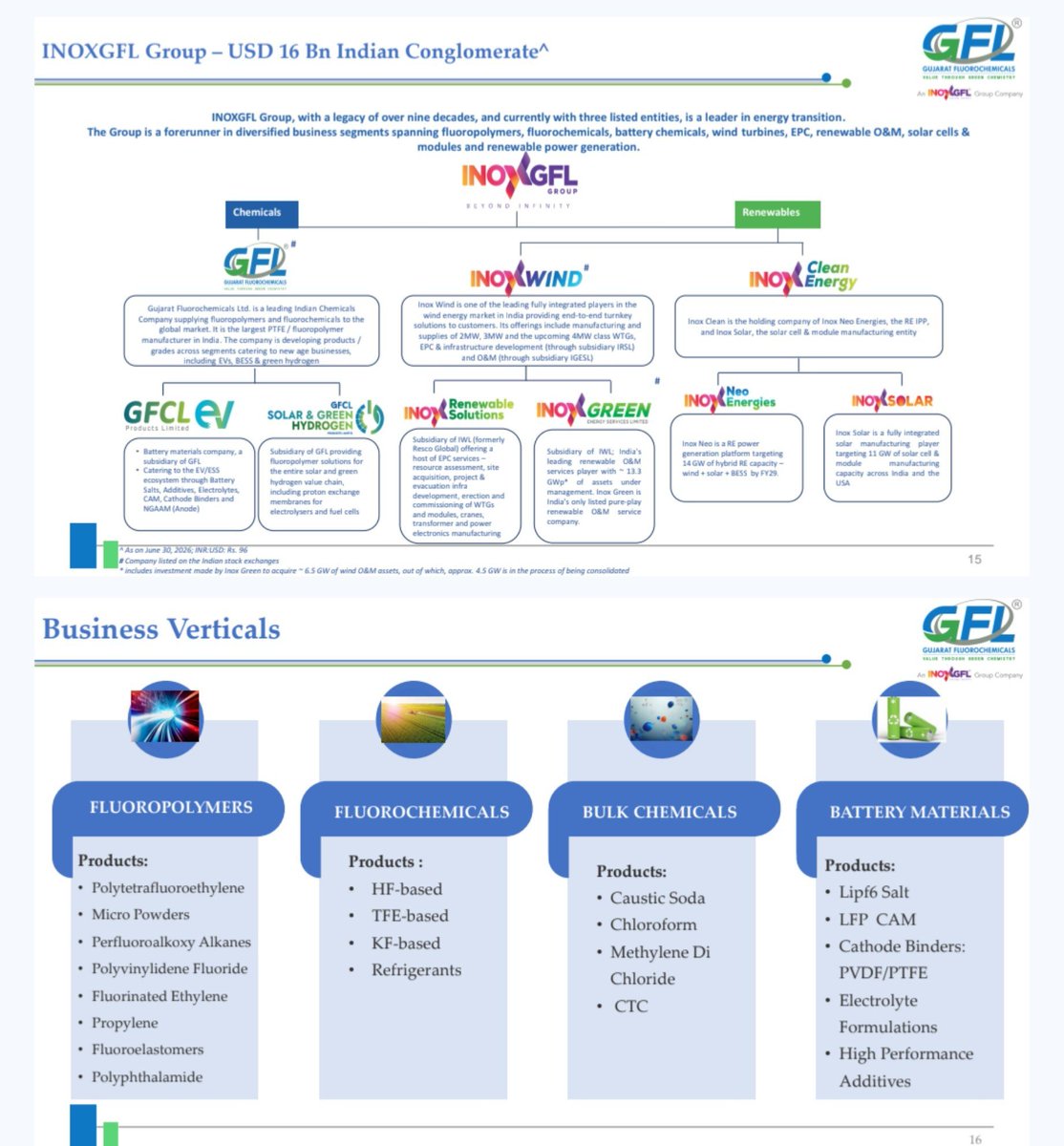
👉What is the biz of GFL?
Simply put, GFL makes special materials used by other companies — in ACs, cars, electronics, semiconductors and now batteries.
But the bigger story is what is coming next.
Lets understand .
1/
GFL has 2 biz making money today:
i) Special materials used in industries like electronics, EVs, semiconductors etc.
Complicated name (they call)
👉 Fluoropolymers
ii) Refrigerant gases used in ACs.
👉Several gases (Fluorochemicals )
From R32, R134A, R22, R125
Not going deep in these.
And now, it is building a 3rd big business 👉 battery materials.
That's the story.
2/
The existing business is doing well.
Q1 FY27:
🔹Revenue: 1,588 Cr | +24%
🔹PAT: 219 Cr | +20%
But chemical PAT grew even faster:
+33%
So this isn't just a revenue growth story.
Profitability is improving too.
3/
The first big growth engine is special materials.( Fluoropolymers)
Think of them as expensive, high-performance materials that normal materials cannot easily replace.
Demand is growing from:
👉
EVs | Semiconductors | Data Centres | Automotive | Green Hydrogen
This business grew 15% in Q1.💡
4/
More importantly, GFL is selling more higher-value products.
Customers have to test and approve these products before using them.
Once approved, the relationship becomes sticky.💡
Mgmt expects this business to grow 17–20% annually.
That's the first growth engine.
5/
The second growth engine is much easier to understand:
AC gases.( Fluorichemicals)
GFL makes refrigerant gases used in air-conditioners.
One of the key products is R32.
And demand is strong.
The refrigerant business grew 52% YoY in Q1.🔥
6/
The important part:
GFL's existing R32 capacity is almost fully utilized.💡
👉
So it is adding more capacity.💡
New capacity expected in Q2 FY27.📝
Mgmt expects the additional capacity to reach full utilization during CY27.
More capacity = more sales.
Simple.
7/
Now comes the BIG story.
Batteries 🔋💡
GFL is building a business supplying materials used inside batteries.
Today this business is tiny.
Q1 revenue:
Just 14 Cr
And it made a loss.❗
So don't value GFL today as a battery company.
8/
But mgmt expects the battery business to start scaling.
The roadmap:
Q4 FY27 → 3-digit quarterly revenue💡
FY28 → significant ramp-up
So the story is:👉
Today = investment
Tomorrow = commercial business
Later = large growth engine
9/
And GFL is betting big on it.
Total planned battery-related capex is part of a 6,000 Cr investment programme by FY28.
Management's stated target:
2x asset turnover + 25%+ EBITDA margin
on the battery biz.
If they execute, this could materially change the company's earnings profile.
10/
There is also a useful trigger in the existing business.
A competitor, AGC, is shutting its UK facility.💡
GFL says it has already started getting enquiries from customers who used AGC's products.
Qualification has started.📝
Mgmt expects potential traction in 1–2 quarters.
11/
So what has changed at GFL?
Nothing complicated.
Existing business:
Growing + profitable
R32:
Capacity expansion coming
Special materials:
Moving towards higher-value products
Battery business:
Moving from testing → commercial sales
12/
The BIG risk?
GFL has to spend a lot of money first.
FY27 planned capex:
2,300 Cr → Battery
800 Cr → Chemical business
The Oman battery project is also being shifted to India.
So execution + funding are important to track .
13/
My simple GFL thesis:
GFL is not a battery company today.
It is a profitable chemical company whose existing businesses are growing.
At the same time, it is investing heavily to build a large battery-material business.
If the battery ramp-up works as mgmt expects, FY28 onwards could look very different.
That's the story I would watch.
No Recommendations, i just tried to explain in simple way whats happening in Gujarat Fluorochemicals .
Please do your own research.
🙏