Deep Calls Unto Deep: A Cry for Greater Intimacy with God.
“Deep calls unto deep” (Psalm 42:7) speaks of the cry of a heart that longs for more of God. No earthly achievement can satisfy the deepest hunger of the human spirit; only God’s presence can. As the psalmist declared, “As the deer pants for the water brooks, so pants my soul for You, O God” (Psalm 42:1).
God invites us to draw near to Him daily. “Draw near to God and He will draw near to you” (James 4:8). Intimacy with God is not built through occasional encounters but through consistent fellowship—walking with Him, listening to His voice, and practicing His presence in every season of life.
Like Moses, may our greatest desire be, “Show me Your glory” (Exodus 33:18), and like Paul, “that I may know Him” (Philippians 3:10).
Prayer
Heavenly Father, grant me an unquenchable thirst for Your presence. Draw my heart continually toward You and deliver me from distractions that weaken my fellowship with You. Give me grace to seek You daily, to remain steadfast in prayer, worship, and Your Word. Let Your presence become my greatest delight and deepest pursuit. May I grow in intimacy with You and walk closely with You all the days of my life. In Jesus’ name, Amen.
#DeepCallsUntoDeep #PresenceOfGod #DrawNearToGod #IntimacyWithGod #SeekHisFace #WalkWithGod #ChristianGrowth #PrayerLife #GodsPresence #FaithJourney
Title: Contemplative Prayer: Resting in God’s Presence
Contemplative prayer is a quiet, loving focus on God. It is less about speaking and more about being with Him. As we become still before God, we learn to recognize His presence, hear His gentle voice, and find peace for our souls. Through regular practice, our hearts become more aware of His constant companionship and transforming grace.
It is a quiet way of spending time with God. Instead of talking to God or thinking deeply about a Bible passage, you simply rest in His presence with love, trust, and attention.
It is not about emptying your mind. It is about focusing your heart on God and gently letting go of distractions.
The Bible encourages this kind of quiet fellowship with God:
Psalm 46:10 — “Be still, and know that I am God.”
Psalm 62:1,5 — “My soul waits quietly for God.”
Matthew 6:6 — Jesus taught us to pray in secret, alone with the Father.
1 Kings 19:12 — God spoke to Elijah in a gentle whisper.
Jesus often went to quiet places to pray (Mark 1:35; Luke 5:16).
During contemplative prayer, choose a simple word or phrase such as “Jesus,” “Father,” or “I trust You.” When your mind wanders, gently return to that word. Do not fight distractions or worry about them. Simply come back to God.
You can also practice this throughout the day by taking short moments to quietly remember God’s presence while walking, working, or resting.
Benefits of Contemplative Prayer:
Greater peace and calm
A deeper awareness of God’s presence
Freedom from anxious thoughts
A stronger relationship with God
A heart that learns to live in God’s presence daily
Contemplative prayer is not mainly about saying words; it is about being with God. Start with a few minutes each day, be consistent, and allow God to draw you closer to Himself. It works beautifully alongside reading and meditating on God’s Word.
#ContemplativePrayer #BeStillAndKnow #PresenceOfGod #PrayerLife #ChristianLiving #FaithJourney #SpiritualGrowth #QuietTime #AbideInChrist #SeekGod #BiblicalMeditation #WaitingOnGod .
KEEPING YOUR MIND AND HEART FIXED ON GOD.
In our busy, noisy world, it’s easy for our thoughts to scatter in every direction. But God invites us to live differently—to keep our minds and hearts steadily focused on Him every day. This is what the Bible calls a steadfast mind, and it brings wonderful peace and strength.
“You will keep in perfect peace all who trust in you, all whose thoughts are fixed on you!”
Isaiah 26:3 NLT
When we choose to stay our minds on God, He guards us with His peace—even in difficult times. This is not something we can do perfectly in our own strength, but by His grace as we practice His presence.
Practicing the Presence of God:
Brother Lawrence, a humble monk who lived hundreds of years ago, learned to turn every ordinary moment into time with God. Whether he was washing dishes or working in the kitchen, he trained his heart to talk with God and enjoy His company. He said that the most important thing is to keep our minds fixed on God and not let them wander away.
We can do the same. God is always with us. We don’t have to wait for a special “quiet time” to meet Him. We can whisper short prayers throughout the day: “Lord, I’m here with You,” “Help me in this moment,” or simply “I love You, Jesus.” Over time, this becomes a natural way of living—always aware that we are in God’s presence.
Guarding Your Heart:
The Bible gives us this clear instruction:
“Above all else, guard your heart, for everything you do flows from it.” (Proverbs 4:23)
Our hearts are like the control center of our lives. What we allow into our minds and hearts eventually shapes our words, actions, and character. That’s why we must be careful about what we watch, listen to, read, and think about.
By God’s grace, we can say “no” to distractions that pull us away from Him; Fill our minds with God’s Word instead of empty or harmful things; Quickly turn back to God when our thoughts start drifting.
Meditating on God’s Word:
One of the best ways to keep our minds on God is by meditating on Scripture. This simply means thinking deeply about a verse or truth from the Bible—rolling it over in our minds, praying about it, and letting it change us. Even a few minutes each day makes a big difference.
As we hide God’s Word in our hearts, it becomes a shield and a guide. It helps us recognize lies, resist temptation, and stay close to Jesus.
Living in the Secret Place:
God calls us to live in “the secret place” of His presence (see Psalm 91:1). This is a quiet, protected closeness with Him that the world cannot take away. It’s a heart attitude more than a physical location. No matter where we are—at work, at home, in traffic, or in a crowd—we can dwell under the shadow of the Almighty.
Simple Daily Practices:
Here are some easy ways to stay your mind and heart on God:
1). Start the day with a short prayer, offering your thoughts and heart to Him.
2). Set reminders (on your phone or in your home) to pause and remember God.
3). Turn worries into prayers.
4). Replace anxious thoughts with Scripture.
5). End the day by thanking God for His presence with you.
You don’t have to be perfect. When you get distracted (and we all do), simply come back to Him. His grace is always there to welcome you.
The Beautiful Results:
When we keep our minds fixed on God and guard our hearts, we experience:
a. Deep peace that doesn’t depend on circumstances.
b. Greater joy and closeness with Jesus.
c. Protection from things that could harm our souls.
d. Clearer direction for our lives.
e. Strength to love and serve others well.
Beloved, make it your daily choice to live with your mind and heart on God. Talk with Him often. Think about His Word. Stay in His secret place. He is worthy of all our attention, and He rewards those who earnestly seek Him.
#FixYourMindOnGod #PracticeHisPresence #GuardYourHeart #ContemplativePrayer #AbideInChrist
The Dominion Mandate: God’s Original Assignment for Humanity
The Dominion Mandate is God’s first recorded instruction and blessing to mankind (Genesis 1:26–28). It is a divine assignment, not a mere suggestion.
What Does Dominion Mean?
God created man in His image and likeness. This means we were made to reflect His character, wisdom, creativity, and authority.
God’s mandate to humanity to “subdue” the earth and “have dominion,” is a call to responsible management, development, and care for His creation. This includes being fruitful and multiplying, filling the earth, managing its resources wisely, caring for animals and the environment, and using our God-given abilities for His glory.
However, the mandate was not a permission to exploit or abuse God’s creation.
After the Flood, God repeated this mandate to Noah (Genesis 9:1–7), showing that it still applies to humanity.
The Fall and Restoration:
When Adam and Eve sinned, the world became broken. Hardship, struggle, and disorder entered creation: (Genesis 3). Sin made it impossible for man to fulfill the dominion mandate and reduced man to slavery (Nehemiah 9: 36-37).
Although sin affected humanity’s ability to rule well, God never cancelled His original mandate.
Jesus Christ, the perfect image of God and the “last Adam,” (1 Corinthians 15:45-49), came to restore what was lost. Through His death and resurrection, believers are being renewed in God’s images and empowered to live according to His purpose (Colossians 3:10; Ephesians 4:24) and called to exercise dominion under Christ’s lordship.
The Great Commission (Matthew 28:18–20) expands this mission by calling us to make disciples and spread Christ’s kingdom throughout the world and in every sphere of life-family, work, culture, science, arts, government, and creation care.
Living the Dominion Mandate Today:
Salvation through the blood of Jesus, put us in a position to exercise our dominion mandate- Ephesians 1:3,7; Galatians 4:1-2; James 4:7-8. Dominion is actually enforcing the victory that Jesus won for us over Satan, sickness, poverty and negative circumstances. Spiritual growth and intimacy with God enable us to practically exercise the mandate on earth.
1. Personal Life
Take responsibility for your life, thoughts, actions, and choices. Do not allow sin, fear, or circumstances to control you. Through the Holy Spirit, live victoriously.
2. Family and Relationships
Build strong families, raise godly children, and create homes that honor God.
3. Work and Society
Whatever your profession, do it with excellence. Turn problems into solutions, disorder into order, and opportunities into blessings. Every honest job can glorify God.
4. Caring for Creation
Use the earth’s resources wisely, and care for animals and the environment. Protect, cultivate, and improve what God has entrusted to us.
5. Spiritual Dominion
Pray with faith, resist the devil (James 4:7) and advance God’s kingdom wherever God has placed you.
Conclusion:
You were not created for defeat, passivity, or mediocrity. God designed you to live purposefully and responsibly under His authority. Dominion is part of your original design as a child of God.
#KingdomLiving #Stewardship #GodsPurpose #FaithAndWork #BiblicalWorld#SpiritualAuthority #KingdomOfGod #BeFruitfulAndMultiply
Pressing Into God: The Path to True Fulfillment
Intimacy with God is the greatest treasure available to man. Connection with God is far superior to personal abilities, achievements, possessions, or influence. Nothing compares to knowing Him and walking closely with Him.
Whatever is lost while pursuing God can be restored. Job’s story is a testimony of this truth. After encountering God more deeply, his losses were restored and his latter days became more blessed than the former. (Job 42:5,10-12)
However, if a person gains everything yet loses God, he has lost all. The rich fool accumulated wealth but neglected his relationship with God, and his earthly treasures could not save him. (Luke 12:16-21)
Therefore, seeking God must take priority over everything else—even above necessary food. Our greatest pursuit should be His presence, His voice, and His pleasure.
Let our desire echo that of David: “One thing have I desired of the Lord… that I may dwell in the house of the Lord all the days of my life, to behold the beauty of the Lord, and to inquire in His temple.” (Psalm 27:4)
Foundational Pillars for Deepening Intimacy with God:
1) Authenticity
Come before God with sincerity. Remove every mask and allow the Holy Spirit to search your heart. Ask Him to uproot every hidden cankerworm—hypocrisy, bitterness, lust, anger, pride, resentment, and every work of the flesh. God draws near to the honest and contrite heart.
2) Consecration
Holiness is essential in our walk with God. Intimacy flourishes where purity is treasured. “Can two walk together, except they be agreed?” (Amos 3:3). God calls His people to be holy because He is holy. (1 Peter 1:15-16)
3) Consistency
A vibrant relationship with God is built daily. Be steadfast in prayer, fellowship, worship, and the study of His Word. Just as the fire on the altar was never to go out, our spiritual fire must be continually maintained. (Leviticus 6:13)
4) Obedience
Love for God is proven through obedience. Jesus said, “If anyone loves Me, he will keep My word.” Obedience opens the door to deeper fellowship and greater revelation of God’s heart. (John 14:23)
Intimacy with God is not an event but a lifelong pursuit. The reward of seeking Him is not merely blessings, power, or answers to prayer—the greatest reward is God Himself.
#IntimacyWithGod #SeekGodFirst #KnowGod #Consecration #Holiness #Prayer #Obedience #ChristianLiving #SpiritualGrowth #Psalm27v4 #WalkWithGod #KingdomLife
CLOSE AND PERSONAL RELATIONSHIP WITH GOD.
God invites us into a close and personal relationship with Him: “Draw near to God, and He will draw near to you” (James 4:8).
Intimacy with God grows as we deliberately seek Him through prayer, worship, obedience, and His Word.
“As long as he sought the Lord, God made him prosper” (2 Chronicles 26:5), showing that seeking God brings divine guidance and favor.
The deeper our knowledge of God, the greater our sensitivity to His voice, character, and purposes.
Intimate fellowship with God is not merely knowing about Him—it is walking with Him daily and experiencing His transforming presence.
#IntimacyWithGod #DrawNearToGod #KnowledgeOfGod
#SeekTheLord #WalkWithGod #SpiritualGrowth
The Blessings of Intimate Knowledge of God (Job 22:21 and Jeremiah 9:23-24 )
Job 22:21 and Jeremiah 9:23-24 hold up one great, bright idea. Not wealth, not cleverness pulls weight here. Knowing God rises higher than every other chase. The cosmos brims with targets. Yet this one outshines all. It matters most.
Close to God changes things. Wisdom might impress, yet it falls short. Strength may carry weight, yet fails here. Riches could buy comfort, still they miss the mark. Nothing lines up beside what closeness with the Divine brings
Peace won’t come from them - knowing God is what brings it, according to Job 22:21.
What sticks isn’t found in titles or status. A name that lasts comes from one place alone. According to Jeremiah 9:23–24, real standing grows through connection with God. Boasting makes sense only when it’s about knowing Him.
Nothing follows them past the grave - Ecclesiastes 5:15 made that clear a long time ago.
Deep inside, a longing stays unmet by anything less than the presence of God.
Richness isn’t measured by money piling up in a vault. Instead it shows itself where peace stays full even when pockets are empty. One soul might own little yet carry everything inside. What lasts cannot be stolen or spent. True abundance lives beyond coins and contracts. A heart aligned with something greater lacks nothing. Eternity changes how we count value.
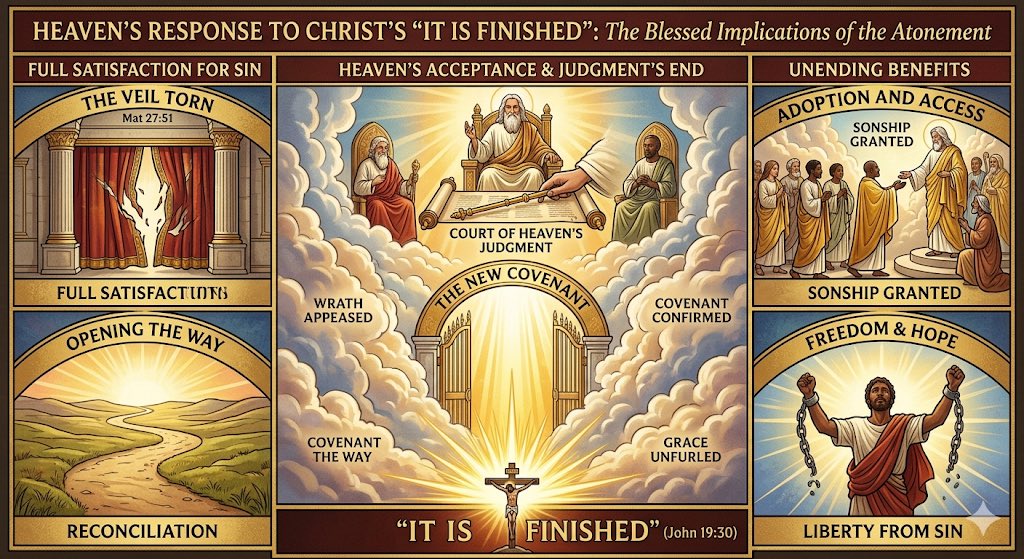
VICTORY AT THE CROSS: Broken Chains, Open Gates.
Below is a colorful chart that explains what happened when Jesus died on the cross. It shows the results of His sacrifice in three main parts:
God's Forgiveness (Left Side): This part shows a heavy curtain ripping in half inside a temple, which means people are no longer separated from God. Below that, a path leading to a bright sunrise shows that the way to God is now open.
The Court of Heaven (Center): This part shows God sitting on a throne surrounded by clouds. A large wooden hammer (a gavel) strikes a scroll to show that humanity's spiritual debt is paid and God's anger is gone. Below the throne, a giant golden gate opens up to let down a bright light of love and grace.
The Gifts for People (Right Side): The top drawing shows a group of different people being welcomed into God's family. The bottom drawing shows a man happily raising his arms as heavy iron chains break off his wrists, showing that people are now liberated from the power of sin.
Accept Jesus as your Lord and Savior, and invite Him into your heart and life.
Prayer for Intimacy with God:
Lord, I want to truly know You—not just know about You. Like Paul, “that I may know Him.” Like Enoch, help me walk with You daily as my loving Father. Acquaint me with You so I may be at peace (Job 22:21). Let my greatest boast be that I understand and know You (Jeremiah 9:23-24). Draw me closer, Father. Amen.
#IntimacyWithGod #KnowingGod #WalkWithGod #PracticingGodsPresence
INTIMACY WITH GOD: KNOWING HIM PERSONALLY
Job 22:21 (NKJV)
“Now acquaint yourself with Him, and be at peace; Thereby good will come to you.”
Jeremiah 9:23-24 (NKJV)
“Thus says the Lord: ‘Let not the wise man glory in his wisdom….But let him who glories glory in this, That he understands and knows Me, That I am the Lord, exercising lovingkindness, judgment, and righteousness in the earth. For in these I delight,’ says the Lord.”
Knowing God vs. Knowing About God:
Many possess accurate theological knowledge—facts about His attributes, doctrines, or Bible stories—yet lack a living, relational connection with Him.
Knowing about God is intellectual while knowing God
is intimate, personal, and transformative—an ongoing relationship of love, trust, and communion, like that of a child with a loving Father.
The Apostle Paul expressed this deep longing in Philippians 3:10 (NKJV):
“that I may know Him and the power of His resurrection, and the fellowship of His sufferings, being conformed to His death.”
Paul’s cry was for experiential knowledge of Christ—intimate fellowship that reshapes every part of life.
Anchored in God’s Word:
God invites us into this closeness. Job 22:21 calls us to “acquaint yourself with Him,” implying deep personal connection that brings peace and blessing. Jeremiah 9:23-24 declares that our greatest boast should be in truly understanding and knowing the Lord.
Enoch: A Powerful Example of Intimacy:
Genesis 5:24 (NKJV) says of Enoch: “And Enoch walked with God; and he was not, for God took him.”
Enoch walked with God as a Father for hundreds of years amid a corrupt world. His life was marked by relationship, not religious performance. So deep was his intimacy that God simply took him to heaven. Enoch shows that close fellowship with God is possible in any season and that pleases Him greatly (Hebrews 11:5).
The Challenge of Religion and Spiritual Performance:
Many Christians today chase religion instead of relationship This can produce a form of godliness without power (2 Timothy 3:5), leading to burnout, pride, or emptiness. True intimacy flows from grace, not striving. It is received through surrender, not earned by performance.
Practicing His Presence:
Intimacy grows through practicing the presence of God—moment-by-moment awareness that He is with us (Matthew 28:20). Like Enoch, we can walk with Him daily.
Practical Steps to Cultivate Intimacy with God:
1. Set Apart Daily Time with God Begin each day with unhurried prayer and Scripture. Read not just to study, but to listen and respond. Psalm 63:1 (NKJV): “O God, You are my God; Early will I seek You…”
2. Practice Continuous Conversation Turn everyday activities into dialogue with God—thank Him while driving, ask for wisdom in decisions, invite Him into conversations. Brother Lawrence called this “practicing the presence of God.”
3. Worship and Gratitude Regularly worship through singing, prayer, or quiet adoration. Maintain a gratitude journal, thanking God for who He is and what He has done. This shifts your heart toward Him.
4. Obey Quickly and Listen Intimacy deepens through obedience. When the Holy Spirit prompts you, respond promptly (John 14:21). Create space to listen—through silence, meditation on Scripture, or journaling what you sense God is saying.
5. Embrace Solitude and Stillness Regularly withdraw from noise to be alone with God (Mark 1:35). In stillness, we often hear His voice more clearly. Psalm 46:10 (NKJV): “Be still, and know that I am God.”
6. Meditate on God’s Character Reflect on His names, attributes, and promises. Knowing Him as loving Father, faithful Friend, and sovereign Lord fuels deeper trust.
7. Walk in Fellowship with Others Share your journey in accountable relationships. The early church grew in intimacy with God together (Acts 2:42).
8. Surrender Daily Lay down performance, worries, and distractions. Renew your surrender each morning: “Lord, I want to know You more today.”
Managing God’s Resources: A Biblical Guide to Faithful Financial Stewardship.
The Bible teaches that all resources belong to God, and we are accountable managers (stewards) entrusted to use them faithfully for His glory, our provision, the good of others, and eternal impact.
1. God Owns Everything; We Are Stewards-
• Psalm 24:1 (NKJV): “The earth is the Lord’s, and all its fullness, The world and those who dwell therein.”
• 1 Chronicles 29:11-12 (NKJV): “Yours, O Lord, is the greatness, The power and the glory… Both riches and honor come from You, And You reign over all.”
• 1 Corinthians 4:2 (NKJV): “Moreover it is required in stewards that one be found faithful.”
Everything we have is on loan from God. Our role is faithful management, not ownership.
2. Diligence and Honest Work-
• Proverbs 14:23 (NKJV): “In all labor there is profit, But idle chatter leads only to poverty.”
• Colossians 3:23-24: “And whatever you do, do it heartily, as to the Lord and not to men… for you serve the Lord Christ.”
• Deuteronomy 8:18 (NKJV): “And you shall remember the Lord your God, for it is He who gives you power to get wealth…”
God blesses honest effort. Laziness or unethical practices contradict stewardship.
3. Wisdom, Planning, and Prudence-
• Proverbs 27:23-24: “Be diligent to know the state of your flocks, And attend to your herds; For riches are not forever…”
• Proverbs 21:20 (NKJV): “There is desirable treasure, And oil in the dwelling of the wise, But a foolish man squanders it.”
• Proverbs 21:5 (NKJV): “The plans of the diligent lead surely to plenty, But those of everyone who is hasty, surely to poverty.”
Budgeting, saving, avoiding waste, and seeking wise counsel (Proverbs 15:22) are essential.
4. Generosity and Giving-
• 2 Corinthians 9:6-7 (NKJV): “But this I say: He who sows sparingly will also reap sparingly, and he who sows bountifully will also reap bountifully. So let each one give as he purposes in his heart, not grudgingly or of necessity; for God loves a cheerful giver.”
• Proverbs 3:9-10 (NKJV): “Honor the Lord with your possessions, And with the firstfruits of all your increase.”
• 1 Timothy 6:17-19 (NKJV): Instruct the rich “to do good, to be rich in good works, ready to give, willing to share, storing up for themselves a good foundation for the time to come…”
Give first to God, support the needy, and advance His kingdom cheerfully and proportionally.
5. Contentment and Trust in God-
• 1 Timothy 6:6-8 (NKJV): “Now godliness with contentment is great gain. For we brought nothing into this world, and it is certain we can carry nothing out. And having food and clothing, with these we shall be content.”
• Hebrews 13:5 (NKJV): “Let your conduct be without covetousness; be content with such things as you have. For He Himself has said, ‘I will never leave you nor forsake you.’”
Avoid the love of money (1 Timothy 6:10) and anxiety over provision (Matthew 6:25-34).
6. Caution with Debt and Avoidance of Greed-
• Proverbs 22:7 (NKJV): “The rich rules over the poor, And the borrower is servant to the lender.”
• Romans 13:8 (NKJV): “Owe no one anything except to love one another…”
Minimize debt, repay faithfully, and reject greed (see the Rich Fool, Luke 12:13-21).
7. Eternal Perspective and Accountability-
• Matthew 6:19-21 : “Do not lay up for yourselves treasures on earth… but lay up for yourselves treasures in heaven… For where your treasure is, there your heart will be also.”
• Matthew 25:21 : “Well done, good and faithful servant; you were faithful over a few things, I will make you ruler over many things. Enter into the joy of your lord.”
We will give an account to God. Use wealth to produce eternal fruit through generosity and kingdom investment.
Financial stewardship is holistic and encompasses all the above principles. It is not about achieving riches or embracing poverty, but about faithfulness with whatever God entrusts (Luke 16:10-11).
AVOIDING DEBT’S SLAVERY - BIBLICAL PRINCIPLES FOR FINANCIAL FREEDOM.
The Bible does not explicitly forbid all debt, but it strongly cautions against it, viewing it as a form of bondage that should generally be avoided or minimized through wisdom and faithfulness. The overarching goal is freedom to serve God and others without the enslaving weight of obligations.
Key Biblical Principles on Debt:
1. The Borrower Becomes a Slave to the Lender Proverbs 22:7 (NJKV): “The rich rules over the poor. And the borrower is slave to the lender.” Debt creates a master-servant dynamic. It limits freedom, adds ongoing pressure, and can hinder generosity or kingdom priorities.
2. Faithful Repayment Psalm 37:21 “The wicked borrows and does not repay, But the righteous shows mercy and gives.” Romans 13:8 (NIV): “Let no debt remain outstanding, except the continuing debt to love one another.” Failing to repay is condemned as wickedness. Believers must honor obligations promptly as part of their testimony and stewardship. This includes taxes and all legitimate dues (Romans 13:7).
3. Avoid Rash or Unwise Commitments Proverbs 22:26-27 (NKJV): “Do not be one of those who shakes hands in a pledge , One of those who is surety for debts; if you have nothing with which to pay, Why should he take away your bed from under you?” Scripture repeatedly cautions against surety (cosigning or guaranteeing another’s debt), viewing it as foolish (Proverbs 6:1-5; 11:15
4. Blessing of Lending, Caution in Borrowing Deuteronomy 15:6; 28:12: God’s blessing enables His people to lend to others without borrowing, positioning them as the “head and not the tail.” Borrowing is often associated with curses or lack of blessing when it stems from disobedience or poor stewardship.
5. Lending to the Needy The Bible encourages generous lending to the poor without interest among God’s people (Exodus 22:25; Leviticus 25:35-37; Deuteronomy 23:19-20), but warns against oppressive lending practices. Jesus teaches, “Give to the one who asks you, and do not turn away from the one who wants to borrow from you” (Matthew 5:42).
Debt Is Not Sin, But Often Unwise:
• Borrowing is not labeled a sin outright (e.g., for necessities or productive purposes like business), but Scripture promotes caution, especially consumer debt for wants or luxuries.
• Debt presumes on the future (James 4:13-17) and can distract from trusting God’s provision (Matthew 6:25-34).
• Old Testament provisions like the Year of Jubilee (Leviticus 25) and debt release every seven years (Deuteronomy 15) show God’s heart for freedom from crushing debt.
Practical Biblical Wisdom for Financial Freedom:
• Avoid debt when possible: Save, budget, and live below your means (Proverbs 21:20; 27:23).
• If in debt: Develop a repayment plan, live sacrificially, and seek God’s help (Proverbs 21:5).
• Exceptions: Some view certain debts (e.g., a mortgage ) as more justifiable, but wisdom is still required.
*Contentment: Reduces the desire for debt-fueled lifestyles (1 Timothy 6:6-8).
• Pray for wisdom (James 1:5), seek counsel, and remember the ultimate debt we owe is love—fulfilled in Christ, who canceled our sin-debt on the cross (Colossians 2:14).
In summary, the Bible urges believers to pursue financial freedom so they can serve God wholeheartedly, give generously, and avoid slavery to lenders. Debt should be approached with fear of the Lord, diligence, and an eternal perspective—holding resources loosely while stewarding them faithfully. This leads to greater peace, fruitfulness, and alignment with God’s purposes.
#FinancialFreedom #ChristianFinance #BibleWisdom
• #Contentment #AvoidDebt
WEALTH WISDOM FROM THE BOOK OF PROVERBS.
Biblical wealth is not measured merely by how much money a person has, but by whether it is acquired honestly, managed wisely, shared generously, and enjoyed under God’s blessing.
The Scriptures Teach:
*Avoid the pursuit of quick riches — wealth gained too rapidly is often unstable and short-lived (Proverbs 13:11).
*Build wealth gradually and consistently — steady effort and disciplined stewardship lead to lasting increase (Proverbs 13:11).
*Do not seek shortcuts to prosperity — blessings obtained prematurely or improperly often end badly (Proverbs 20:21).
*Guard against greed — the desire for unjust gain brings trouble to individuals and their families (Proverbs 15:27).
*Reject bribery and corruption — integrity preserves life and invites God’s favor (Proverbs 15:27).
*Never use deception to make money — dishonest gain may seem rewarding at first but ultimately brings regret and loss (Proverbs 20:17).
*Speak truth in all financial dealings — wealth built on lies is temporary and spiritually dangerous (Proverbs 21:6).
*Value character above riches — a good reputation is worth more than financial gain obtained dishonestly.(Proverbs 22.1)
*Recognize that God cares about how wealth is acquired as much as the wealth itself.
*Seek God’s blessing rather than merely seeking money — wealth accompanied by God’s favor brings peace rather than sorrow.(Proverbs 10:22)
Core Biblical Principles on Wealth:
Integrity before prosperity.
Patience before abundance.
Character before capital.
Stewardship before ownership.
Truth before profit.
God’s blessing before personal ambition.
Long-term faithfulness over short-term gain.
Contentment over greed.
Honest labor over dishonest shortcuts.
Eternal values over temporary riches.
FEAR OF GOD IS FREEDOM.
The fear of God is not bondage—it is freedom from sin, confusion, and destructive choices.
When we honor God above all else, wisdom, peace, and divine direction follow. “The fear of the Lord is the beginning of wisdom.” (Psalm 111:10) 🙏📖
#FearOfGod #Freedom
#Wisdom
#Faith
#ChristianLiving