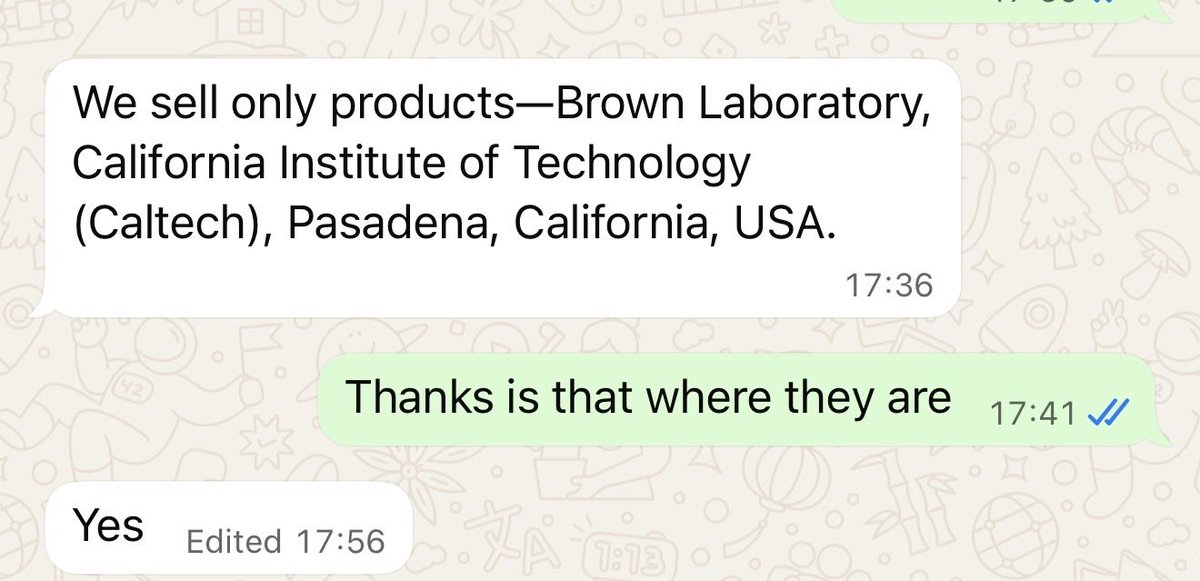
My article on this is out shortly, but I've found another vendor using Brown Biology and when I asked for address, they gave me this Brown Institute. This is gone beyond a joke now
The Peptide Grey Market, Endless Testing Wars, and Why Biohacking Keeps Getting Overcomplicated
Not long ago I was in DMs asking the same questions everyone asks: “Is this place safe? Have you tried them? What’s the best source right now?”
Then I learned about COAs. At first it was simple — purity, identity, and how much actual peptide was in the vial (usually averaged from a batch sample). That’s still basically all I care about today.
After that the goalposts started moving. Heavy metals. Endotoxins. Now fentanyl and whatever else vendors can throw on a report. A lot of this testing has turned into straight marketing ammo. Vendors use it to attack each other. Everyone feels forced to add more tests — not because it suddenly makes the product dramatically safer for the average user (you’re very likely fine with solid basic testing), but because they don’t want to lose customers to the next guy’s “we test for more scary things” gimmick. It’s created another toxic layer in the space, especially among resellers.
Buying straight from overseas is one game. Resellers who actually pull batches and run real testing here in the States add a layer of accountability that’s genuinely valuable. The odds of getting something with correct identity, decent purity, accurate dosing, and meaningful harmful contaminants at the same time are extremely low when you’re dealing with vendors who have consistent track records and batch COAs. Real talk — basic HPLC purity + identity + assay testing from a reputable source already covers the vast majority of what actually matters.
That said, grey market peptides aren’t risk-free. Under-dosing, synthesis byproducts, and occasional endotoxin issues do show up when people send stuff for independent testing. Heavy metals are possible with shitty manufacturing (though EXTREMELY unlikely). Fentanyl in peptide vials though? That’s mostly fear porn used for marketing. Different supply chains. The real issues are more boring and more fixable with decent vendors.
Here’s the hypocrisy that kills me: the same people obsessing over every extra test on their peptides are slamming back Amazon supplements, protein powders, and “natural” stacks multiple times a day with zero COA, zero testing, and documented cases of heavy metal contamination when anyone actually bothers to check. But nobody wants to talk about that because it doesn’t fit the “I’m doing everything the safest possible way” narrative.
My advice after being in it for a while: Find your people. Find vendors with consistent feedback over time, transparent batch testing, and reasonable pricing. Stick with them. Tune out the constant noise and pissing contests. The testing escalation is mostly theater at this point and it just drives costs up for everyone.
Then there’s the dosage arguments, which are equally exhausting.
We’ve got people going to war over mitochondria peptides like MOTS-c and SS-31, or healing compounds like BPC-157, KPV, GHK-Cu, TB-500 — arguing exact mcg amounts like they’re dialing in TRT or HGH. Everyone is different. Some people run low maintenance doses because they’re not completely broken to begin with. Some need to feel something and push higher. Some mega-dose everything. Then you’ve got the GLP crowd who think running maximum doses forever just to kill food noise is a long-term strategy, and they mock anyone who says “I’m on 500mcg of Retatrutide and doing great.”
Real talk from my own experience: At a dose that gives basically zero appetite suppression, I can still eat in a solid surplus and put on way less body fat than I would have before. The metabolic effects are still running in the background. But try telling that to the “food noise must be obliterated at all costs” crowd. They don’t want to hear it.
The truth is we’re all still researching. There is no holy grail protocol. Most of these compounds have limited human data, especially at the doses and combinations people actually run. Healing peptides in particular seem to have individual response curves — what works great for one person at 250mcg might do nothing or feel off for someone else at 500mcg. Same with the mitochondria stuff. We don’t have perfect dose-response curves because this entire category lives in the research/experimental space for most users.
That’s not a bug. That’s the actual reality.
Let it stay the beauty of it.
Stop treating every peptide like it needs pharmaceutical-level precision and endless debate. Track how you respond. Adjust based on real feedback from your body and basic bloodwork where it makes sense. Find sources you trust and stop chasing the next vendor’s marketing report. The over-complication is making everything more expensive and more stressful than it needs to be.
Most people would get better results just by being consistent with decent product and paying attention to how their body actually reacts instead of arguing in comment sections about whose tested batch is the most tested.
That’s the game. Keep it simple where you can.
CORRECT ME IF I'M WRONG BUT, As I turn 43 this year, I have realised, as a man, no one cares about you. Not your wife. Not your family. Not your friends. Not your workmates. Nobody. People act like they care, but deep down, they don't. You are on your own. Always on your own.
Gym bros - still criminally underrated.
Yea most don’t have the fancy degrees and credentials that society deems “respectable.”
But many have qualities that can’t be awarded by a university.
- They wake up before sunrise without anyone forcing them to
- They delay gratification for years
- They seek discomfort
- They’re passionate scientists that test ideas, track data, change their minds when evidence changes, and willingly bang their heads against failure… then come back for more
- They learn physiology, nutrition, pharmacology, and physics because they want to be better and grow… not to pass their exam tomorrow
There’s a place for formal education, but never underestimate gym bros. They’re the pioneers practicing their craft at the bleeding edge, taking direct feedback from reality.
Our country wasn’t built only by the credentialed. It was built by bros willing to take responsibility, embrace risk, work relentlessly, and continually improve themselves.
Courage, curiousity, and discipline.
Happy 4th SFL 🫡 🇺🇸
Look at Christ
Scripture: “Have this mind among yourselves, which is yours in Christ Jesus…” — Philippians 2:5
Thought: There has only been one man in the history of history who had the right to be entitled: King Jesus.
He deserved worship. He deserved obedience. He deserved honor, comfort, glory, praise, and power. Every throne belonged to Him. Every crown was His by right. Every angel existed to obey His voice. Every molecule was held together by His word.
And yet, He humbled Himself. He served. He suffered. He obeyed. He gave. He died.
The only man who deserved everything demanded nothing. And the rest of us, who deserve nothing, spend our lives demanding everything.
That is the insanity of entitlement. So when entitlement rises in you, my encouragement: look at Christ.
Look at the Son of God washing feet.
Look at Him touching lepers.
Look at Him welcoming children.
Look at Him silent before His accusers.
Look at Him carrying the cross.
Look at Him praying, “Father, forgive them.”
Jesus did not use His rights to serve Himself. He laid them down to save His enemies. That is the death of entitlement.
A man who asks, “What am I owed?” and starts asking, “What has God entrusted to me?” is a man who has learned to receive life as a gift rather than demand it as a debt.
That is a truly free man.
The most grateful men are not the men who have the most. They are the men who have looked longest at Jesus and finally realized: Everything is grace.
- by Chris Harper in BetterMan Morning Devo July 3rd
The Grey Market Sleazebag’s Guide
1. Inflate your position and your means. Pretend you’re bigger, richer and more connected than you really are.
2.Always take, never give. Act as the middleman, never reveal your own sources, but happily expect everyone else to reveal theirs.
3.When a deal succeeds, make sure you win. Keep 80% for yourself and leave everyone else fighting over the scraps.
4. When shipping goes wrong, it’s never your problem.
If customs seize it, that’s your customer’s loss.
If it arrives leaking or mouldy, that’s their problem too.
Need to clear old stock? Don’t think twice about changing the expiry date to make the sale.
5. Socialise the risk, privatise the profit. If there’s a loss, make sure someone else carries it while you walk away untouched.
6. Use other people’s reputations for your own gain. Drop names as vouches without asking permission, expect free products, and avoid paying whenever you can.
7. Sell exclusivity, not information. Make every conversation feel like you’ve chosen them to receive “top secret” insider knowledge. The more exclusive it sounds, the more valuable it appears.
8. Avoid phone calls and real-life meetings at all costs. The whole act works best in text. Calls, video, and in-person meetings are dangerous because that’s when the illusion starts to crack.
9. Never underestimate the person asking the questions. The biggest mistake a grey market sleazebag can make is assuming everyone will take their word for it. Especially when the person digging into the details has a name that starts with K. That’s usually when the paper trail starts.
The golden rule: Take all the upside, accept none of the downside, and never mess with K.☠️☠️☠️
Inside a Large-Scale RUO Peptide Manufacturer
During my visit today I was able to tour the facility including cleanrooms, sterilisation and autoclaving areas, getting a first-hand look at how production is carried out.
A few interesting facts from the visit:
Production runs 6 days a week, with Saturday being a half day.
The biggest bottleneck is the lyophilisation (freeze-drying) process.
The facility has 6 lyophilisers:
Largest: 9,000 × 3 ml vials per cycle
Mid-size: 4000 × 3 ml vials
Small: 3200 × 3 ml vials
Excipients
The preferred excipient is trehalose, which they consider the better cryoprotectant, although some mannitol is also used.
The Biggest Challenge
The manufacturer said the hardest part isn’t making the peptide itself—it’s developing the correct lyophilisation cycle. Every product behaves differently, making this a steep learning curve that takes significant experience.
According to them:
Easier to lyophilise short chain peptides
BPC-157
TB-500
More difficult to lyophilise:
NAD+
AOD-9604
Glutathione
Equipment
New lyophilisers cost around $300,000–400,000.
Used machines can still cost around $150,000.
Production
The facility produces approximately 15,000 vials per day, operating 6 days a week—around 90,000 vials every week.
They told me they sell everything they produce, with demand keeping pace with production.
A typical custom SKU is around 5,000 vials.
One point they kept returning to was that testing isn’t something you can skip. In their view, rigorous testing is essential regardless of production scale.