Victor Lustig was the smoothest con artist who ever lived. In 1925, he posed as a high-ranking French government official. He gathered the city's biggest scrap metal dealers at a fancy hotel and whispered a secret: the government was broke and planned to tear down the Eiffel Tower to sell the 7,000 tons of iron. He asked for bids. One dealer, Andre Poisson, was so eager to join the inner circle that he paid Lustig a massive bribe plus the cost of the tower. Lustig took the suitcase of cash and fled to Austria. When the dealer realized he had been scammed, he was too embarrassed to go to the police. So, incredibly, Lustig returned to Paris a month later and tried to sell the tower again to a different dealer. This time, the police were tipped off, and he fled to America to con Al Capone.
In July 2024, a quiet morning of fishing off the coast of Portsmouth, New Hampshire, turned into a viral sensation. Two young fishermen were sitting in a 23-foot center-console boat when a massive humpback whale, likely chasing a school of fish, launched itself out of the water. It didn't breach next to the boat; it breached on the boat. The whale's massive head slammed onto the stern, crushing the engine and flipping the vessel like a toy in a bathtub. The two fishermen were thrown viol3ntly into the Atlantic. Boaters nearby captured the entire incident on video, watching in horror as the white belly of the whale crushed the fiberglass. Miraculously, neither the boys nor the whale were seriously i*jured. The boys were rescued by a nearby vessel within minutes, wet and shaken, with the ultimate "the one that got away" story.
It is a story that sounds like a cartoon plot, but it actually happened in Haryana, India, in early 2024. Darshan Singh Brar, 80, had been on a ventilator for days with a severe heart condition. Doctors eventually declared him d3ad, removed the machines, and handed his body over to his grieving family. His grandsons were transporting his body home for the cremation rites. The roads were in ter*ible condition. The ambulance hit a deep, violent pothole, shaking the entire vehicle. Minutes later, the grandson noticed the "body" moving its hand. He checked for a pulse and felt a faint beat. They diverted the ambulance to the nearest hospital, where doctors confirmed that Darshan was indeed alive. The violent impact of the pothole had acted like a manual chest compression (CPR), shocking his heart back into rhythm. The family cancelled the funeral and celebrated a miracle caused by bad infrastructure.
In January 2024, 61-year-old Will Fransen was marlin fishing solo off the coast of New Zealand. While hooking a fish, he lost his balance and fell overboard. He watched in horror as his boat, still in gear, motored away toward the horizon, leaving him alone in the ocean. He tried to swim to the Poor Knights Islands, but the current was too strong. As night fell, he was circled by a shark, which he managed to kick away. He hallucinated and shivered through the cold night. The next day, exhausted and ready to drown, he saw a small fishing boat in the distance. He couldn't shout loud enough, so he raised his left arm. He used the glass face of his analog wristwatch to catch the sunlight and flash it at the boat. The fishermen saw the tiny glint of light, thought it was weird, and came to investigate. They found Will floating, barely alive. He had turned a fashion accessory into a life-saving beacon.
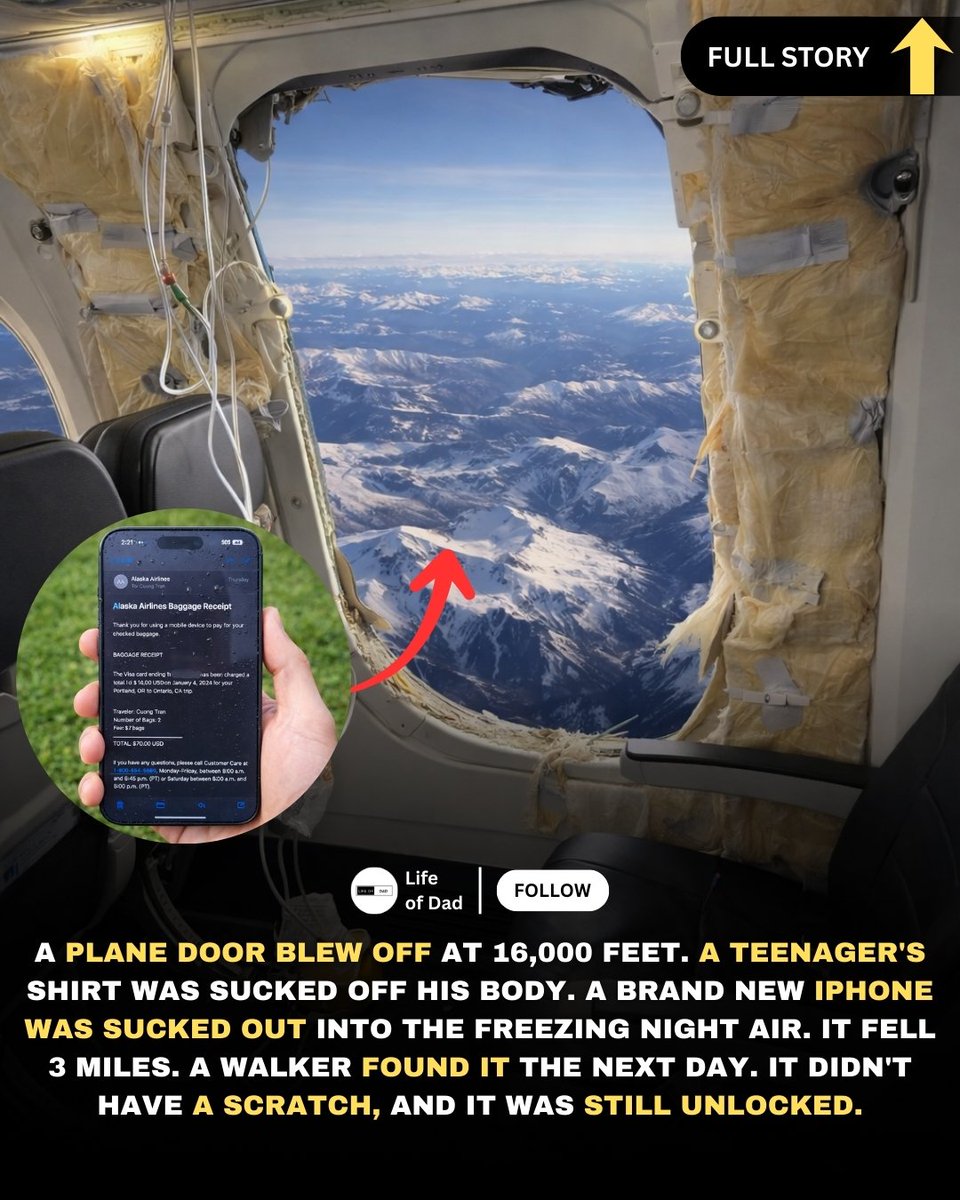
In January 2024, Alaska Airlines Flight 1282 suffered a catastrophic depressurization when a door plug blew out mid-air. The force of the vacuum was so violent it ripp3d the shirt off a teenage boy sitting in row 26. Alongside the debris, an iPhone belonging to a passenger was sucked out of the cabin, tumbling 16,000 feet (5 kilometers) through the night sky. Terminal velocity for a phone is about 60 mph, usually enough to shatter it on impact. However, a man named Sean Bates was walking on the side of a road in Portland, Oregon, when he saw a phone lying in a patch of grass. To his shock, the screen was unbroken. When he swiped up, it was unlocked and open to the Alaska Airlines baggage claim email. The phone had survived a drop from the stratosphere without a case, likely cushioned by the specific angle it hit the soft, wet grass. It remains the most extreme "drop test" in history.
It sounds physically impossible, but adrenaline is a powerful thing. In 2021, 51-year-old Marcus McGowan was snorkeling near a luxury resort island in Queensland, Australia. He was looking at coral when something clamped down on his h3ad. He thought it was a shark, but when he reached up, he felt the hard, scaly snout of a saltwater crocodile. The predator had his entire he*d inside its mouth and was preparing to d3ath-roll him.
Marcus realized he had seconds to live. In a moment of primal survival instinct, he jammed his fingers into the crocodile's jaws and leveraged them open just enough to slide his h3ad out. The crocodile snapped again, bit*ng his hand, but Marcus punched it and swam frantically to the nearby boat. He was pulled aboard ble*ding profusely from scalp lacerations and puncture w*unds, but he was alive. He was airlifted to a hospital. Experts say escaping a croc's grip once it has bitten you is statistically almost zero. Marcus did it by refusing to be eat3n.
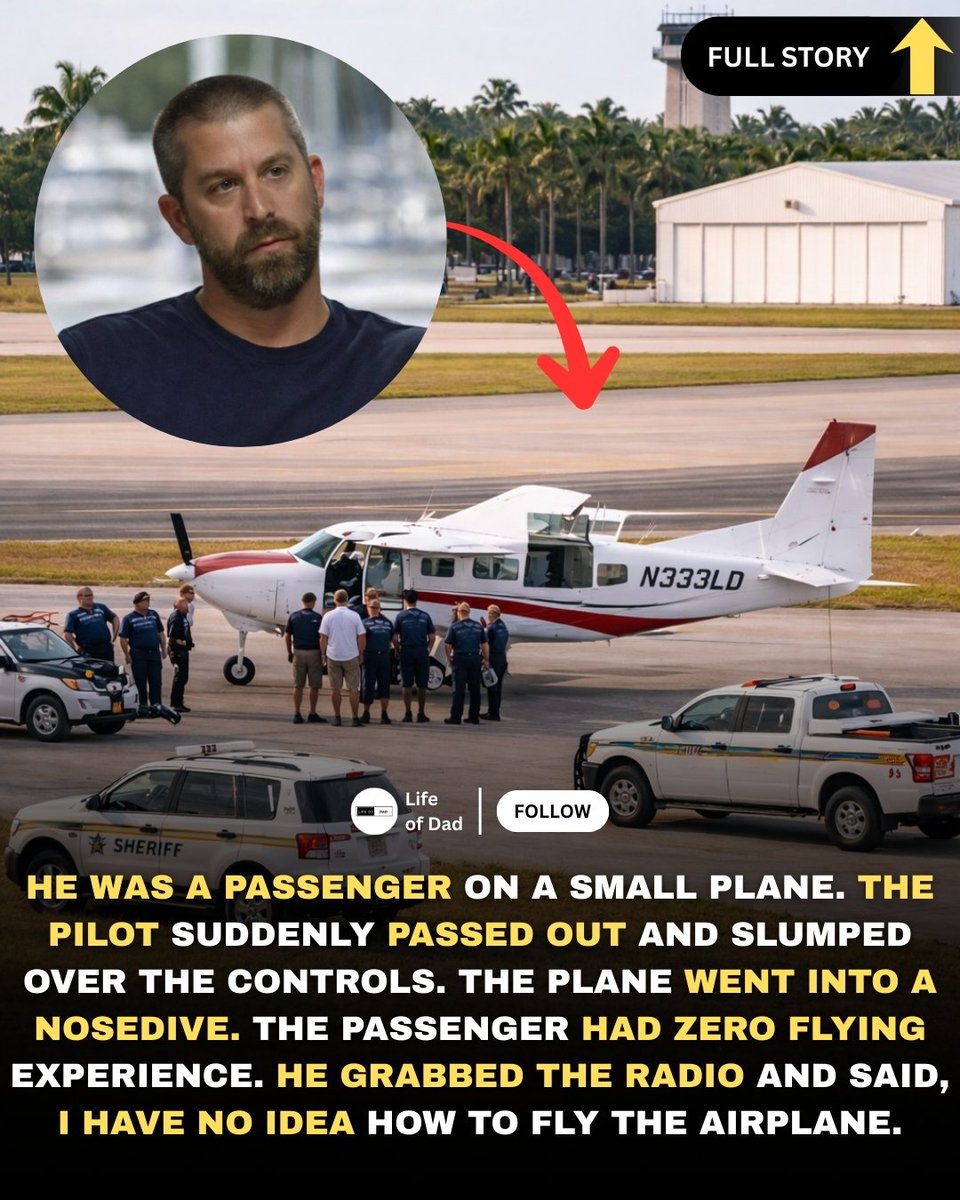
It is the scenario everyone fears, but only one man lived it. In May 2022, Darren Harrison was flying home from the Bahamas on a single-engine Cessna 208. He was relaxing in the back when the pilot suddenly groaned, clutched his chest, and fell unconscious due to a torn aorta. The plane pitched down, diving toward the ocean at high speed. Darren, who had no flight training, unbuckled his seatbelt and crawled into the cockpit.
He pulled the yoke back to level the plane, using sheer instinct. He put on the headset and radioed Air Traffic Control with a chilling message: "I've got a serious situation here. My pilot has gone incoherent. I have no idea how to fly the airplane." The air traffic controller, Robert Morgan (who was also a flight instructor), calmly talked him through it. "Push forward on the controls and descend at a very slow rate," he instructed. For miles, Darren flew the aircraft with steady hands. As the runway at Palm Beach International Airport appeared, he had to figure out how to slow down and touch the wheels to the ground without cra*hing. Miraculously, he greased the landing, bringing the plane to a gentle stop. The pilot was rushed to the hospital and survived, saved by the passenger who became a pilot in seconds.
It is every parent's n*ghtmare. In January 2023, a 15-year-old boy named Fahim was playing hide-and-seek near the commercial port in Chittagong, Bangladesh. He found the perfect hiding spot: an empty shipping container. He climbed in, but while waiting for his friends to find him, he accidentally fell asleep. While he slept, port workers sealed the door, loaded the container onto a massive cargo ship, and the ship set sail.
Fahim woke up in total darkness. He screamed and banged on the metal walls, but the noise of the ship's engine drowned him out. He had no food and no water. He was trapped in a metal box in the middle of the ocean for six days. He survived by licking condensation off the walls. When the ship finally docked in Port Klang, Malaysia—2,000 miles away—dock workers heard strange knocking sounds coming from inside a container. They opened it, expecting to find smugglers. Instead, a bewildered, emaciated boy walked out into the sunlight of a foreign country. He didn't speak the language and had no idea where he was. He was treated for dehydration and eventually sent home, the winner of the most extreme game of hide-and-seek ever played.
It is the most heartwarming survival story of recent years. In April 2023, 54-year-old Australian sailor Tim Shaddock set off from La Paz, Mexico, attempting to sail his catamaran across the Pacific to French Polynesia. His only companion was a stray dog he had adopted named Bella. A few weeks into the journey, a violent storm struck. It wiped out his electronics, destroyed his sail, and kil*ed his engine. He was left drifting in a d*ad boat in the middle of the largest ocean on Earth, unable to call for help.
For 90 days—three full months—Tim and Bella drifted aimlessly. They survived on a diet that would break most people: raw tuna that Tim managed to catch by hand and with fishing gear, and rainwater he collected during storms. He spent his days sheltering under a small canopy to avoid the blistering sun and sharing his meager food with Bella. He later said that taking care of the dog gave him a purpose and kept him from going insane in the isolation. On July 12, 2023, a helicopter from a tuna fishing vessel spotted a tiny white speck in the vast blue water more than 1,200 miles from land. When the rescue boat pulled up, they found Tim with a massive, bushy blonde beard, gaunt but alive. And miraculously, standing on the bow wagging her tail was Bella, healthy and happy. The doctor who examined him was stunned by his stable condition. He had survived the open ocean for a quarter of a year, proving that man's best friend is also man's best survival tool.
It sounds like a character written for a violent action movie, but Sir Adrian Carton de Wiart was a real British Army officer who simply refused to d*e. His medical record is the most ter*ifying document in military history. He served in the Boer War, World War I, and World War II. During the Boer War, he was sh*t in the stomach and groin. Most men would retire. He didn't. When WWI started, he was sh*t in the face, losing his left eye. He simply put on a black eyepatch and went back to the front lines.
Later, at the Battle of the Somme, he was sh*t in the skull and ankle. At the Battle of Passchendaele, he was sh*t in the hip. But his most legendary moment of toughness came when his hand was sha*tered by shrapnel. The doctor refused to amputate two of his dangling fingers, so Adrian—impatient to get back to the fight—bit them off himself and tossed them away. He eventually lost the whole hand.
Between the wars, he survived two separate plane cr*shes. When WWII broke out, he was in his 60s, but he enlisted again. He was captured by the Italians and held in a POW camp for high-ranking officers. Despite being a one-eyed, one-handed senior citizen, he dug a tunnel and escaped, evading capture for eight days by pretending to be a peasant (which was hard, given he didn't speak Italian and was wearing a suit). When the war finally ended, after suffering nearly a dozen near-f*tal wo*nds, he wrote in his memoirs: "Frankly, I had enjoyed the war." He d*ed peacefully at home at the age of 83, proving that the only thing that could ki*l him was old age.
It is the most famous survival story in climbing history. In 1985, two young British climbers, Joe Simpson and Simon Yates, scaled the treacherous West Face of Siula Grande in the Peruvian Andes. They made it to the top, but d*saster struck on the way down. Joe slipped and sha*tered his leg, driving his lower leg bone through his knee joint. In the "d*ath zone," this is usually a f*tal sentence. Simon refused to abandon his friend. He tied two ropes together and began an agonizing rescue, lowering Joe down the mountain 300 feet at a time in a blinding blizzard.
But then, the worst happened. Joe was lowered over an unseen overhang. He was left dangling in mid-air, 100 feet from the wall, pulling Simon down with him. Simon held the weight for over an hour, his hands freezing, sliding toward the edge. Knowing they would both fall and d*e, Simon made the impossible decision: he took out his knife and cut the rope. Joe plummeted 150 feet into a massive glacial crevasse.
Simon survived and descended, assuming Joe was d*ad. But Joe wasn't d*ad. He had landed on a small ice bridge deep inside the crevasse. Alone, in the pitch black, with a sha*tered leg and no food, he knew he couldn't climb up. So he did the unthinkable: he lowered himself deeper into the abyss, hoping to find a path out at the bottom. He found a small hole leading to the glacier. For the next three days, Joe crawled across rocks and ice, dragging his useless leg behind him, delirious with pain and dehydration. He reached base camp in the middle of the night, crawling into the tents just hours before Simon was planning to leave. He had survived the fall, the freeze, and the cut.
It is one of the most underrated survival stories of the 20th century. In 1921, an expedition was launched to claim the remote Wrangel Island (north of Siberia) for Canada. The team consisted of four young, experienced male explorers and one 23-year-old Iñupiat woman named Ada Blackjack. Ada wasn't an adventurer; she was a destitute single mother who joined solely to earn money to treat her son's tuberculosis. She was hired as a cook and seamstress. She was te*rified of g*ns and polar bears.
The expedition was a d*saster. The relief ship that was supposed to pick them up in 1922 never arrived due to ice. The food ran out. As starvation set in, three of the men—Crawford, Maurer, and Galle—set off across the frozen sea to find help in Siberia. They walked into the white mist and were never seen again. The fourth man, Lorne Knight, was bedridden with severe scurvy. Ada, the smallest and weakest of the group, was left to nurse a dy*ng man in the middle of the apocalypse.
When Knight finally d*ed in June 1923, Ada was completely alone. For the next three months, this shy seamstress transformed into a warrior. She realized that if she didn't hunt, she would d*e. She taught herself to sho*t the expedition's rifle by f*ring at empty tin cans. She built a viewing platform to spot polar bears before they spotted her. She trapped foxes, sh*t seals, and reinforced the tent with driftwood. Her only companion was the expedition's cat, Vic. On August 20, 1923, a rescue schooner finally broke through the ice. The crew expected to find everyone d*ad. Instead, they found Ada, wearing a coat she had sewn from reindeer skins, healthy and cooking breakfast. She had survived the Arctic that had ki*led four strong men.
It is the ultimate test of professional composure under pressure. In April 1961, 27-year-old Leonid Rogozov was the sole surgeon on a Soviet expedition to Antarctica. During the middle of the polar winter, a massive blizzard buried the station, making evacuation impossible. Suddenly, Leonid fell ill. He recognized the symptoms immediately: acute appendicitis. He knew that if the organ b*rst, peritonitis would set in, and he would d*e a slow, agonizing d*ath. With no one else to help him, he made the te*rifying decision to operate on himself.
He recruited a meteorologist and a driver to hold retractors and a mirror. He lay down on the operating table, injected a local anesthetic into his abdominal wall, and made a 12-centimeter incision. The surgery was a n*ghtmare. The mirror showed everything in reverse, confusing his movements, so he ended up working mostly by touch, digging inside his own bl*eding intestines with his bare hands (in gloves) to find the inflamed organ. He grew weak and nauseous, having to pause every five minutes to stop from fainting. After an hour and 45 minutes of grueling work, he located the appendix, c*t it out, applied antibiotics, and stitched himself back up. He slept for two days straight, and within two weeks, he was back on duty. He had looked d*ath in the eye and literally c*t it out of his body.
In the late 1500s, Korea faced invasion from a massive foreign navy. Cities were falling. Supply lines were collapsing. Panic spread fast. At sea, everything depended on one man. Admiral Yi Sun-sin.
Yi wasn’t flashy. He didn’t come from a powerful family. What he had was discipline, preparation, and an obsessive attention to detail. He trained his sailors relentlessly, studied tides and currents, and designed armored warships that could withstand enemy f*re.
He never lost a battle.
That should have made him untouchable. It didn’t.
Court politics turned against him. Rivals accused him of disobedience. The king believed them. Yi was arrested, b*aten, stripped of his rank, and reduced to a foot soldier. Another commander was put in charge of the navy.
That commander lost almost everything.
Fleet after fleet was d*stroyed. Ships b*rned. Sailors drowned. The enemy controlled the sea. Korea stood on the edge of collapse.
That’s when the king sent for Yi Sun-sin again.
Yi returned to command and surveyed what was left of the navy.
Twelve ships.
That was it.
The enemy fleet numbered more than three hundred.
Yi didn’t complain. He didn’t ask for reinforcements. He didn’t argue strategy in court. He wrote one line in a report that became famous in Korean history.
“Those who seek d*ath shall live. Those who seek life shall d*e.”
He chose a narrow strait where tides reversed violently. He positioned his ships so the current would work against the enemy. When the battle began, Yi’s ships held formation while the enemy fleet was thrown into chaos by water they didn’t understand.
Yi led from the front. He stood exposed on deck, directing f*re, refusing to take cover. Cannon after cannon struck enemy ships. One by one, they b*rned, collided, or capsized.
By the end of the day, the enemy fleet retreated.
Not one of Yi’s twelve ships was lost.
The battle turned the entire w*r. Supply lines were cut. Momentum shifted. Korea survived.
Yi Sun-sin went on to win every naval battle he ever fought. Twenty-three battles. Zero defeats.
In the final battle of the w*r, Yi was sh*t by a stray bullet. As he fell, he gave his last order.
“Do not announce my d*ath.”
The battle continued. Victory was secured. Only then was his body revealed.
Yi Sun-sin didn’t d*e famous. He d*ed ensuring his sailors wouldn’t lose morale for a single moment.
He had been b*aten by his own government.
H*miliated.
Stripped of everything.
And when history needed him again, he didn’t ask for justice. He asked for the tide tables.
There are billions of human stories.
Most are loud failures or quiet lives.
Yi Sun-sin’s story endures because it proves something uncomfortable and rare.
That real greatness doesn’t come from power, praise, or permission.
It comes from competence, resolve, and doing the job even after the world has already decided to break you.
In November 2016, Wanda Dench, a grandmother in Arizona, sent a text message she had sent many times before. It was simple. She was inviting her grandson to Thanksgiving dinner.
The problem was the number was no longer his.
The message went to Jamal Hinton, a 17-year-old high school student who had never met Wanda and had no idea who she was. Confused but curious, Jamal replied asking who she was. Wanda responded honestly. She realized her mistake and apologized, explaining she thought she was texting her grandson.
Most conversations like that end right there.
This one didn’t.
Jamal sent a photo of himself and joked, asking if he could still come to Thanksgiving dinner even though he wasn’t her grandson. Wanda didn’t hesitate. She replied, “Of course you can. That’s what grandmas do. They feed everyone.”
Thanksgiving Day came, and Jamal showed up.
What could have been awkward wasn’t. They talked. They laughed. They ate. Jamal stayed for hours. He later said he felt welcomed in a way he didn’t expect, like he had walked into a family that didn’t ask questions before pulling up a chair for him.
When the day ended, they hugged and went their separate ways.
They didn’t stop texting.
The next year, they did Thanksgiving again. Then again the year after that. Photos of their dinners went viral as people followed the story online. Strangers expected it to be a one-time feel-good moment. It wasn’t. It became a tradition.
In 2020, Wanda’s husband Lonnie passed away. Jamal was there for her. He said she had become family long before the internet noticed. Wanda said Jamal filled a space in her life she didn’t know needed filling.
They kept showing up for each other. Birthdays. Holidays. Hard years. Good years.
By 2024, they had spent eight Thanksgivings together. What started as a wrong number turned into one of the most unlikely long-term friendships people had ever watched unfold in real time.
Wanda later said she never saw it as something special at first. She just didn’t believe in turning people away, especially on a holiday meant for gathering. Jamal said one decision changed the shape of his adult life.
No miracle.
No big lesson written on a wall.
Just a missed digit, a joke that landed, and two people choosing kindness instead of moving on.
One text went to the wrong phone.
And somehow, it ended up in exactly the right place.
In July 2023, scientists monitoring seismic activity in Seattle noticed something unusual. Their instruments were picking up consistent ground vibrations strong enough to register clearly on seismographs. At first glance, it looked like a small earthquake.
But there was no earthquake.
The vibrations lined up perfectly with the schedule of Taylor Swift’s Eras Tour concerts at Lumen Field. Over two nights, more than 70,000 fans packed into the stadium each evening. They weren’t just listening. They were jumping, dancing, and screaming together.
In sync.
Researchers at the Pacific Northwest Seismic Network analyzed the data and confirmed it. The combined movement of the crowd, especially during songs like “Shake It Off,” created seismic energy equivalent to a magnitude 2.3 earthquake. The ground didn’t crack. Buildings didn’t fall. But the Earth definitely moved.
This wasn’t just one spike. The vibrations lasted for hours and showed clear patterns matching the concert’s setlist. Scientists could tell when songs started and stopped just by looking at the seismic readings.
It wasn’t the first time humans had caused detectable ground movement, but it was one of the clearest examples of collective energy ever recorded from a single event. Even professional sports games rarely create vibrations that strong or sustained.
What made it more remarkable was how far the signal traveled. Instruments miles away picked it up. Not because of sound, but because tens of thousands of people were physically moving the ground beneath them at the same time.
The scientists weren’t alarmed. They were fascinated. It was a real-world demonstration of how human activity, when synchronized at scale, can interact with the planet in measurable ways.
Fans loved it. Social media exploded with jokes about “Swiftquakes.” The singer herself acknowledged it later, laughing about literally shaking the ground.
No damage was done.
No danger existed.
But for a brief moment, music did something it’s always claimed to do metaphorically.
It moved people so much that the Earth noticed.
Not with destruction.
Not with force.
Just with rhythm, timing, and tens of thousands of people jumping together, turning a concert into something scientists could feel through the planet itself.
On December 9, 2019, White Island, an active volcano off the coast of New Zealand, looked calm. Steam drifted lazily from the crater. Tour boats arrived like they did almost every day. Visitors walked along the rocky surface, cameras out, listening to guides explain the landscape beneath their feet.
Without warning, the volcano e*upted.
A massive b*ast of ash, gas, and superheated rock shot straight up from the crater. Temperatures instantly soared above 1,000 degrees Fahrenheit. People closest to the vent were hit first. Some were knocked off their feet. Others were b*rned where they stood.
There was no evacuation route. No shelter. No alarm system that could outrun the b*ast.
Tourists ran through falling ash and boiling steam, trying to reach the shoreline. Some collapsed before they made it. Others helped strangers, pulling them along even as their own skin was b*rning.
One man, a guide named Hayden Marshall-Inman, ran back into the eruption to help i*jured people reach safety. He made multiple trips. He did not survive.
Boats rushed in as soon as the ash cloud lifted enough to see. Crew members pulled people from the water and the rocks, many with severe b*rns. Helicopters landed despite ash still rising from the crater. Pilots later said visibility was nearly zero and the heat was intense.
Of the 47 people on the island that day, 22 d*ed. Many others were critically i*jured. Survivors spent months in hospitals and b*rn units. Some underwent dozens of surgeries. Many said the pain was beyond anything they could describe.
Investigations later found that the volcano had shown signs of increased activity, but eruptions are notoriously hard to predict. The b*ast happened so suddenly that even perfect planning would not have guaranteed safety.
For survivors, the memory is frozen in seconds. One moment taking photos. The next, the world turning white, then black, then b*rning.
White Island remains closed to tourists now. The volcano still vents steam, quiet again, as if nothing happened.
But for those who were there, the calm is deceptive. They know how quickly the ground can turn on you.
They didn’t climb a mountain.
They didn’t chase d*nger.
They stood inside a volcano, trusted the quiet, and learned how fast nature can erase the space between normal and catastrophic.
In March 2024, Brieonna Cassell left her home in Indiana to drive a familiar route. It wasn’t a long trip. No bad weather. No warnings. At some point, she took a wrong turn, lost control, and her car slid off the road into a deep ditch hidden by tall grass.
From the road, nothing looked wrong.
Her car was completely invisible to passing traffic. No headlights. No movement. No sound. Cars drove by just a few feet away for days without knowing she was there.
The crash pinned her inside the vehicle. Her phone was d*ad. She couldn’t climb out. One of her legs was badly i*jured. The temperature dropped at night. Time stopped meaning anything.
She waited.
After the first day, she realized no one was coming. She rationed her energy. She screamed when she could. Mostly, she stayed quiet to survive. With no food and no water, dehydration set in fast.
By the third day, she began hallucinating.
By the fifth, she was drifting in and out of consciousness, convinced she wouldn’t make it.
What saved her wasn’t a search helicopter or technology. It was a man driving farm equipment who noticed something slightly off in the grass. Not a car. Just flattened weeds that didn’t look natural.
He stopped.
When he looked down into the ditch, he saw the roof of a car. Then he heard a voice. Weak. Barely there.
Emergency crews rushed in. Brieonna had been trapped for six days. Doctors said she was severely dehydrated and critically i*jured, but alive. Another night and she likely wouldn’t have survived.
At the hospital, she asked the same question again and again.
“How long was I gone?”
When they told her, she cried.
Police later said the location made her almost impossible to spot. No skid marks. No debris on the road. Just a silent car hidden by land that looked untouched.
Brieonna survived surgeries, recovery, and the knowledge that help passed her over hundreds of times without knowing. She later said the hardest part wasn’t the pain. It was realizing how close people were, and how invisible she was at the same time.
She didn’t survive because she was strong.
She didn’t survive because of luck alone.
She survived because one person noticed something small that didn’t belong and decided to stop instead of driving past.
Sometimes survival isn’t about being found fast.
It’s about holding on long enough for someone to finally look twice.
On February 6, 2023, a massive earthquake struck southern Turkey and northern Syria while most people were asleep. Buildings collapsed in seconds. Entire neighborhoods turned into piles of concrete and dust. Families were buried where they had gone to bed the night before.
In the city of Kahramanmaraş, a father named Mesut Hancer ran to what was left of his apartment building. Where his home once stood was a mountain of rubble. Somewhere underneath it was his 15-year-old daughter, Irmak.
Rescue workers searched. Neighbors helped dig with bare hands. Hours passed. The cold was brutal. Snow fell. Sirens echoed everywhere.
Eventually, they found her.
Irmak was trapped beneath a concrete slab. Her body was c*ushed. She did not survive the collapse. There was nothing anyone could do.
But Mesut didn’t leave.
He sat down on the rubble beside her, reached through the broken concrete, and held her hand. He wrapped his fingers around hers and stayed there, motionless, as the world continued collapsing around him.
Photographers captured the moment. A father sitting alone in the ruins, holding the hand of his d*ad daughter, refusing to let go. The image spread across the world within hours. People didn’t need an explanation. Everyone understood it instantly.
Mesut later said he stayed because it was the only thing he could still do for her. He couldn’t save her. He couldn’t protect her. He could only be there.
Around him, thousands of others were living the same nightmare. Parents searching for children. Children waiting for parents who would never come. More than 50,000 people would d*e in the earthquakes. Millions would lose their homes.
But that single moment cut through all the numbers.
One father.
One daughter.
One hand held after everything else was already gone.
Rescuers eventually asked Mesut to move so recovery could continue. He stood up slowly. He let go.
Nothing about that day was fair.
Nothing about it was fixable.
And that’s why the photo hurt so much. Because it showed the part of tragedy statistics can’t capture. The part where love doesn’t stop just because life does.
In 2019, a Florida teenager named Lucas Alvarez was doing what millions of people do out of boredom. He was scrolling around on Google Earth, zooming in on random places near his home. Neighborhoods. Backyards. Lakes. Nothing unusual.
Then he stopped.
In a retention pond behind a house in Wellington, Florida, something looked wrong. Beneath the surface of the water, visible in an old satellite image, was the outline of a car.
Not debris.
Not a shadow.
A car.
Lucas zoomed in further. The shape was unmistakable. He showed it to a friend. They both felt the same chill. That pond had been there for years. If there was a car in it, someone didn’t just lose it yesterday.
They told an adult, who contacted authorities.
Police arrived at the pond expecting very little. Google Earth images can be misleading. Water reflections. Distortions. But when divers went down, they found exactly what the satellite photo showed.
A car.
Inside it were human remains.
The vehicle belonged to William Moldt, a man who had gone missing in 1997. He had left a nightclub one night and never made it home. For 22 years, his case had gone cold. No suspects. No evidence. No answers for his family.
Investigators concluded that Moldt likely lost control of his car late at night, drove into the pond, and sank. The pond had been built shortly before his disappearance. Over time, water levels changed, and vegetation grew. From the ground, nothing looked suspicious.
From space, everything was visible.
What stunned police most wasn’t just that the car was there. It was that people had lived in the surrounding houses for decades, walking past the pond every day, never knowing what sat beneath the surface.
The satellite image that revealed the car was years old. It had been publicly available the entire time. No one had noticed until a bored teenager decided to zoom in.
William Moldt’s family finally got answers after more than two decades. No mystery suspect. No conspiracy. Just a tragic accident hidden in plain sight.
Lucas never set out to solve a missing persons case. He wasn’t a detective. He wasn’t even looking for anything specific. He just happened to look at the right place, from the right angle, at the right time.
The case became a reminder of something quietly unsettling.
We map the entire planet.
We photograph it from orbit.
We archive it online.
And sometimes, the truth has been sitting there the whole time, waiting for someone curious enough to notice it.