Missionary Ahmadiyya Muslim Community. ROR Central American Coordinator. Outreach, research, writing. English/Spanish/Urdu. "Love for All, Hatred for None".
@GodLogic_GL Jesus claimed to be a a prophet, then Christians made him divine and have been floundering with the contradictions ever since.
Learn the truth about the Prophet Muhammad (sa) here:
https://t.co/7hr1X49Glc
"A mosque only serves its purpose when it is used for both the worship of God and also to manifest Islam’s true teachings of kindness, love, and compassion for all mankind." 🕌🌍
In a historic keynote address at the inauguration of the Bait ur Raheem Mosque in Cardiff, His Holiness Hazrat Mirza Masroor Ahmad (aba) outlined the true essence of a mosque. He emphasized that worship is incomplete without serving humanity, protecting the vulnerable, and upholding justice.
From condemning modern economic slavery to highlighting the rights of neighbors, this address serves as a powerful reminder that a true mosque is a beacon of peace for the entire community.
Watch the full inauguration:
https://t.co/5sRyjcN6M0
Read the full transcript here:
https://t.co/rFzIFhB8uN
#Ahmadiyya #Islam #Peace #Cardiff #Mosque #Humanity #Justice
Alhamdulillah, our Humanity First Tucson Chapter volunteers distributed nearly 100 pies along with fresh produce and essentials across five churches, kiosks, and local camps. This is Islam in action - serving the poor and needy without distinction.
#Islam#Ahmadiyya#Tucson #Arizona #USA
I was honored to participate in the Southwest Region Fazle Umar Youth Refresher course. Young men from Los Angeles, Phoenix and Tucson gathered to discuss faith, challenges and servant-leadership alongside offering prayers and enjoying the hospitality of the local Community.
@kasifhanif1 You can read a summary of his commentary on the verses in Surah Kahf where Zul Qarnain is mentioned. This is where he explains that it refers to Cyrus.
https://t.co/Sfl7TatG6n
Select the five volume commentary on the wheel and then open the footnote.
Islamic teachings clarify that 'jinn' refers to hidden or unseen entities, often symbolic of metaphysical concepts or natural phenomena like bacteria, not supernatural beings who possess humans. True Islamic doctrine rejects the idea of jinn possession and supernatural control; these are superstitions. The Quran and Sunnah emphasize focusing on faith and personal responsibility rather than fears of jinn influence.
Read the truth about Jinn here:
https://t.co/o5sEkwRpxq
Promised Messiah (as) denied that the Arabian Peninsula was already inclined towards monotheism before the arrival of Islam:
"So, with their Dajjali [antichrist-like] deceptions, they wanted to throw dust on the sun. So, perforce, as Padre James Cameron Lees has published in his lecture, they deceived the ignorant in this way, that those people were already prepared to be amenable to guidance, and idol-worship and polytheism had become contemptible in their eyes. But if those who express such an opinion are true in their view, then it is incumbent upon them to provide proof in support of their view, just as the Holy Qur’an provides proof against them, for it says: اِعْلَمُوا أَنَّ اللَّهَ يُحْيِ الْأَرْضَ بَعْدَ مَوْتِهَا. And declaring all of them as dead, it attributes their being brought to life solely to itself. And in various places, it says that they were entangled in the chains of misguidance; it was We who gave them release. They were blind; it was We who made them see. They were in darkness; it was We who gave them light. And these things were not said in secret; rather, the Qur’an conveyed them to the ears of all of them, and they did not deny these statements, nor did they ever make it apparent that we were already prepared; the Qur’an has no favour upon us. So, if our opponents have any counter-narrative in support of their statement, which has been running parallel to the Holy Qur’an for thirteen hundred years, then they should present it. Otherwise, such things are merely the fabrication of a Christian nature, nothing more."
(Nur ul Qur'an, Ruhani Khazain vol. 9, pg. 367 Footnote)
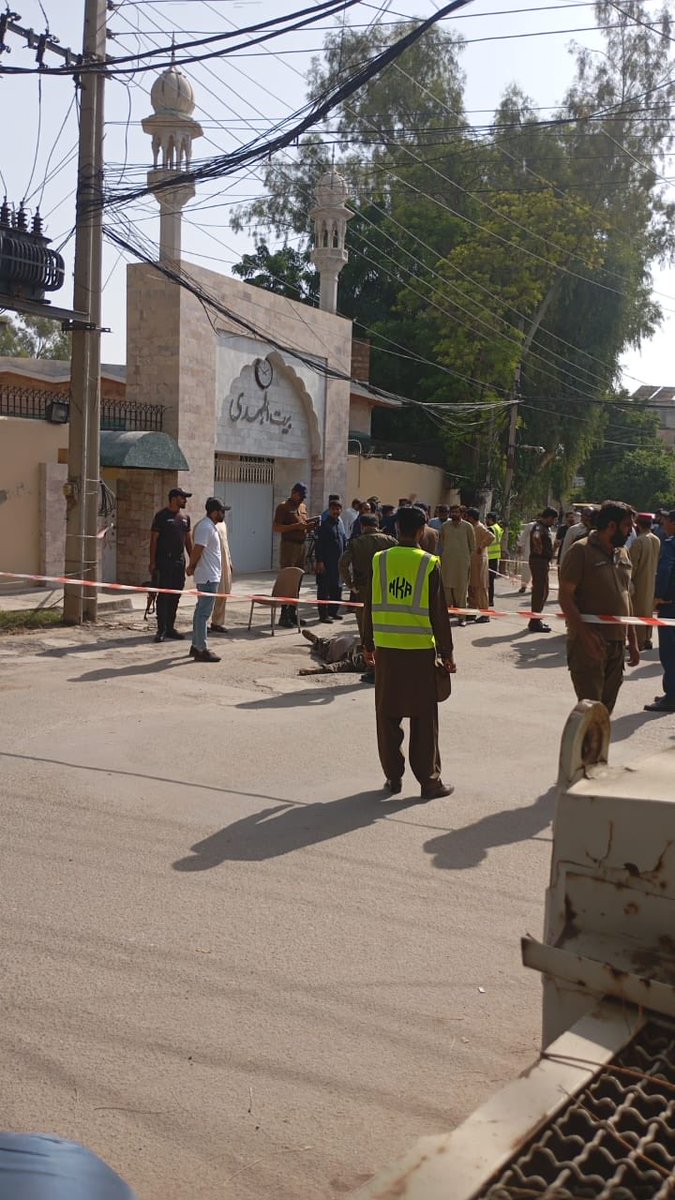
I am deeply concerned by the horrific attack at an Ahmadi Muslim mosque in Rabwah.
Once again worshippers at the Fazl Mosque in Southfields fear for the safety of their loved ones in Pakistan.
I’ve written to the Foreign Secretary 👇
🚨BREAKING: The Ahmadi Mosque Bait-ul-Mahdi in Rabwah, Pakistan was attacked by terrorists shortly after Friday prayers. Multiple injuries have been reported. The Ahmadi’s in Rabwah are living in fear as the situation remains fluid and investigations continue.
Update to follow.
5 major principles of Islam Ahmadiyyat
In a leaflet addressed to the government, the Promised Messiah (as) clarified misconceptions and refuted false accusations against himself and his Jama’at, outlining five core principles of the Community:
"I have repeatedly announced that my major principles are five.
First, to believe that God Almighty is One, without partner, and is pure from every imperfection, death, illness, helplessness, pain, suffering, and other unworthy attributes.
Second, to believe with certainty that the Seal of the line of God's prophethood, the bringer of the final law, and the one who shows the true path to salvation is our leader and master, Muhammad Mustafa, peace and blessings of Allah be upon him.
Third, that the call to the religion of Islam should be made solely through rational arguments and heavenly signs, and to consider the ideas of *ghazi*-ism [holy war], *jihad*, and belligerence as absolutely forbidden and prohibited for this age, and to consider one who adheres to such ideas as being clearly in error.
Fourth, not to harbour any seditious thoughts in the heart regarding this benevolent government under whose protection we live, that is, the British Government, and to be engaged in its obedience with sincerity of heart.
Fifth, to have sympathy for mankind and to continue striving for the worldly and otherworldly welfare of every person as much as possible, and to be a supporter of peace and reconciliation, and to spread good morals in the world.
These are the five principles which are taught to this community. And my community, as I will state further on, is not a community of ignorant and savage people; rather, most of them are highly educated, acquirers of current knowledge, and distinguished in respected government positions. And I see that they have made great progress in conduct and virtuous morals, and I hope that at the time of trial, the British government will find them to be first-rate well-wishers."
(Ishtiharat, vol. 2, pg. 408)
A couplet of the Promised Messiah (as) captures the state of the Muslim Ummah today:
می سزد گرخون ببارد دیدۂ ہر اہلِ دیں
بر پریشان حائی اسلام و المسلمین
It is fitting that the eye of every person of faith should weep tears of blood over the distressed state of Islam and the scarcity of true Muslims.
(Durre Thameen Farsi, vol. 1, pg. 231)
Bulletin: The Divine Attribute of Forbearance
Qur’an: The Reward of Patience
وَلَا تَسۡتَوِي الۡحَسَنَةُ وَلَا السَّيِّئَةُ ؕ اِدۡفَعۡ بِالَّتِيۡ هِيَ اَحۡسَنُ فَاِذَا الَّذِيۡ بَيۡنَكَ وَبَيۡنَهٗ عَدَاوَةٌ كَاَنَّهٗ وَلِيٌّ حَمِيۡمٌ
"And good and evil are not alike. Repel evil with that which is best. And lo, he between whom and thyself was enmity will become as though he were a warm friend."
(Ha Mim As-Sajdah, 41:35)
Hadith: A Prayer for Times of Distress
Hazrat Abdullah bin Abbas (ra) narrated that at a time of severe distress, the Holy Prophet (sa) used to recite the following prayer:
"Lā ilāha illallāhul-ḥalīmul-karīm, subḥānallāhi rabbil-‘arshil-‘aẓīm, subḥānallāhi rabbis-samāwātis-sab‘i wa rabbil-‘arshil-karīm."
[There is no god worthy of worship except Allah, the Forbearing, the Gracious. Holy is Allah, the Lord of the Great Throne. Holy is Allah, the Lord of the seven heavens and the Lord of the Noble Throne.]
(Sunan Ibn Majah, Kitab-ud-Dua’, Hadith: 3883)
Writings of the Promised Messiah (as): Forbearance and Endurance
"Once, an envoy came to the Holy Prophet (sa). He repeatedly extended his hand towards the blessed beard of the Holy Prophet (sa), and Hazrat Umar (ra) would push his hand away with his sword. Finally, the Holy Prophet (sa) stopped Hazrat Umar (ra). Hazrat Umar (ra) submitted, 'He is committing such insolence that I desire to kill him.' However, the Holy Prophet (sa) endured all his impertinence with forbearance."
(Malfuzat, Vol. 5, p. 324, 1988 Edition)
Hazrat Sheikh Yaqub Ali Irfani (ra) stated: "This incident took place in the house known as Mahbub Rai's. As far as I can recall, a Brahmo leader (I believe it was Anbash Mozumdar Babu) was asking the Promised Messiah (as) some questions, and he (as) was replying. In the meantime, a foul-mouthed opponent arrived and launched some very hurtful and vile attacks directly at him (as). That scene is still before my eyes. He (as) had his hand over his mouth, as it was often his custom, to cover his mouth with a part of his turban's shawl or sometimes just his hand. He remained silent while the other person continued his tirade. He (as) sat so absorbed and engrossed as if nothing was happening, as if someone was engaged in a very sweet discourse. The Brahmo leader tried to stop him, but the person paid no heed. The Promised Messiah (as) told the Brahmo leader, 'Do not say anything to him, let him speak.' Ultimately, the person got tired of his own ranting and left. The Brahmo leader was deeply impressed and said, 'This is a great moral miracle of yours.' At that moment, the Promised Messiah (as) could have silenced him or could have had him removed from his house. And due to his abusive language, his tongue could have been cut out with only the slightest gesture from him (as). But the Promised Messiah (as) gave a practical demonstration of his perfect forbearance and self-control."
(Sirat Hazrat Masih-e-Maud (as), by Sheikh Yaqub Ali Irfani (ra), pp. 426-427)
Guidance from Hazrat Khalifatul Masih V (atba): The Divine Attribute of Al-Haleem
"One of Allah the Exalted's attributes is Haleem [The Forbearing], which, when used for God Almighty, means the Merciful Being, the Forgiver, the One who overlooks. That is, in the case of disobedience, He does not immediately send down His wrath upon the disobedient. Disobedience does not provoke Him. Furthermore, He is the Concealer of faults. It is as if this attribute of Allah the Exalted encompasses the meanings of several attributes. He is also Raheem [the Merciful], Ghafoor [the All-Forgiving], and Sattar [the Concealer of faults]. However, when a person persistently begins to transgress the boundaries established by Allah the Exalted, then, if He so wills, those of His attributes which involve seizure and punishment come into action. In the Holy Qur’an, Allah the Exalted has mentioned at various places that He is not hasty in seizing. For if God Almighty were to be hasty in seizing, then man, who is an embodiment of sin, would be punished for every sin and crime. In fact, Allah the Exalted states that I give respite even to the great sinners, even to the disbelievers and those who cause pain and suffering to the Prophets. As He states: 'And if Allah were to punish men for their wrongdoing, He would not leave on it [the earth] a single living creature, but He gives them respite till an appointed term; and when their term is come, they cannot remain behind a single moment, nor can they get ahead of it.' (An-Nahl:62). So, this is the answer for those who do not believe in God, who treat the Prophets with mockery, and who have been completely blinded by the glamour of the world, that Allah certainly seizes those who do wrong and mock His beloved ones. Therefore, do not think that if Allah has never seized you or if His punishment has not yet come, then—God forbid—the Prophets of Allah are false or that God doesn’t existence."
(Friday Sermon, 14th March 2008, Al-Fazl International, 4th April 2008)
Conclusion
Let us strive to adorn our character with the raiment of forbearance, reflecting the divine attribute of Al-Haleem. In every trial, let us exhibit patience and respond to harshness with gentleness. For it is in controlling our passions and showing mercy to creation that we may truly draw near to our Merciful Creator and become deserving of His grace. May Allah enable us to do so.
#islam #ahmadiyyat
@Liquid_Solidus_ A utopian Ahmadi society would be regulated morally primarily through advice, admonition and social conventions, not through legislation.
Advice regarding the use of Quranic verses and Ahadith on occasions of jest and mockery.
"Today, this is the same condition of those Muslims who are irreligious. Those who are irreligious are what they are, but those who are called religious, the scholars or the Sufis, they too make a mockery of religious matters. Sometimes they will recite a verse of the Quran out of place, sometimes on occasions of jest they will recite a prophetic hadith, whereas the station of Allah and His Messenger is very high. To narrate their words on occasions of jest and mockery is a very dangerous matter. This thing blackens the heart, kills spirituality, and crushes piety. To overcome this sin, there is no need for any great effort. There is no question here of suppressing any greed. A little attention is needed. Those in whom this disease is found can remove this defect with a little attention and, with a little effort, can reform their hearts in such a way that it will prepare them for great tasks.
So, completely abandon jest and mockery in matters of Allah and His Messenger. This sin is without pleasure and makes the human heart completely dead. Whenever the mention of Allah and His Messenger comes, a reverence should be created in the heart, which is accompanied by love. His mention should never go without capturing one's attention. No one makes a mockery of their parents. No one makes a mockery of their parents' words. Then why should the words of Allah and the Messenger be used on occasions of jest? Why should the names of Allah and the Messenger be used as a form of mockery, and the worship of a lifetime be wasted for a moment's joke? الْحَذَرُ ثُمَّ الْحَذَرُ – Beware, and again, beware!"
(Hazrat Musleh Maud, Tafsir-e-Kabeer, vol. 2, pg. 118)