🚀 Likwid is Live: The First Oracle-Free Leveraged Trading Protocol
Likwid empowers permissionless margin trading (long/short) and lending for any token — no oracles, no gatekeepers.
🌐 AMM upgraded: (x + x′)(y + y′) = k
💡 Unified liquidity for Swap, Lending & Margin
📈 Leverage long-tail tokens from day one
🏆 Backed by Uniswap Foundation
📜 “Just as Uniswap unlocked spot trading in 2018,
Likwid now unlocks oracle-free leverage for DeFi.”
🔗 Try it now: https://t.co/vgTJKXZH3l
#DeFi #Leverage #Likwid
Hayden's essay ends on one line: the edge belongs to whoever holds inventory most cheaply.
Agreed. The next edge: make each unit do more jobs.
On Likwid, one deposit is spot depth, lending inventory, and leverage backing. Swap fees, interest, margin fees — one curve.
#DeFi #Liquidity
Borrowing should not move a pool's price.
On Likwid, a loan shifts real reserves into mirror reserves. The expanded balance stays constant, so the quote holds.
Leverage swaps through the curve, moving price like a real trade.
Same pool. Different action.
#DeFi#Lending
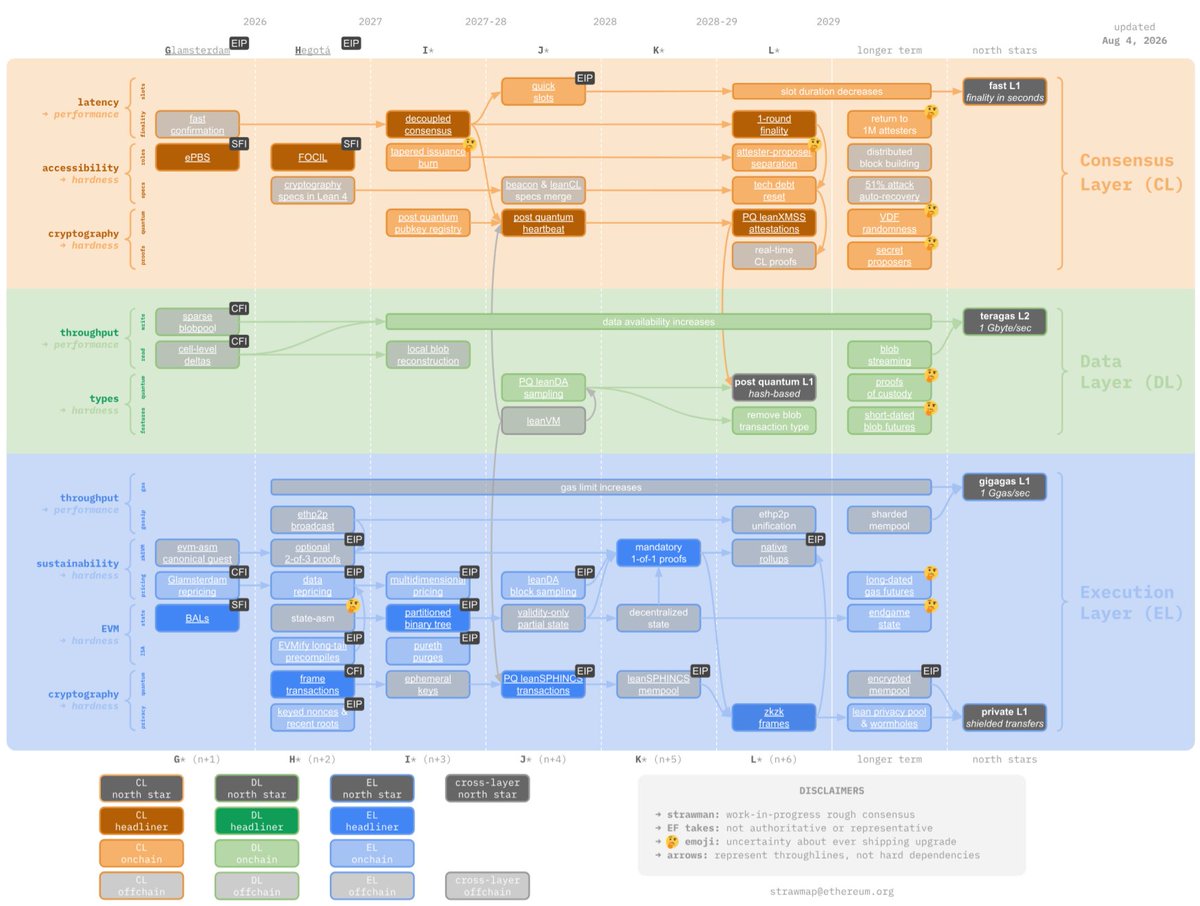
Vitalik's new roadmap ends with a promise: Ethereum will be quantum-safe, private, censorship-resistant. And Lean.
Likwid has no oracle, no order book, no counterparty. The L1 is our whole trust model.
When your only dependency is EVM, its roadmap is your roadmap.
#DeFi #Ethereum #DeFiSecurity
I updated my 2023 roadmap diagram to overlay where the items that were there sit in the current Strawmap ( https://t.co/I35mrXutP2 ).
In general, a lot of overlap, but:
* Some things got reshuffled in order (eg. quantum safety up-prioritized)
* Some things deprioritized (eg. VDFs; many EVM improvements)
* Some things replaced with superior constructions (eg. Verkle -> unified BT -> PBT; state expiry -> new state types)
What's most striking, however, is that some completely new things are in the strawmap that are NOT in this diagram, because they were not in the 2023 roadmap at all. These reflect changing priorities.
Notably:
* First-class attention to strong privacy. This covers: keyed nonces and recent roots, aspects of FOCIL, lean privacy pool & wormholes
* Aggressive scaling in the context of post-quantum. This covers: leanSPHINCS signatures and aggregation, zkzk frames (see https://t.co/ibrOpMxMfO )
* Lean-ification of the spec, to assist in formal verification (full FV of everything is only possible because of modern AI)
* Blob and gas futures (this idea just didn't exist back in 2023)
* Native rollups (SNARKs were nowhere near mature enough to even consider this back in 2023)
* A more open design space for the "future of the EVM". zkzk frames already implies that the protocol will expose to users some ISA that's not the EVM - current leading candidates are leanISA and RISC-V. These ISAs are more simple, modern and efficient than the EVM. Once they're there, why not expose them to developers everywhere? (And then, why not turn the EVM into being an IR on top of that ISA, instead of an enshrined feature massively complicating the base protocol?) Though much of the deeper exploration here is too early even for the strawmap.
* New state types are not just a replacement for expiry, they're a fundamentally different paradigm to how Ethereum does scaling
A common theme in scaling, found in both state types and zkzk frames (both new ideas), is that instead of trying to maximally scale ALL ethereum activity, we try to create specialized mechanisms that have more restrictive properties that make them more scaling-friendly, while supporting the heaviest loads incurred by users and applications today (eg. token transfers, swaps) and tomorrow (eg. privacy protocols).
The other common theme is treating STARKs and AI-accelerated FV as first-class objects, that we are okay betting the technical future of Ethereum on. There are recursive STARKs in many layers of the protocol, one particular primitive (the "aggregate to union verified dependencies" primitive) is expected to be used in *three* places in the protocol: EL, CL and DL. This can only be safe with formal verification, which is itself only feasible with modern AI tools.
In general, many steps forward in maturity. And a huge amount of hard work by many dozens of Ethereum researchers and developers on all of these features.
Ethereum will be quantum-safe. Ethereum will put users' privacy first. Ethereum will be secure. Ethereum will be censorship-resistant. Ethereum will be highly performant and scalable while satisfying the above. And Ethereum will be Lean.
The detail most skip: those funds hold overnight repo.
Repo is collateralized, short-duration, real-asset credit — finance's quiet giant.
Likwid margin runs on the same primitive: borrow the real asset against collateral, interest realized at repayment.
Repo is next.
BlackRock put a $6.2B money market fund on Ethereum — cash, short-term Treasuries, and overnight repo, tokenized.
When the world's largest asset manager settles here, tokenization stops being a thesis. It's a certainty.
That's why Likwid builds on Ethereum. Long-term.
#DeFi #Tokenization #RWA
BlackRock has launched two tokenized money market funds.
The $6.2 billion BlackRock Select Treasury Based Liquidity Fund (BSTBL) now has a tokenized share class issued on @ethereum, with BNY as transfer agent and tokenization provider.
A second vehicle, BRSRV, launches alongside it, with Securitize as transfer agent and tokenization provider.
Both invest in cash, short-term US Treasuries, and overnight repo backed by Treasuries, and both intend to qualify as eligible reserve assets for permitted US payment stablecoin issuers under the GENIUS Act.
BlackRock at a glance:
→ Over $15 trillion in assets under management
→ More than $1 trillion overseen by its Cash Management business
→ Around $60 billion in stablecoin reserves already managed
The world's largest asset manager and the world's largest custodian are both building on Ethereum.
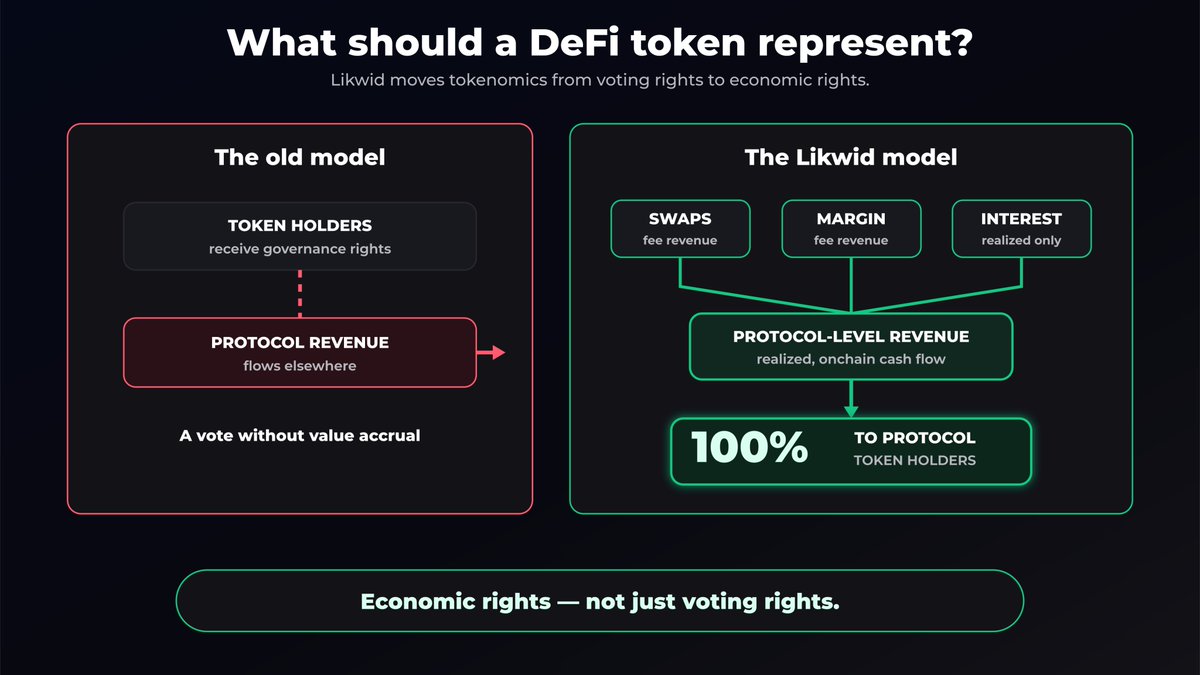
What counts as protocol revenue?
• 10% of swap fees
• 20% of margin fees
• 5% of interest actually paid at repayment
Not accrued interest. Not paper yield. Realized onchain cash flow—all allocated to protocol token holders.
Governance matters. Ownership should mean more.
DeFi spent years giving token holders governance while protocol revenue flowed elsewhere.
We think the model should be simpler: a token should represent economic rights, not just voting rights.
Likwid commits 100% of protocol-level revenue to its protocol token holders.
#DeFi #Tokenomics #RealYield
How the buffer works:
• Collateral shortfall → that pair’s fund absorbs losses first
• Fund depleted → the remainder becomes debt against that fund
• Future fund revenue repays that debt before reserves rebuild
One market’s bad debt doesn’t spill into another.
One insurance fund for a protocol creates one shared blast radius.
Likwid isolates risk at the pair level.
Each liquidity pair has its own fund. Liquidation losses stay in that market, while profitable liquidations replenish its buffer.
Contain risk. Prevent contagion.
#DeFi #RiskManagement #DeFiSecurity
The colors are warnings, not liquidation switches:
🔴 <1.17: danger
🟡 1.17–1.97: warning
🟢 ≥1.97: healthy
These bands guide the UI. The on-chain liquidation trigger is separate: 1.1 by default. Add margin or reduce leverage before the buffer disappears.
Leverage needs a health metric you can trust.
Margin Level = Asset Value / Debt.
Higher means more buffer. Lower means closer to liquidation. Likwid calculates it from manipulation-resistant truncated reserves—not a price feed—and liquidates only at the on-chain threshold.
#DeFi #Leverage #RiskManagement
Robinhood Chain is exactly where Likwid should live: RWA-native, EVM-compatible, built for tokenized markets.
Likwid brings real margin on top of pools — no oracle, no order book, no counterparty matching.
Open to exploring deployment with ecosystem support.
https://t.co/V727vPf1TA
Docs: https://t.co/nXT53obdjh
Why this matters:
• Pools keep depth for liquidations
• Sudden price gaps are reduced
• Arbitrage has less room to exploit liquidity vacuums
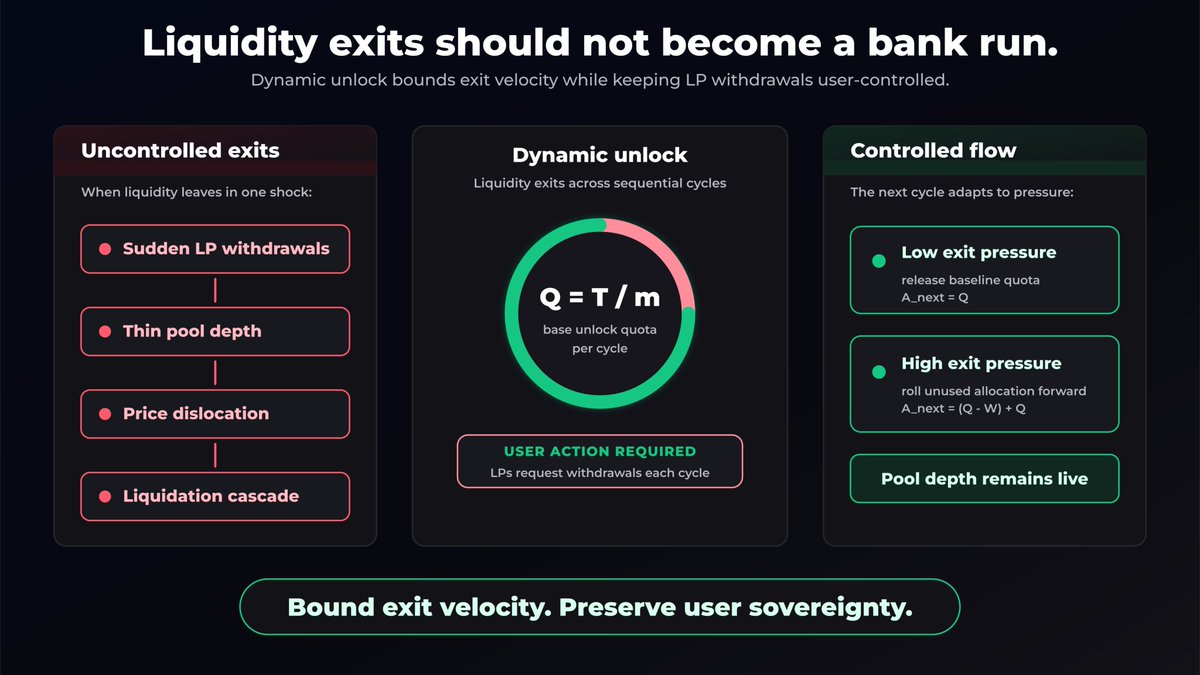
• LPs still choose to exit — the protocol bounds exit velocity, not ownership
Liquidity protection by mechanism.
The hidden risk in DeFi isn't just bad debt.
It's everyone pulling liquidity at once.
Likwid's dynamic unlock turns LP exits into controlled flow: withdrawals happen over cycles, and high exit pressure rolls unused quota forward so pool depth doesn't vanish in one shock.
#DeFi #RiskManagement #Liquidity
$2M swapped into $14K. Not a hack — a routing bug + a backrun bot.
A victim's trade dumped ~1,117 ETH into a thin AVAIL/WETH pool, buying AVAIL at ~120× its real price. A same-block backrunner sold a sliver of AVAIL back in, drained ~1,072 WETH — and paid most of it to the block builder.
On LIKWID, this class of MEV is priced out by design 🧵👇
1. Root cause: fragmented, low-liquidity side pools.
A router can shove size into a thin pool and eat catastrophic slippage. That self-inflicted mispricing is free money — the backrunner just sells the asset back in at the real price and walks off with the WETH.
2. Likwid puts spot + leverage in ONE native pool per token.
No thin side-pool to route into. No oracle to lag or manipulate — price comes straight from reserves, and borrowed size stays "on the books" as mirror reserves, so lending can't fake the quote.
3. The killer: dynamic fees scale cubically with how hard you shove the price.
• ≤10% move → 0.3% base
• 20% → ~8×
• ~70%+ → capped at 99%
A trade that yanks price 120× would hit the 99% cap. The backrun's arb margin evaporates — predatory MEV becomes too expensive to bother.
4. The takeaway from this $2M loss: slippage + MEV aren't edge cases. They're structural.
Likwid taxes the exact behavior that makes these attacks profitable — at the pool level, no oracle required.
👉 https://t.co/p3vsC8TEJC
#DeFi #MEV
😱 How Did $2M End Up Swapped Into Just $14K?
This was a real, highly imbalanced backrunner arbitrage, not a classic sandwich attack. Titan Builder captured the majority of the value from this incident, but not by "directly taking ETH from the victim's address." Instead, it was extracted by a searcher/backrunner.
During the victim's transaction, the routing contract selected a low-liquidity AVAIL/WETH pool. Due to an oversight, the user purchased AVAIL at a severely inflated price, resulting in significant losses. Later in the same block, the backrunner sold a small amount of externally sourced AVAIL back into the pool, extracting approximately 1,072 WETH, and paid approximately 1,018 ETH to Titan Builder as a builder payment.
The user ultimately spent approximately 1,126.4409 ETH but received only approximately 5,775.66 LIT:
▪︎ 1,116.8661 ETH -> 6,678,869.8333 AVAIL on Uniswap V3
▪︎ 5,877,385.7340 AVAIL -> 14,508.015161 USDC on Uniswap V3
▪︎ 14,508.015161 USDC -> 5,775.663051 LIT on Uniswap V4
The same-block arbitrage transaction first swapped 0.3942 WETH for 697.268911 USDT.
It then obtained 2,154.1720 AVAIL.
It then sold that small amount of AVAIL back into the AVAIL/WETH pool, extracting 1,072.4640 WETH.
It subsequently transferred 1,018.2518 ETH directly to Titan Builder (0x4838b1).
Root cause: When the victim bought AVAIL, the execution price was approximately 120× the price that could later be realized. This happened because the routing contract routed a large amount of WETH into a low-liquidity AVAIL/WETH pool, causing the victim to receive AVAIL executed at a severely inflated valuation before ultimately swapping it into LIT.
Backrun arbitrage: After the victim's mistaken trade, the pool contained a large amount of newly added WETH and AVAIL whose price had been artificially inflated. The backrunner only needed to source a very small amount of AVAIL elsewhere at its true market price to extract the WETH from the pool. Based on the arbitrage transaction, the bot incurred a cost of only about 0.3942 WETH, yet extracted a net inflow of 1,072.0698 WETH. This is a textbook case of same-block backrun extraction.
Most leverage blowups trace back to one thing: a price feed someone could push.
Likwid has no feed to push.
• Liquidations price off pool reserves, slippage-adjusted
• Dynamic fees scale cubically — a 20% push pays ~8x the base fee
• Truncated price kills single-block flash attacks
#DeFi #MEV #DeFiSecurity
This is the unlock:
Every new pair = a leveraged market, instantly.
Depth scales with the pool. Liquidation math accounts for real slippage, not a fragile feed.
Long-tail trading was always the missing leg of on-chain derivatives. Now it has one.
The moment a token has a pool, you can long it. Or short it. With leverage. Day one.
No oracle to integrate.
No order book to bootstrap.
No market maker to beg for liquidity.
Perp DEXs structurally can't list long-tail fast. Likwid can — price comes from the pool, not a feed.
#DeFi #Leverage #LongTail