Why Is the US Government Focusing on Harvard University?
The situation began in March 2025, when the US government, created a task force to investigate antisemitism (hostility toward Jewish people) on college campuses. Harvard was named as one of the top schools of concern.
The government said it believed Harvard wasn’t doing enough to protect Jewish students during protests related to the Israel-Gaza conflict.
There are also concerns that some international students, especially those from China, could be involved in activities that threaten U.S. national security. These concerns include fears about espionage, technology theft, or ties to foreign governments.
Then, in April 2025, the Department of Homeland Security (DHS) sent a letter asking Harvard to share detailed information about its international students, including:
Academic records
Disciplinary issues
Video footage of protests on campus
Social media activity
Harvard responded but did not provide everything the government asked for, saying it would violate student privacy laws and freedom of speech protections.
In response to Harvard’s refusal
- The government froze about $2.2 billion in research grants and $60 million in contracts
-On May 22, 2025, the DHS revoked Harvard’s certification to enroll new international students. This affects about 25% of Harvard’s student body
-The State Department is reviewing visas for anyone connected to Harvard including students, professors, and researchers. This includes looking into their social media and protest activities.
-Harvard filed a lawsuit on May 23, 2025, saying the government’s actions are illegal and violate the rights of the university and its students. A judge blocked the student ban temporarily, but the case is ongoing.
#HarvardUniversity @realDonaldTrump #Israel #Antisemitism #Harvard
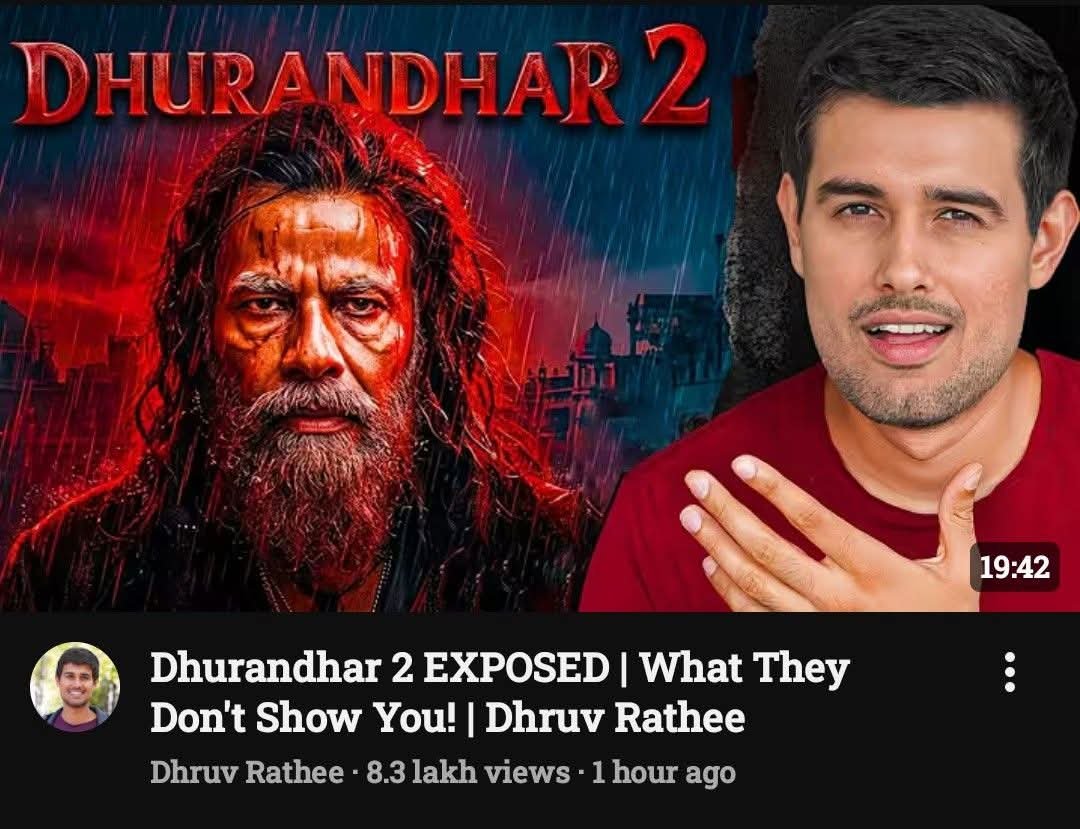
I was watching Dhruv Rathee's latest video while having dinner, and honestly, I was laughing throughout. He kept quoting what seemed like factually incorrect claims, apparently picked up from different social media platforms.
But there was one moment where things suddenly changed, and it genuinely made me think.
Throughout the video, while referring to Aditya Dhar and Narendra Modi, he used words like "uska" and "tu," which come across as casual or even disrespectful.
However, the moment he started talking about Atiq Ahmed and his brother, who were killed in an encounter, his tone shifted noticeably, and he began using words like "unke" and "unke liye," as if showing a certain level of respect.
Now, I understand that he may have strong disagreements with Dhar and Modi, but imagine showing more respect to a criminal who himself admitted to having links with the ISI.
At this point, it honestly feels like Dhruv Rathee isn't even trying to hide it anymore.
By Pranjal Malviya
Students go abroad purely by personal choice and for personal gain, not as part of any national duty or service to India.
If they are capable of leaving the country on their own terms, they are equally capable of returning on their own. Emergency evacuation is justified only when a conflict erupts suddenly and all exit routes are cut off. But when war clouds are gathering, transport is available, and the embassy repeatedly issues clear advisories to leave, and those advisories are ignored in the hope of a free, state-funded return, the responsibility lies squarely with the individuals, not the GoI.
The GoI should therefore stop rescuing those who wilfully ignore official advisories, because doing otherwise only entrenches entitlement and guarantees the same recklessness in future crises.
Sitting in India right now, watching the world burn in real time. US & Israel striking Iran. Iran retaliating across the Gulf. Russia-Ukraine still raging. Pakistan-Afghanistan tensions simmering.
Missiles flying over Tehran, Bahrain, Abu Dhabi, Qatar.
And here I am, safe at home on a Saturday evening, in a democratic, peaceful country, worrying about none of this at my doorstep.
We don't say this enough - we are incredibly lucky. Not perfect, not without problems. But at peace. That's not a small thing in 2026.
Amazon is laying off 14,000 employees, including in India, as AI takes over their roles.
The cruel part is how fragile private sector “stability” is. You get a job, start earning, feel settled, plan a future, buy a house on EMI, and one fine morning the company decides to “downsize”. Suddenly, you’re jobless. If a new job doesn’t come quickly, those EMIs can destroy your peace and your life.
And the govt! While you earn, you must pay taxes. The moment you lose your job, you’re on your own. Farmers get compensation when crops fail, despite many paying zero income tax, but a taxpayer losing his job gets practically nothing.
Maybe it's time to introduce reforms like make EMI pauses for few months more liberal for those who lose their jobs, and providing a time-bound monthly allowance for few months from the govt, except for disciplinary cases of course. Ladla/Ladlis can get free money, free ration, free water and electricity, so why not support a worker who has been paying taxes and contributing?
Diwali, Chakra Cleansing & the Power of Fire 🔥
This isn’t just about lights & sweets. It’s a cosmic opportunity to awaken your inner light.
Let’s dive into the Sanatan secrets of Deepavali and why this is the best time for spiritual reset 👇
Placed an order on Zomato!
Delivery person assigned!
His name was Arjun!
He came to the 11th floor to Deliver!
I said, “Thank you Arjun!”
He got the beautiful smile just because I named him! 😊😊😊
You don’t know where he’s struggling in his life, how well his day treating him but the small gestures can make anyone’s day! 😊😊😊
With all due credits to Indian origin CEOs for their ability to take people along and work hard, let me tell something about Indian media.
Many of them also are of the same colonial "psychophancy & servile" mindset. They apologize for the silence and inaction of these Indian origin CEOs and create excuses for them, so they can get interviews with them being in their good books.
Have any of these Indian media questioned these Indian origin CEOs, when they come on trips to India acting all humble - narrating their India struggles from hostels to h1b to drinking horlicks instead of proper meals - projecting themselves as one among the Indian masses, what they have done or contributed to India's and Indian interests apart from using it as a large market and cheap talent pool?
An American reporter will boldly ask hard hitting questions like "why are you silent on Trump's policies on visas which you too used" or "what is your take on the increased racism and xenophobia on your platform?" Indian media seldom does.
Many Indian reporters - not all as I know some real patriotic ones - will be massaging their egos, asking questions about cricket, and what they ate for their last meal in India laughing along like psychophants. I have seen it all to say this. Most Indians have.
Let's not build excuses for, say, their inaction in controlling hate against Indians on their platforms - which they earnestly do, even before being commanded, for say the Jews or the Chinese - who make up 0.1% of Indians as their market.
I have a hypothesis about why Indian CEOs are being selected in such large numbers by international boards.
Indian CEOs are, of course, smart, talented, and capable leaders. But plenty of Americans, Brits, Israelis, Europeans, Chinese, Japanese, and Koreans are too.
And it's not just about speaking English either, as some think, given immigrant Indians are chosen as being better than American or five eyes born native English speakers who are equal, or more in numbers in the western talent pool.
My theory is that they're chosen because they tend to be docile and servile along with all the great qualifications and qualities of a leader.
An Anglo-Saxon white, Chinese, or Israeli CEO might let their community's or birth country's interests creep in and interfere at some point. Or they will just be more brave and open about voicing their opinions and taking decisions which may affect shareholder value.
For example, in the recent H1B visa fee hike case, I saw so many Whites (including Elon), Jewish and Chinese Americans (including CEOs) openly come out against it and support hi-tech immigration, even directly support Indian immigrants.
Indian origin leaders, on the other hand, are a safe bet for keeping their mouths shut in silence. For instance, they haven't yet posted a single line condemning racial targeting, attacks, or killings of Indians, or speak out against H-1B visa policy changes that hurt their own community - or even their own company.
Indians, especially India born ones, can just be trusted to play it safe, focusing solely on their personal and company interests. In fact, they'll bend over backwards to serve their boards, companies, and the deep state, if any, dictating.
My hypothesis can be further proven by seeing that India born Indian origin leaders are picked for CEO jobs in US companies, and not many US born Indian Americans (not even close) who are as qualified with all the great credentials and just as good - if it is really the race or culture that makes good CEOs.
Because, even though they are Indians with similar achievements, qualifications from top schools, and capabilities, being born and brought up in the US, they tend to have a bit more of the independent American spirit and much less of the docility and spineless, servile attitude.
"H-1B NRIs will come back and build India now. Yay! Good news for India."
No! Doesn't work that way. Firstly, it will not create new jobs but only redistribute existing ones. And:
1. A sudden oversupply of talent would crowd the domestic job market, creating tougher competition, lowering salaries, slowing promotions, and even leaving many underemployed and unemployed.
2. Returnees with US exposure may demand leadership or high-value roles, clashing with existing hierarchies and sidelining Indian managers.
3. Salary structures would compress downward, reducing the bargaining power of local employees, who are already burdened by EMIs. Many locals will lose jobs and will struggle to cope.
4. Cities would face extra strain on housing, traffic, and healthcare, while returnees’ higher lifestyle expectations may cause dissatisfaction and social tension.
The key to India’s development is not in bringing NRIs back but in retaining homegrown talent and giving them space to innovate. With the current red tape, bureaucratic hurdles, lack of funding and corruption, even the brightest minds will struggle to create here.
Satyuga
Hiranyakashyap: If your Hari is everywhere, call him. Where is he now?
Kaliyuga:
Go and ask the deity itself to do something now.
Everyone knows what happens next when you challenge Shri Hari like that.
"Go and ask the deity itself to do something now. You say you are a staunch devotee of Lord Vishnu, so go and pray.”
These were the words of CJI BR Gavai to a petitioner seeking restoration of the 7-foot beheaded idol of Lord Vishnu at a temple in Khajuraho, that was mutilated during Mughal invasions and left that way ever since.
Such remarks are unacceptable. If the plea has no legal merit, just dismiss it. Say it cannot be allowed and close the matter. But mocking faith and deities is not the role of the Court.
And to be clear, this treatment is not uniform. Between Nov and Feb, a bench led by same Justice Gavai stayed the demolition of the Madni Mosque in Kushinagar, UP. Couldn’t he have told the petitioner in that case to pray for the mosque’s protection instead of directing the UP govt to halt demolition?
Courts are meant to uphold justice, not play preacher selectively.
Modi is not perfect, but he is far ahead of his predecessors and, in my view, the best prime minister India has had.
Most criticism of him is not about failures but about the expectations we place on him, shaped by what we see in developed nations, and that is fair. But India cannot transform into a superpower overnight, constrained by its vast population, democratic checks and balances, and the historic backlog of poverty and underdevelopment it inherited. Unlike China’s top-down model, every reform here must navigate states, coalitions, and social complexities.
Taxpayers’ aspirations in India are particularly high because they contribute more and get little, but it’s also a reality that democracy itself acts as a handicap. Elections are rarely won on vision or development; they are won on caste loyalties and freebies that appeal to the masses who care little about infrastructure, education, development, environment, or progress. Any govt, no matter how capable, is forced to dilute long-term reforms in order to survive short-term populism.
On top of that, real transformation requires decades of consistent effort in economic modernization, R&D, defense capacity, and global positioning, all of which no leader, not even Modi, can compress into a few years. What he can do, and is doing, is laying the groundwork for a stronger, more self-reliant India of the future.
Criticism must continue, it pushes things in a positive direction. But credit should also be given where it’s due. Happy birthday, Prime Minister Shri @narendramodi. May you continue to lead the nation for many more years.