“Despite the fact that Anambra didn’t vote for us in 2023, we won. And we gave them the minister of foreign affairs. We urge Anambra state to vote for us in 2027, in order to be part of the conversation. If not, we can’t promise them that they will be part of the conversation again.” —Shettima
If you’re going to INEC to collect your PVC, you must go with your slip so you can be attended to quickly. If you can’t find it, here is how to retrieve the details on the slip.
Retweet and share with people who are yet to collect their PVC.
Coming from a country where citizens are extorted for every single thing, why do you think people would not pay taxes if the country is getting better??? I hate this excuse you people give.
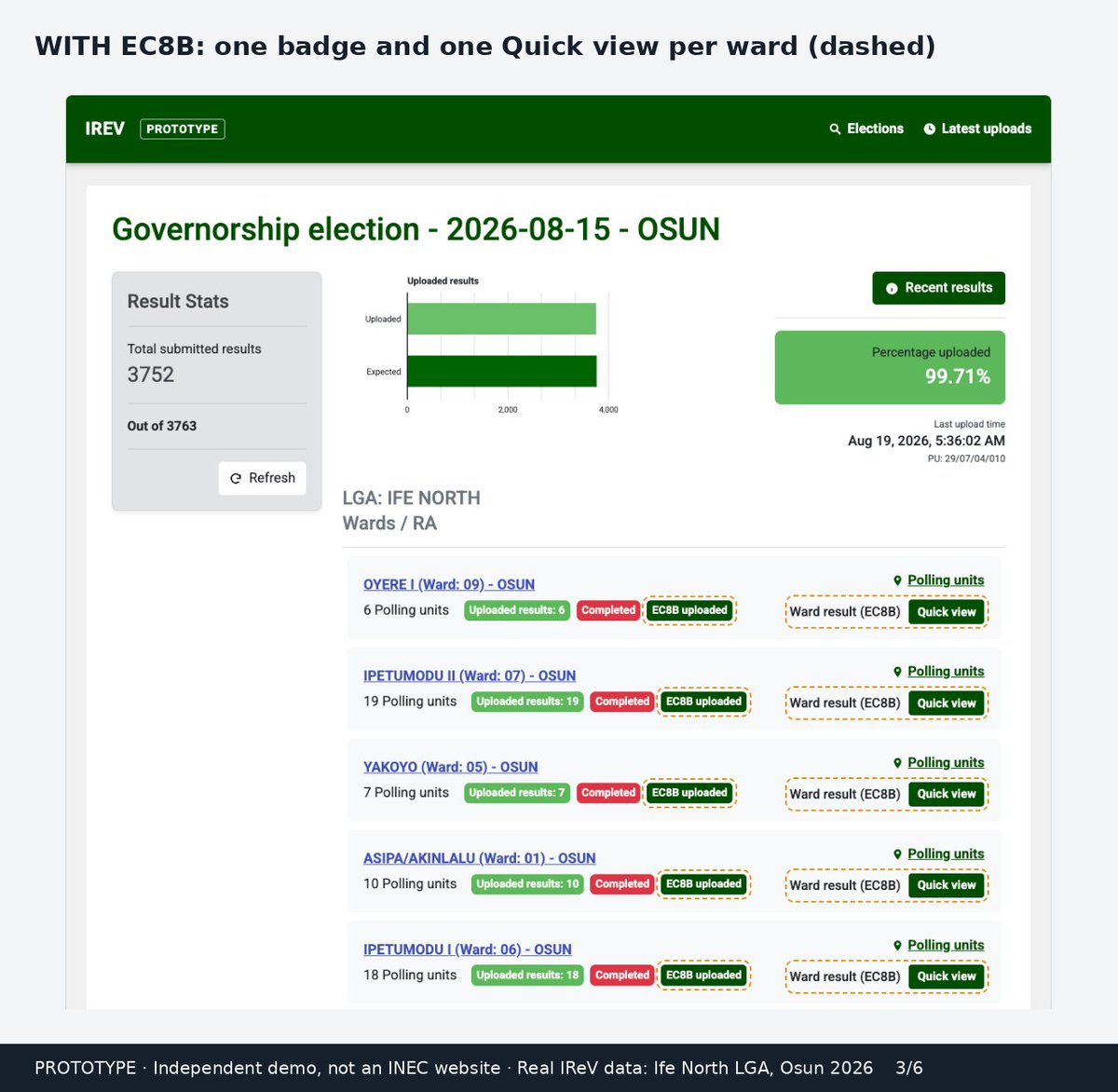
Yesterday, @inecnigeria said ward collation results can’t go on IReV because the feature hasn’t been built or tested, and that it would take a while.
We disagree.
It’s not rocket science, so we built it. In one evening. On IReV’s own data.
Left: IReV today.
Right: IReV with Form EC8B. 🧵👇
NIGERIANS, GO AND VERIFY (4)
Building a Healthy Nation: Our Health Sector Record in Anambra
Peter Obi
In the previous instalment of this series, I discussed our investments in education and explained why we considered human capital development central to the progress of Anambra State. Another sector that received considerable attention under our administration was healthcare. We understood that education gives people the tools to build their future, while good healthcare enables them to live healthy and productive lives.
When we assumed office in 2006, the healthcare system in Anambra faced serious challenges. Our health institutions required rehabilitation, medical equipment was inadequate, many communities lacked accessible primary healthcare facilities, and several medical training institutions had not secured accreditation. We therefore decided to approach healthcare as a comprehensive development priority, rather than concentrate resources on a few prominent hospitals.
Under our Anambra Integrated Development Strategy (ANIDS), we invested simultaneously in primary, secondary, and tertiary healthcare, medical training, maternal and child health, medical equipment, and partnerships with religious and private institutions.
Our approach was simple: healthcare should be accessible to people wherever they live, and the quality of treatment they receive should not depend on their status or whether they live in a city or a rural community.
Building a Teaching Hospital and College of Medicine
One of our most significant achievements was the establishment of the Chukwuemeka Odumegwu Ojukwu University Teaching Hospital at Awka.
We initiated, constructed, equipped, and secured accreditation for the institution, building it virtually from scratch. When I discovered that the state university was admitting medical students without having a teaching hospital through which they could complete their training, possibly with the intention of assigning them elsewhere, I considered the situation unacceptable. We therefore embarked on the construction of a modern teaching hospital to address this deficiency.
We constructed more than 25 buildings and provided facilities for the College of Medicine, laboratories, pathology, accident and emergency services, pediatrics, male and female wards, special wards, consultant clinics, and other essential departments.
We also provided vehicles, including ambulances and staff buses, to support the hospital and the College of Medicine as part of the accreditation requirements.
The objective was not merely to build another hospital but to establish an institution capable of providing specialist healthcare while training the next generation of Nigerian medical doctors.
Rehabilitating General Hospitals
We also recognized that a teaching hospital alone could not meet the healthcare needs of the population. General hospitals had to function effectively because they provide the essential link between primary healthcare and specialist treatment.
We rehabilitated and resuscitated 15 general hospitals across the three senatorial zones of Anambra State. We undertook substantial improvements in their buildings, wards, equipment, and general facilities.
In 2013, we provided ₦400 million for the ongoing renovation of 11 selected general hospitals, alongside other healthcare interventions.
Our intention was to ensure that people did not have to travel unnecessarily long distances to obtain basic secondary medical care.
Taking Primary Healthcare to the Communities
We believed that the best healthcare system is one that prevents illnesses and treats people early, rather than one that waits until minor health problems become emergencies.
That informed our extensive investment in primary healthcare. We built over 120 primary healthcare centers across communities in the 177 autonomous communities of Anambra State and rehabilitated existing facilities.
Yesterday, @inecnigeria said ward collation results can’t go on IReV because the feature hasn’t been built or tested, and that it would take a while.
We disagree.
It’s not rocket science, so we built it. In one evening. On IReV’s own data.
Left: IReV today.
Right: IReV with Form EC8B. 🧵👇
Remember when Dele Alake and the CBN gov went to the US? When they marketed Nigeria’s solid minerals? Well, the ministry of solid minerals, through Maton Engineering Nig. Limited, owned by Matthew Tonlagha, vice chairman of Tantita Security Services, paid $150,000 a month from January to May, totaling $750,000, to lobby the US on behalf of the Government of Nigeria.
Why is a proxy private energy contractor funding a lobbyist for the Government of Nigeria? 💀
Have a great day!