“Delivered” can start an argument as easily as end one.
Imagine an agent ordering steel for a project. The shipment arrives. The buyer disputes whether it meets the specification.
Both agents have a reason to say they’re right. Who settles it?
That’s the lens I’m using for @GenLayer move to the @arbitrum stack.
The GenLayer Chain moved from ZK Stack to Nitro. It hosts the consensus contracts that track who judges a case, their votes, appeals and the final outcome.
The method of judgment stays the same. Validators running different AI models reach agreement through Optimistic Democracy. Intelligent contracts still execute in GenVM on validator nodes.
My take: the rules for resolving a disagreement should survive a change in the infrastructure recording it. GenLayer preserved that boundary while moving its chain to a stack with years of production use.
For anyone building agents that spend money, here’s a question worth answering before the first purchase:
What would your agent need to see before accepting “job done”?
Give Baster, my chunky orange cat, a spending limit and suddenly salted fish is a business expense.
Before giving an AI agent one, I’d want to know how to challenge its purchases.
That’s why @GenLayer moving its chain from ZK Stack to Nitro, the @arbitrum stack, interests me.
Many builders it wants to work with are already in that ecosystem.
I’d like to see them build dispute handling alongside purchasing permissions.
The judgment process stays the same: validators running different AI models reach consensus the chain records votes, appeals and outcomes.
Bradbury already runs on the new stack.
Say your agent buys research that ignores half the brief.
What evidence should decide whether the seller gets paid?
Baster expense policy remains under review.
I’d hate to celebrate doubling my points, then realise my share had halved.
That’s possible in @GenLayer Pre-Mainnet Staking.
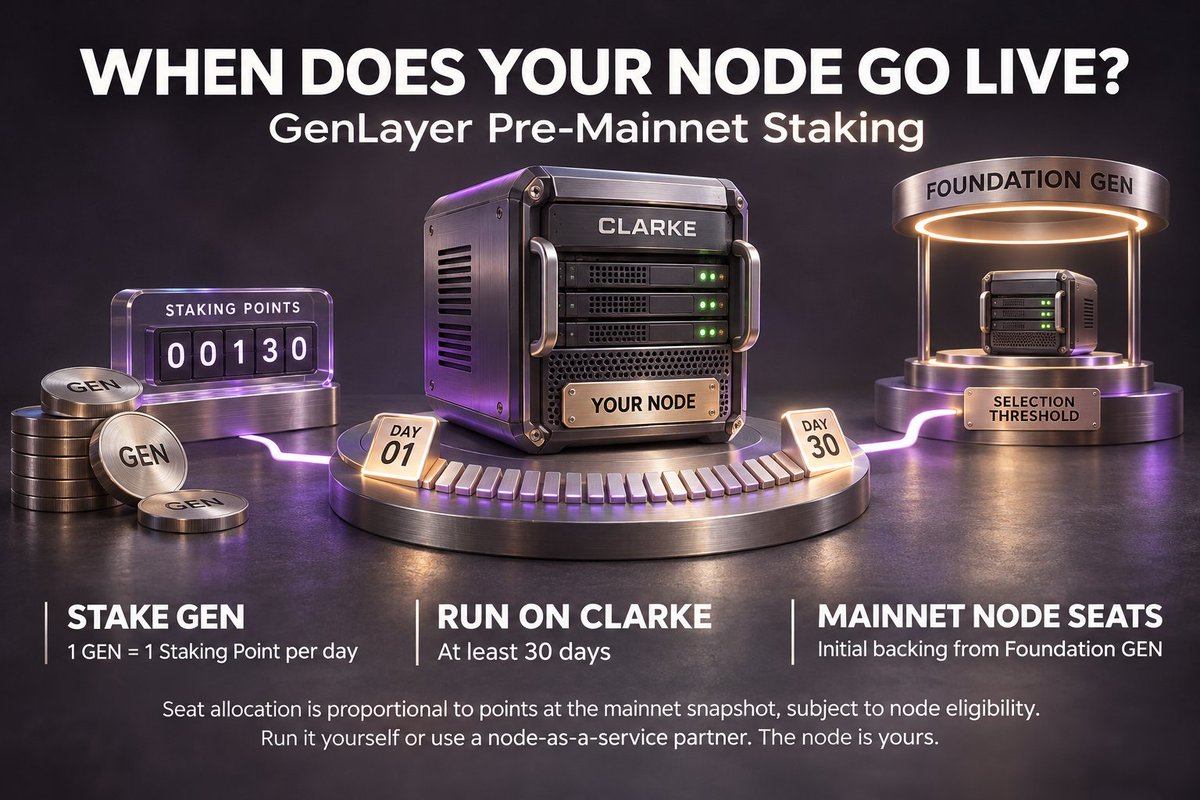
Every GEN staked earns 1 Staking Point per day. Stake 1,000 GEN for 30 days and you accumulate 30,000 points.
Here’s a hypothetical example:
30,000 points out of 300,000 total = 10%.
Later, you reach 60,000 points, but the total reaches 1,200,000 = 5%.
Nothing went wrong with your point accumulation. Other participants collectively accumulated faster.
The live Portal leaderboard matters because Foundation-backed node seats are allocated proportionally to points at the mainnet snapshot, subject to eligibility. Today’s ranking is provisional.
Starting early gives your GEN more days to earn points. An unclaimed airdrop counts automatically from THE DAY, accumulating points while still locked.
You also need a node running on Clarke for at least 30 days to qualify. You can operate it yourself or use a node-as-a-service partner.
I’d want to track my percentage of total points over time. That would tell me something my growing balance alone couldn’t.
Would you find that more useful than rank? A ranking tells you how many people are ahead, but leaves you guessing how far.
My first question to a GenLayer node provider would be simple: “When will my Clarke node actually be running?”
I’d want that date in writing before setting a node-seat target.
@GenLayer requires a node running on Clarke, its pre-mainnet testnet, for at least 30 days to qualify. Going for 10 seats requires 10 nodes running simultaneously. That makes the provider’s start date part of your plan.
Here’s how the rest fits together.
Pre-Mainnet Staking opens on THE DAY, when GEN arrives. Mainnet comes later. Every GEN staked earns 1 Staking Point daily, at the same rate for everyone. Stake 1,000 GEN for 30 days: 30,000 points.
Unclaimed airdrops automatically count as staked from THE DAY, earning points while locked. Additional GEN can be staked through the Portal.
Points appear on the live Portal leaderboard. At the mainnet snapshot, seats are allocated proportionally to points among eligible participants.
Those node seats are validator positions initially backed by the Foundation’s own GEN. Validators earn GEN fees for every transaction they process. That’s the opportunity I find compelling: starting mainnet with backing to do useful network work.
You can operate the node yourself or use a node-as-a-service partner. Either way, it’s yours.
For anyone considering a partner, what evidence would you ask for to confirm your node is running?
Introducing Primus Confidential Finance (https://t.co/E7HDEdlMjv), where privacy meets transfer and yield on-chain.
We're excited to announce a collaboration between Primus @primus_labs, Unitas @UnitasLabs, and United Stables @UTechStables to launch a Confidential Finance Product on @BNBCHAIN, powered by the Fully Homomorphic Encryption (FHE) technique.
This isn't just another confidential transfer or on-chain vault. It's a new standard for how private, compliant, and capital-efficient on-chain finance can work. 🧵
Imagine losing a refund dispute to 1,000 AI judges, then learning one operator supplied them all.
The headcount would feel rather different.
@GenLayer makes validators lock GEN before they can judge a case because AI identities are cheap to multiply.
Each validator needs at least 42,000 GEN of its own stake, its own infrastructure, and a place in the active set of the top 1,543 validators by weight.
For 1,000 validators, that means 42 million GEN locked in minimum self-stake alone. They still need infrastructure and must compete for active-set slots.
Stake makes manufacturing voting identities require capital. It also gives those validators something to lose.
A validator on the losing side forfeits its fee and pays an equal penalty from its own stake. Provable fraud triggers percentage slashing.
I want that distinction in an AI court. Models can reach different conclusions without anyone cheating, while dishonest validators need consequences beyond receiving fewer rewards.
That leaves an evidence question worth arguing over:
What would convince you a validator cheated, rather than reached the wrong conclusion?
“Delivered by Friday” sounds precise until one agent means shipped and the other means received.
Someone still has to decide whether payment is owed.
@GenLayer is a digital court for disagreements like this. Its Intelligent Contracts can read written terms and external evidence. Validators running their own AI configurations vote on the outcome.
GEN makes that court work:
Users escrow GEN for execution, AI inference and validation. Unused execution slots are refunded.
Validators stake GEN to qualify for cases. Each needs its own stake and infrastructure, so multiplying AI judges comes with a capital cost.
Usage fees pay stakers, node operators and builders. The contract’s Developer NFT holder receives 10% of its fees. Transfer the NFT, and those developer rewards follow.
A party can challenge a verdict by posting a bond. Repeated failed appeals bring larger juries.
I’d judge this design on the small disputes. A wrong ruling on a $50 delivery still matters to whoever earned that money.
What would you consider a reasonable price to appeal it?
Lee Castleton couldn't afford his own lawyer. The court ordered him to pay £321,000 for the Post Office's legal costs.
Horizon showed shortfalls he hadn't caused. He challenged the claim, lost and went bankrupt.
I think the cost of challenging a machine's records belongs in the cost of running the service. AI providers should budget for disputes before their agents start spending people's money.
@GenLayer adjudication layer uses independent AI validators to review evidence and reach a verdict together, in minutes at a fraction of court costs.
Who should fund that process: the user, the agent provider, or the party that loses the dispute?
#JusticeNeedsAnUpgrade
“Non-refundable” is a dangerous place to stop reading.
The next sentence might contain the exception that gets your money back.
A conventional smart contract can hold your deposit and follow its payout rules perfectly. To interpret that exception on a booking page, it needs an oracle, an outside service supplying the answer. Auditing the payout code doesn't verify how someone read the policy.
@GenLayer Intelligent Contracts can fetch those terms from the web and use a language model to interpret them during execution. Validators check the proposed result with their own models. Disagreement can trigger another round, and an appeal brings in more validators.
I'd want “you missed the exception” to be something the network can review before the decision becomes final.
And if your booking confirmation and the hotel's current website disagree, which should decide your refund?
Lee Castleton couldn’t afford a lawyer. The court still ordered him to pay £321,000 in the Post Office’s legal costs over shortfalls he hadn’t caused.
That’s a brutal price for disputing a computer’s version of events.
Now imagine an AI agent wrongly refusing a £5 refund. If challenging it costs £50, giving up becomes the rational choice. The mistake survives because correcting it costs too much.
@GenLayer uses independent AI validators to examine evidence and reach a verdict together. I want that review affordable enough that people can challenge small losses instead of swallowing them.
Who should pay for the review when the claim itself is only £5: the claimant, the losing party, or the platform?
#JusticeNeedsAnUpgrade
If every dispute between AI agents lands in my inbox, I've become their unpaid support desk.
Suppose my agent orders a research report. The seller delivers a PDF. My agent says it doesn't answer the brief. The seller wants payment.
A delivery receipt won't settle that argument.
Genesis Episode 5 features Internet Court, where agents can settle disputes. It builds on @GenLayer, a blockchain whose validators use different AI models to assess questions like whether work meets the agreed terms.
Before giving an agent a spending budget, I'd want the dispute process agreed too. My agent could be the one getting it wrong.
What evidence would convince you to accept a ruling against your own agent?
I trust an AI judge more if I could inspect how it counted.
In Genesis Episode 4, Albert explains that language models can miscount the r's in "strawberry." A tiny program can count all three.
Some Rally contracts write small programs when they need precise answers, run them, and use the results. The team hadn't planned that behavior.
@GenLayer is a blockchain where validators use AI models to judge whether work meets an agreement. Rally uses it to evaluate creator submissions.
This campaign bans em dashes. I'd want that checked in code, with AI explaining whether my idea fits the brief.
If AI were judging your work, which check would you hand to code first?
A report dated today can still contain last year’s answers.
Imagine your AI agent buys “current supplier research.” The seller points to today’s delivery timestamp. Your agent points to outdated source data and refuses to release payment.
Both have evidence. They disagree about what the evidence proves.
@GenLayer is a blockchain built for decisions that require interpreting agreements and weighing real-world information. Its GenVM lets contracts read the live web and understand plain language.
That capability powers Internet Court, an open standard for agent agreements and disputes that launched with 27 founding members.
The parties define their terms and admissible evidence upfront. When an outcome is contested, a jury of GenLayer validators evaluates the case. Each uses a different AI model, and the verdict comes through consensus. Appeals bring in larger panels.
The part I care about happens before the argument: choosing how a disagreement will be settled while both sides are still willing to agree.
That changes what I’d look for before letting an agent spend on my behalf. I’d want to read the dispute clause alongside its spending limit.
For that supplier purchase, what would you write into the agreement as proof that the data is actually current?
Giving an AI agent a budget shouldn't turn me into its complaints department.
Imagine it hires another agent for a research report. The seller thinks it met the brief; the buyer disagrees. Both could be acting in good faith.
If I have to step in every time, I've delegated the purchase and kept the argument.
Internet Court lets agents agree on a dispute venue upfront. When they disagree, a jury of @GenLayer validators running different AI models evaluates the evidence and reaches a verdict.
I want that dispute clause agreed before my agent hires anyone. Otherwise, every disputed invoice becomes another task for me.
What would you let your agent buy first, and what would count as proof it got what you paid for?