@Ofmooseandmen@GuardianBooks@thebookseller@PublishersAssoc @BookCornerHX Um, JUDY Starr, actually. And I would like to point out that I also have eleven 'O' levels, a green belt for judo, City & Guilds Handmade Fine Furniture and an honours degree. Just in case anyone thinks that's my only qualification.
New novel by Sharon Duggal on the way. Really looking forward to this as I absolutely loved her previous two novels Should We Fall Behind, and The Handsworth Times. Can:t wait. @MsSDuggal
12 years ago we published
BEASTINGS by Benjamin Myers.
Won the @ThePortico Prize and Northern Writers Award @NewWritingNorth
And the great folk behind TV worldwide phenomenon
ADOLESCENCE have optioned the book.
Watch this space.
@thebookseller
SIGNED BOOK NEWS!
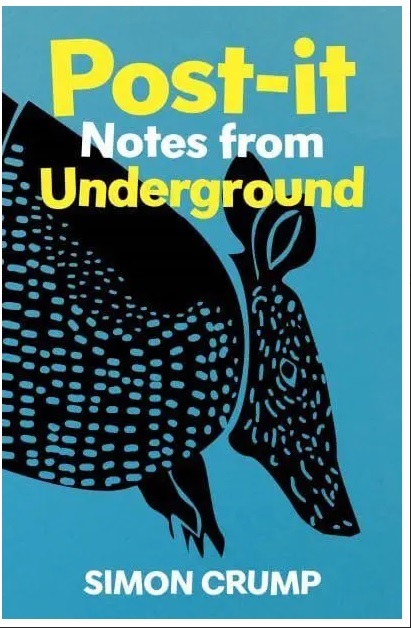
One of my favourite authors Simon Crump has a new book out next month.
"Post-It Notes from the Underground"
@Ofmooseandmen sent me an early copy & it's AMAZING.
Simon will be signing copies especially for us!
ORDER HERE!
https://t.co/1oVsB5bOVc
He was sent to a mental hospital three times and later became one of the world's top-selling authors. His most popular book has sold over 150 million copies and has been translated into more than 80 languages.
They tied him to a table and turned on the electricity. He was just a teenager whose only crime was wanting to be a writer instead of a lawyer. His panicked parents thought his creative mind was a sign of insanity and committed him to a psychiatric institution three times.
Yet, decades later, that same man sat down and wrote a book that would change the world in just fourteen days.
His name is Paulo Coelho, and his story proves that our harshest critics are often completely wrong about our future.
In 1988, Paulo poured his soul into a simple fable about a shepherd boy chasing a dream in the desert. He called it "The Alchemist." He knew it was special, but the publishing world didn't care.
The first publishing house to print the book watched it sit on the shelves gathering dust. Sales were so poor that they officially dropped it and gave him back the rights.
They told him the book was a complete failure. Anyone else would have given up right then. After all, the experts had spoken out. But Paulo had survived actual electroconvulsive therapy; he wasn't going to let a rejection letter stop him.
He firmly believed in the central message of his book, which states that when you want something, the universe conspires to help you.
He refused to give up. Paulo found a second publisher willing to give him a chance, and then something wonderful happened. It wasn't a resounding success due to a massive and expensive marketing campaign. The book grew slowly, almost whispering.
One person read it, felt a change in their heart, and passed it on to a friend. That friend passed it on to another.
Soon, that whisper turned into a roar.
The book traveled from the streets of Brazil to the entire world. Today, The Alchemist is one of the most successful books in human history. It has sold over 150 million copies and has been translated into more than 80 languages.
It sits on the desks of the most powerful world leaders and in the backpacks of penniless students.
If Paulo had listened to his parents, he would have spent his life as an unhappy lawyer. If he had listened to his first publisher, his masterpiece would have been lost forever. Instead, he chose to trust his inner voice.
He showed the world that the only true failure in life is refusing to begin the journey, or giving up the moment someone says no.
Your current difficulties are not a punishment. They are simply preparation for the wonderful things that await you along the way.
Keep moving forward, because the world is waiting for your story.
Israel yesterday kidnapped four women. Two are footballers in the Palestinian National Team.
Their names are: Natali Abu Dia and Rand Halwani.
Is it normal to kidnap footballers, @FIFAcom? Where are sports media organisations? This story should be the headline everywhere.
Good morning.
Today is the start of @BelfastBookFest
Unfortunately I won't be able to attend as I had an emergency eye operation yesterday.
All the best for the next few days and amongst some great authors will be.
@jamesgwriter and Rónán Hession.
Magic.
Lardy cake is a slab of enriched dough laminated with handfuls of lard, sugar, and dried fruit, folded and rolled and folded again, then baked until the lard caramelises through every layer and the bottom of the tin is a sticky golden mess.
It is the cake equivalent of a croissant invented in Wiltshire by farmers who had a pig and some flour and no time for nonsense.
Modern versions almost universally use butter or vegetable shortening instead of lard. Both are inferior. Lard has a higher melting point than butter, so it does not soak into the dough during baking the same way - it pockets, melts, and creates the distinct flaky pastry layer that defines a proper lardy cake.
Lardy cake is also one of the oldest British uses for pig fat, made the same way for at least three hundred years until the fat panic of the 1980s recast lard as poison. Bakers switched to butter or industrial shortening, the texture went flat, and a cheap farmhouse treat became a sad imitation of itself.
The recipe:
- 500g strong white flour.
- 7g instant yeast.
- 1 teaspoon salt.
- 300ml warm milk.
- 200g pure lard, kept cold.
- 150g caster sugar.
- 200g mixed dried fruit (currants, raisins, sultanas).
- A pinch of mixed spice.
Mix the flour, yeast, salt, and milk into a soft dough. Knead 8 minutes. Rise covered for an hour.
Roll into a long rectangle. Dot a third of the lard, sugar, fruit, and spice over two-thirds of the dough. Fold like a letter. Turn 90 degrees.
Repeat twice more.
Press into a greased deep tin. Rise 45 minutes.
Bake at 200C for 30 to 35 minutes.
Turn out upside down so all the caramelised lard runs back into the cake.
The bottom will be sticky. The top will be flaky. The smell will fill the house.
A wedge of this with a strong cup of tea was the Wiltshire farmer's three o'clock break. We have a Pret protein ball.
@SamaHoole Oooh! In the early 60s my friends and I used to hitch-hike from Bournemouth to Southampton on Saturdays to get the best lardy cake in the area. I think I'll give your recipe a try.
We're celebrating our 20th birthday together with @leedslibraries at @LeedsLit
On Saturday 13th June, 1pm at Leeds Central Library
Do come along if you can.
https://t.co/Mf9S6idANR
There is a legend about how the world found coffee, and it begins with a goat.
Picture a hillside in the Ethiopian highlands, somewhere around the ninth century, dawn coming up over the forest where the wild coffee shrub had been quietly growing since long before anyone thought to give it a name. A goatherd, remembered as Kaldi, watches his flock wander in among the glossy green bushes and start working through the little red cherries. And then his goats, ordinarily content to chew and doze, refuse point blank to settle. They skip. They butt. They dance about the slope at an hour when every sensible animal should be drowsing, lit up with the unmistakable glow of something that has just changed its mind about the morning.
Kaldi, the story goes, tried the cherries himself, felt the same bright lift rise through him, and somewhere in that moment the most consequential beverage in human history opened one eye.
It is almost certainly a tidy tale. Nobody wrote it down until 1671, a thousand years too late to check, and the goatherd may never have drawn breath. But it has outlasted a dozen drier accounts for one simple reason. It sounds exactly right. A goat is the most fearless investigator of the edible world that nature ever produced. If there was a bush of stimulant berries glowing red on an Ethiopian hillside, a goat absolutely found it first, ate it without a flicker of hesitation, and stood there gently vibrating on the slope until somebody wandered over to ask what in the world had got into the goats.
And what the goat found, humans took and carried to the ends of the earth. The first people to use it crushed the berries and bound them with animal fat into a dense little ball of fuel, food for a long walk before it was ever a drink. Then the Sufi mystics of Yemen learned to roast and steep it, and drank it through the long nights to hold themselves awake and clear at their prayers, and from those quiet monastery cups it spread. To Mocha and Cairo and Damascus. To the coffee houses of Constantinople and London where empires were argued into being over the rim of a cup. To the espresso bar, the campfire tin, the chipped office mug, the flask carried out into the cold. Billions of cups a day, every one of them descended from a curious animal on a hill who simply could not be told.
Half of what our species knows about which plants will heal us, feed us, or wake us up, we learned by watching the animals get there first and taking notes. The goat has been our scout for ten thousand years, eating the untested world on our behalf and reporting back through sheer enthusiasm.
So tomorrow morning, before the day takes you, lift the first cup an inch off the table toward a hillside in Ethiopia and the small, greedy, fearless creature standing on it.
It found this for you. It very probably found it first.