Peter Thiel just said America’s deficit era is ending.
His argument: once interest rates stopped being zero, the West’s model of big welfare states, already-high taxes, and large deficits stopped being sustainable.
There are only three choices left.
1. Massively cut spending
3. Massively hike taxes
3. Keep kicking the can down the road
For close to 20 years, the answer has been #3. Ever since the 2008 crisis, we’ve just been borrowing more and more money.
The result is a fiscal trap that arithmetic, not ideology, is now closing.
Think exploding interest costs crowding out everything else. Trust funds running down. No slack left for the next shock. A country that used cheap money to delay every hard choice.
The numbers already show the can is getting heavier:
> FY2026 deficit already $1.4 trillion through 9 months and on track for $2T or more
> Total federal debt around $40T, roughly 123% of GDP
> Annual interest now over $1T
Then he added the part people usually skip:
“My intuition is we’re close to the point where that ends, and then you’re going to be pushed to a very non-centrist solution of either socialist levels of taxation or some really tough austerity measures.”
Zero rates made centrism look possible. Higher rates make it look like delay.
It seems America’s real fiscal problem may not be starting the spending.
It’s refusing to admit the cheap-money version of kicking the can has an expiration date.
Ben Affleck talks about the origin of InterPositive, the AI company he founded in 2022, which Netflix later bought for $587M in cash.
Affleck saw early OpenAI demos, called Matt Damon, and said they had to shoot every movie they could -Hollywood was finished.
The panic ended when he realized the researchers were brilliant at models and blank on how a shot is lit, framed, and cut.
That gap became InterPositive. Netflix bought it in March 2026 for $587M.
Ben Affleck:
- Obsesses with AI while Hollywood panics
- Knows more about it than 99% of AI influencers
- Says “AI won’t replace filmmakers”
- Builds AI to automate VFX, continuity, cleanup, and post-production (not creativity)
- Netflix pays $587M for Ben Affleck’s AI startup InterPositive in cash
Absolute legend.
Ben Affleck:
- Obsesses with AI while Hollywood panics
- Knows more about it than 99% of AI influencers
- Says “AI won’t replace filmmakers”
- Builds AI to automate VFX, continuity, cleanup, and post-production (not creativity)
- Netflix pays $587M for Ben Affleck’s AI startup InterPositive in cash
Absolute legend.
In case you missed it, Ben Affleck just laid out how he actually builds production-grade video AI:
He fine-tunes open models by unfreezing weights and training only the last cinematic layer, after shooting his own controlled-stage dataset for months so the foundation isn’t built on other filmmakers’ work.
Each new film then trains a private model on its own dailies - the production keeps the footage and the learning.
That’s the product Netflix bought (InterPositive) for $587 million.
“Craftsmanship is knowing how to work. Art is knowing when to stop.”
After the full talk, it’s clear Affleck treats AI as a controllable post-production tool with ownership baked in, not a prompt-to-movie machine.
Affleck knows the craft.
Jensen Huang says the first thing you should do when deploying an AI agent is to take away all of its rights.
His argument: agents get broad access by default, the way trusted employees do. The result is tools, files, networks, or the internet they were never meant to reach.
He put it plainly:
Job number one is to take away all of its rights.
Then you give access to files, data, tools, the network, or the internet only if it needs it.
You don’t put an agent into your company and give it access to everything.
“We don’t give that to people. We don’t give that to any level of executive. We have to apply the same philosophy to AI agents. That’s what OpenShell is: a force field around the agent, provisioning rights, responsibilities, and access.”
Turns out, the real problem may not be getting agents to act.
It’s refusing to give them more authority than the people they work for.
In case you missed it, Ben Affleck just laid out how he actually builds production-grade video AI:
He fine-tunes open models by unfreezing weights and training only the last cinematic layer, after shooting his own controlled-stage dataset for months so the foundation isn’t built on other filmmakers’ work.
Each new film then trains a private model on its own dailies - the production keeps the footage and the learning.
That’s the product Netflix bought (InterPositive) for $587 million.
“Craftsmanship is knowing how to work. Art is knowing when to stop.”
After the full talk, it’s clear Affleck treats AI as a controllable post-production tool with ownership baked in, not a prompt-to-movie machine.
Affleck knows the craft.
Elon Musk just said America can win software and still lose superintelligence.
His argument: the West still leads on models, talent, and anything purely digital. That lead disappears if the other side can turn on far more watts and far more chips.
Models follow power. Chips follow fabs. Output follows both.
There are only three things that actually matter at the limit.
1. Scale electricity generation
2. Scale logic and memory fabrication in a secure region
3. Keep treating permits and process as the binding constraint
For years the default has been #3. Software progress looked like it could outrun the physical stack. Higher intelligence per watt made the gap feel smaller than it was.
The result is a power trap that arithmetic, not ideology, is now closing.
Think data-center queues measured in years. Interconnection backlogs. A competitor adding generation capacity at a multiple of the U.S. rate. A country that used its software edge to delay the harder industrial choices.
The numbers already show the gap:
> China's electricity demand is roughly 10,500 TWh vs. about 4,500 TWh in the United States
> U.S. average power consumption around 500 gigawatts
> Every additional 5 gigawatts is about 1% of U.S. power use
Then he added the part people usually skip:
“I would bet anyone that a 1% increase in power usage corresponds to roughly a 1% increase in GDP. Because the intelligence per watt keeps increasing.”
Software leadership made centrism on energy look possible. The watt gap makes it look like a delay.
It seems America’s real superintelligence problem may not be starting the models.
It’s refusing to admit that winning the digital layer still requires building the power plant first.
The age of remote video interviews is officially over.
The woman in this video is a real-time-generated AI agent.
In-person, on-site hiring is the only way to go now.
In case you missed it, Ben Affleck just laid out how he actually builds production-grade video AI:
He fine-tunes open models by unfreezing weights and training only the last cinematic layer, after shooting his own controlled-stage dataset for months so the foundation isn’t built on other filmmakers’ work.
Each new film then trains a private model on its own dailies - the production keeps the footage and the learning.
That’s the product Netflix bought (InterPositive) for $587 million.
“Craftsmanship is knowing how to work. Art is knowing when to stop.”
After the full talk, it’s clear Affleck treats AI as a controllable post-production tool with ownership baked in, not a prompt-to-movie machine.
Affleck knows the craft.
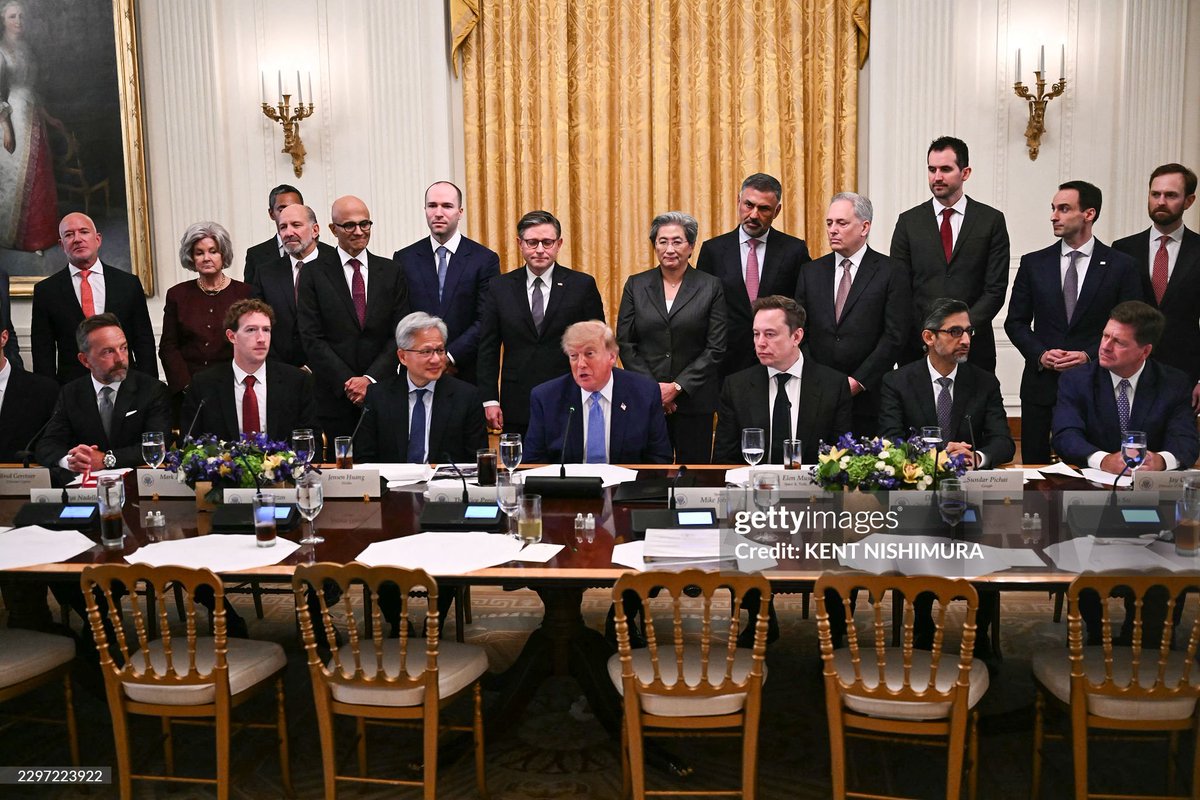
This is the AI version of the Last Supper.
$10 trillion+ in combined public market cap around one table - Nvidia, Microsoft, Meta, Google, Amazon, Tesla/SpaceXAI, AMD, Palantir, and the frontier labs all in the same room.
Seating charts have never been investment research, but proximity to the president might be the alpha signal hiding in plain sight.
Surprisingly, Apple was the only tech giant missing from the White House Super Intelligence Luncheon.
Maybe John is too busy Ternus-ing the company around.
@the_real_inpoh on the surface of this, it makes sense I guess.
but more important question is what the numbers are and how sustainable they are.
i.e. you can be spending $3 for every $1 in revenue, but how long can it last?
Billionaire investor Bill Ackman says an AI bubble forms when fear of missing the future pulls more and more capital into the same trade until prices detach from reality.
His argument: technological shifts attract capital faster than judgment. In venture, that shows up as competition to get in early, preempted rounds, and valuations that jump before a company has even raised on purpose.
He put it plainly:
“There’s a lot of people fearing missing out on the future. And so a lot of capital going into venture, a lot of competition, and a lot of preempting. And it’s leading to very high valuations.”
You don’t need widespread fraud for the dynamic to work. Investors race to commit before the next investor does, companies get funded at multiples that assume the outcome has already arrived, and the process feeds itself.
Turns out, the real problem may not be whether the technology is real.
It’s that the capital chasing it has stopped waiting to find out.