This ad broke every rule of advertising and became one of the most successful campaigns ever printed.
1948. New York Times.
6,540 words. No offer at the top. No urgency. No price. No proof stack. Nothing that any modern marketer would sign off on.
One insertion pulled around 10,000 replies.
Not because it was long.
Because every single word answered a question people were already asking.
The length was not a flaw. It was the filter.
Watch the 40 seconds. Then tell me in the comments what you would cut from it.
Because I have a suspicion that most of what we call optimisation today is just removing the parts that were doing the work.
⚡ TILLY BOOSTED ON DEXSCREENER ⚡
More eyes → more holders → more volume.
Smash the 🚀🔥 under the chart — it's free and it pushes us up the board.
CGmBrG4GRiMvFSGaEiB7cwEd9uDYiqrXzkoyR2Qa3KrC
The man who wrote it was Louis Engel at Merrill Lynch.
His problem was never awareness. Everyone knew Wall Street existed. The problem was that ordinary people were scared of it and too embarrassed to say they did not understand it.
Every competitor was selling stocks.
He sold understanding instead.
Same principle runs every ad that works today. Find the question your market is already carrying around silently, then answer it better than anyone else is willing to.
This ad broke every rule of advertising and became one of the most successful campaigns ever printed.
1948. New York Times.
6,540 words. No offer at the top. No urgency. No price. No proof stack. Nothing that any modern marketer would sign off on.
One insertion pulled around 10,000 replies.
Not because it was long.
Because every single word answered a question people were already asking.
The length was not a flaw. It was the filter.
Watch the 40 seconds. Then tell me in the comments what you would cut from it.
Because I have a suspicion that most of what we call optimisation today is just removing the parts that were doing the work.
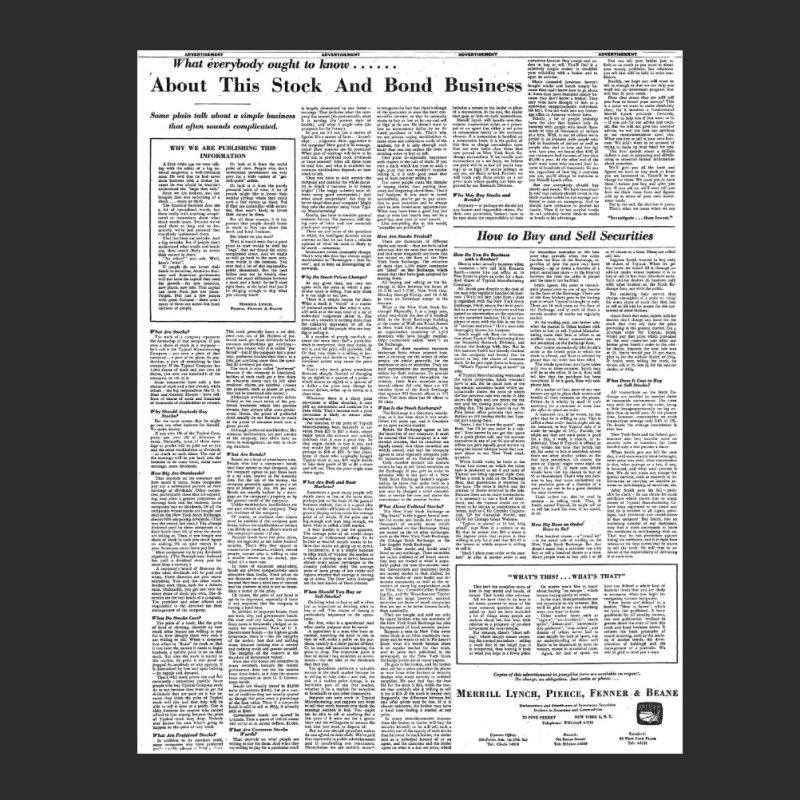
This is the actual page.
6,540 words. One newspaper. No targeting, no pixel, no retargeting, no lookalike audiences.
Merrill Lynch, Pierce, Fenner and Beane. October 1948.
Look at how much of it is explanation and how little of it is selling. The offer is a single line near the bottom.
Most brands today would not run this. Too long, too plain, no hook, no urgency, no proof stack.
It outperformed almost everything that came after it.
Bookmark this one. Next time someone tells you attention spans died, this page is the counterargument.
In 1948 a man broke every rule of advertising and accidentally built the most effective lead gen campaign of the century.
No offer at the top.
No urgency.
No price.
Just 6,540 words of plain explanation in the New York Times.
Louis Engel worked at Merrill Lynch. His problem was not awareness. Everyone knew Wall Street existed. The problem was that ordinary people were afraid of it and too embarrassed to admit they did not understand it.
Every competitor was selling stocks.
He decided to sell understanding.
The headline was not clever:
"What Everybody Ought to Know About This Stock and Bond Business"
Underneath it, no persuasion. Just questions real people were already asking, answered in language a factory worker could follow.
What is a stock.
What is a bond.
How do you actually buy one.
Then the part most marketers still get wrong today.
At the very bottom, buried under thousands of words, sat one quiet line offering a free booklet version of the ad. No pressure. No deadline. Just an address.
A single insertion pulled around 10,000 replies.
The ad kept running for years and became one of the most reprinted pieces of advertising ever written.
Here is what actually happened, in performance terms.
He did not chase attention. He answered demand that already existed. The questions in that ad were the questions people were already carrying around silently.
He qualified before he sold. Nobody reads 6,540 words about bonds by accident. Every person who reached the coupon had self selected into being a real prospect. The length was not a flaw. It was the filter.
He inverted the funnel. Instead of interest leading to information, information created interest. By the time you reached the offer, you were not being convinced. You were already convinced and simply needed the next step.
He removed the risk from the response. Free. No obligation. Write or call. The smallest possible commitment at the exact moment the desire peaked.
Now translate that to 2026.
Nothing changed except the format.
Long is not the enemy. Irrelevant is.
People will watch a 12 minute video, read a 3,000 word page and sit through 40 slides if the content is answering a question they were already asking.
They will skip a 6 second ad that answers a question nobody asked.
The most expensive mistake in performance marketing is not a bad creative.
It is a good creative pointed at demand that does not exist.
Engel understood that in 1948, in a newspaper, with no targeting, no pixel and no data.
The tools got better.
The principle never moved.
Find the question people are already asking. Answer it better than anyone else is willing to. Then make the next step almost free to take.
That is the whole campaign.
Bookmark the post above — you'll need the steps in that order.
And if you've ever bought something because of a single line: quote it with that line. I want to see what actually moves people, not what marketers think moves them.
I haven't written a hook from scratch in years.
I retrieve them.
Because a hook isn't a sentence you invent — it's a demand that already exists, written down by strangers who thought nobody was reading.
The difference in practice:
Guessing → you write 10 hooks, 1 works, you don't know why.
Reverse-engineering → you find 10 hooks that already worked, and you know exactly which tension made them work.
Same output count. Completely different odds.
The chain I run, in order:
1 — What's already surviving
Meta Ads Library. PiPiAds. SimilarWeb.
Not to copy creative.
To find ads that have been live for months. Longevity isn't luck. It's a spend-verified angle.
2 — Where the demand already sits
Google Keyword Planner.
Not a keyword tool. A demand detector.
Volume = people who already care. Nobody has to be convinced.
3 — What already got clicked
YouTube titles that rank.
That's a headline test somebody else already paid for. Free results.
4 — How the market actually talks
Amazon reviews. Facebook groups. Reddit. Comments under authority blogs.
Pull the raw text, run it through a word-frequency tool. What comes back is the customer's vocabulary — not the brand's.
That gap is where most ad copy dies. Brands write "supports energy metabolism."
Customers write "I'm tired by 2pm and I don't know why."
One of those is a hook. The other is a label.
5 — What's hot right now
Groups, forums, authority blogs. What changed this month.
A correct hook delivered six months late is a wrong hook.
Then it gets built:
demand → intent → hook → AIDA → pattern interrupt → retention → conversion
Two things most people get backwards:
The hook is not the intro. It's the targeting.
The first line decides who stays.
Broad line = cheap views, expensive silence. Specific line = fewer people stop, but the algorithm learns from buyers instead of tourists. That's the difference between a spike and a scale.
You test hooks, not videos.
Same body, 10 openers. Mistake angle. Wasted-money angle.
Timeline angle. Contradiction. Insider. Too-late. Rotate the first frame, the colors, the pacing — keep everything else identical.
Otherwise you're not testing, you're guessing with extra steps.
None of this is creativity.
It's retrieval.
Every hook you need is already sitting in a search bar, a review section and a comment thread — written by the exact person you're trying to reach.