I built an AI-governance coach you can ask in plain English — text or voice. Grounded only in a tested, cited 290-page corpus, zero-retention, and it refuses to say “you're compliant.” Meet the Coach:
https://t.co/JpYDE6YPqh
#AIGovernance#CISO
Directors do not need a forty-page report to oversee AI.
They need to know what the organization found, what it is doing about it, who owns each action, and when they will hear next. That fits on one page.
This week in the CISO Learning Journey I look at the Board Memo: one page, in the CEO's voice, with two parts. What we found. What we are doing. Each action names its owner, and the page carries the same identifier as the detailed risk report behind it.
Delaware law has long expected directors to make a good-faith effort to oversee risks critical to the business. For a growing number of organizations, AI is one of them. A one-page memo, and one sentence in the minutes that references it, is how a board shows it saw the risk and asked for the next update.
Is AI on the agenda for your next board meeting?
#AIGovernance #BoardOfDirectors #CISO #CorporateGovernance #RiskManagement
Directors do not need a forty-page report to oversee AI.
They need to know what the organization found, what it is doing about it, who owns each action, and when they will hear next. That fits on one page.
This week in the CISO Learning Journey I look at the Board Memo: one page, in the CEO's voice, with two parts. What we found. What we are doing. Each action names its owner, and the page carries the same identifier as the detailed risk report behind it.
Delaware law has long expected directors to make a good-faith effort to oversee risks critical to the business. For a growing number of organizations, AI is one of them. A one-page memo, and one sentence in the minutes that references it, is how a board shows it saw the risk and asked for the next update.
Is AI on the agenda for your next board meeting?
https://t.co/iTjyNolKRB
#AIGovernance #BoardOfDirectors #CISO #CorporateGovernance #RiskManagement
@SRKDAN@OutFrontCNN I agree. Detection and containment have to run at the same speed as the attack, with people setting the policy and reviewing the decisions afterward.
@OutFrontCNN The number that stands out to me is the gap. 14 minutes to complete the attack and 4.5 hours to identify it. Phishing-resistant MFA, short-lived sessions and automated containment that acts at machine speed are how defenders close that gap.
@hopscotch1q@AC360 That works best when the off switch is designed in from the start, with clear authority over who can use it and regular tests that it works.
@AC360 This is a conversation worth having in public. The practical work is available to us today. Keep people accountable for the decisions, record what AI systems do, and test the controls before they are needed. Governance is how we keep both the benefits and the oversight.
Eight ideas I expect the next Leadership Dozen to sharpen, for anyone deciding how far to trust an AI system with real work. Swipe through, then read the full post:
https://t.co/VOpPUQff56
Which of the eight would you put in front of your board first?
#Leadership#AIGovernance #FoundersReadingNotes
I finished the twelve books in the Leadership Dozen, and the next twelve are on the shelf.
The first dozen was about evidence: someone had the uncomfortable fact, and an institution chose the comfortable account. Reading them, I kept noticing that the failure started earlier. Before evidence can show whether a system is working, someone has already decided what success means, what gets measured, and which consequences count.
That is the subject of the next twelve. They include a history of how automated sorting came to replace deliberation, the fall of a regime every dashboard called stable, a con man whose testimony was trusted because it closed cases, the sabotage of a strategic pipeline, the economics of ransomware, and two stories of organizations built well, chosen on purpose so the lessons are about building as well as catching.
For chief executives, CISOs and boards, the thread through all twelve is the same: the choices made before any evidence exists decide what an organization is able to see. I will read each one with three questions. What did the organization optimize for? What did that make invisible? What decision would I change in a business I am building?
The next twelve: https://t.co/VOpPUQeHfy
If you missed the original list, here it is: https://t.co/u0hUqrTGoM
If you have read any of these, which would you hand a board first?
#Leadership #AIGovernance #ExecutiveReading #FoundersReadingNotes #IntelligenceEra
In September I shared a reading list I called the Leadership Dozen: twelve books I chose for leaders in the intelligence era, and a promise to read every one and write down what they taught.
I have now finished all twelve, and the reading notes are complete.
Only one of the twelve is about AI on its face. The rest are about trust, power, institutions and what people do when the evidence is inconvenient. That was the point. If AI is moving from answering questions to taking actions, the lessons that matter most are older than the technology.
The book that stayed with me most was When the Heavens Went on Sale by Ashlee Vance. A few founders asked why satellites and rockets had to be so expensive, built small and cheap, and let the launch pad grade the work. It is the best description I have read of what founders building with AI face now.
The rest of the shelf taught the other half of the lesson. In almost every failure, someone had the uncomfortable fact, and the institution chose the comfortable account.
The notes include ten lessons, the four books I would hand a board first, eight early signals that show a problem while it is still small, and an evidence test any leader can take into a meeting about an AI deployment.
The reading notes: https://t.co/NNUE6Jo4Xq
If you missed the original list, here it is: https://t.co/u0hUqrUeek
If you have read any of the twelve, which one would you hand a board first?
#Leadership #AIGovernance #ExecutiveReading #FoundersReadingNotes #IntelligenceEra
4 p.m.: vision like thick gauze.
9:50 a.m. next day: electric blues and startling clarity.
My first 18 hours after cataract surgery—what I saw, felt and wish I’d known. 👁️
https://t.co/Flcrgh27rD
Your organization is already using AI. Can you actually prove how you govern it?
Some AI tools were formally approved. Others arrived embedded inside software you already own. Still others were adopted by employees without anyone ever documenting them.
Now imagine your board, auditor, or insurer asks:
"How are you governing all this AI, and where is the evidence?"
What would you show them?
To help answer that question, I created a new SanctumShield overview—available as a three-minute video and a slide-by-slide walkthrough—showing how organizations move from AI uncertainty to documented decisions and independently verifiable evidence.
What you’ll discover inside:
🔹 Watching, blocking, and deciding are different. AI monitoring, security enforcement, and governance serve distinct purposes—and produce very different records.
🔹 Shadow AI has two faces. Employees using undocumented tools, and autonomous agents holding access nobody explicitly authorized.
🔹 One guided assessment. Four governance documents. SanctumShield generates an Executive Risk Report, an AI Acceptable Use Policy, a Board Memo, and an AI Posture Summary.
🔹 Three assessment depths. Choose Light, Standard, or Complete—each produces the same four documents tailored to the level of detail you need.
🔹 Independently verifiable evidence. Every document includes a Verification URL, letting third parties confirm its creation date without exposing confidential contents.
🔹 A practical first 30 days. A structured path to establishing your governance baseline, with nothing to install.
Explore the overview:
🎬 Watch the 3-minute video: https://t.co/8jl9CtToEv
📖 Read the slide-by-slide walkthrough: https://t.co/otB71x1NvS
Connecting Organizational & Individual Accountability
Effective AI governance isn't just an inventory of tools; it's knowing who is accountable, what was decided, and what evidence backs it up. That’s why SanctumShield and SanctumShield Academy work together to answer two essential questions:
SanctumShield: What did the organization decide, and where is the record?
SanctumShield Academy: What did each person learn, and where is the evidence?
If AI governance appeared on your next board agenda, what would your board ask to see first?
#AIGovernance #ShadowAI #CISO #EUAIAct #RiskManagement
Remembering Brian Tracy (1944–2026): Ten Lessons That Stayed With Me
Brian Tracy passed away on November 12, 2026, at the age of 82.
I read many of Brian’s books and listened to many of his tapes over the years. His ideas about personal responsibility, lifelong learning, goal setting, discipline, and helping others have stayed with me throughout my career.
My sincere condolences and sympathy go to his family, friends, and everyone who had the privilege of knowing him personally.
Here are ten of my favorite Brian Tracy quotes of all time:
1. “If you have to eat two frogs, eat the ugliest one first.”
— Eat That Frog!
2. “Everything is learnable, and what others have learned, you can learn as well.”
— Eat That Frog!
3. “A clear vision, backed by definite plans, gives you a tremendous feeling of confidence and personal power.”
— Goals!
4. “If what you are doing is not moving you towards your goals, then it’s moving you away from your goals.”
— Goals!
5. “Any goal can be achieved if you break it down into enough small parts.”
— Time Management
6. “The fact is that you cannot save time; you can only spend it differently.”
— No Excuses!
7. “It doesn’t matter where you are coming from. All that matters is where you are going.”
— Maximum Achievement
8. “The more credit you give away, the more will come back to you.”
— Maximum Achievement
9. “Always choose the future over the past.”
— Create Your Own Future
10. “People buy products and services because they feel they will be better off as a result.”
— The Psychology of Selling
For me, the greatest tribute to a teacher is to put what they taught into practice.
I did not want to read these ideas and then forget them. Brian taught that everything is learnable and that any goal can be reached if you break it into small enough parts, so I have tried to put that into practice.
I built tools that help people encourage and appreciate one another, as my way of paying forward what he taught me. iAppreciateYou and Lantern Post both come from that belief.
https://t.co/ATUViDSgSW
https://t.co/zxXMhiCSqy
He taught millions of people that success can be learned.
Rest in peace, Brian, and thank you.
#BrianTracy #Leadership #PersonalDevelopment #LifelongLearning #Gratitude
Two of the failures in this primer are ours.
Not anonymised. Not framed as "a client we worked with." Ours — the product, the team, the decisions we made and then measured our way out of.
We included them because a primer that only lists other people's mistakes is not worth reading. You already know the category is full of advice written by people who have never shipped anything into it.
What else is in the piece:
→ On unbranded category questions in our September 2026 measurement, engines recommended us in 0 of 200 recorded answers — while branded retrievability sat at 100% across the same four engines. That gap is the whole problem in two numbers.
→ Every category answer in that sweep was assembled from "best tools" roundup pages. Not one came from a vendor's own product page.
→ The Princeton GEO study associated adding statistics with roughly a 41% citation-visibility lift — which is either encouraging or a little embarrassing depending on how long you've been ignoring it.
→ Ahrefs found brand mentions correlated with AI mentions at rho 0.664, against 0.218 for backlinks. The thing you've been optimising for is the weaker signal.
The free self-checks are in there too — no tool required, nothing to sign up for. Run them on your own site this afternoon.
(We make one of the tools in this space, so you should read us with that in mind.)
https://t.co/ipSvJ6UV0n
Every website gets questions it never hears.
A visitor arrives with something specific to ask. Do you offer weekend appointments? Does this plan include support? Is this the right course for my team? When the answer is hard to find, many people simply leave.
Today I am pleased to introduce Poise Website Coach, an AI voice and chat agent for any website.
Here is how it works. You enter your website address. Poise reads your pages (up to 50, respecting robots.txt) and builds a coach that knows your products, services, policies and brand voice. You add one line of code to your site, and every visitor can hold a button and ask a question by voice, or type it, and get a clear answer in seconds.
What makes it different is how much care goes into trust:
• Answers come only from your own website, with a link to the page each answer came from. • When your site doesn't cover something, the coach says so and points visitors to your contact page. • It is private by design. Audio is sent only while the button is held, nothing is recorded or stored, and every interaction carries a signed "no audio retained" attestation. • Visitors need no account, and it speaks English, with Spanish and German available. • Your dashboard shows what visitors ask most and what your site doesn't yet answer. That second list is a ready-made guide to improving your content.
It works with WordPress, Wix, Squarespace, Shopify and plain HTML, and it suits law firms, clinics, online shops, nonprofits, software companies, restaurants and almost any business with a website.
Website Coach joins Poise Frontline Coach, the push-to-talk coach that helps restaurant, café, wine bar and retail teams answer any question about their own menu, policies and procedures.
You can try both live right now, including a real website the coach has already read: https://t.co/fskrKPvakR
I would welcome your thoughts, and I would be glad to hear which questions your own visitors ask most.
#AI #WebsiteMarketing #SmallBusiness #CustomerExperience #VoiceAI #PrivacyByDesign
Today I took the Board & CEO role test in the SanctumShield Academy and passed with distinction. I believe whoever builds a course should be able to pass it, and to show a record that anyone can check.
Since February 2, 2025, Article 4 of the EU AI Act has asked organizations that provide or use AI to take measures for the AI literacy of their people. For a board, the practical question is simple. If a regulator, auditor or insurer asked tomorrow, what record would we hand them?
The Academy gives each role its own reading path, an AI Tutor and a role test, and a dated credential on passing:
• Board and CEO: 9 modules in about an hour, on oversight, due care and the board's place in AI risk. • CISO and Security Leader: the full 20-module program, from shadow AI to agent incident response. • CTO, CIO and IT: 14 modules on tooling, agents, deployment gates and observability. • Legal and Compliance: 13 modules on applicability, frameworks, effective human oversight and litigation readiness. • Employee Essentials: 7 modules in about 30 to 40 minutes, for everyone who uses AI at work.
Every credential has a public verification link with a SHA-256 fingerprint, so an employer, auditor or board can confirm it in seconds. This is mine: https://t.co/JzKlta0ihC
It is a record of knowledge shown in a timed, randomized examination. That is the kind of dated, role-specific record that helps an organization show the measures it took.
If your board or team is working through AI literacy, you can see every role path here: https://t.co/xw2deD2Xm7
#AIGovernance #AILiteracy #EUAIAct #BoardGovernance #CISO
I will be exhibiting at KC AI Expo 2026, hosted by the Kansas City AI Club, on Tuesday, November 10th from 4 to 8 PM at The Mint in Lenexa.
At the PIGENAI table, we will be showing live demos of fourteen exciting and innovative AI apps, each one built to help a specific group of people with a real problem:
AI for businesses that want to be found and recommended by AI answer engines (AEO Analyzers)
AI governance and AI literacy for leaders and teams (SanctumShield and SanctumShield Academy)
AI voice coaches and website experts for frontline and retail teams (Beyond Poise)
Scheduling and marketing for small and mobile businesses (BookMobile and AdFlash)
Stock and macro investing research (AI Stock Assist and Macro Lens)
Learning for schools, drone pilots and families (Quiz Showdown, Checkride107, NeoAesop and HeroicVerse)
Creativity and connection (CharacterCanvas and Lantern Post)
The idea behind all of them is simple. AI should make you smarter, not think for you.
If you are in the Kansas City area, I would enjoy meeting you. Please stop by the table, try any of the apps on your phone, and tell me what you are working on.
See the live demos now: https://t.co/RrrXMzbnVg
Tickets: https://t.co/QT24QLkhYc
#KCAIExpo #KansasCityAI #AI
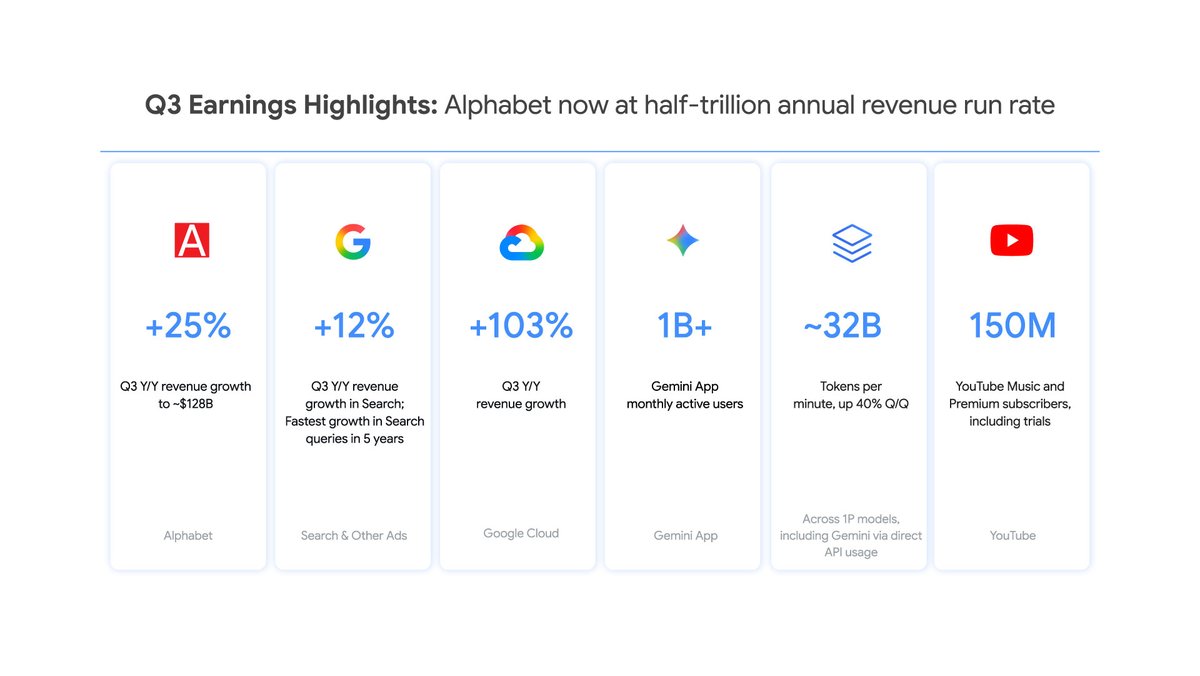
Q3 is in the books! We’re now on a half-trillion annual revenue run rate, with Alphabet revenues growing at 25%.
- Our AI investments are driving overall Search query growth, including commercial queries - our YoY query growth rate is the highest it’s been in the last five years.
- Google Cloud revenue grew 103%, powered by extraordinary demand for our AI infrastructure and AI solutions. Our 1P model APIs now process nearly 32B tokens/min (up 40% QoQ).
- Strong momentum in model progress with Argon and Carbon leading the frontier, and Genie 4 our most advanced new world model yet.
Thanks to our partners and employees around the world. More to share on the call soon!