📊 In September, U.S. manufacturing posted its ninth straight month of expansion. New orders accelerated. Employment grew for a third consecutive month. Backlogs built up to their strongest reading in months. For a sector that spent much of 2024 and early 2025 in contraction, that is a huge shift.
So why are purchasing executives sounding more cautious than ever?
https://t.co/nvs0Ah1yZG
A manufacturing startup founder told me yesterday they raised $2M to
“revolutionize the factory floor with AI.”
I looked at what they built.
It’s basically a dashboard, some machine data piped into the cloud, 3 OpenAI API calls, and a database.
They’re burning tens of thousands a month on cloud compute to tell a plant manager what an experienced supervisor can see walking the floor.
Meanwhile, a $200 edge computer, MTConnect, a properly structured database, and a few deterministic rules could solve 90% of the problem.
Manufacturing doesn’t need more AI wrappers.
It needs infrastructure that actually understands machines, tooling, quality, downtime, labor, capacity, and flow.
We’re not short on AI.
We’re short on people building systems that understand the factory.
@ShopData360 When the next owner didn't come up through the floor, the systems have to carry what tribal knowledge used to. Gross margin without process clarity is a fragile way to run a shop.
@GB_Drone@RadioFreeTom Seen the same on boutique A&D work. One late special process and the whole kit stops. Buffer where the supply base is thin, not where the textbook says WIP is waste.
@BoldXIndustries I've lived this exact nightmare - it's late the day it arrives and the downstream operations feel all the heat on schedule. The handoff package is the real lead-time driver, not the spindle time.
@zachglabman Agree. After 15 years at A&D primes I now work with small shops facing close or sale. Biggest gap I see is undocumented process knowledge.
This article captures well what I saw & caused me to leave my successful corporate job and go to the lower tiers and build lasting value to keep American manufacturing strong.
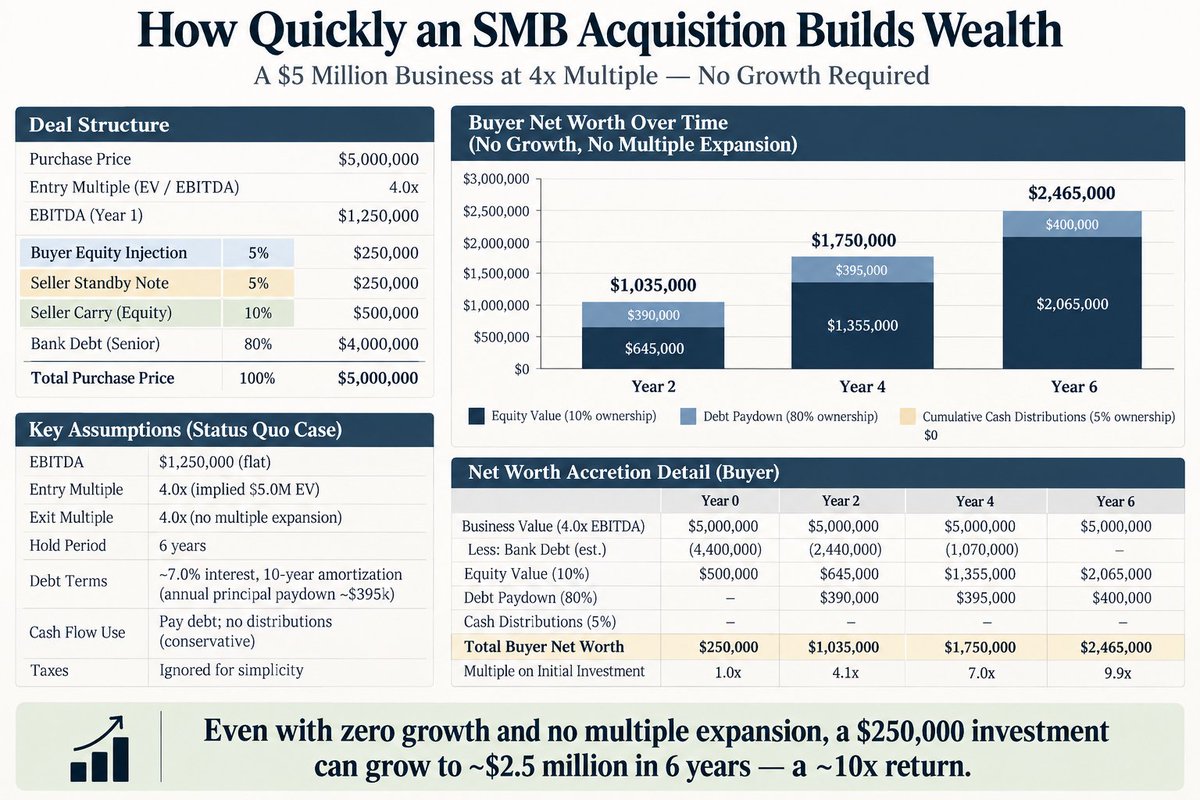
Despite all the headaches, THIS is why buying a business has become so popular:
> Even with ZERO growth, a fairly standard SMB acquisition can create millions of dollars of net worth for the buyer in just a few years.
You don’t need to double revenue, expand margins or rely on multiple expansion.
The basic math is simple:
Buy a good business. Keep it alive. Maintain the earnings. Use the cash flow to service and pay down the acquisition debt.
Every dollar of principal you pay down becomes another dollar of equity.
So a buyer can put in a few hundred thousand dollars, simply maintain the status quo, and end up with millions of dollars of equity several years later.
That’s the magic of acquisition entrepreneurship.
The execution risk is very real. But there are very few places where the potential wealth creation relative to the initial equity investment looks anything like this.
After 15+ years in aerospace and defense engineering, ops, & business leadership I kept seeing great shops worth less than they should be, because too much ran through the owner.
So I started LineShift Partners.
I help owners of manufacturing businesses see what a buyer would discount, and fix it.
@RandBusiness One option is partnering with trade schools for a pipeline. Another interesting route is an ESOP in which you offer equity to attract the best talent on the growth upside
Manufacturing X People - coming up on 1.5 years of publishing this list of makers. This is the September 2026 Update
100+ real ppl on X building stuff that matters
Opt in by commenting what you do
RT appreciated. 🇺🇸💪🏭
@ManufacturingMg@ValensPC The indirect cost would go into overhead and therefore allocated across all products, but knowing which one's require it and how they contribute to the margin is important.
Rogue Fitness just announced the near completion of their newly expanded US manufacturing facility for squat racks, barbells, and more in Columbus, Ohio.
This puts their factory size at over 1,000,000 sq. ft. and the ability to process up to 250K lbs of steel per day.
This makes Rogue the largest single-site strength equipment manufacturer in the United States.
The most interesting part, though, is that Rogue is owned 100% by Bill & Caity Henniger who started it out of their garage.