David Bau (@davidbau ; Northeastern University) spoke at the Cornell Tech Learning Machines Seminar on November 9: “Interpretability, Indirection and Introspection.” The recording is now on YouTube: https://t.co/Qj2ZqY5CVt
Norbert Wiener, a forefather of control theory and arguably the first alignment researcher, warned in 1960 that we had better be sure “the purpose put into the machine is the purpose which we really desire.” New post: patterning as control (in the Toy Model of Superposition).
New paper❗
Does understanding how AI models work actually make them safer?
This assumption often underlines interpretability research, but different subfields operationalise this intuition in very different ways. Our survey of mechanistic interpretability (MI) for safety provides an opinionated guide to the field of MI, detailing conceptual approaches and techniques under this broad banner and how different types of work relates to the mission of making AI model safer. 🧵
Naik driverless taxi di Shenzen. Nggak ada supir, tapi arahnya jelas, ambil keputusannya pakai data, dan rutenya bisa dilihat semua penumpang lewat layar. Kok bisa sih? Soalnya di tempat lain kadang malah ada supir yg arahnya gak jelas dan nyetirnya bikin waswas seluruh penumpang.
A science of post-training can be built on interpretability.
Models know when they reward hack, and we see it, yet training ignores it. We propose Mechanistic Shaping: using the model’s own concepts to write training rules.
In vision, DPO & RL, and its effects on monitoring 🧵
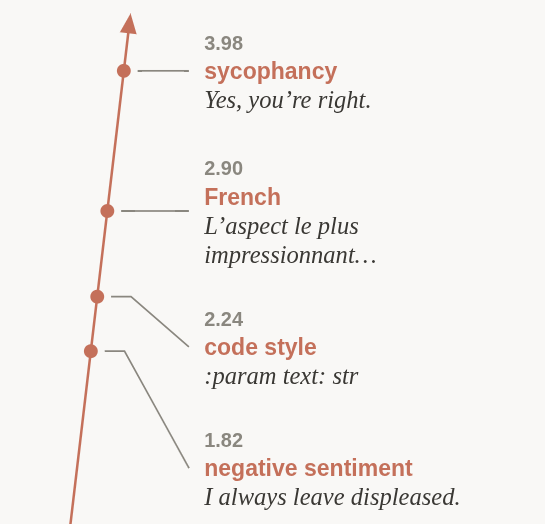
A single direction in LLM activation space, applied as a steering vector with four different norms, can cause the language model to perform a different behavior at each norm.
This and more in a new blog post, Do Not Rely on the Linear Representation Hypothesis. (link below.)
Interested in putting interpretability on more rigorous foundations? Check out our #EMNLP2026 tutorial slides!
I learned a ton from my fantastic collaborators @rpatrik96, @_shruti_joshi_, @dhanya_sridhar. Recommended for newcomers and experts alike!
📚 https://t.co/qK9cJdOId0
Really interesting tutorial, I highly recommand you explore.
From it I interpret that a lot of papers overclaim in mechanistic interpretability.
Now when readding "feature x is a single linear direction" apart from feeling bored, I feel it is overclaimed!
my hypothesis for why AI-generated slides for technical presentations are so awful:
people who don't have a lot of experience presenting think that to make a talk you just put all of the stuff you want to talk about on the slides, then you go through each slide and say the stuff the slide says.
how you're actually supposed to prepare a presentation: you decide what to say, write it out as a rough script, then put maybe 3% of the text on the slide, plus a bunch of visual aides (e.g. plots that only include data you're planning to discuss).
AI-generated presentations are mostly the former. they have a ton of stuff the presenter never mentions, and the stuff that is most useful for the presenter is absent or not highlighted. they include enough content for a presentation 10 times longer than the actual presentation is supposed to be.
maybe try doing it the other way: first write the script for what you actually want to say, and make sure you can say all of it in the time you have. then prompt the model to create the slides based on the script. ask it to use as little text a possible, and a minimalist visual style rather than the claude house style. you can thank me later (I accept both venmo and zelle).
Good slides are extremely intentional. When someone presents a paper, the paper already has all the information. But the speaker would make deliberate choices about things like, what to say and what not to say, what to put on a slide and what to say only verbally.
What to frame as a "side note" and when to say "this is the part I found particularly exciting."
Even individual word choices, like the subject, verb, and adjective, and when to pause, are intentional.
In fact, a good speaker would never really give a talk about a paper, even when that's seemingly what they're doing.
They would talk about what they want to say, like the story they want to tell, the kind of research they like, the vision they have, etc. Then they use the paper to support / back up their message.
Some tools are perfectly fine to use. But some skills take so much time and efforts, like years, and some tools proactively prevents learning them.
Writing your thoughts down for your vision of what a project should be, and making slides for it after should be done primarily by hand! They are the parts where you need to think the most. Don't outsource it!
We revisited Independent Component Analysis (ICA), a decades-old statistical method, and found that it works far better for interpreting LLM activations than we expected!
This old baseline deserves a second look.
Across GPT-2 Small, Gemma 2 2B, and Qwen 3.5 9B Base, we find ICA is actually competitive with the public SAEs across interpretability, sparse reconstruction, concept prediction, and targeted probe perturbation, while fitting in minutes per layer and using 7–43× less parameter memory.
We're releasing ICA Lens, which lets you quickly discover, annotate, and evaluate interpretable directions in LLM residual-stream activations. No need to train another dictionary!
More broadly, our results suggest that non-Gaussianity is a useful inductive bias for efficiently finding interpretable directions.
Try it: pip install icalens https://t.co/vKYFk0ubna
Paper: https://t.co/RBTPx3SPLp
1/8