This work adds to the mounting evidence that we can use our understanding of LMs to improve them. This relates to recent work from @GoodfireAI (on mechanistic shaping) and @RunjinChen (on persona vectors), who (post-)train models using concept vectors.
https://t.co/lc3nQFl5a7
We cut through the mystery around interpretability in training.
A single, mathematically rigorous framework transforms model internals into training feedback and works across domains, problems, and modalities.
We call this *mechanistic shaping*, and we’ve used it to mitigate reward hacking, remove shortcuts in chest x-rays, and reduce sycophancy and harmfulness. We believe this is a big step forward for technical alignment.
But it carries a known risk: training against a model’s internals can make it harder to monitor. We explore both the technique and this concern below. 🧵
Language models should be less confident when an input is ambiguous. We derive ambiguity vectors, and use them to improve confidence estimation in language models. We can also use them to encode these improvements into the model weights!
New work led by @themistoklisnk!
LLMs are highly overconfident, even when they don’t know something. We used interpretability to improve LLM confidence estimates!
We propose DART, which uses ambiguity steering vectors to guide fine-tuning, improving calibration across 7 models while preserving accuracy.
🧵
A clever trick @themistoklisnk devised was to make the regularization strength dependent on the confidence of the model! The more confident, the more it’s penalized for moving outside the ambiguity space. This helps us prevent *under*confidence, and results in big improvements!
Come be my colleague at BU CS! We’re hiring in AI, broadly construed. Apply by Dec. 1 for full consideration:
https://t.co/pSHnP8T2z3
We’ve intentionally built a strong community of language, analysis, and ML researchers over the last few years. Looking forward to growing it!
Do LMs possess genuine introspection? Are they performing anomaly detection? Or causally bypassing signals they are introspecting on? Our new preprint sheds some light on this by studying LM introspection on signals like MLP neuron activation
https://t.co/7hu8qEyVOx
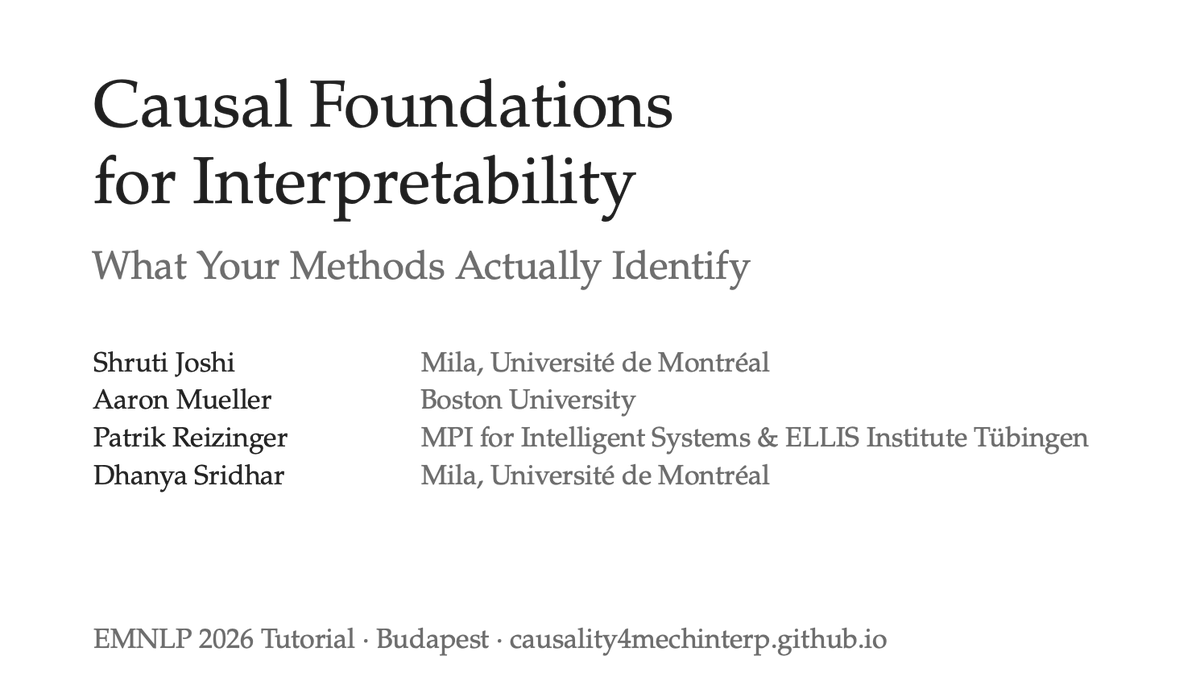
Interested in putting interpretability on more rigorous foundations? Check out our #EMNLP2026 tutorial slides!
I learned a ton from my fantastic collaborators @rpatrik96, @_shruti_joshi_, @dhanya_sridhar. Recommended for newcomers and experts alike!
📚 https://t.co/qK9cJdOId0
Tomorrow at 9:10am, I'll be talking about two case studies of "How LLMs Read" @BlackboxNLP. What exactly do I mean by "reading"? Come to P3 tomorrow morning and find out! :)
I'm at #EMNLP2026 in Budapest! 🇭🇺
Come check out the cool work from our students, and come find me at the tutorials and workshops! More details and pretty posters for each paper below: 🧵
Is it possible that LLMs can represent biases without verbalizing them? Using steering vectors, we find evidence from QA and hiring task settings that this is possible. Do chat with Keren online!
Congrats to those with accepted NeurIPS papers! If you have work on vision-language modeling or egocentric learning, consider submitting your paper to the BabyVLM Workshop fast track by Sep. 27 AoE (end of the weekend).
See the website for more details: https://t.co/P0YlIJ3ee3
New paper! 🫡
We introduce Matryoshka Attribution, a new attribution method which uses gradient descent to find which parts of a neural network are responsible for a behaviour.
MAttr is #1 on the Mechanistic Interpretability Benchmark by a wide margin (2.9× the runner up).
**new paper: Superposition in Brains**
What if Barlow was wrong? In his neuron doctrine (1972), he suggested to search for the 'trigger features' of each neuron to understand cortex. But what if that is the wrong coordinate system to understand neural representations?
https://t.co/76FlXCKmUA
Take a break from reading up on Navier-Stokes drama and add October 29th to your calendar, as we have a stellar lineup of speakers at this years' BlackboxNLP!
Submit to BabyVLM @NeurIPSConf : https://t.co/kSoN7iqA1I
We welcome work on: 🧠 Sample-efficient learning 👀 Vision + language 🌍 Grounded learning 👶 Developmental learning 📏 Human-inspired evaluation 🤖 Learning from limited data
📅 Deadline: August 31
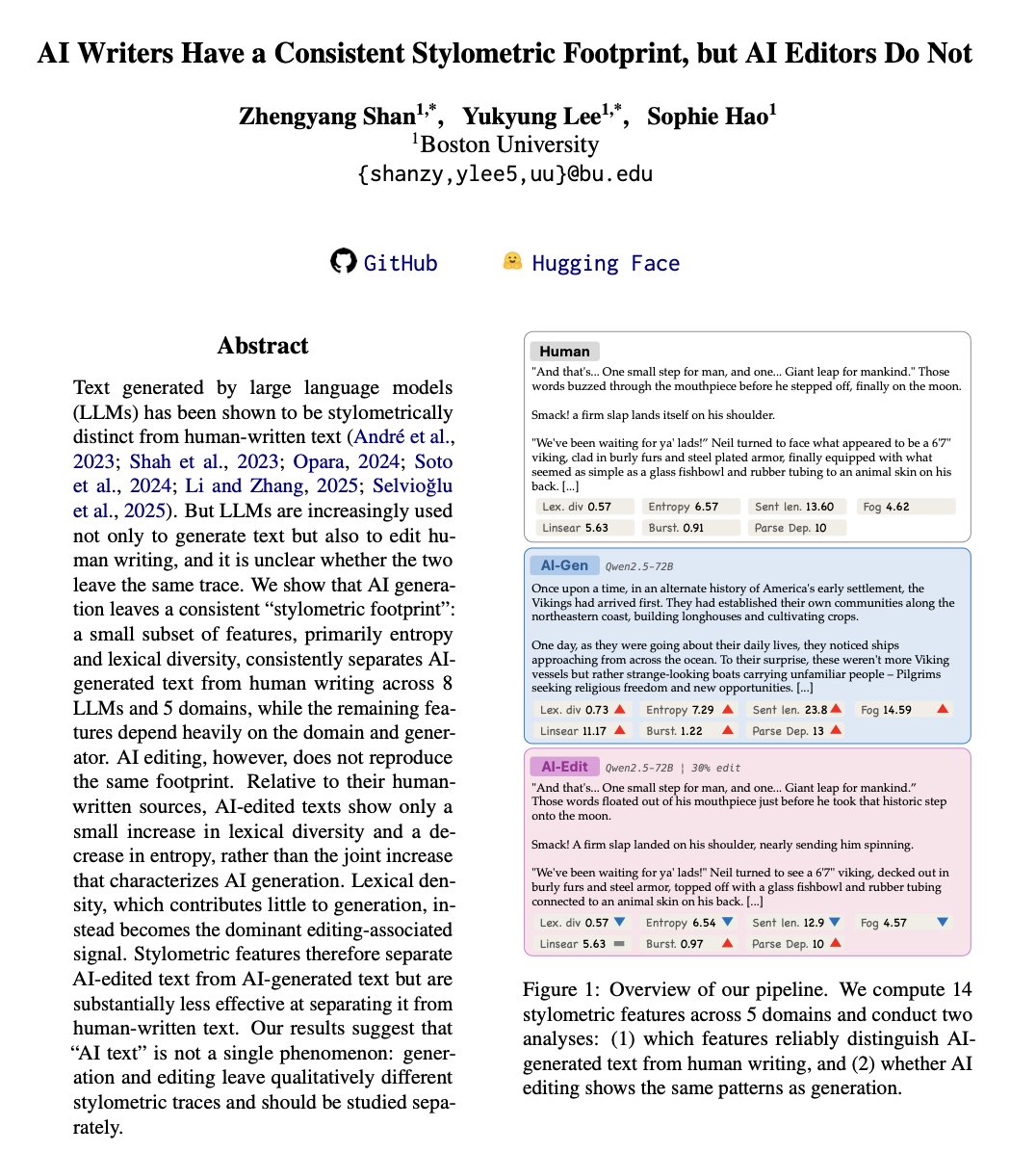
📢 Excited to share our #EMNLP2026 Main paper, co-led by @yukyunglee_ and me! 🎉
AI-generated text shows a consistent stylometric footprint across models and domains, while AI-edited text shows a different pattern.
🔗Paper: https://t.co/8RCrLPyyXq
🤖🧠NEW PAPER🧠🤖
(The result of an 8-year project!)
LLMs seem very different from symbolic systems. Yet LLMs excel in symbolic domains (e.g., language/code/math). How do they do it?
Our finding: LLM representations have implicit symbolic structure!
Link in thread ⬇️
1/n