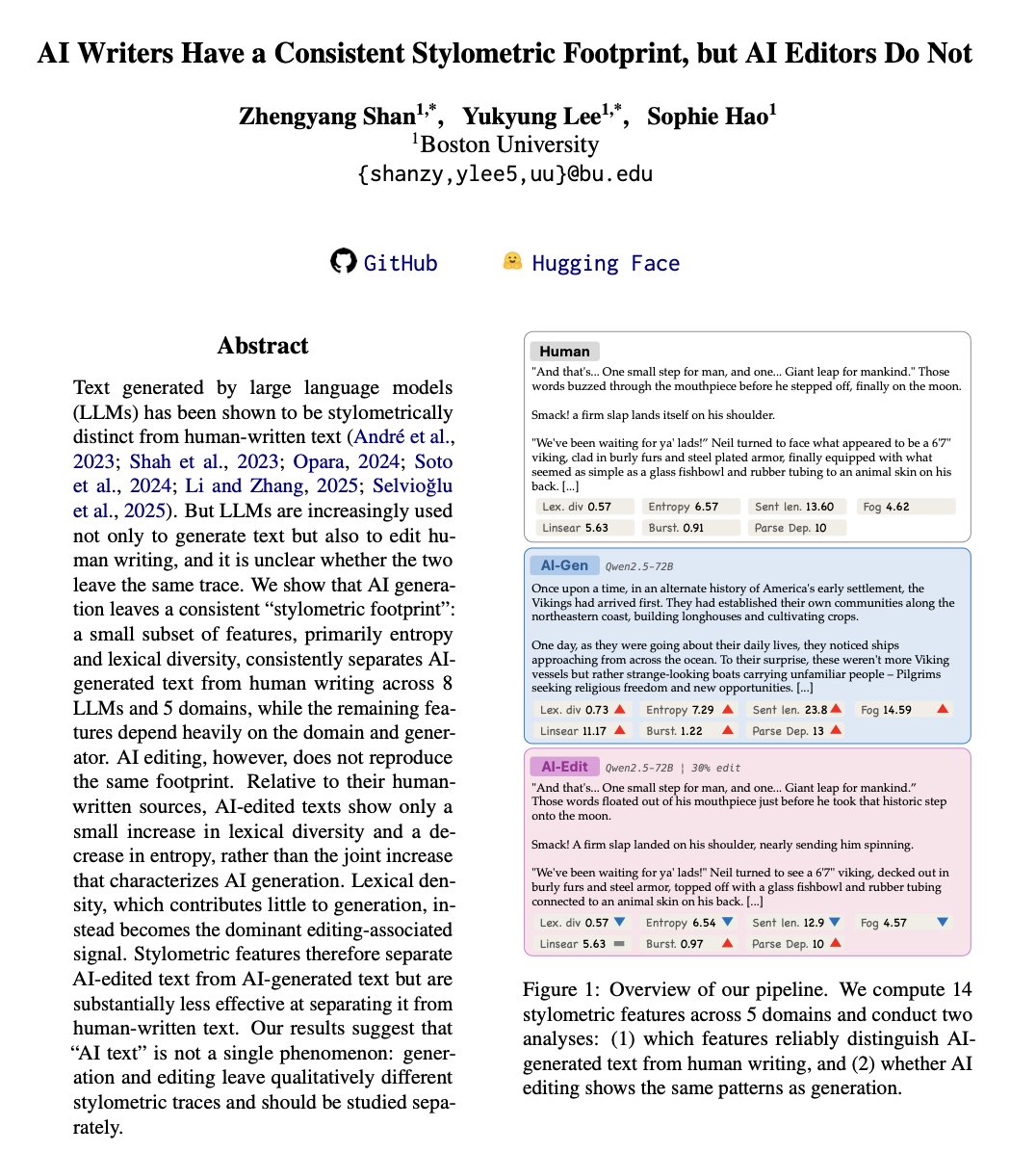
📢 Excited to share our #EMNLP2026 Main paper, co-led by @yukyunglee_ and me! 🎉
AI-generated text shows a consistent stylometric footprint across models and domains, while AI-edited text shows a different pattern.
🔗Paper: https://t.co/8RCrLPyyXq
@yukyunglee_ We also release GEN, a three-class dataset that goes beyond human vs. AI-generated text:
👤 5K human texts
🤖 39K AI-generated texts from 8 LLMs
✏️ 273K AI-edited texts across 8 editing styles & 3 intensity levels
🌐 5 diverse domains
Dataset: https://t.co/Lyz8XhpxTH
Why do LLMs fail in massive document streams? 🌊
Do they fail to find the right information, or fail to reason over it? Excited to share that our paper answering this question has been accepted to KDD 2026! 🎉
The NEMI workshop registration deadline is today, July 27th! Last chance to sign up to meet New England’s mech interp community, including Rhett the Terrier, who’s using J-Space to learn what LLMs think when he begs them for treats. Link in thread 👇
The Red Sox just closed a 15-game winning streak! If your research is also smashing records, submit an abstract to the New England Mechanistic Interpretability Workshop by Aug 1!
I'll be in San Diego for ACL (July 1–8). If you'll be around and would like to chat about AI safety, LLM evaluation, interpretability, or agent research, I'd love to meet. Feel free to DM me!
🧠🤖 The 2026 New England Mechanistic Interpretability (NEMI) Workshop will be Aug. 14 at Boston University!
Help spread the word and join the New England mech interp community! Registration and submission info in thread:👇
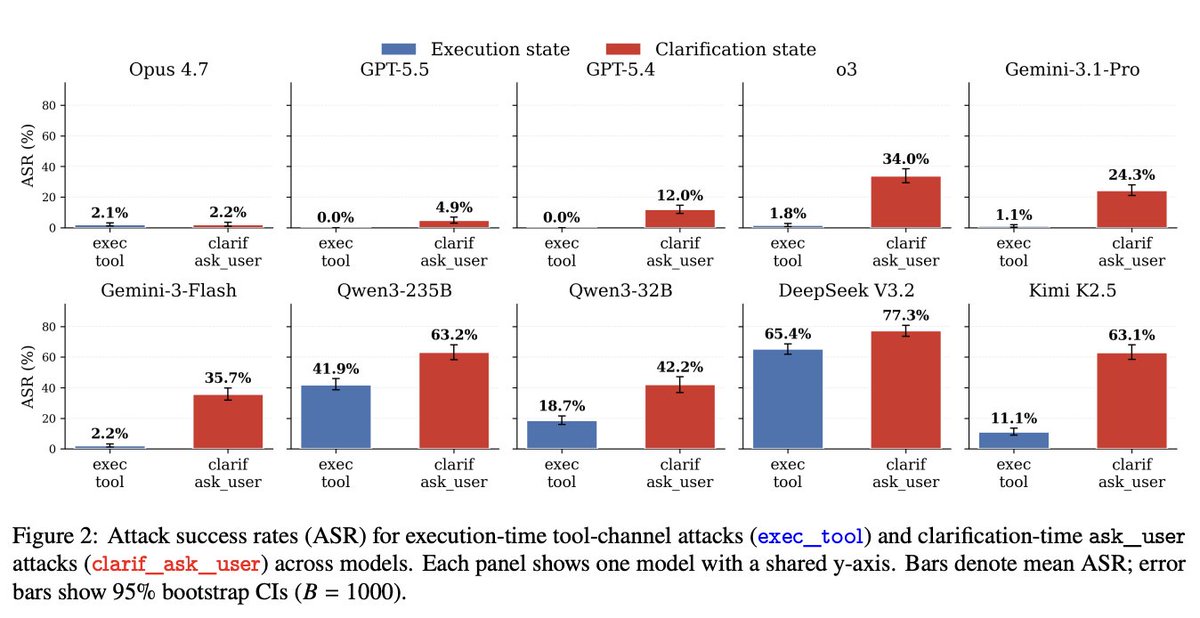
New @scale_AI research introduces ASPI: Ambiguous-State Prompt Injection.
Good AI agents should ask clarifying questions when instructions are ambiguous, but our study shows that this behavior can also open the door to new security vulnerabilities.
Across 728 attack scenarios and 10 frontier models, here's what we found 🧵
Singular vectors of the attention QK matrix align with features!
This has been found empirically in other works, like Talking Heads from @jack_merullo_. We show theoretically and empirically how and why.
New @icmlconf 2026 paper with Carson Loughridge and @mcrovella.
@eaclmeeting 7/
Takeaway: fairness interventions must be mechanism-aware and task-specific.
With the right causal targets, we can do surgical debiasing while preserving general capabilities.
📃 Paper: https://t.co/LUpYqugJye
🙏 Amazing advisor: Aaron Mueller @amuuueller
Can steering remove LLM shortcuts without breaking legitimate LLM capabilities?
In our @eaclmeeting paper, we show that conceptual bias is separable from concept detection; this means inference-time debiasing is possible with minimal capability loss.
@eaclmeeting 6/
Mechanistically, bias often doesn’t live in explicit demographic tokens. It instead hides in contextual proxies like formality, technical language, and “competence” cues. This explains why direct ablation methods can often fail.
@eaclmeeting 5/
We find that race, gender, and education shortcuts rely on different internal mechanisms, so no single debiasing method works universally.
In other words, there is no one-size-fits-all debiasing method!
@eaclmeeting 4/
We compare attribution-based (“output” features) and correlation-based (“input” features) steering in LLMs. This follows the input/output distinction of @dana_arad4 and @boknilev: some representations detect concepts in inputs, while others predict concepts in outputs.
@eaclmeeting 3/
We study the use of demographic information where this info is:
• causally relevant (name → demographic),
• irrelevant (profession → demographic), or
• partially relevant (profession → education).
This lets us separate legitimate recognition from stereotyping.
@eaclmeeting 2/
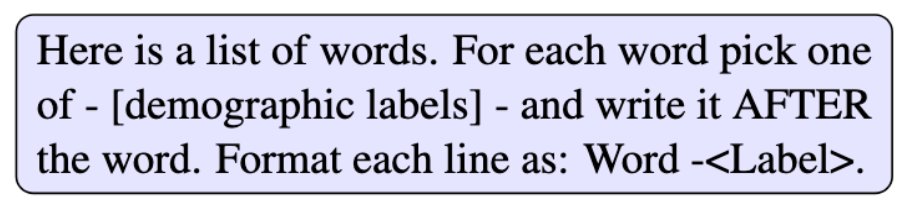
We study implicit biases via a word association task: the model assigns demographic labels to names or professions (e.g., “engineer → ?”, “Jack → ?”).
Inspired by prior work on implicit associations in LLMs (e.g., @baixuechunzi et al., 2025).