Vibe coding as a daily practice.
Harness engineering beyond the model.
Building AI-native products that actually ship.
Forged in clarity. Built like gold.🔥
Letting AI write 100% of your code is the fastest way to become a tourist in your own repository.
Generating logic is cheap, but maintaining the mental model of how your system interacts is expensive. The second a silent regression hits production—one that the compiler misses—you aren't debugging your own logic anymore. You are reverse-engineering a black box you never really built.
You cannot fix a system you don't actually understand.
this is exactly where the vibe coding dream violently collides with reality. generating an app interface is easy, but eventually the abstraction leaks. if you don't understand the underlying plumbing of package managers and build steps, your startup dies the second a dependency throws a peer conflict.
the biggest lie in the agent space is that you can just give an llm a prompt and let it figure out the execution. production-grade ai is just 90% boring, deterministic code acting as a cage for the 10% non-deterministic magic. if you don't build the guardrails, you aren't building a product, you're building a slot machine.
@julianharris this is the exact reality of the post-typing era. when execution becomes instant and free, the entire bottleneck shifts to cognitive load and architectural taste. we didn't eliminate the hard part of software engineering, we just distilled it down to pure decision fatigue.
models are incredible at fixing stack traces. they are terrible at fixing silent regressions. the real production nightmares aren't when the app crashes; it's when the code runs perfectly, the logs are completely green, but the business logic is subtly inverted. if you didn't build a mental model by touching the actual code, the ai can't help you, because it has no idea what correct is supposed to look like.
AI will confidently gaslight you into thinking a 10-year-old open-source library is broken, just to avoid admitting its own code is wrong.
If you don't deeply understand the underlying system, you will waste three days rewriting a perfectly good database schema to fix a hallucinated dependency. Models output code, but they have zero accountability for system stability.
In the age of AI-assisted dev, your own intuition is the only compiler that actually matters.
in 2027 it's back to a team of 5, but they aren't writing boilerplate anymore. they are system editors, security auditors, and risk managers. when the cost of generating code drops to zero, the ambition of what we try to build will just 100x. you'll still need a full team just to manage the massive architectural complexity and keep the whole thing from collapsing.
the absolute worst part of ai-assisted dev right now. models have zero accountability. if you don't know the underlying system well enough to call bs on the model, you'll spend three days rewriting a perfectly good database schema just because the ai hallucinated a dependency issue. the senior dev is the only compiler that matters now.
exactly. it's the same cycle as when we moved from assembly to higher-level languages. people thought compilers would kill dev jobs. instead, it just let us build wildly more complex systems. ai is just the ultimate compiler. the job shifts entirely to defining the constraints and architecture.
"vibe checker" is hilarious but incredibly accurate. the economics of software are completely flipping right now. generating 10k lines of code is basically free, but verifying that those 10k lines won't leak customer data or collapse under load? that's where the premium is. devs are transitioning from writers to high-stakes editors.
@valigo complexity is the easiest way to mask a lack of understanding. the most resilient enterprise systems i've shipped are criminally simple under the hood. if you need 15 layers of abstraction just to move data around, you're building a resume, not a product.
spot on. building for agents means aggressively stripping away the human ui. if you're making an llm parse a visual dashboard instead of directly hitting a clean api endpoint, you're burning tokens and reliability for zero reason. the best agent infrastructure is completely invisible.
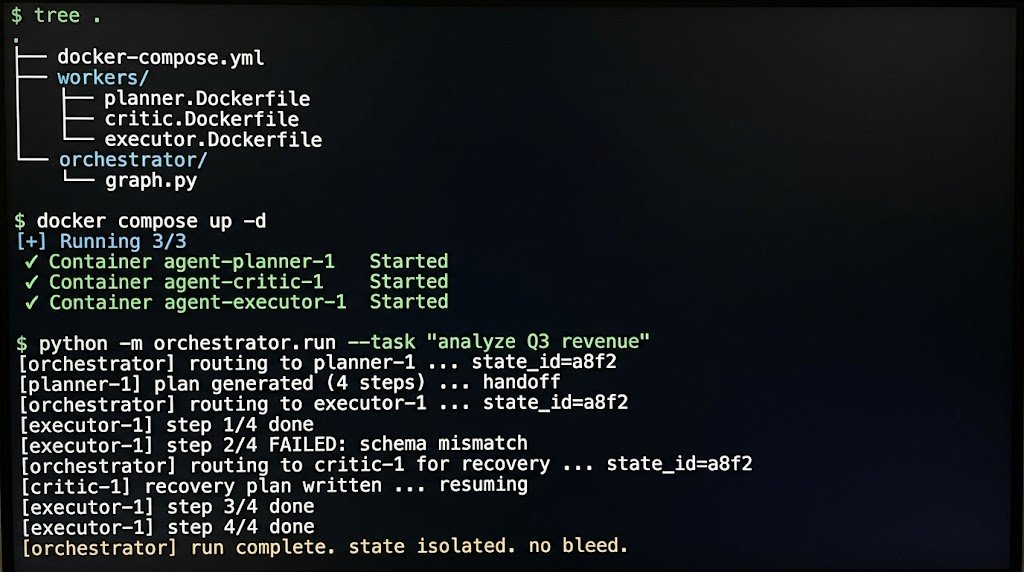
Stop using git worktrees for multi-agent state isolation.
It is a trap!
If your agents share state, a single bad tool call will poison your entire pipeline.
The fix is process-level isolation.
- Spin up a docker subprocess per worker node.
- Map each to its own langgraph state.
Zero dependency bleed.
Zero poisoned runs.
Past a certain capability floor, data curation eats model size.
Teams are still out here optimizing the wrong variable.
- Bigger models.
- More parameters.
- The latest release.
Meanwhile, a smaller model on a cleaner training slice quietly outperforms them all.
The moat is the data. Not the weights.
Been pushing the "let LLMs audit LLMs" workflow for weeks.
But I finally realized the trap today.
If the Executor AI specs what to probe, the Debug AI is only testing what the Executor already assumed. It becomes a closed loop.
You aren't catching bugs. You are just watching two models agree.
Probe design stays human. Or property-based.
Never hand it off.
100%. the whole "one-shot vibe coding" myth is wild. models have a strict task budget and if you don't respect it, you're just building spaghetti code. for my workflows, i strictly enforce a multi-agent pipeline: planner -> execution -> cross-review -> surgical debug. if you aren't doing modular development and treating agents like an assembly line, you're setting yourself up for failure.