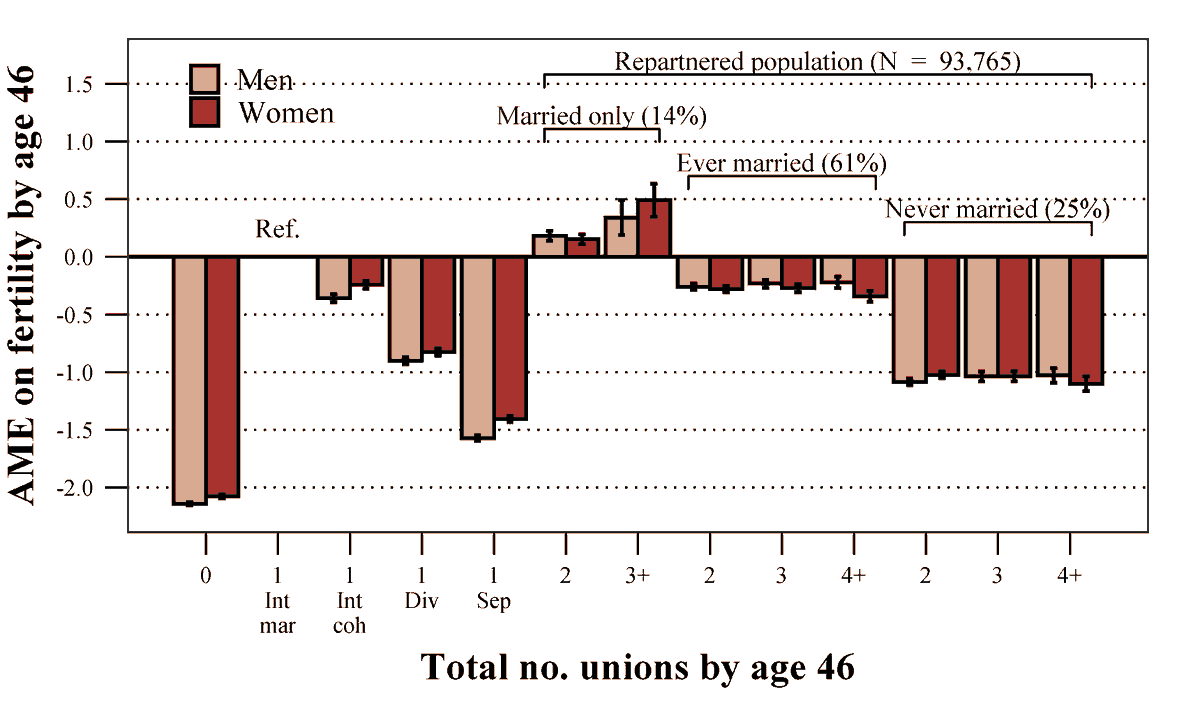
In 🇫🇮, young adults are increasingly separating from their first co-residential partner before the couple has any children. On the other hand, more people are having children in their second or subsequent co-residential union.
#Fertility@Linus_Andrsson
https://t.co/YFMdLAWIg6
We’re hiring!
💎 1-2 Senior Researchers in demographic and sociological research
💎 Contract-based positions from 1.5.2024 to 30.4.2026
💎 Deadline for applications is 26 March 16:00
#Hiring#OpenVacancies#SeniorResearcher@INVEST_Flagship@UniTurku
https://t.co/QIxxGZeNZ0
@MoreBirths Finnish admin data on CFR corroborate the marriages->childbearing argument, but problematize the one-single-spouse->childbearing argument: Re-married men & women have higher fertility than baseline (single intact marriage) by age 46. @lymanstoneky@FamStudies@ReadDemography
We started @malengo in 2021 to support Ugandan students on their journey to a Bachelor's degree in Germany. We admitted 10 students in 2021; 30 in 2022; and 120 in 2023.
Our next goal: FOUR HUNDRED!
We urgently need both investors and donors — please read and spread widely! 1/n
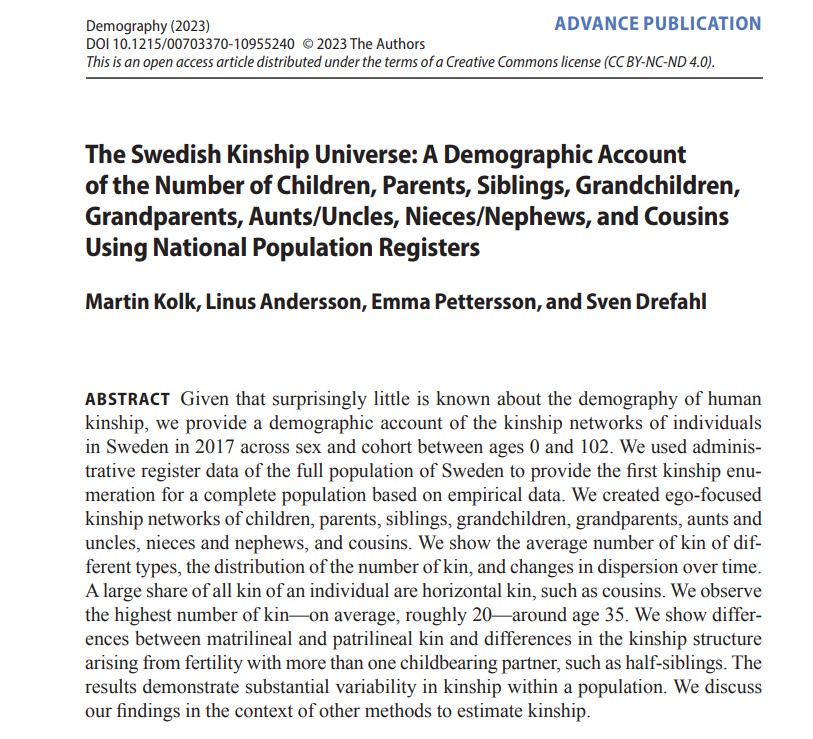
“The Swedish Kinship Universe”: @MartinKolk@Linus_Andrsson Emma Pettersson & @DrefahlSven conducted “a full assessment of kinship links in contemporary Sweden," finding the greatest variance for cousins & grandchildren." @SUDA_Sthlm@Framtidsstudier
https://t.co/FuiFeAutci
Read the full paper written by @Linus_Andrsson, Emma Petterson, @DrefahlSven, where we present many more results than those shown here, and discuss exactly how we derived these findings.
https://t.co/srEmXfWG0o
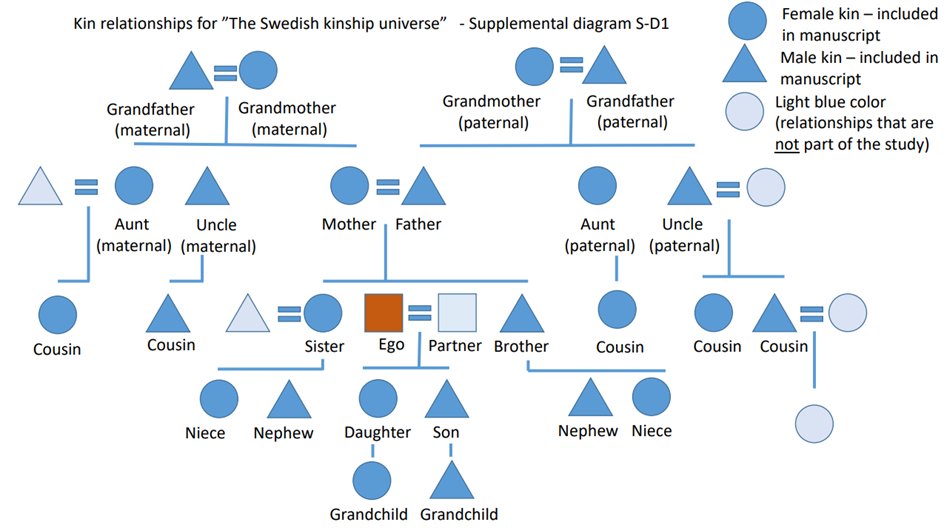
In our new paper in @ReadDemography we count all observable kinship relations in contemporary Sweden using register data. We use linked parent-child records to estimate counts of kin such as cousins, grandparents, and grandparents.
https://t.co/srEmXfWG0o (open access)
Max Planck-Humboldt call to establish Research Units in sub-Saharan Africa in collaboration with a Max Planck Institute.
Funding of 150k Euros per year for 5 years. Deadline: Oct 15.
More info: https://t.co/h25Dm0gMm5
Feel free to get in touch with us if interested
In @HallstenMartin and my new paper we find 7 generations of inequality persistence (or social mobility) in education, wealth, and occupation. We use data from 18th-century northern Sweden until today in our new study in American Journal of Sociology.
https://t.co/HyMODY13ae
Role of Gender Differences in Partnering & Re-partnering for Completed Fertility [Finland]: "Men have marginally higher re-partnering rates at older ages, when birth rates are low, whereas women have higher rates of repartnering at prime childbearing ages" https://t.co/fLqy44tMP1
"Exciting Fertility Data in the United States" is a session open for #PAA2023 attendees interested in fertility & admin data. Wed, April 12, at 10 am. No pre-registration required. Welcome!
@SUDA_Sthlm@FLUX_Consortium
I am looking for a postdoc to work on topics related to kinship and demography. The position is for three years and offers a competitive salary, not to mention access to the great @MPIDRnews community! Could this be you? Apply by May 15! Or get in touch if you have questions 👇
New study published about period trends in union (cohabitation and marriage) prevalence, entries, an exits by educational level for men and women in Finland. Authors @MarikaJalovaara & @Linus_Andrsson
👉https://t.co/YCqNWZjvek
💸NEW WP ALERT💸
In Business Education and Portfolio Returns we study the causal effect of university-level business education on financial behavior and outcomes. Business education leads to larger stock market investments, higher returns, and more wealth! 💸 [1/13]