The Day 15,000 Demons Named the One They Fear Most
Near Carcassonne in the early 1200s, St. Dominic was preaching the Rosary to a crowd of over 12,000 people when a possessed Albigensian heretic was brought to him.
The man had mocked the fifteen mysteries of the Rosary. As a result, 15,000 demons had entered him, one thousand for each mystery he attacked.
Dominic began the exorcism. Forced to speak, the demons admitted they hated him more than anyone on earth because of the souls he was snatching from them through the Rosary.
Then he asked the question that shook hell:
Which saint in heaven do you fear most?
The demons screamed so violently that many people in the crowd collapsed. They begged, wept, and pleaded for mercy. They offered to whisper the answer privately. Dominic refused. He demanded they speak the truth out loud.
When they fell silent, he knelt and prayed:
“O powerful Virgin Mary, by the power of your Rosary, command these enemies of the human race to answer.”
At that moment, the Blessed Virgin appeared to Dominic (unseen by the crowd), surrounded by angels. She struck the possessed man with a golden rod and ordered the demons to speak.
Reluctantly, they confessed:
“She is our enemy, our ruin, and our destruction. We fear her more than all the other saints in heaven combined. No one who perseveres in her service is ever lost. One sigh from her to the Trinity is worth more than all the prayers of the saints. And no one who perseveres in the Rosary is damned, because she obtains for them true contrition and God’s mercy.”
Dominic then led the entire crowd in praying the Rosary slowly and devoutly.
At every Hail Mary, demons poured out of the man in the form of burning coals. When the last one left, he was free. The Virgin (still invisible) blessed the people, and a great joy filled them. The man renounced his errors, converted, and joined the Rosary Confraternity. Many others followed.
This account, preserved by St. Louis de Montfort, remains one of the most striking testimonies to the power of the Rosary and to the unique terror that the Mother of God inspires in the demonic world.
THE HIDDEN MEANING BEHIND JESUS’ GAZE IN THE DIVINE MERCY IMAGE
In the famous Divine Mercy image, Jesus’ eyes are not looking straight at the viewer. They are slightly lowered, gazing downward.
When St. Faustina first noticed this detail, she did not fully understand its meaning. She later asked Jesus about it. He answered her with a simple but profound explanation: “My gaze from this image is like My gaze from the cross” (Diary 326).
The lowered eyes recall Christ looking down from the Cross upon humanity with mercy, not judgment. It is the gaze of the Savior who, even in His suffering, fixed His attention on those He came to redeem. Rather than confronting the sinner with severity, Jesus looks with compassion, inviting trust and conversion.
This detail remains one of the most moving elements of the Divine Mercy image, a quiet reminder that the Lord continues to look upon us with the same merciful love He showed from Calvary
Even the moon cannot bring back the ones we miss. 🌙
She sits beneath a thousand years of moonlight, dressed in silk and gold, looking as though the entire world belongs to her.
But there is one thing all the beauty in the world cannot give her — the person she wishes were sitting beside her.
When we were young, we believed love could last forever. As we grow older, we learn that sometimes forever exists only in our memories.
The moon is still the same. The night is still beautiful. Only the person we once shared it with is gone.
And perhaps that’s what growing older really means — learning to admire the beauty of a world that no longer contains everyone we love.
If you could spend just one more evening with someone from your past, who would it be? ❤️
I’d love to hear your story.
Image : ChatGPT
Video : Seedance 2.0, 15s, 2K.
List of things Pope Leo XIV has condemned and spoken against in recent days:
1. He has challenged the transhumanist dream of using technology to transcend human limitations, overcome human weakness and achieve a supposedly enhanced form of humanity.
2. He has encouraged men and women not to be afraid of marriage, starting families and having children. He has urged married couples to open their homes to life.
3. He has upheld the understanding of marriage as the union of a man and a woman.
4. He has condemned absent fathers, machismo, abuse and violence against women.
5. He has condemned sexual abuse and demanded truth, justice, reparations and accountability for victims.
6. He has condemned abortion and reaffirmed the dignity and sanctity of human life from conception to natural death.
7. He has called for a ban on lethal autonomous weapons, insisting that decisions involving human life must never be delegated to artificial intelligence.
8. He has warned against allowing technology and artificial intelligence to dominate humanity, insisting that machines are tools, not persons.
Is there anything I left out???
I am genuinely happy that the Pope we have today is not afraid to speak the truth, even when that truth challenges the prevailing culture and the powerful interests of this world.
He is reminding the world that the Church must never compromise the truth to please society.
Habemus Papam! 🇻🇦❤️
An 11-year-old girl received Jesus in Holy Communion for the first time… and moments later, she was dead. But the most shocking part of her story isn't how she died. It's what her death reveals about the way WE receive the Eucharist today. ⤵️
Her name was Blessed Imelda Lambertini, and she lived in Bologna, Italy, during the 1300s. From a young age, Imelda had an extraordinary love for Jesus in the Eucharist. While living with Dominican nuns, she watched the sisters receive Holy Communion, longing to receive Him herself.
But there was a problem. She was considered too young.
Imagine kneeling in church, watching everyone else receive the One you love most, knowing you aren't allowed to approach. Imelda's longing was so intense that tradition remembers her asking, "How is it possible to receive Jesus into one's heart and not die of joy?"
Then, in 1333, something extraordinary happened.
After Mass, Imelda remained in the chapel praying. Suddenly, according to Dominican tradition, a consecrated Host appeared miraculously suspended in the air above her. The astonished sisters summoned a priest, who understood this as a sign that Imelda should finally receive her First Holy Communion.
And so, at just 11 years old, she received Jesus for the very first time.
But what happened next left the sisters stunned.
Imelda remained kneeling in prayer. When the sisters returned, they found her motionless. They tried to wake her. She was dead.
Catholic tradition remembers her death as an extraordinary Eucharistic ecstasy. The little girl who had spent years longing to receive Jesus had died after finally receiving Him.
But here's the part that should shake every Catholic reading this.
Imelda begged for what many of us receive every Sunday without a second thought. She approached the Eucharist with overwhelming love. We sometimes approach distracted, impatient, or simply out of routine.
She knew WHO was waiting for her. And sometimes, we forget.
The real question isn't whether we believe Jesus is truly present in the Eucharist. It's whether our hearts reflect that belief.
💬 If you knew your next Holy Communion would be your last, would you receive Jesus differently?
Blessed Imelda Lambertini, pray for us.
Somewhere, there's a Catholic who has forgotten how extraordinary the Eucharist really is. Perhaps this little girl's story is exactly what their heart needs today.
PADA TAHUN 2012, SEORANG PEMILIK JARINGAN RESTORAN SUSHI ASAL JEPANG TERBANG KE SOMALIA DAN MENGAJARKAN PARA BAJAK LAUT CARA MENANGKAP IKAN TUNA — DAN 'SECARA MANDIRI MENGAKHIRI SERANGAN BAJAK LAUT DI SOMALIA...'
Pada tahun 2011, bajak laut Somalia menyerang 237 kapal dan menahan ratusan pelaut sebagai sandera dalam satu waktu dan menuntut uang tebusan jutaan dolar...
Kebanyakan orang Amerika mengetahui masalah ini dari satu insiden — pembajakan kapal Maersk Alabama dengan kaptennya, Richard Phillips, pada tahun 2009, yang berakhir dengan penembak jitu Navy SEAL dan dibikin film Hollywood dimana aktor Tom Hanks berperan sebagai Captain Phillips...
Dua tahun kemudian, kapal perang dari AS, Uni Eropa, NATO, China, India, dan Jepang berpatroli di Teluk Aden, dan gak satu pun bisa menghentikan serangan bajak laut...
Kemudian seorang pemilik restoran sushi dari Tokyo terbang ke Somalia dan pergi ke pesisir untuk berbicara dengan para bajak laut...
Namanya Kiyoshi Kimura, pemilik jaringan Sushi Zanmai — pria yang dijuluki Jepang sebagai Raja Tuna, yang membayar rekor $3,2 juta untuk satu tuna sirip biru Januari ini...
Menurut pengakuannya sendiri, dia pergi sekitar tahun 2012 dan menyimpulkan bahwa para bajak laut itu adalah nelayan yang kehilangan pekerjaan karena ikan di perairan mereka udah dihabiskan oleh kapal pukat asing...
Jadi katanya ia memberi mereka empat kapal penangkap ikan, mengajari mereka menangkap tuna sirip kuning, menyediakan freezer untuk menyimpan hasil tangkapan, dan berjanji akan membeli setiap ikan...
"Mereka bahkan gak suka merompak," katanya... "Saya menyarankan agar mereka menangkap ikan tuna aja, dan mencari nafkah yang membanggakan untuk keluarga mereka..."
Serangan bajak laut Somalia turun dari 237 pada tahun 2011 menjadi 15 pada tahun 2013, dan pada tahun 2015 pembajakan udah berhenti...
International Maritime Bureau memberi kredit kepada Angkatan Laut, penjaga pantai, dan pemerintah Somalia...
Nama Kimura gak ada di dalam daftar itu...
Begitulah cara seorang penjual sushi dari Tokyo untuk selamanya "mengakhiri pembajakan di perairan Somalia seorang diri..."
If God is good, why does He allow suffering?
This is the question that has driven more people away from faith than any other. It deserves an honest answer, not a slogan.
So let's state it at full strength. If God is all-powerful, He could stop suffering. If He is all-good, He would want to. Yet children die of cancer, tsunamis sweep away whole villages, and innocent people are tortured. So either God isn't powerful, isn't good, or isn't there. The argument is usually traced back to the ancient Greek philosopher Epicurus, and David Hume sharpened it in the eighteenth century. Dostoevsky gave it its most painful form when he had one of his characters say that no future harmony could ever be worth the tears of a single tortured child.
Christians who brush this off with "God has a plan" haven't felt its weight. So let's feel it, and then look closer.
First, notice what the objection assumes. To call the world's suffering evil, you need a standard of good that the world falls short of. C.S. Lewis said his own case against God rested on the universe being cruel and unjust. Then he asked where he'd gotten the idea of "just" in the first place. If there is no God, suffering isn't evil. It's just nature doing what it does. The protest against suffering is itself a cry that things are not as they should be.
Second, much of the suffering in this world comes from human hands. Love that cannot be refused isn't love, and a world with real freedom is a world where people can choose cruelty. Scripture goes further and says the whole creation was subjected to futility and groans under it (Romans 8:20-22). The Bible doesn't pretend this world is the way God made it.
Third, "I can't see a reason" is not the same as "there is no reason." Job demanded an answer from God, and God never gave him one. Instead, God asked him where he was when the foundations of the earth were laid (Job 38:4). Joseph, sold into slavery by his own brothers, said years later, "You meant evil against me, but God meant it for good" (Genesis 50:20). He couldn't see that for twenty years.
And here's where Christianity says something no other answer does. It doesn't explain every suffering. It claims that God did not stay outside of it. Jesus stood at the tomb of His friend Lazarus and wept (John 11:35), even though He knew He was about to raise him. Then He went to the cross and entered the worst of it: betrayal, torture, abandonment, and death. We do not have a God who cannot sympathize with our weakness (Hebrews 4:15).
The story isn't finished, either. Scripture promises a day when God will wipe away every tear, and death and pain will be no more (Revelation 21:4).
So if you're asking this question from inside the suffering, here's what I can't give you: a neat reason for your specific pain. But I can point you to a God who has nail scars. He doesn't explain suffering from a distance. He carried it, and He has promised to end it.
Have you ever wrestled with this question?
Jacinta was deeply moved by the vision of Hell and the call to sacrifice for sinners:
Near the end of her life, she said (to Lúcia):
In a short time now I am going to heaven. You are to stay here and say that God wishes to establish in the world the devotion to the Immaculate Heart of Mary. … Tell everybody that God grants graces through the Immaculate Heart of Mary; that people are to ask her for them; and that the Heart of Jesus wants the Immaculate Heart of Mary to be venerated at his side. Tell them also to pray to the Immaculate Heart of Mary for peace, since God has entrusted it to her. Oh that I could put into the heart of everybody the flame that I feel burning within my breast and which makes me love so much the Heart of Jesus and the Heart of Mary.”
St. Jacinta Marto, pray for us
"The door to your heart is the door of love.
I have placed within you the grace of surrender that leads you to happiness. This happiness, my children, is within you. How can I go and seek what is inside you when you close your hearts to me by refusing to come to me? My Mother, your sweet Mother, holds the key to the door that is your heart. Pray to my Mother; she will help you open this door. There you will find my graces, which will help you discover the happiness that is within you."
Jesus of Love
https://t.co/sr8UqlH3xd
Vietnamese artist Thiên Dinh is known for his delicate paper‐art works where he transforms fragile sheet of paper into stunning animal sculptures of fishes, birds and even dragon, which possess stunning sense of realism.
Look at these Betta fish.
In 1930s Rome, a little girl called Nennolina wrote to Jesus as if he were in the room.
Antonietta Meo was five when doctors found bone cancer and amputated her leg. The disease spread. She did not complain. She told her mother she had offered the leg to Jesus for the conversion of sinners, then began writing letters — more than a hundred — to Jesus, the Blessed Mother, the Father, and the Holy Spirit. At first she dictated them. Later she wrote them herself and left them at the foot of her crucifix.
One of them said: “Dear Jesus, I love you very much. I want to abandon myself in your hands. Do with me what you want. Help me with your grace, since without your grace I can do nothing.”
She received her First Communion on Christmas 1936 and stayed on her knees for an hour afterward, even with a prosthetic leg. She died on July 3, 1937, at six and a half. In 2007 Pope Benedict XVI declared her Venerable. She is still one of the youngest people the modern Church has recognized for heroic virtue.
Her letters are short, plain, and hard to forget. Holiness did not wait for her to grow up.
Venerable Antonietta Meo, pray for us. 🌹🕊️
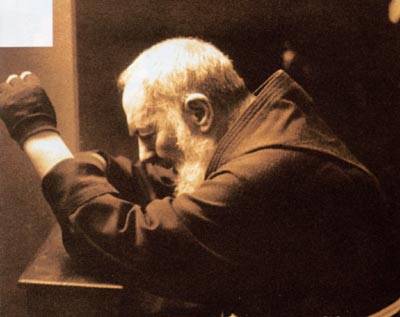
GESU' PARLA DI PADRE PIO
La Venerabile Serva di Dio Madre Eleonora Francesca Foresti, fondatrice delle Suore Francescane Adoratrici, di cui è in corso la causa di beatificazione, nel suo Diario, riporta quanto Gesù stesso le disse a proposito dell’eccezionalità di San Padre Pio:
"L’anima di padre Pio è fortezza inespugnabile, è cella vinaria in cui mi inebrio a mio piacere. É cielo tersissimo in cui gli angeli riflettono il loro volto stupendosi.
E favo di miele! È il mio rifugio nelle ingratitudini degli uomini.
È specchio della mia anima in cui mi rifletto, come un purissimo raggio di sole, attraverso il più puro cristallo! La mia voce in lui è come l’eco riprodotto tra due monti! II suo linguaggio è dolce e tagliente! […] misterioso come il mio: conforta ed abbatte.
Ha il mio stesso imperio, perché, Io, Gesù, vivo in lui.
Il suo spirito è diffusivo come un fluido. Il suo gesto, la sua parola, il suo sguardo operano più di un profondo discorso di un grande oratore. Io do valore a tutto ciò che emana da lui.
É il capolavoro della mia misericordia.
A lui ho conferito tutti i doni del mio Spirito, come a nessun’altra creatura.
E il mio perfetto imitatore, la mia ostia, il mio altare, il mio sacrificio, la mia gloria!" (cfr. pp. 20-21).
Some melodies aren’t just meant to be heard, they can be experienced visually, too. Pachelbel’s “Canon in D” offers a captivating blend of music and visual beauty.
Made with Claude Opus 5.5.
The fearmongering about AI always makes us forget that NOTHING WENT FOOM, as was always predicted.
Send this to your doomer friend who has a very high P(Doom).
Accelerate.