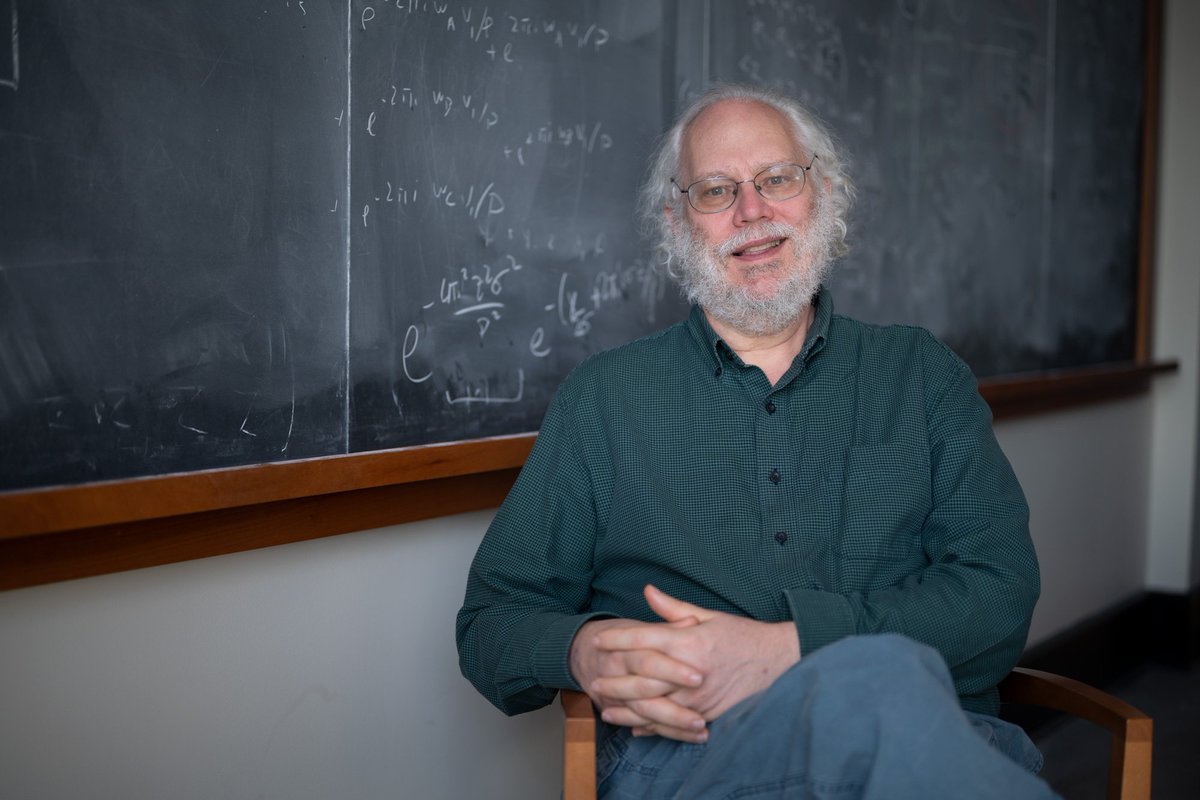
A mathematician at Bell Labs wrote something on paper in 1994 that made every government on earth quietly panic. The machine that runs it doesn't exist yet. The panic never stopped.
His name is Peter Shor. He is a professor of applied mathematics at MIT. He won the Turing Award in 2021, the highest honor in computer science. And the thing he is most famous for is a piece of mathematics he wrote in four days that he did not fully intend to write.
Here is the story almost nobody tells, and why it should change how you think about the security of everything you do online.
In 1994, Shor was a researcher at AT&T Bell Labs in Murray Hill, New Jersey. Bell Labs at the time was the most intellectually alive research environment in the world. The same building that produced Claude Shannon's information theory, the transistor, and the Unix operating system was now full of physicists who interrupted each other mid-sentence and argued through lunch.
Quantum computing in 1994 was not a field. It was a rumor. A handful of theorists believed that computers built on quantum mechanical principles could solve certain problems exponentially faster than classical machines. Most of the scientific establishment considered them eccentric. There was no working quantum computer. There was no clear proof that one would ever matter. It was the kind of research that serious people called interesting and quietly avoided.
Shor was not avoiding it.
He had been thinking about a problem called the discrete logarithm, a mathematical operation that sits underneath several encryption schemes. Encryption works because certain mathematical operations are easy to perform in one direction and almost impossible to reverse. Multiply two enormous prime numbers together and you get a product in seconds. Start with the product and try to find the two original primes and a classical computer would take longer than the age of the universe. That asymmetry is the lock. Every bank transaction, every encrypted email, every password you have ever entered online is protected by some version of that lock.
Shor worked out a quantum algorithm for the discrete logarithm problem. He presented it at an internal Bell Labs seminar. The physicists in the room paid attention for the entire talk, which was unusual. The talk ended, and people started talking.
Then the telephone game started.
The discrete logarithm is used in some encryption systems, but not most. The dominant encryption standard protecting most of the world's sensitive data, RSA, is built on a different problem: prime factorization. As news of Shor's seminar spread through the halls of Bell Labs and then through the physics community, something got lost in translation. By the time the story reached physicists across the country four days later, the rumor was that Shor had solved factoring. He had not. He had solved something related but different.
Shor heard the rumor. And then, in four days, he made it true.
He sat down, looked at what he had already built, found the mathematical connection between the discrete logarithm and prime factorization, and extended his algorithm to cover both. The rumor had described something that did not exist. He built it to match the rumor before anyone found out it was wrong.
What he had now was a quantum algorithm that could factor enormous numbers exponentially faster than any classical computer. In practical terms, what that meant was this: if a quantum computer ever existed with enough stable qubits to run Shor's algorithm at scale, RSA encryption would be broken. Not weakened. Not compromised at the margins. Broken completely. Every message ever encrypted with RSA would be readable. Every private key ever generated would be derivable from the public key. Every lock built on the assumption that factoring is hard would unlock.
The paper went out. The reaction was not what most people imagine.
There was no press conference. No announcement. A 32-page technical paper appeared in the proceedings of a symposium on the foundations of computer science. Cryptographers read it and understood immediately what it meant. Intelligence agencies read it and understood immediately what it meant. Governments that had spent decades and billions of dollars building encryption infrastructure understood immediately what it meant.
None of them said much publicly. They started working.
The NSA gave Shor a Mathematics in Cryptology Award in 1995, one year after the paper came out. That is a fast turnaround for an award from an intelligence agency. The implication is that they read the paper and moved.
The problem was the machine. Shor's algorithm requires a quantum computer with enough fault-tolerant qubits to factor the kind of numbers used in real encryption, numbers with hundreds of digits. In 1994, no such machine existed. In 2001, IBM demonstrated Shor's algorithm on a 7-qubit quantum computer and used it to factor the number 15 into 3 and 5. That was the proof of concept. It was also a machine that required more infrastructure than most university labs own, running a calculation a fourth grader could do in their head.
The gap between that demonstration and a machine capable of breaking real encryption is enormous. The numbers involved in modern RSA encryption have hundreds of digits. Factoring them with Shor's algorithm would require a quantum computer with potentially millions of stable, error-corrected qubits. The best machines available today have thousands of qubits, most of them too noisy to use reliably for extended computation.
But the direction of progress is not ambiguous.
Every year, the machines get larger. Every year, error correction improves. Every year, the gap between what exists and what Shor's algorithm requires gets smaller. Nobody knows exactly when a machine capable of breaking RSA will exist. Estimates from serious researchers range from ten years to thirty. The NSA has said publicly that it believes the threat is real. NIST, the US standards body, spent years running a global competition to identify encryption algorithms that would survive a quantum computer, and in August 2024 published the first official post-quantum cryptography standards. Google has already integrated one of them into Chrome. Apple adopted another for iMessage. Signal switched to a hybrid post-quantum system in 2023.
All of that activity, every dollar of it, every hour of engineering, traces back to four pages Shor wrote in 1994.
The most interesting detail is the one Shor himself has repeated in multiple interviews. He compared the current scramble to build post-quantum cryptography to Y2K, the race to patch computer systems before the year 2000. He said the difference is that Y2K had a fixed deadline. The quantum threat has no deadline. Nobody knows when the dangerous machine will exist. And his warning was blunt: if you wait until it is obvious that a sufficiently powerful quantum computer is coming, you will already be too late. The migration of critical infrastructure to post-quantum standards takes years. The systems protecting financial markets, government communications, and military networks cannot be updated in an afternoon.
The race is not theoretical. It is happening right now, in every major government and every serious technology company on earth.
Shor is 65 years old. He still teaches at MIT. He did not build the machine. He wrote the paper that proved the machine would matter before anyone had built it. He won the Turing Award 27 years after the paper came out, which is either a sign that the committee moves slowly or a sign that the full weight of what he wrote is still arriving.
The most dangerous algorithm in the history of cryptography has never successfully been used against a real target.
Every system protecting your money, your messages, and your government's secrets is safe for exactly one reason. The computer that breaks them has not been finished yet.
An MIT mathematician sat down in 1950 and wrote a small, non-technical book aimed at the general public. He was not predicting the future. He was warning them. He said machines would eventually replace human work, optimize ruthlessly for the wrong goals, and quietly turn human beings into components inside systems they did not control.
Almost nobody listened. 75 years later, every warning he made has come true.
His name was Norbert Wiener. The book is called "The Human Use of Human Beings."
The textbook story of AI ethics says the field began in the 2010s, when Stuart Russell, Nick Bostrom, and a small group of researchers started writing about the dangers of intelligent machines. That story is wrong. The first serious book about the ethics of AI was published in 1950, by a man who had personally invented the science that AI would eventually be built on, and who saw exactly what was coming with a clarity nobody else managed to match for the next 70 years.
Here is the story almost nobody tells you.
Norbert Wiener was a child prodigy. He graduated from Harvard at 14. He had a PhD in mathematics by 17. He became an MIT professor before he turned 30. During World War II he was assigned to work on anti-aircraft fire control systems. The problem was simple and impossible. How do you aim a gun at a fast-moving plane that will not be where it is by the time the shell arrives.
His answer turned into a new science. He called it cybernetics, from the Greek word for steersman. In 1948 he published a technical book by that name. Cybernetics was the foundation of modern control theory, robotics, and almost everything that became artificial intelligence. The book was dense. Most readers could not get past the math. The ideas inside it were too important to leave trapped in equations.
So in 1950 Wiener sat down and wrote a second book aimed at ordinary people. No equations. No jargon. Just consequences. He titled it The Human Use of Human Beings. It is barely 200 pages. It is one of the most prescient documents ever written about technology.
The first thing he warned about was automation.
He predicted, in 1950, that machines would replace human work across every industry. Not just factory work. Not just manual labor. Any task that could be reduced to a procedure would eventually be automated. He specifically said white-collar work would not be safe. Bookkeeping. Translation. Drafting. Calculation. Anything where a human was being paid to follow a defined process would eventually be done by a machine for a fraction of the cost.
He was not celebrating this. He was warning about it. He said the social consequences would be enormous, that entire industries would collapse, that the value of human labor itself would be undermined for tasks where humans had been useful for centuries. He wrote this 75 years before ChatGPT made every white-collar professional check their job description twice.
The second thing he warned about was the alignment problem. He did not call it that. The phrase did not exist. But he described it precisely.
He said that machines optimize for the goal you give them. They do not optimize for what you meant. They optimize for what you wrote down. If the goal is poorly specified, the machine will pursue the literal version of it with terrifying efficiency, and the result will be a disaster the builders did not foresee.
He used the metaphor of the magic monkey's paw from a horror story by W.W. Jacobs. A grieving father wishes his dead son alive again. The paw grants the wish. Something climbs back out of the grave that is technically the son. The wish was granted exactly as stated. The outcome is hell.
Modern AI safety researchers use almost the same metaphor 75 years later. They call it specification gaming, reward hacking, mesa-optimization. The names are new. The problem Wiener described in 1950 is exactly the same.
The third thing he warned about was the loss of human agency.
He predicted that humans would gradually surrender their decision-making to systems they did not understand. Not because the systems would force them to. Because the systems would be more convenient, more accurate, and more profitable than human judgment. People would offload their navigation, their reading, their relationships, and eventually their thinking to optimization processes designed by companies whose interests were not aligned with their users.
He said something in 1950 that I cannot stop thinking about. He said the more efficiently a society delegates its decisions to machines, the less able it becomes to make decisions at all. The atrophy is gradual. By the time anyone notices, the capacity to choose is gone, and what remains is people executing decisions that were made for them, by systems they did not build, in service of goals they were never asked about.
Look at modern social media feeds, recommendation algorithms, dating apps, navigation systems, news aggregators, and you are looking at exactly what he described.
The fourth thing he warned about was the easiest one to ignore at the time and the most disturbing now.
He warned that authoritarian regimes would use the new computing technology to track, manipulate, and control populations at a scale never previously possible. Not in the future. Soon. He said the same techniques that made cybernetics useful for guiding missiles would be used to guide societies, and that the small, incremental decisions about what to optimize, who to surveil, and how to feed information back into the system would compound into a kind of soft control that did not need force to function. People would do what the system wanted because the system would shape what they wanted in the first place.
He saw modern surveillance states 75 years before they existed.
The strangest thing about reading the book in 2026 is realizing how few of these problems have been seriously addressed.
Wiener was not anti-technology. He had personally helped build it. He was not nostalgic for a pre-machine age. He was warning that any tool powerful enough to amplify human capability is also powerful enough to amplify human stupidity, greed, and indifference, and that the dangers were not in the machines themselves but in the unwillingness of human institutions to ask hard questions about who the machines were being built for.
He died in 1964. He never lived to see most of his predictions come true. He never used a personal computer. He never followed a hyperlink. He never saw a modern recommendation algorithm.
He just wrote down, in 1950, in plain English, what the world would look like when the technology he had helped invent was built out by people who had not read his warnings.
The book is around 200 pages. It is in print. Used copies are everywhere for under ten dollars. It reads like science fiction in which the author already knows how the story ends.
The first serious book about the ethics of AI was published before there was any AI to be ethical about. Almost nobody who works on the problem today has read it.
The warnings are the same. The author has been dead for 60 years. The book is one click away from anyone who wants to read it.
I've seen firsthand the chaos inside Donald Trump's administration. And I've seen firsthand how his extreme plans are hurting Virginia's families.
I won't sit by any longer.
So today, I'm launching my campaign for Congress. I'm going to fight like hell to undo the harm that Donald Trump has done to hardworking Americans – but I can't do it alone. RT if you’re with me.
Too on point not to share, “Aussie reply to Trump rant about NATO not being there for us.
Mate. You run a country with 600,000 homeless people sleeping on the street tonight. A country where 40% of adults can't cover a $400 emergency without borrowing money. A country where insulin costs more than a car payment and people are rationing it to survive. A country where medical debt is the number 1 cause of bankruptcy. A country where women are dying in hospital car parks because doctors are too scared of abortion laws to treat a miscarriage.
You lock up more of your own citizens than any nation on earth. More than China. More than Russia. More than North Korea. The land of the free has 2 million people in cages, and a quarter of them haven't even been convicted of anything. They're just too poor to make bail.
Your life expectancy is going backwards. You're the only developed nation where that's happening. Your infant mortality rate is worse than Cuba's. Your kids do active shooter drills between maths and English while you sell the gunmaker's stock to your mates.
Your minimum wage hasn't moved in 15 years. You've got teachers working 2 jobs and veterans sleeping under bridges and you just spent a trillion dollars flattening a country that didn't attack you.
And you’ve got a convicted felon, adjudicating raping, paedophile protecting, porn star shagging insurrectionist running the biggest dumpster fire war campaign since the Taliban thanked you very much for losing again.
And you're calling Greenland poorly run?
Greenland has universal healthcare. Free education. One of the lowest incarceration rates in the world. Nobody goes bankrupt there because they got sick. Nobody dies in a waiting room because their insurance said no.
"NATO wasn't there when we needed them." When exactly was that, champ? September 11? Because NATO invoked Article 5 for the first and only time in history FOR YOU. Soldiers from dozens of countries deployed, fought, bled, and died in Afghanistan FOR YOU. Australia wasn't even in NATO and we still showed up. For 20 years.
And you pulled out at 2am without telling anyone and left them to deal with the mess.
So maybe before you start calling other countries poorly run, have a look at your own backyard, you spray-tanned aluminium siding salesman. The only thing poorly run in this picture is your fucking mouth. Credit (borrowed from) Jim Scroggins - original author 📷 unknown”
BREAKING: In defiance of Vladimir Putin and Viktor Orban, voters in Hungary today will vote against Orban’s authoritarianism. Today’s the day Orban’s reign ends. This is being almost entirely ignored by mainstream media. Let’s make it go viral.
ICE detained a dialysis patient the morning of her treatment.
She died 36 hours later in a detention infirmary.
They logged it as "natural causes."
When policy kills, call it what it is.