.@PeteButtigieg criticized President Trump's economic priorities during a campaign event for Jocelyn Benson (D): "You're not alone if you believe the wealthiest people in this country ought to be paying more of their fair share and not less."
Every carton of milk you have ever pulled from a refrigerator was designed by a woman locked inside a freezing boxcar in 1905.
Her name was Mary Engle Pennington. She was thirty-two years old. She was a Quaker-raised bacteriological chemist from Philadelphia with a Ph.D. from the University of Pennsylvania. She was the first woman ever hired as a scientist by the Bureau of Chemistry — the federal agency that would eventually become the U.S. Food and Drug Administration.
Her job, on paper, was to sit at a back desk and file paperwork.
Instead, she strapped a thermometer to her belt, climbed into a moving freight train in the Chicago rail yards, and let them lock the door behind her.
Then she did it again. And again. Five hundred times over two years.
In 1905, most Americans died young because of food.
Milk shipped from Wisconsin dairies to Manhattan tenement apartments arrived in wooden barrels packed with dirty lake ice harvested from frozen ponds. By the time it reached the city, half of it was curdled. Dairies covered the sour smell with formaldehyde. Butchers rubbed borax on decomposing beef to hide the rot. Children in New York and Philadelphia were dying by the thousands every summer from milk-borne bacterial infections.
The federal government had almost no power to stop it.
Dr. Harvey Wiley, the head of the Bureau of Chemistry, was fighting to change that. He needed a scientist willing to prove — in hard, incontrovertible temperature-log data — exactly how and why the American food supply was rotting in transit.
He needed someone who would ride in the refrigerator cars.
He knew exactly who he wanted.
Pennington was the daughter of a Quaker family that had moved from Nashville to West Philadelphia when she was three. She had discovered chemistry at twelve by borrowing a college-level textbook from the public library. She had completed the coursework for a bachelor of science in chemistry at Penn's Towne Scientific School — and the university's trustees had refused to grant a woman a degree. They handed her a "certificate of proficiency" instead.
She stayed anyway. She kept working. She wrote a doctoral thesis. She forced the same trustees to grant her a Ph.D. at twenty-two.
Wiley had known the Pennington family for twenty years. He knew what she could do.
In 1905 he had her take the federal civil-service exam under the signature M. E. Pennington. The score guaranteed a hire. When she walked into the Bureau of Chemistry office the following Monday, the personnel officer realized what had happened. Federal law required them to hire her anyway.
They tried to bury her at a back desk.
She spent one week doing filing. Then she walked into Wiley's office and asked for the rail schedules.
The Bureau had no cold-weather field gear cut for a woman. She went to a Washington department store and bought her own — heavy wool skirts, oversized men's sweaters, thick wool socks, leather-lined boots. She packed a glass thermometer, a set of sterile glass sampling vials, a leather-bound ledger, and a fountain pen.
She walked into the Chicago slaughterhouse rail yards at dawn.
She climbed into the ice bunkers of moving freight cars packed with raw poultry and beef. The doors were locked from the outside. She sat in the freezing dark for hours. She measured the temperature wall by wall, floor to ceiling, corner to corner. She sampled the meat every three hours. She wrote everything down in the ledger.
She did five hundred of these expeditions over the next two years. She slept in cabooses on rural sidings. She caught pneumonia twice. She kept going.
The rail companies had believed for fifty years that cold air, once loaded into a boxcar with ice, would fill the space evenly.
Pennington's measurements proved them wrong.
Cold air fell to the floor. It stayed there. Warm air generated by rotting cargo rose to the ceiling and stagnated. The meat stacked near the roof was slowly cooking in its own bacterial gases while the meat near the floor was flash-frozen solid. The corners of the cars had dead zones the cold air never reached at all.
She discovered that a constant thirty-two degrees Fahrenheit — exactly at the freezing point of water — completely halted the growth of the specific bacterial strains that caused most food-borne deaths.
The average American refrigerator car was operating at forty-five degrees.
She drafted a complete redesign specification. Exact ice-bunker dimensions. Elevated floor racks so cold air could circulate underneath the cargo. Precise insulation thickness in the walls. Ventilation channels to move air through the dead zones in the corners.
The rail industry fought her. Their lawyers, their lobbyists, their Congressional influence, and the political backing of the meatpacking monopolies. They argued a female chemist could not tell railroad engineers how to build trains.
She did not argue back.
She published the temperature data.
The rail companies could not dispute the math. They eventually adopted her specifications wholesale. Spoilage rates collapsed. Big-city childhood mortality from milk-borne infection dropped inside a decade.
Her defining test came in April 1917.
The United States entered the First World War. The War Department needed to move thousands of tons of perishable American beef across the Atlantic to the Western Front. The commercial rail industry contributed forty thousand refrigerator cars to the war effort.
Pennington evaluated every single one.
Only three thousand of the forty thousand — seven and a half percent — met her institutional standard. She spent the next eighteen months personally overseeing the emergency retrofit of the other thirty-seven thousand cars. She standardized freezing at the slaughterhouses before the meat ever touched a train. She specified the exact temperature the ocean cargo holds had to maintain from Chicago to Brest.
The spoilage stopped. The troops were fed.
She served on Herbert Hoover's War Food Administration through the end of the war. In 1919 she left the federal government. In 1922 she founded her own refrigeration-engineering consulting firm, which she ran until she died. In 1923 she founded the Household Refrigeration Bureau to educate American consumers about the emerging home-refrigerator revolution.
In 1940 the American Chemical Society awarded her the Francis P. Garvan Gold Medal.
She was still consulting on a commercial refrigeration project the week she died — on December 27, 1952, in New York City, at eighty years old.
In 2018, sixty-six years after her death, she was inducted into the National Inventors Hall of Fame.
You walk into a grocery store in July. You pull a carton of milk from the back of the case. You do not smell it for rot. You open it. You pour it.
You are drinking from the specification of a woman who let them lock her in the freezing dark for two years to prove she was right.
If her story stayed with you, drop one word in the comments — Mary, ice, thirty-two, anything that comes to mind. Tap the like button so more people find this story. The page is small. Every reaction helps us keep telling stories like this one.
After quickly rising from unknown mayor of South Bend, Indiana, to winner of the Iowa caucuses, Pete Buttigieg now has a high-profile Cabinet position on his résumé and is on a path that goes beyond early primary states and into places Democrats probably won’t win this fall. https://t.co/nrBPwwk47l
Buttigieg: We have to recognize that if something's going to take a long time, that's all the more reason to do it now. If it's going to take 10 or 20 years to do an amendment, then we ought to be underway yesterday on this, right?
And here again, whether it's the civil rights community and the struggle for empowerment of black voters or frankly some of the objectives of the conservative movement that started in the 1970s with ideas that were considered crazy then. The idea you would go after social security, the idea you would go after a right to choose—frankly, the idea you would go after the Voting Rights Act would have seemed extreme. And they patiently built up their power until they could do it. But I think that patience has to be matched with a kind of impatience for what we can do right now
Dear Scott Pelley: pull the entire 60 Minutes team together and go to MSNow and offer a package deal to recreate the show for Sunday night and call it The Hour
To say “the system is broken” hardly qualifies as a hot political take anymore. Just about everyone running for federal office says some version of this.
The real question is what we’re going to do about it.
Pete Buttigieg’s latest piece on Substack. —> https://t.co/7ZfYIQ4qsp
Pete Buttigieg has become one of the most prolific midterm campaigners among possible presidential candidates, backing candidates in more than 30 races and traveling to over a dozen states.
Those endorsements give him a record to tout on a potential future debate stage, especially as the party looks for leaders who can break through in Republican territory. https://t.co/QuShgAZJZc
our knee can heal itself. It just needed Germany to hand it the blueprint.
Doctors in Stuttgart did something quietly radical. They built a gel that lets damaged joint cartilage rebuild itself, no implants, no metal, no major reconstruction.
It's called ChondroFiller liquid.
Here's how it works.
A surgeon injects the liquid into the damaged spot during a single minimally invasive arthroscopic procedure. Within 3 to 5 minutes, it hardens into a stable matrix, molding perfectly to the exact shape of the lesion.
Then the real magic starts.
That matrix becomes a scaffold. Your own repair cells migrate in from the surrounding tissue, multiply, and slowly transform into chondrocytes, the cells that actually build cartilage. Over the following months, your body replaces the gel with brand-new tissue grown from you.
No fibrin glue. No drilling into the bone.
This isn't a fringe experiment, either.
The device is made by Meidrix Biomedicals, developed alongside scientists at the Fraunhofer Institute for Interfacial Engineering and Biotechnology in Stuttgart. It's been CE-certified since its market launch in 2013 and has already been implanted in more than 20,000 patients worldwide.
The numbers back it up.
In one study of 26 patients with hip cartilage defects larger than 2 cm², 81% achieved good or excellent results. MRI scans confirmed significant healing in over 90% of cases.
One important caveat: it's built for small, focal cartilage defects, not advanced arthritis. Patients with severe osteoarthritis saw weaker results.
But for the right injury, this flips the script entirely.
Instead of replacing the joint, you give it the tools to repair itself.
Source: Meidrix Biomedicals / Fraunhofer Institute IGB, Stuttgart; clinical data via Kazinform News Agency
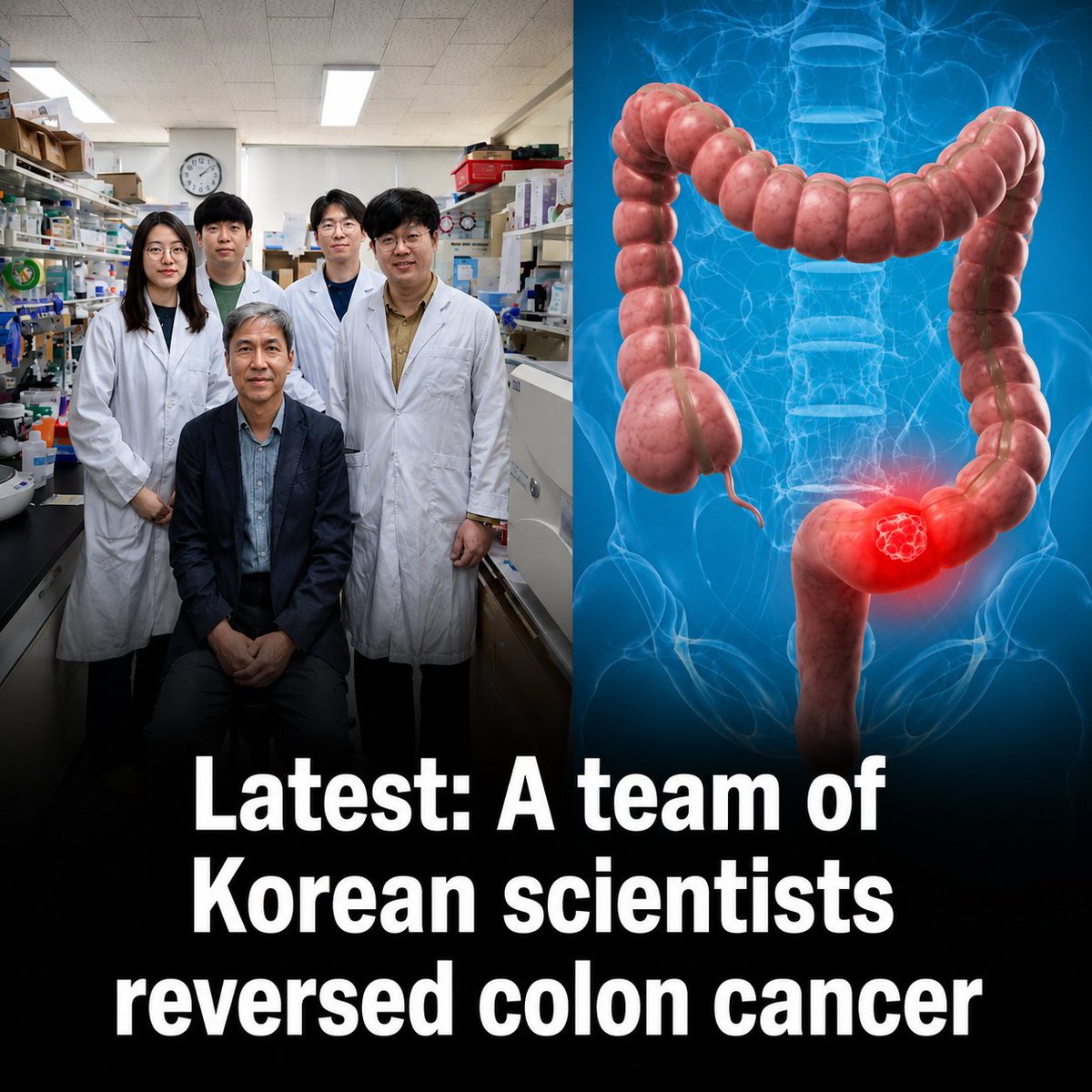
They didn't kill the cancer. They told it to go home.
A team of Korean scientists at KAIST just pulled off something that sounds like science fiction.
Instead of nuking colon cancer cells with chemo or radiation, they convinced them to turn back into normal, healthy colon cells.
No killing. No collateral damage. Just a quiet U-turn at the cellular level.
Here's how it works.
Led by Professor Kwang-Hyun Cho at the Department of Bio and Brain Engineering, the team built a "digital twin" of the gene network that controls how a normal cell becomes cancerous.
They ran simulations. They hunted for the exact moment a healthy cell flips into a malignant one.
Then they found the switches.
Three master regulator genes — MYB, HDAC2, and FOXA2 — were the keys to the whole transformation.
Flip those switches back, and the cancer cell stops behaving like a cancer cell. It starts looking and acting like a normal enterocyte, the kind of cell that lines a healthy intestine.
No gene editing. No permanent rewiring. Just the body's own natural signals, used in reverse.
The team confirmed it in molecular experiments, cellular experiments, and animal studies. The malignant cells stopped multiplying out of control and went back to doing their actual job.
The research has already been handed off to a company called BioRevert Inc. to develop into real-world treatments.
This isn't a cure tomorrow. But it rewrites the entire playbook for how we think about cancer.
You don't always have to destroy the enemy.
Sometimes you just have to remind it who it used to be.
Source: KAIST / Advanced Science (Gong et al., 2024) via ScienceDaily and OncoDaily
Jess is absolutely right; consider the impact of your vote and reflect on what has happened to our country since the 2024 election. The actions of this administration may have caused damage to our nation and global reputation that might never be fixed. #DemsUnited
Buttigieg: "In my experience, Sen. Cassidy is a normal, honest, and very conservative Republican. It turns out people like that have less and less of a home in Donald Trump's Republican Party. We are seeing more extreme candidates. It's organized more and more around one man, who remains deeply unpopular."