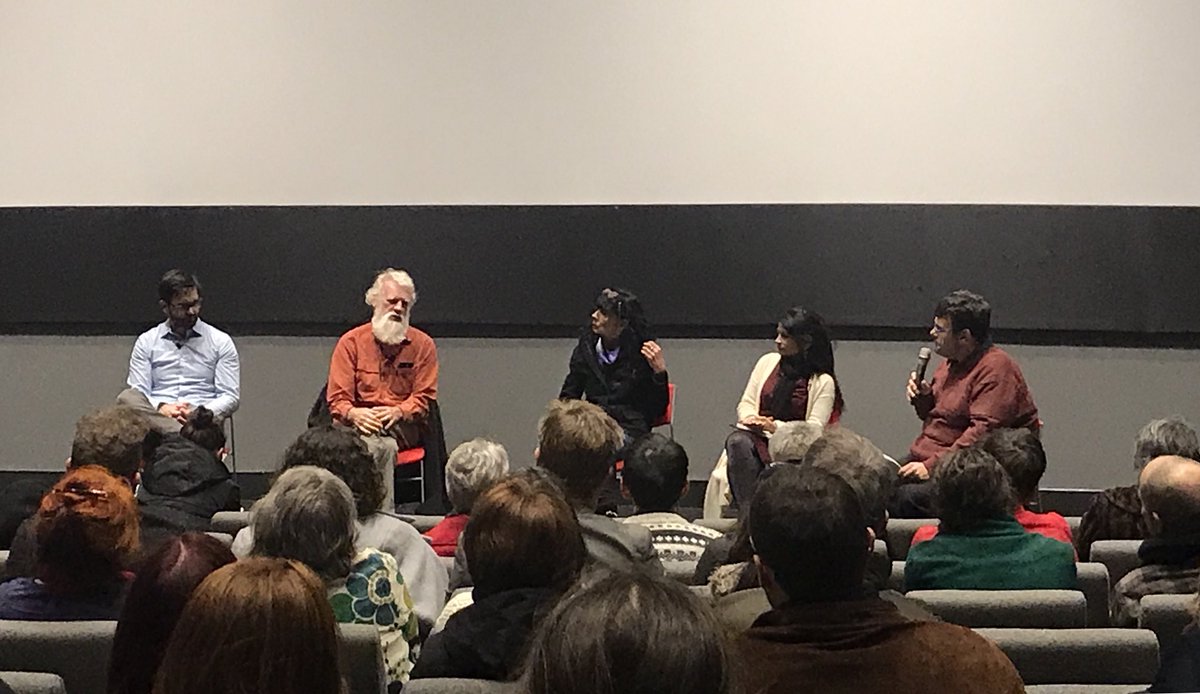
Aunty Jeanine: I can understand why we need some form of categorisation but I feel that genre is problematic to me, my stories don't fit within those structures. Sometimes I have to subvert those structures out of respect or responsibility.
Shannon is charting a link between the decline of the Western canon in intellectual fashion with the increasing access that working class people can have to that work through publishing distribution and popular culture.
Uncle Bruce: If you can write you have a responsibility, the world is in peril. Everything you write has to be with that consciousness. To fail to acknowledge that responsibility is cowardice. We have to uses voices responsibly to encourage the world.
Uncle Bruce: @BangarraDance have done so much for our community by bringing our stories forward through dance. I love the company, I love their ethics, I love their skill, I was extremely proud to have them adapt Dark Emu.
Michelle: The difficulty of getting fiction published is often about who you are. I'm interested and challenged by how difficult it is for the mixed ancestry voice to be heard.
Shannon: I wanted to mark out something of myself. To challenge some of the assumptions people had about me because of the nature of my intellectual work.
Bruce Pascoe: “HOW WE LOVE OUR COUNTRY IS GOING TO SAVE OUR BACON... I don’t think I write a sentence that doesn’t remember that”. #LitInterface#Naidoc2018
The question of genre has been raised in both the Writing Sex & Gender and Writing & Political Change panels, echoing the important work being done on Genre Worlds by @lmfletcher72, David Carter, Kim Wilkins, and @Beth_driscoll aka @PopFicDoctors 💕 @LitInterface#LitInterface
Uncle Bruce: Australia has allowed important knowledge to disappear from the history books. If we're going to look after our children we need to tell them the truth. How we know our country is going to save our bacon (unless you're a vegetarian).