Working on the future of civil litigation. Former litigator, now litigation KM, pricing, and innovation. Amateur coder & fledgling ML practitioner. Views own.
Across Canada, our justice system is under attack. In British Columbia, the New Democratic Party is erasing the law society, eliminating with it the independence of lawyers.
This is a great paper. LLMs cannot plan and reason on their own -- they're pattern-matchers. But that doesn't mean they can't be useful for reasoning. They work best *in conjunction* with systems that can actually plan or reason -- such as symbolic planners.
Annual Twitter Tradition. Fathers Day and Pride in June. People can have complicated feelings this time of year so I'll make the same offer I make every year. If you like the LAST TWEET of this thread, I'll msg you to say, unironically, that I love you and am proud of you. 1/4
This chart is a great rebuttal of the view that RAG will solve hallucination. In the legal domain, it turns out that it does improve precision somewhat, but at the expense of recall. Really great paper by Stanford & Yale researchers assessing legal AI. https://t.co/jMYtAXDSiP
UK and US law have infected LLMs (according to Linklaters).
I shudder to think what LLMs have learnt from being trained on US contracts:
- big slabs of verbose text
- pointless legalese
The broader conclusions are not surprising: LLMs don't produce reliable legal advice.
Do the RAG GenAI systems of the big law tech companies give the “hallucination-free” drafting assistance they claim?
@chrmanning & Mirac Suzgun aided a @Stanford RegLab study showing they do much better than GPT-4 but still hallucinate about 1 time in 6.
https://t.co/QUsVir5XUx
The talk about hallucinations in LLMs has gotten it all wrong. The true hallucinations are by company execs who think it is OK to release to general users products that are based on LLMs that confabulate wildly, as all LLMs do. Time will show a high price paid by society.
For those interested in watching via Zoom, on June 13 at 12 noon, the @ONCA_en will determine whether the public has any right to know how many cases go to trial or how long they take to get there, and whether the open court principle really applies in Ontario.
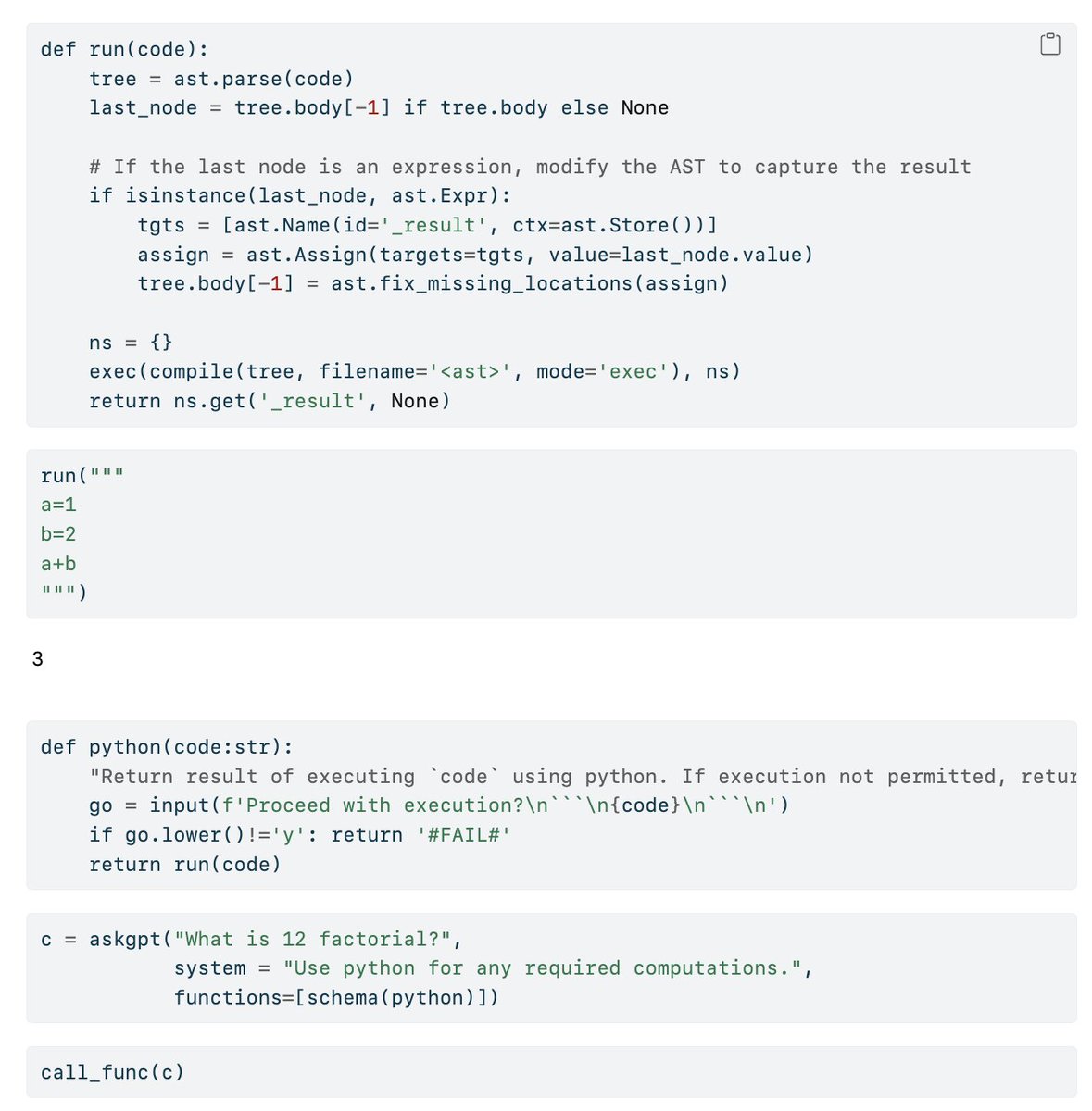
Below is an explanation of "Agentic" workflows in ~ 15 LOC. At its core, "Agentic" just means LLMs that can call functions.
Another ex of how unnecessary jargon confuses people
https://t.co/w0YYsxoyLT
Our paper dissecting AI hype in law by @sayashk, @PeterHndrsn and me is now officially published. https://t.co/xsNWgY5vWD
Legal Tech is a well established industry and language models offer many avenues for improving existing products. But a robot lawyer isn't on the cards.