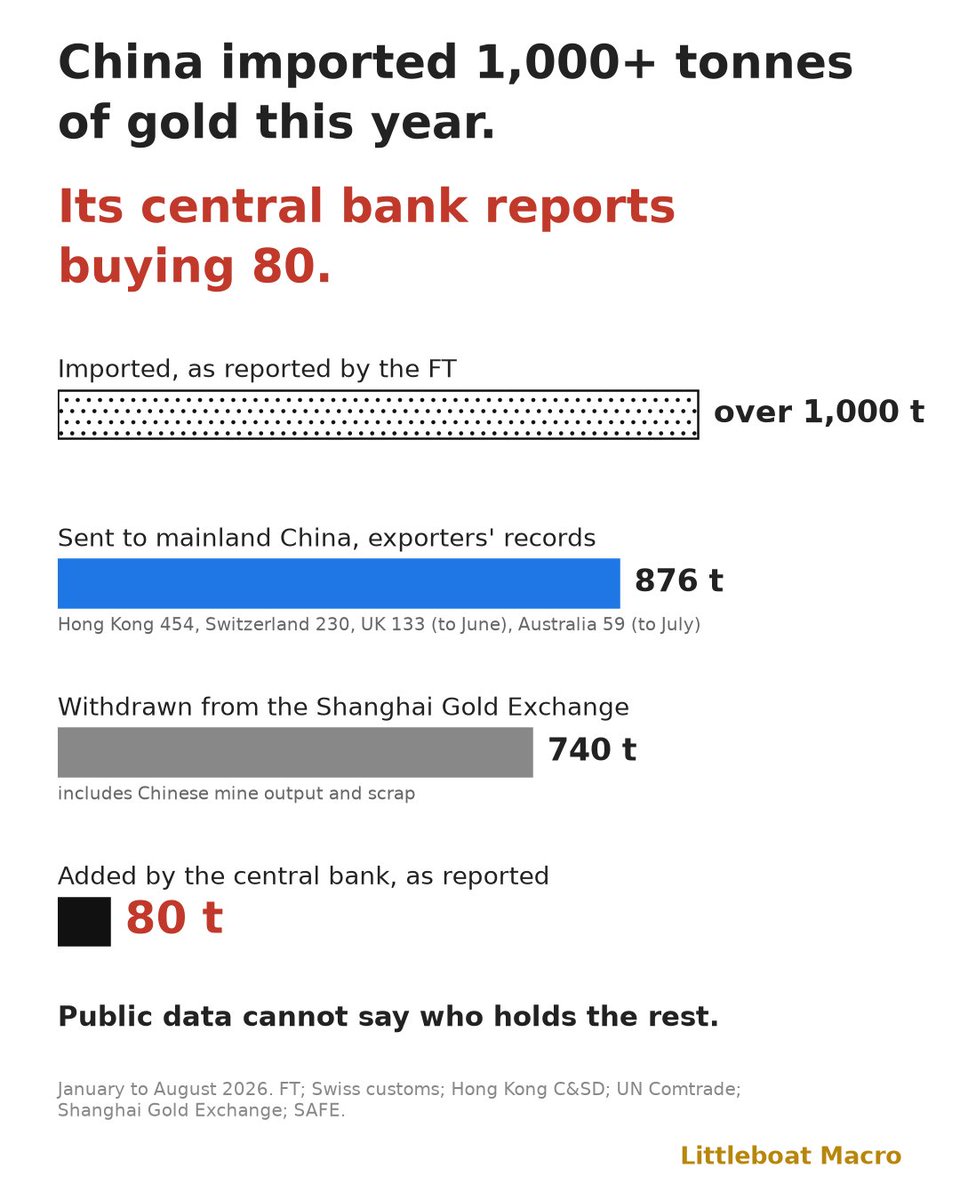
China imported more than 1,000 tonnes of gold in the first eight months of 2026. Its central bank reported buying 80. So are we back on a gold standard? No. There is no fixed price and no convertibility, and gold is 21% below its January high. But on the question underneath it, gold or Treasuries, reserve managers have picked a side: • As gold fell, central banks outside the US added 174 tonnes (February to July) • Foreign official holders sold $236bn of Treasuries over the same months • Central banks kept adding as the price fell. What slowed was Chinese private buying From gold's high, oil rose 88%, broad commodities 30%, and speculators' copper longs reached their highest since 2024. Foreign official money did not go back into Treasuries. China's side, first eight months: • Its trade surplus grew $24bn. Its precious-metal imports grew $109bn • It bought 15% less crude at war prices and held its oil bill flat • Most of its other extra imports were chips and computers And the claim that cheap Chinese debt proves the point? China's 10-year is second lowest of 20, a point above Switzerland. It fell with China's inflation. Not a gold standard. A gold preference. Sources: FT, IMF, US Treasury, CFTC, China customs, SAFE.
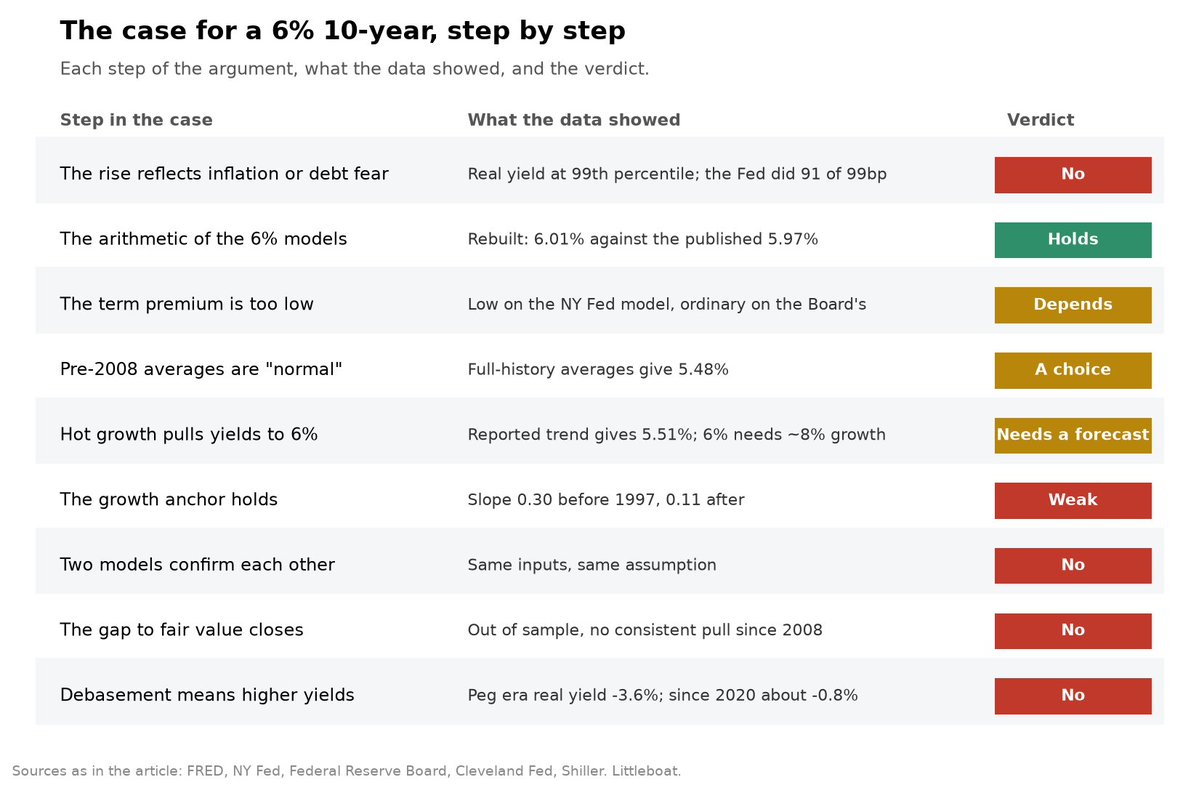
8/ So: 6% is fair value on one assumption, the pre-2008 world with nothing holding yields down.
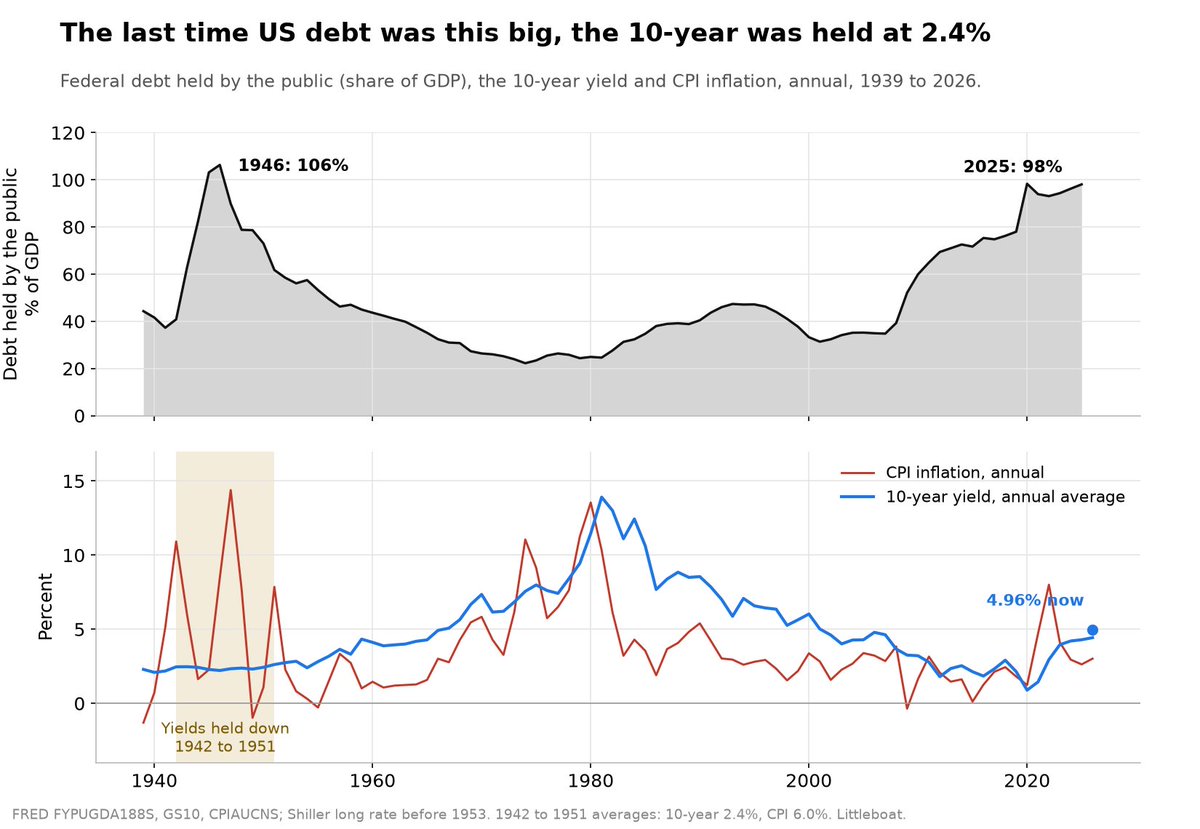
Debt is 98% of GDP. Only 1945, 1946 and 2020 were higher. Last time, yields were held down.
The maths says 6%. The record says that isn't what decides.
https://t.co/VamADj9enB
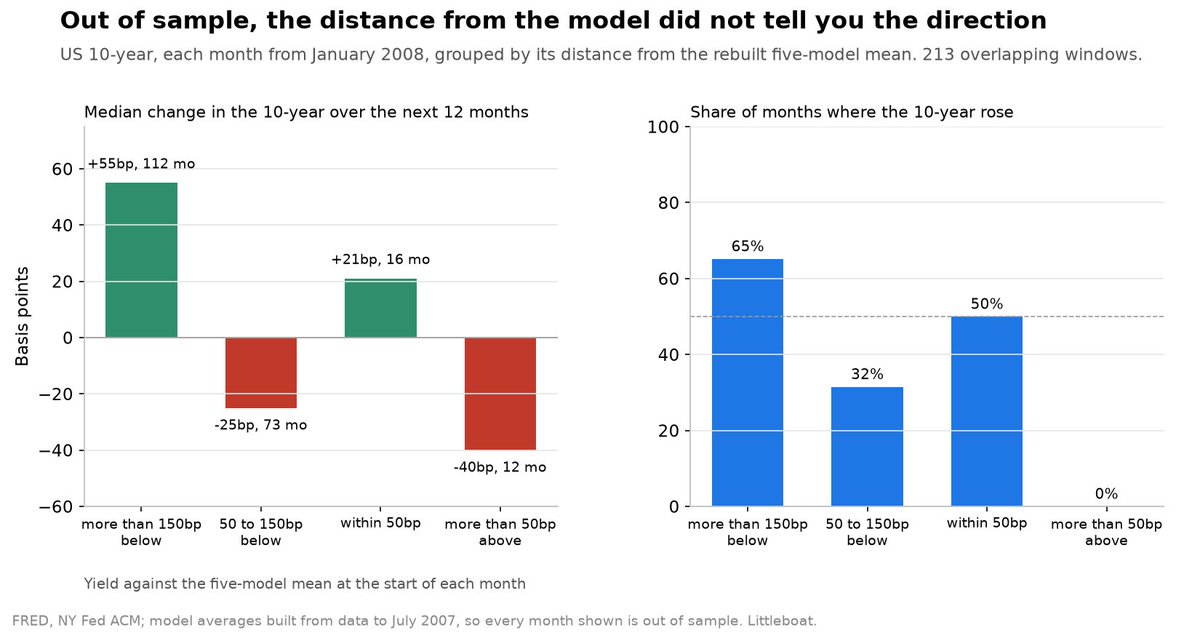
6/ The real test. Pre-2008 averages never saw anything after 2007, so every month since is out of sample.
The 10-year sat below "fair value" in 92% of those months. At one point by 480bp.
The gap to fair value did not tell you which way yields went next.
7/ "But debasement."
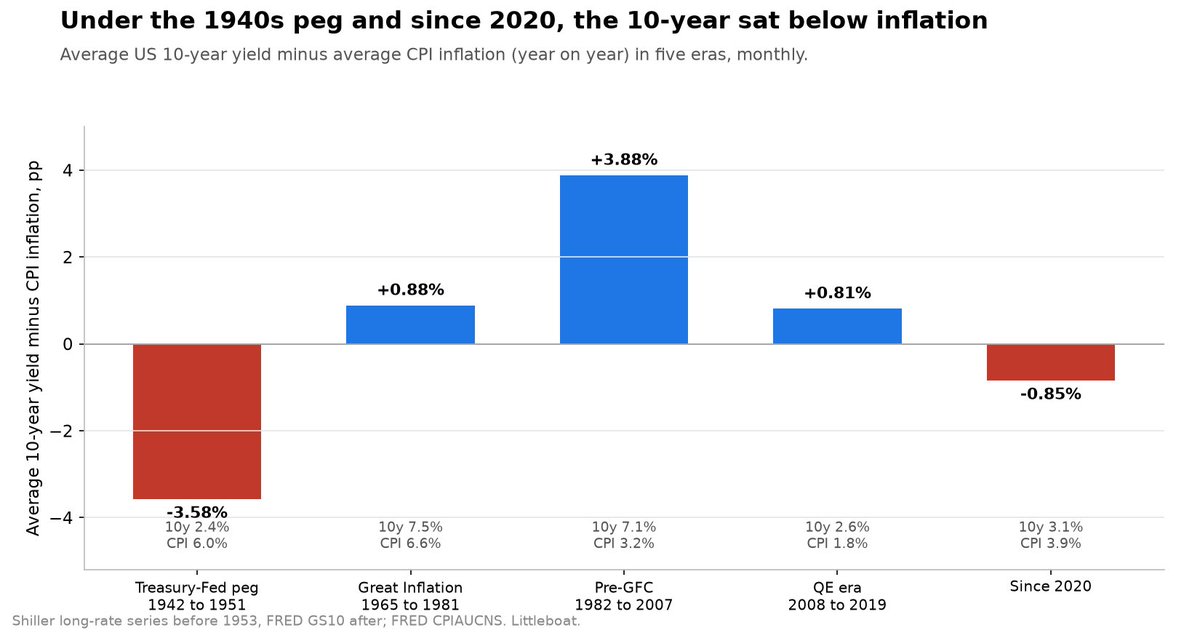
The last time the US inflated a war debt away, 1942 to 1951, the 10-year yielded 2.4% while inflation ran at 6%.
Real yield: minus 3.6%.
That debasement did not push yields up to fair value. It held them below inflation.
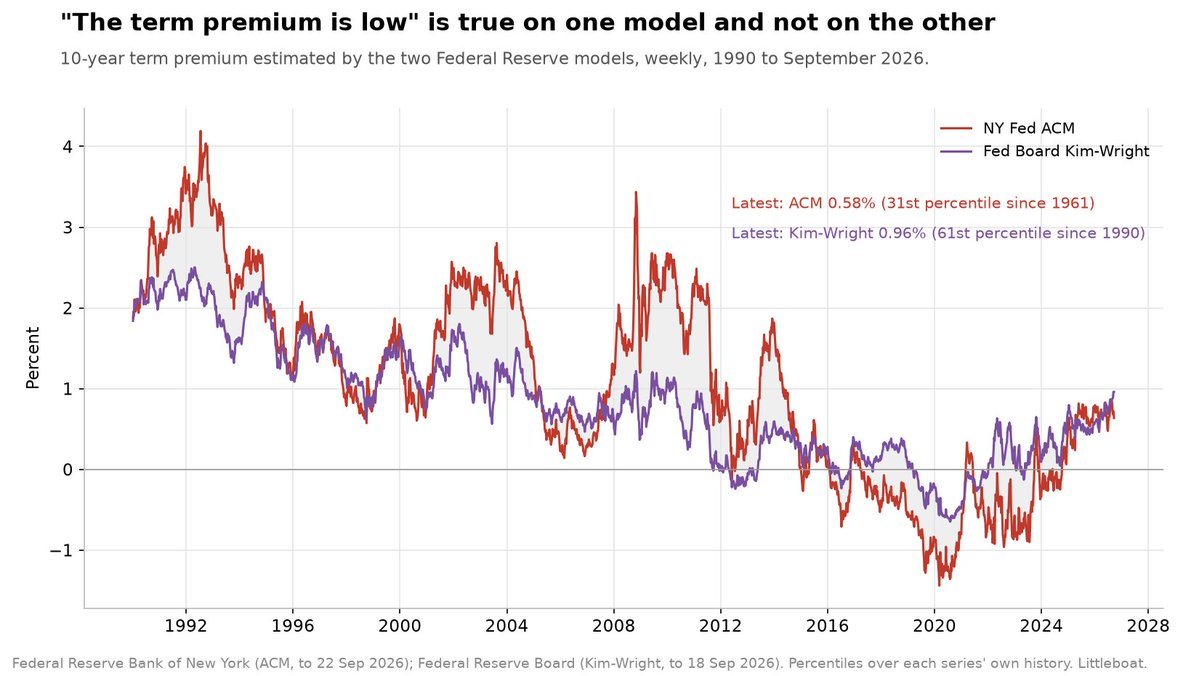
5/ "The term premium is too low" is the other pillar.
On the NY Fed's model: yes, 0.58%, 31st percentile since 1961.
On the Fed Board's own model: 0.96%, 61st percentile, and up 50bp this year.
Two Fed models, two answers.
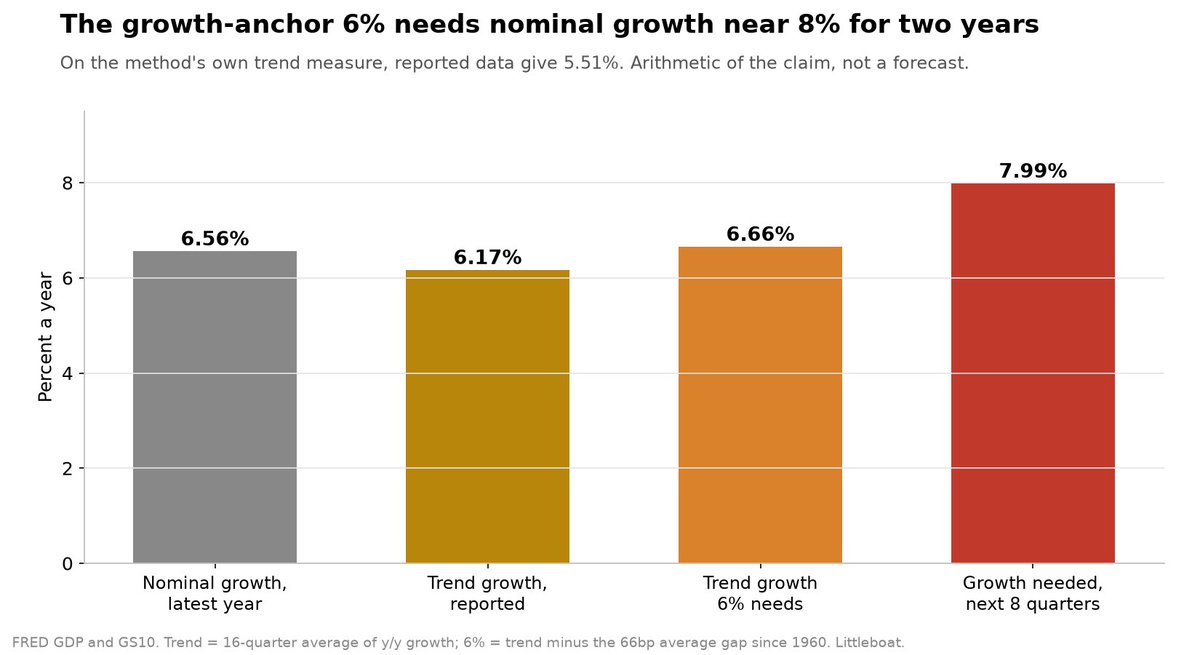
3/ The second anchors the 10-year to trend nominal GDP growth.
On the growth actually reported so far, it gives 5.51%.
To reach 6% it needs nominal growth near 8% a year for the next two years. The latest print is 6.56%.
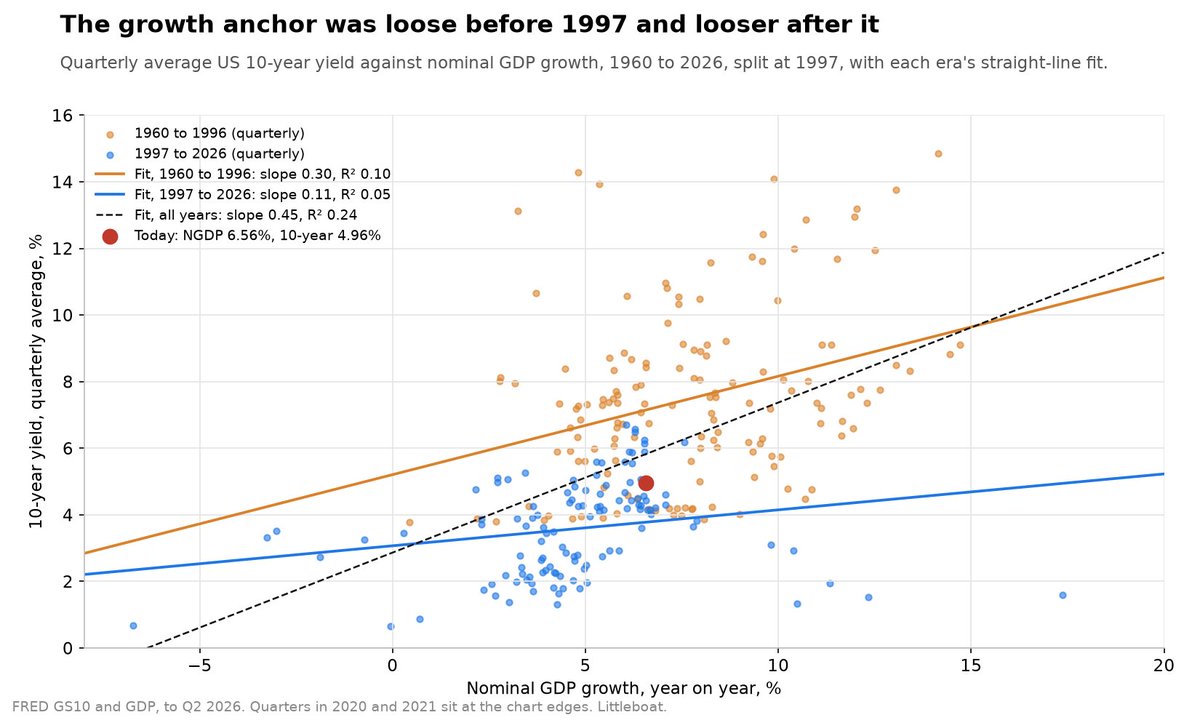
4/ Both lean on one idea: yields track nominal growth.
Before 1997 the fit was loose. Since 1997 it has barely existed.
Slope: 0.30 to 0.11
R²: 0.10 to 0.05
On the post-1997 fit, today's growth maps to a 10-year of 3.78%.
2/ Two widely followed models get to 6%. The first: five models, each asking where the yield sits if one driver returns to its pre-2008 average.
Rebuilt on FRED and NY Fed data: 6.01%, vs the published 5.97%.
On the full history instead: 5.48%.
Put the pre-2008 world back and the US 10-year's fair value is 6%.
Assume 4% inflation: 6.6%.
The last time US debt was this big, the 10-year was held at 2.4% while inflation ran at 6%.
The fair value isn't the question. Whether the yield is ever allowed there is.
1/8
@vohvohh Yes seems pretty clear institutional adoption is on avalanche. This might be a huge mispricing opportunity for those who understand the push for tokenization and the chains that can support what the needs are.
Implication 4: the destination is not measured yet.
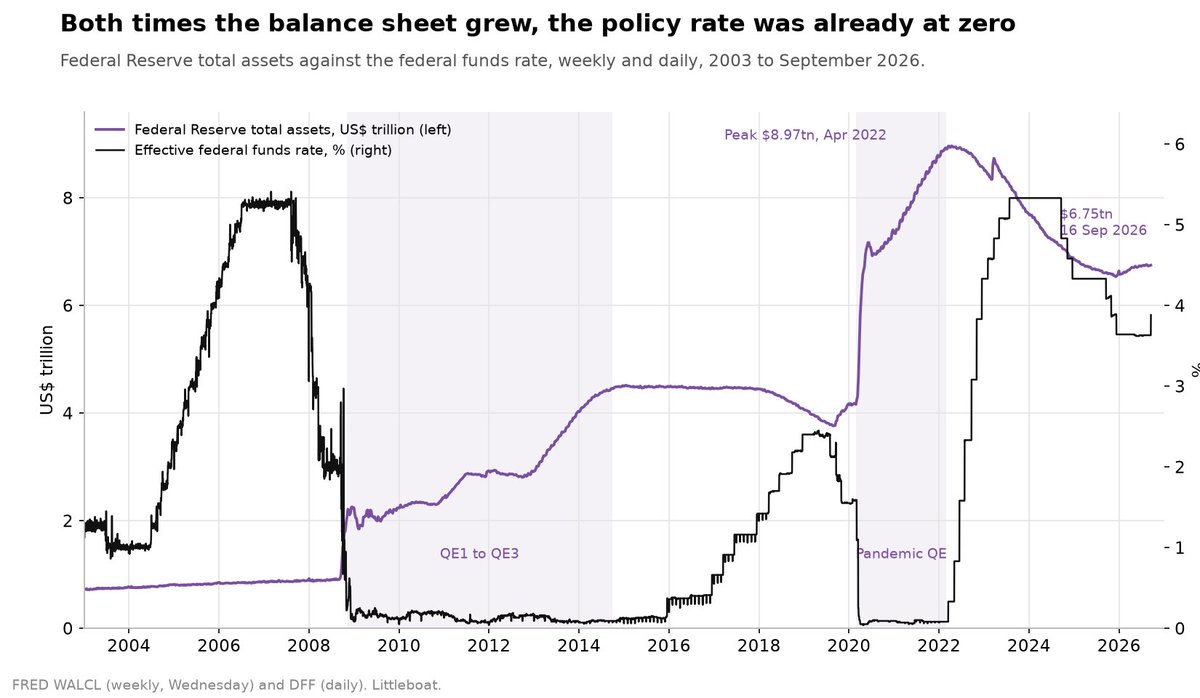
Nine hiking cycles since 1974, cuts followed every one, median five months. Two episodes of printing, both at a zero rate. The balance sheet is $6.75tn, falling. Tighten then cut is the record. Tighten then print is not, yet.
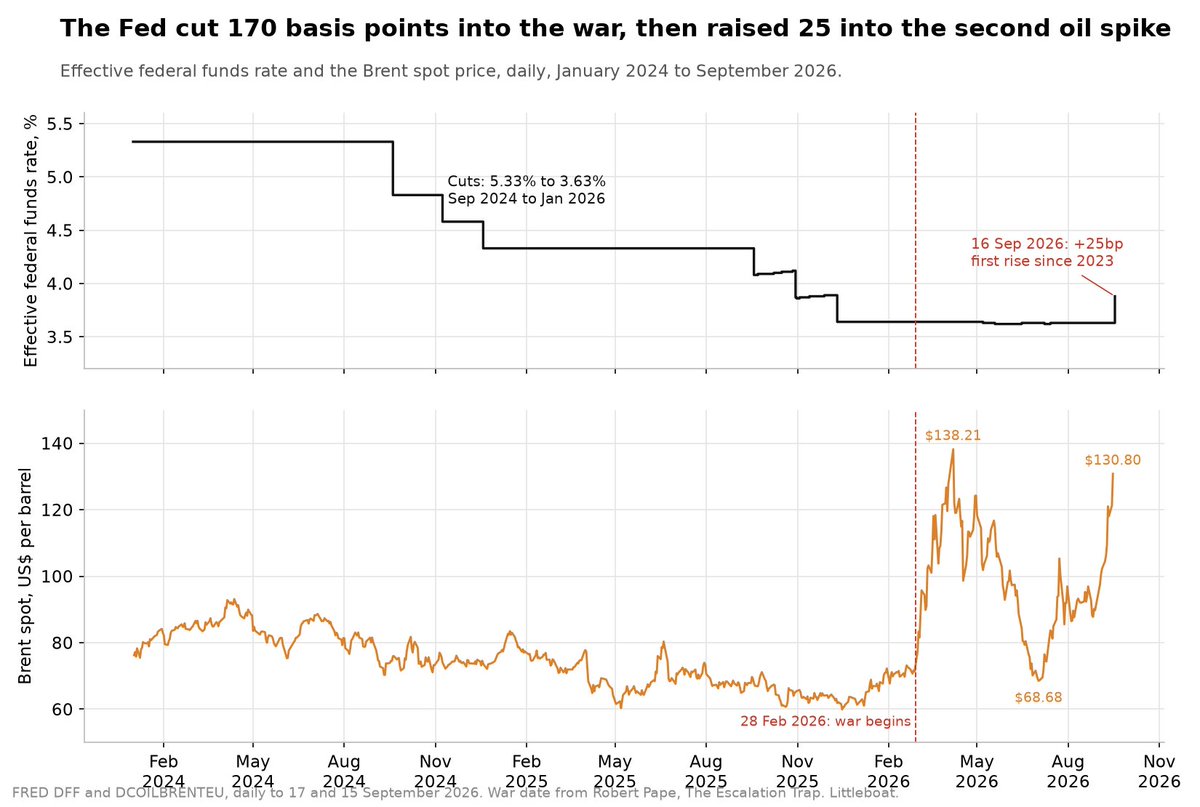
The Fed raised 25bp on 16 September with Brent at $130.80.
On the record, a rate rise works on the slowest part of inflation, pays the households it is meant to slow, and reaches oil only through a recession. Three questions, nine charts:
https://t.co/uNLwjf5dvo
Implication 3: the fiscal cost of a rise arrives faster than the disinflation.
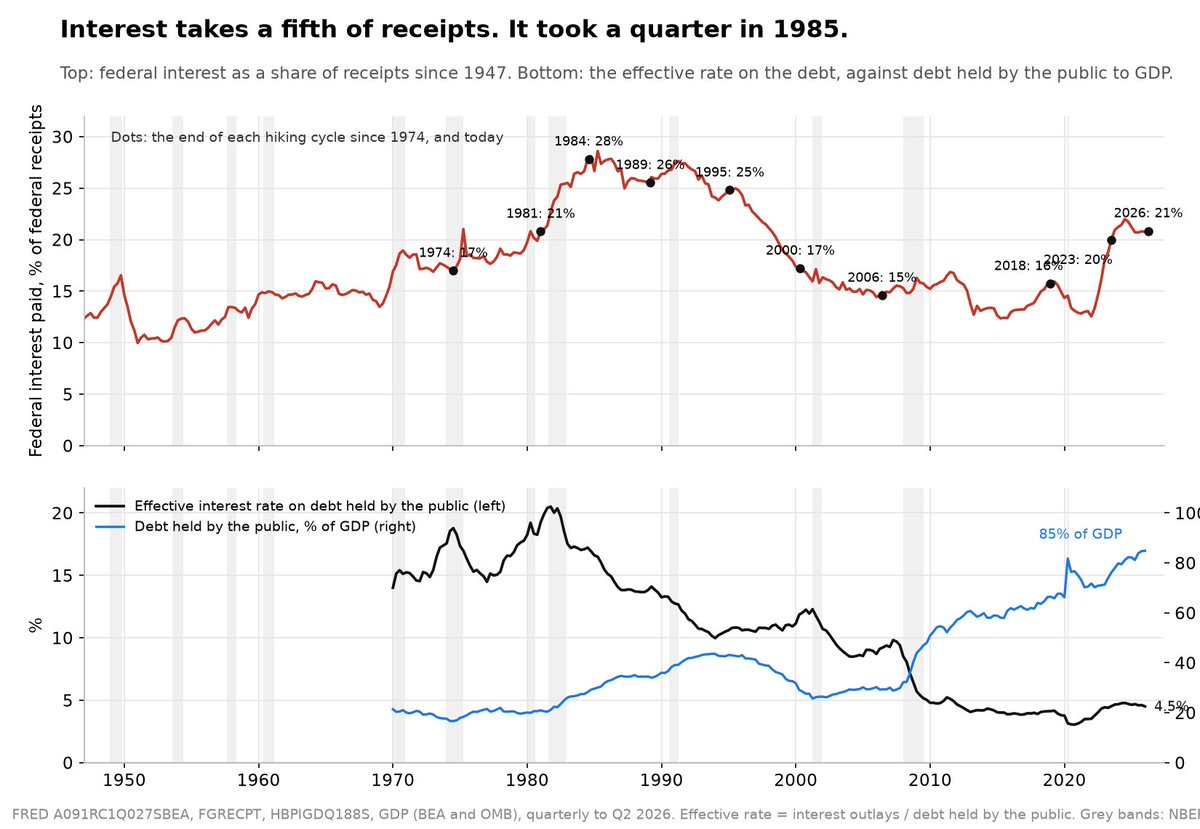
Federal interest went from 12.6% of receipts to 22% in ten quarters last cycle. Core took 24 months to fall three points. Interest was 28% of receipts in 1985, at 16% on 30% of GDP. Now 4.5% on 85%.
The East West pipeline did not take a scratch. Three pumping stations got hit. That is not a three day weld job. April’s single station outage was fixed fast. This is multiple stations, specialised kit, and skilled crews under fire risk. The “back in days” line is a bypass story, not a rebuild. Full repair is weeks. Months if the bypass gets hit again. Warsh can hike funds to 4%. He cannot repair a Saudi pump. Physical scarcity does not clear on the dots.
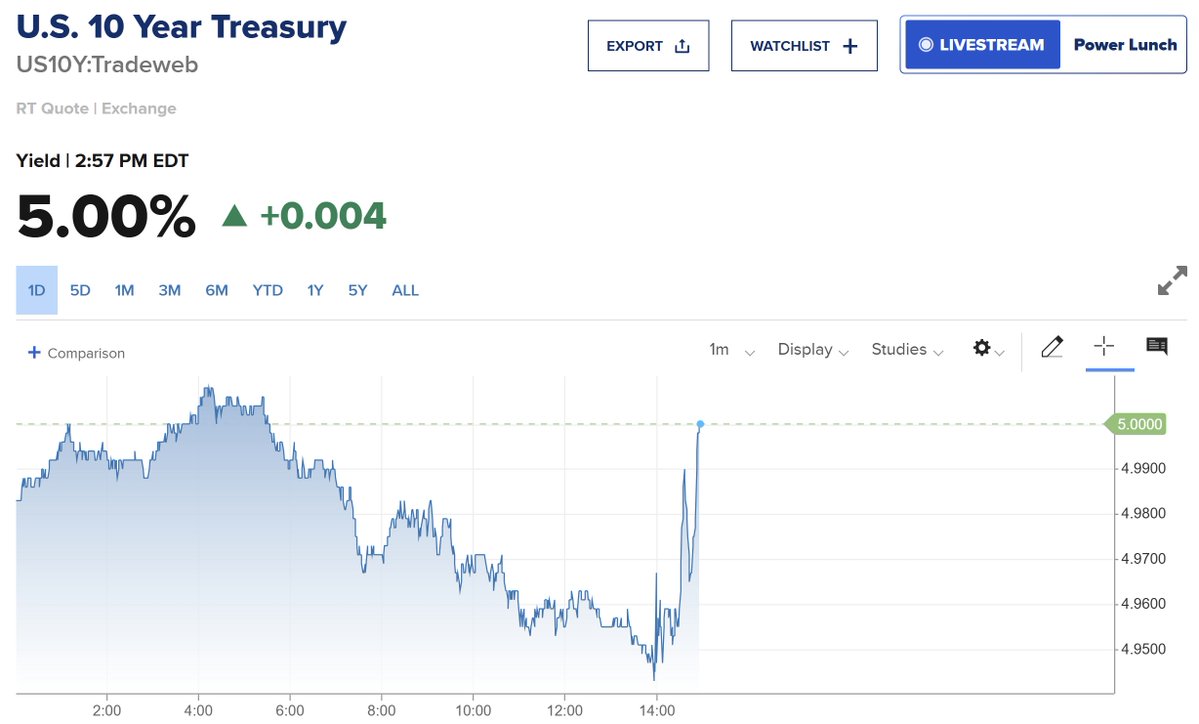
Warsh hiked funds to 3.75% to 4% and the market still sold the long end. That is the tell. A hike that leaves the 10y higher is not a credibility win. It is the market saying front end hawkishness does not clear an energy shock or a financing wall. Bessent can buy back duration. Until yields fall on the hike, not rise into it, the Committee has not bought the peace it thinks it paid for.
Meaningfully increasing prospective Federal deficits is a reason to sell bonds, not buy them.
This is true whether you increase deficits by going to war or by the Fed raising rates instead of cutting rates.
Check to you Warsh and Bessent.