@EricRSammons@TheKingDude Assuming the accurate articulation of the initial post, it’s particularly sad that a priest doesn’t understand that distinction or even the heresy/schism distinction.
@EricRSammons@TheKingDude To avoid confusion for your readers, I think your second parenthetical meant to say “can do that.”
Thanks for your clarification on that. I see a lot of Catholics who apparently don’t understand Penance and Matrimony require jurisdiction distinct from, e.g., the Eucharist.
@Zacbunchanumbrs@Aquinas_Quotes I believe he’s saying she was intimate with a man she believed to be her husband. Similar to when Jacob thought he was sleeping with Rachel, but it was her sister Leah. (Gen. 29)
“A library is not a luxury but one of the necessities of life, because it is there that a civilization stores its memory and teaches the next generation how to think.”
— Henry Ward Beecher
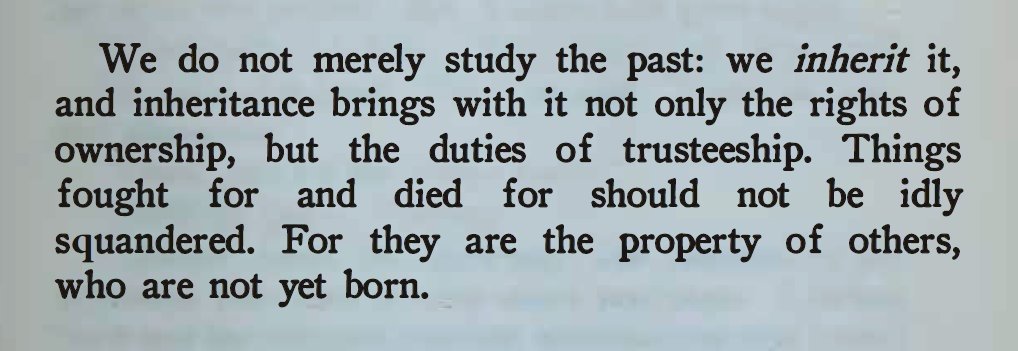
“Let every man remind their descendants that they also are soldiers who must not desert the ranks of their ancestors, or from cowardice fall behind.”
— Plato
“A man should hear a little music, read a little poetry, and see a fine picture every day of his life, in order that worldly cares may not obliterate the sense of the beautiful which God has implanted in the human soul.”
-Johann Wolfgang von Goethe
"To the first point, thus proceeding, It seems that law is not something of reason. For, as the Apostle says (see Rom. 7), 'I see another law in my members' etc. But nothing that is of reason is in the members, because reason does not make use of a bodily organ. Therefore law is not something of reason.
Furthermore, in reason there is nothing but potency, habit, and act. But law is not potency of reason itself. Similarly, is it also not something of the habit of reason, because the habits of reason are intellectual virtues, as is stated above. Neither also is it an act of reason, because when reason ceases, the law ceases, as in the case of sleep. Therefore law is not something of reason.
Furthermore, law moves those who are subjected to law to the right things that ought to be done. But to move to things that ought to be done properly pertains to the will, as is clear from what has already been demonstrated. Therefore law does not pertain to reason, but more to the will, according to which also the Jurist says, 'That which pleases the prince has the force of law.'
On the contrary, it pertains to law to command and prohibit. But to command is of reason, as stated above. Therefore law is something of reason.
I respond, that law is a certain rule and measure of acts, according to which something is induced to action or to refrain from action, for it is said that lex is derived from ligando, because it obligates to action. But the rule and measure of human action is reason, which is the first principle of human action, as has clearly been shown, for to order to an end is of reason, which is the first principle of action, according to the Philosopher."
That's enough for now. This is challenging.
@JeffCassman@lukei4655 If I remember correctly, prior iterations of canon law (at least as recent as the 19th century with St John Vianney) said that once being named pastor, the priest had the canonical right to remain there until death (apart from adjudication otherwise) for that very reason.
@JeffCassman@lukei4655 That doesn’t seem like the right lens with which to view this. A pastor is a spiritual father, and there should be long term continuity between him and his spiritual children. We don’t rotate new parents every 6 years.
The secular power is subject to the spiritual, even as the body is subject to the soul. Consequently the judgment is not usurped if the spiritual authority interferes in those temporal matters that are subject to the spiritual authority or which have been committed to the spiritual by the temporal authority (ST 2-2.60.6ad3)