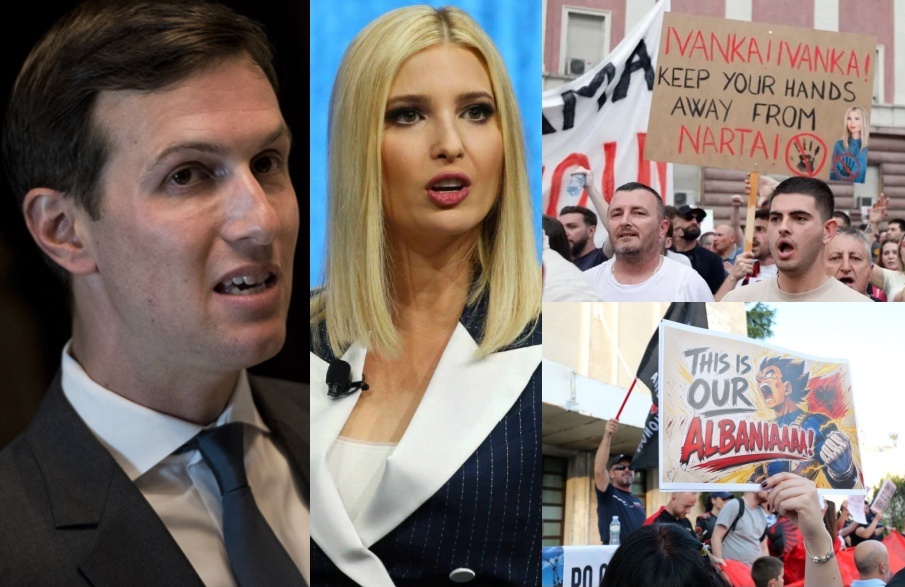
BREAKING: HELL YES! Albania strikes a crushing blow against Jared Kushner's corrupt private island development by FREEZING the bank accounts of a major company tied to the project.
And it gets even better...
According to Albanian reporter Lindita Cela, the nation's anti-corruption prosecutors have frozen the accounts of a landholding company involved in Kushner's $4 billion luxury resort plans.
The move comes as massive protests sweep the country, with local residents incensed at the idea of Ivanka and Jared gobbling up coveted real estate to create a vacation spot for the Epstein Class. The slogan “Albania Is Not for Sale" has been spreading like wildfire and clashes between police and protestors are increasing in intensity.
The asset seizure was ordered by the Special Prosecution Against Corruption and Organized Crime and is part of a broader investigation into possibly fraudulent property titles.
Suspiciously, the company in question is owned by Qatari oligarchs Moutaz and Ramez Al-Khayyat. Kushner's ties to dirty Gulf money are well-established. They blossomed during his time in the first Trump administration, where he twisted American foreign policy to benefit specific actors in the region in return for massive investments and business advantages. This deal is rotten all the way to the core.
The Al-Khayyats have snatched up property along a protected stretch of coastline of the Adriatic Sea and it's here and on a nearby island that Kushner intends on erecting his resort for the top 1% of the top 1%. Given what we know about the Trump family, it's safe to presume that the development will serve as a paradise for pedophiles, war criminals, and human traffickers.
But this time, Jared bit off more than he can chew. Albanians are a proud, defiant people. They've survived centuries of larger regional powers seeking to divide their land, rewrite their history, and erase their culture. They're not going to let one greedy businessman defeat them now.
We stand with Albania!
Kushner out! Ivanka out!
Do you stand with the Albanian people?
Please ❤️ and share to demand more investigations into Kushner!
⛔️The Major Corruption Story behind the Albanian Island scandal‼️
⛔️ - **Summer 2021**: Jared Kushner vacations on Nat Rothschild's yacht, meeting Albanian PM Edi Rama, initiating a private project linked to the U.S. president.
⛔️- **June 2021**: Saudi Arabia's Public Investment Fund (PIF) commits $2 billion to Kushner's Affinity Partners, despite internal recommendations to reject the proposal due to Kushner's inexperience.
⛔️- **December 2024**: Qatar Investment Authority and Abu Dhabi's Lunate invest an additional $1.5 billion in Affinity, raising total assets to $4.8 billion. Kushner announces the funding round closed before the election.
⛔️- **December 8, 2024**: Bashar al-Assad's regime falls, leading to the rise of Al-Golani - AKA- Ahmed al-Sharaa's transitional government, while the Caesar Act restricts reconstruction funding.
⛔️- **December 30, 2024**: Albania grants strategic investor status to Atlantic Incubation Partners LLC, linked to Kushner, just before Trump's second inauguration.
⛔️- **May 13-14, 2025**: Trump unexpectedly announces plans to lift U.S. sanctions on Syria, meeting with al-Sharaa and MBS the following day.
⛔️- **Summer 2025**: Mohamad Al-Khayyat pitches a Syrian coastal megaproject to Congressman Joe Wilson, who suggests branding it as "Trump" to gain attention. Khayyat presents a foundation stone for "Trump International Golf Club, Syria" to Wilson.
⛔️- **August 25, 2025**: U.S. officials, including Senator Jeanne Shaheen, meet the new Syrian president, al-Sharaa, as sanctions are lifted, paving the way for Syria's recovery.
⛔️- **November 2025**: UCC Holding signs a $4 billion deal to redevelop Damascus International Airport, marking the first major reconstruction project post-sanctions.
⛔️- **December 18, 2025**: Trump signs the FY2026 NDAA, which repeals the Caesar Act, quietly removing sanctions against Syria.
⛔️- **January 21-22, 2026**: Ivanka and Kushner visit Albania, attending a working dinner with PM Rama and local business leaders.
⛔️- **January 22, 2026**: Trump hosts the Board of Peace charter signing at Davos, with Albania as a founding signatory, enhancing Rama's profile.
⛔️- **February 19, 2026**: Rama participates in the inaugural Board of Peace meeting in Washington, photographed with Trump and other officials, as Trump pledges a $10 billion contribution.
⛔️- **April 1, 2026**: Sazan Operations, the implementing company for the project, is registered in Albania, linked to the Khayyat brothers.
⛔️- **April 19, 2026**: An investigation confirms the Khayyats' partnership with Kushner, indicating that sanctions were lifted at Kushner's request to facilitate Ivanka's investment in Albania.
It's fascinating to watch US elites & policymakers try to navigate the following contradiction:
1. China's (AI-fueled) productivity boom is "taking everyone down”
2. The coming US AI-fueled productivity boom (that’s driving the US stock boom) won't hurt US employment at all
🤔
Albania's Prime Minister just LOST IT on live CNN "LET ME FINISH!" "WHAT'S WRONG WITH YOU" - As nationwide protests intensified over selling protected coastal land to foreign investors linked to Trump and Kushner
What China just did with the blocking statutes against U.S. extraterritorial sanctions sets quite a major precedent, probably the financial equivalent of what happened with rare earths last year (in the sense that this is China taking a major step to push back against a U.S. hostile measure as opposed to taking it on the chin).
It's a little complex but, to start with, what many people ignore (and will probably be surprised by) is that - by and large - Chinese companies and financial institutions have largely complied with extraterritorial U.S. sanctions.
Anecdotal story on this: I know for a fact, because I personally know the person, that a very famous guy (whose name I won't reveal but that everyone of you would know) sanctioned by the U.S. was in China recently and tried to exchange money at the counter of a random Chinese bank. Just simply exchange dollars for a Chinese yuan, in mainland China. And he was refused, because he is sanctioned by the U.S. - despite the fact that China as a country has absolutely no problem with the person.
This goes to illustrate just how much goodwill China extended to the U.S. on this - a Chinese bank, in China, refusing to serve someone China has no problem with, just to comply with U.S. extraterritorial sanctions.
It also goes to illustrate why this blocking order marks such a sharp departure.
What triggered it is not new sanctions by the U.S. but recent efforts under the so-called "Operation Economic Fury" to dramatically ramp up enforcement of existing sanctions on Iran.
The U.S. notably issued at the end of April alerts to financial institutions worldwide - including in China - on "the sanctions risks associated with independent 'teapot' oil refineries in China, primarily in Shandong Province, given their continued role in importing and refining Iranian crude oil" (https://t.co/LkHFCKdY5c)
Even more importantly, they also specifically went after Hengli Petrochemical Dalian (https://t.co/y2iGTbiu7R), one of China's largest private refineries, with 400,000 barrels per day capacity and a parent company (the Hengli Group) that's a Fortune Global 500 company.
In effect, what the U.S. extraterritorial sanctions mean is that Hengli - and all other Chinese 'teapot' oil refineries being targeted - is cut off from the dollar system, and any bank, insurer, or trading partner anywhere in the world - including in China - that deals with them risks being cut off too. Which is obviously a major hostile move by the U.S. against China (and, of course, Iran).
Except that China, this time around, is not having it.
Since 2021 they've had regulations ("Measures to prevent the improper extraterritorial application of foreign laws and measures", https://t.co/ENBSJBVor1) that gives the Chinese government power to formally prohibit compliance with foreign sanctions, and that, since this April (https://t.co/82yw0izC6z) are also extraterritorial in nature.
In effect what these regulations - and their April addendum - say is that if you comply with U.S. extraterritorial sanctions by cutting off a Chinese company, you are violating Chinese law. Any entity - Chinese or foreign - that refuses to deal with a sanctioned Chinese company because Washington told them to can be sued in Chinese courts, fined by MOFCOM, and since April, placed on a 'Malicious Entity List' with asset freezes and trade restrictions.
In a nutshell on one side you have the U.S. saying "cut them off or we cut you off" and now China says "well, if you do cut us off we're going to be real nasty with you, in China and potentially beyond."
These regulations were - until yesterday - purely theoretical: they've never actually been applied. But, yesterday, China's MOFCOM made it crystal clear this time is different: they used a statement with a triple negative, saying the U.S. sanctions "shall not be recognized, shall not be enforced, shall not be complied with" ("不得承认、不得执行、不得遵守", https://t.co/3NlBy7I1jL).
In effect you now have companies that are in the middle of this - for instance financial institutions serving Hengli - caught in quite a bind: face U.S. or Chinese hostility. It's a no-win, they need to choose a camp on this.
Concretely speaking, given that the overwhelming majority of companies affected are operating inside China, they'll obviously choose the China side.
The real question therefore is: Is the U.S. ready to act on its threat and cut off Chinese banks or other institutions that keep servicing these refineries?
Because that probably means sanctioning major Chinese financial institutions, which is a whole different level of escalation. The moment the U.S. designates a major Chinese bank for dealing with Hengli, this stops being about Iranian oil and becomes a direct financial confrontation between the two largest economies on earth, which is a much bigger deal with probable consequences for the entire global financial system.
Or will the U.S. back off, meaning China would have effectively caught their bluff, showing that extraterritorial sanctions are a lot of bark but not a lot of bite?
We'll know in the next couple of weeks I guess.
One thing is sure though: whatever happens with these refineries, the broader damage is done. China used to extend remarkable goodwill on sanctions compliance - voluntarily cooperating with extraterritorial sanctions inside its own borders even though it had no legal obligation to respect them. That goodwill has been spent.
And, from a U.S. standpoint, a China with less goodwill vis a vis U.S. financial hegemony is undoubtedly a far bigger issue than a few teapot refineries buying Iranian oil.