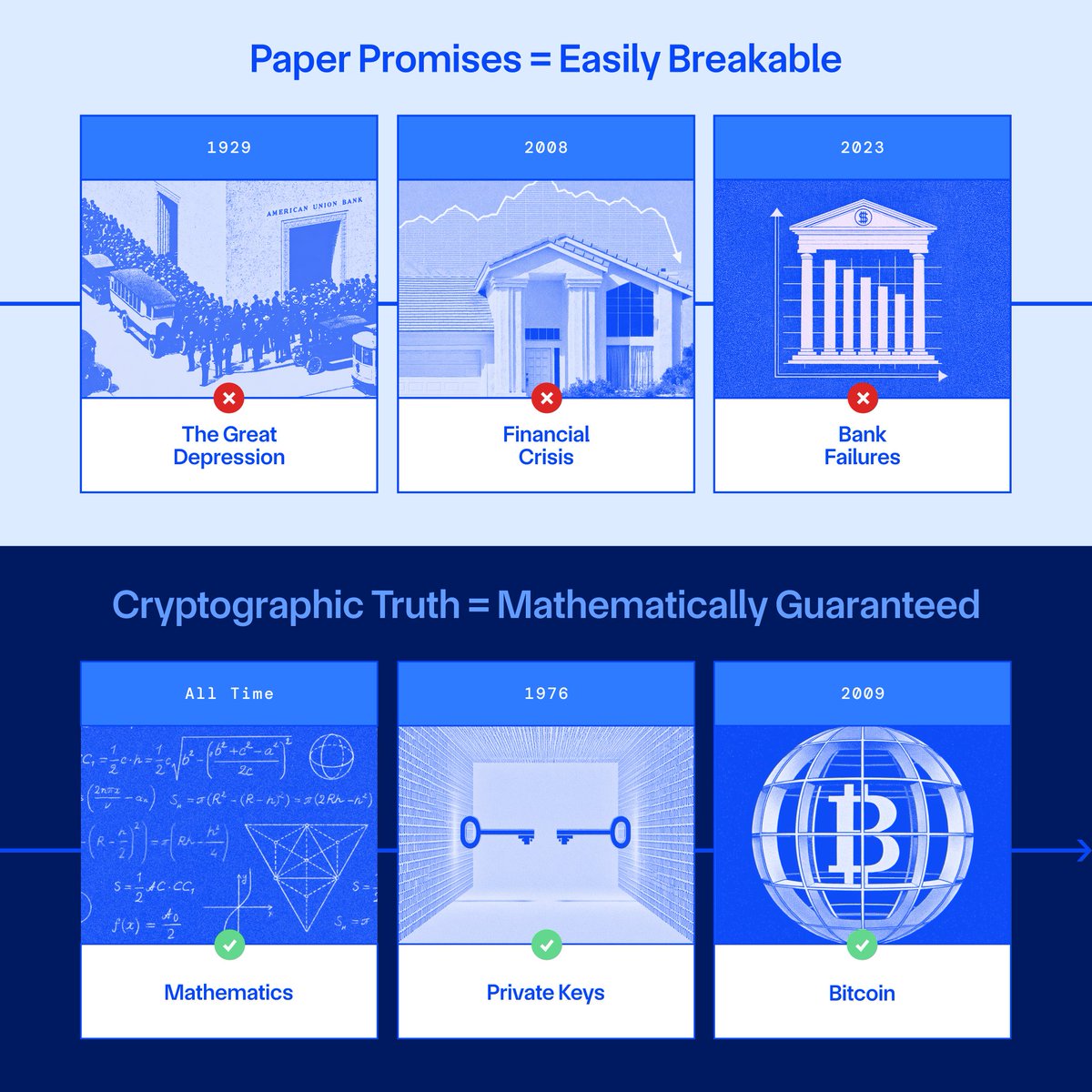
Paper promises have slowed the advancement of society.
But new solutions powered by mathematical certainty are changing how the world works.
Chainlink technology unlocks this fair, unbiased world.
Tokenization is going to be massive.
Not because it’s crypto hype, but because for the first time, you can own a fraction of a building, a fund, or a piece of private equity, without being a millionaire.
The barriers that kept most people out of the best investments are coming down.
We’re early. But it’s happening.
CALLING ALL BUILDERS: Learn how to build faster, more secure cross-chain applications with Chainlink CCIP 2.0.
Join LinkLab for a dev masterclass of CCIP 2.0’s new capabilities that provide upgraded control over cross-chain speed, security, & compliance.
Today I call upon the blockchain industry to calmly begin planning for "bunker mode". My personal recommendation is to set in motion a controlled mass migration of assets to fresh addresses, i.e. addresses whose pubkeys remain hidden behind a hash.
Holders, starting with large and sophisticated ones, should consider moving the bulk of their funds to addresses that have never signed a transaction. And when they do sign one, they should also move remaining funds to a new address (possibly generated from the same seed phrase).
Don't rush. While I believe there is cause for action a rushed migration would do more harm than good. Don't panic either. Moving assets to protected addresses is a simple, preventative step which does not require new cryptography or new wallets.
IMO it is now reasonable to brace for the possibility that ECDSA breaks before qday, in the worst case in months not years. By "break" I mean fast private key recovery (e.g. in one week) on available hardware (e.g. a large GPU cluster).
Recent days have been humbling for human mathematical intuition. Long-held, unquestioned hypotheses have fallen. This includes the n log(n) bound for integer multiplication and the 3SUM conjecture. In hindsight, May's unexpected disproof of the Erdős unit distance conjecture was our warning shot.
Yesterday's OpenAI drop made it clear that mathematical superintelligence is upon us. They say there are weeks where decades happen. We are about to live through weeks where centuries of mathematical progress happen. Could our magic 64-byte ECDSA signatures be too good to be true? Was it just security through obscurity all this time?
Elliptic curves feel especially vulnerable to superintelligence. Curves carry rich structure, with room for fancy tricks like Schoof, Frobenius, pairings. (By contrast, hashes are designed to minimise algebraic structure.)
Separately, as Ewin Tang can attest, an efficient quantum algorithm sometimes foreshadows an efficient classical one. We should be open to the possibility of a classical counterpart to Shor that breaks elliptic curves and RSA at once.
Also noteworthy is the striking under-representation of cryptographic breakthroughs among the 722 mathematical results OpenAI published. I've witnessed first-hand the US government censoring academic quantum cryptanalysis results. Backroom interventionism is my base case.
I urge large, sophisticated actors to lead by example. Project11's "risq list" (bitcoin-risq-list.projecteleven[.]com) is a great tracker of exposed BTC pubkeys. Binance, Bitbank, Robinhood, Bitfinex, and Tether have an opportunity to harden their cold storage. Next month I'll address institutions in London in a live Q&A (forum.ethereuminstitutional[.]org/london-2026).
Again, please do not rush. Wallets holding under 50 BTC enjoy partial cover from "Satoshi's shield", i.e. his 20K exposed addresses that hold 50 BTC each. Load-bearing signers like oracles and L2 security councils should consider rotating ECDSA pubkeys with every signed message and/or multi-signing with a hash-based schemes like SPHINCS.
Exiting bunker mode safely will require post-AI cryptography. My inclination is to go all-in on hash-based cryptography and avoid structured mathematical assumptions entirely, whether from curves, lattices, or isogenies. A single battle-tested hash (e.g. from the SHA or BLAKE families) yields plausible post-AI security.
The Ethereum roadmap on strawmap[.]org fully embraces hash-based cryptography with end-to-end formal verification as a response to the quantum threat. Those timelines must now be revisited and accelerated in light of mathematical superintelligence. I'll be pushing for maximum defensive acceleration.
EXCLUSIVE: Sergey Nazarov On The Tokenization Supercycle (And Whats Coming Next)
I hosted the first sit down interview with Chainlink’s Co-founder Sergey Nazarov at Sibos 2026.
@SergeyNazarov@chainlink@therollupco
00:00 Intro
01:55 Chainlink's Best Sibos Booth Ever
03:49 Chainlink and Swift Ledger
05:43 More Chains Means More Chainlink Value
07:44 DTCC Deeply Integrates Chainlink Data Feeds
09:56 Chainlink Solves The Digital Twin Problem
14:25 Tokenization Is Not About Tokens Themselves
17:44 Laws Will Change Then All Settlement Goes Onchain
19:38 Fragmentation Is Actually Chainlink's Tailwind
21:39 Chainlink Solves Each Problem As It Appears
23:34 Smart Contracts Defined By Sergey Nazarov
The launch of CCIP 2.0 is something we've been working on with the world's top financial institutions for a while, we have now implemented their feedback on what is needed for institutional grade bridging of data and the movement of the digital assets themselves across both public and private chains.
The response from the capital markets community here at Sibos has been very positive, and it is clear that the additional compliance, risk management, configurability and network participation capabilities of CCIP 2.0 are something that institutions find attractive and useful.
I think the digital asset industry will end up at a new level of risk management for their data all of their tokenized value; where digital assets that are not bridged via a secure method and/or are relying on data that can be manipulated, will be viewed as much more risky. If the digital assets that bridge via providers which are not secure by default and/or keep repeatedly losing bridging keys, then they will receive worse asset risk scores which necessarily leads to worse terms for their usage as collateral, their inclusion on a balance sheet, and various other use cases. In some cases we are already seeing that having unreliable bridging or easy to manipualte data for valuation is leading to some digital assets to not be accepted for collateral or other users cases at all.
We are now working closely with top FMIs, the leading banks, top asset managers, top GSIs and various capital markets technology providers to enable digital assets to operate in a derisked way, to unlock the liquidity found in public chains and to efficiently connect the next generation of digital assets to the benefits of DeFi.
https://t.co/rYzhSWCcPY
THIS WEEK’S MAJOR CHAINLINK U.S. MOMENTUM 🇺🇸
→ @SergeyNazarov joined @realDonaldTrump & top executives at the White House
→ Wyoming’s official stable token migrated to CCIP
→ Sergey Nazarov advised policymakers & industry leaders at the CFTC IAC roundtable
Accelerate 🧵⬇️
NEW: U.S. ambassador says Portugal is poised to attract more than $40B in American technology investment by 2031, making it Europe’s largest hub for U.S. AI infrastructure.
The Sub7 Security team is at Luxembourg Blockchain Week! Excited to connect with everyone attending and looking forward to great conversations. Feel free to reach out if you’re here!