Grateful to be welcomed into the @Circle Alliance Program 🤝
USDC is the settlement layer onchain finance is being built on, and it sits at the core of everything we do at Sweepr.
We are an onchain asset management platform. Users recover idle balances, trade, earn yield, and manage multi-chain portfolios from one place. Every sweep settles into USDC. Our savings layer is USDC denominated. And with @arc, Gateway, and CCTP, we are making cross-chain USDC feel effortless.
Live on 12 chains today. This is just the start.
Building the future of onchain finance alongside Circle feels exactly right.🟢
Sweep everything. Trade. Save. Earn. Grow.
Excited to share that we have joined the @Circle Alliance Program, a global network of like-minded companies and teams focused on the future of finance.
As members, we are looking forward to building new connections and continuing to learn and innovate with #USDC and web3 technology.
Learn more about the Alliance Program: https://t.co/nlY1yWo4zD
YC just put crypto back on the RFS list.
“The best time to build in crypto.”
They’re right. Bear markets filter builders.
We spent this cycle rebuilding Sweepr into something far bigger than where we started.
Sweepr is an onchain asset management platform.
We began with dust recovery because it was the hardest, most ignored problem in crypto.
Solved it across 12 chains.
But recovery was never the destination. It was the entry point.
Onchain capital is fragmented by default. Scattered across chains. Impossible to see, expensive to move, painful to manage.
CEXes solved this years ago behind custodial walls. DeFi never built the equivalent.
Now we’re building the full stack:
*Recover idle balances across every chain Trade multi-asset baskets in one transaction.
*Earn yield on USDC.
*Grow with portfolio dashboards and one-click rebalancing.
*Plus our own aggregation engine.
*Zero third-party routing dependency.
*Live on 12 chains.
*B2B API ready.
Sweep everything.
Trade. Save. Earn. Grow.
https://t.co/8vwmpEqpWN
Every Token Counts.
Output in USDC, SOL, ETH or Other Native Tokens.
🚀 Try It Now: https://t.co/afUYkWsZyv
🌐 Website: https://t.co/JOepqPbzAV
📖 Docs: https://t.co/SK4J0hohPO
Introducing Sweepr.
Sweepr converts dust balances into usable capital in a single sweep.
Protocol-level. Non-custodial. No Signup. Multichain. Just Connect and Sweep.
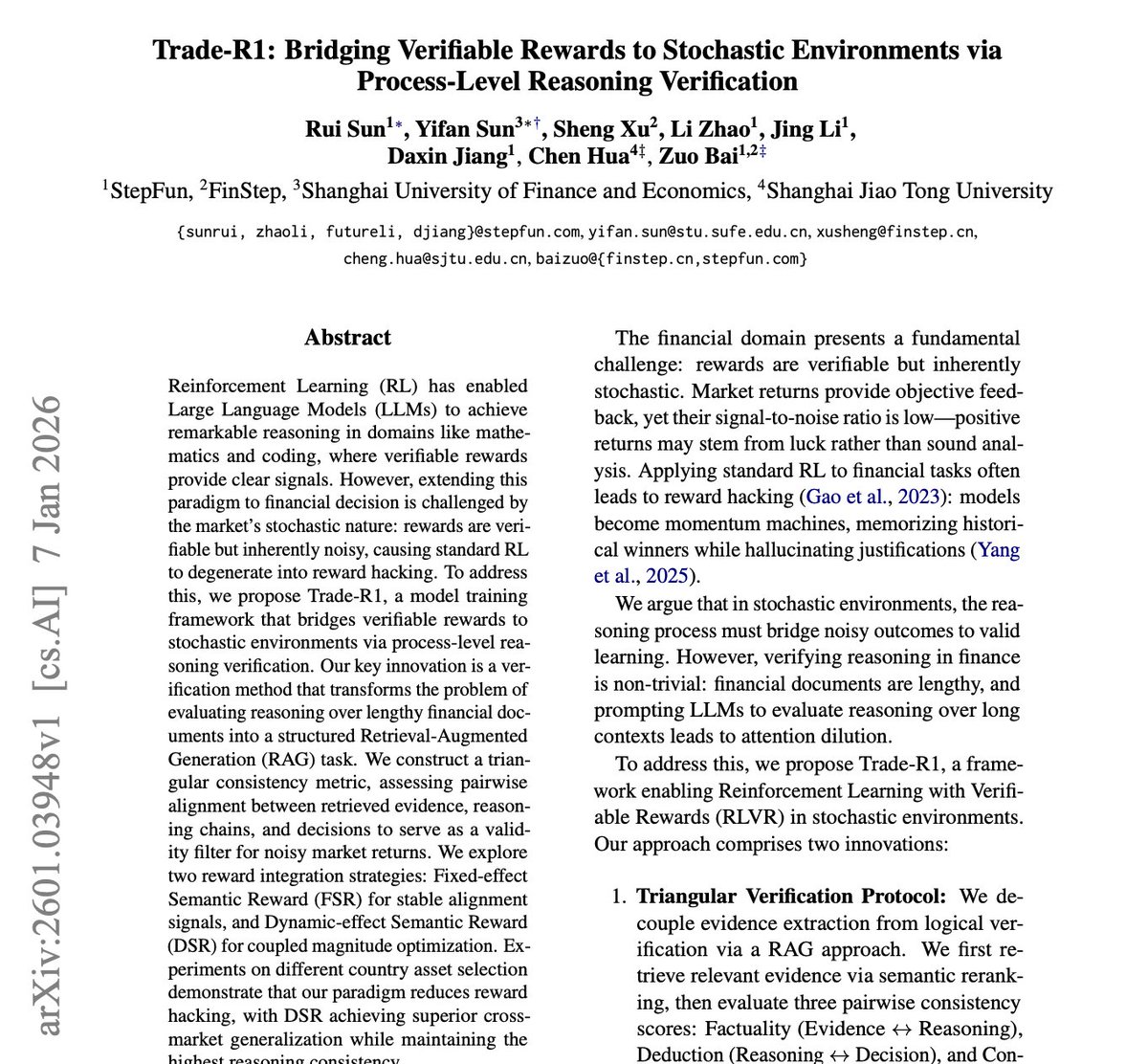
🚨 This paper just proved why most “AI traders” are fake.
Not because the models are dumb. But because the reward signal is lying to them.
Here’s the core failure mode:
If you train an LLM agent directly on market returns, the model quickly learns a shortcut: memorize historically winning assets → ignore reasoning → hallucinate justifications after the fact.
The paper shows this explicitly.
A “Market-Only” RL agent achieves 37.62% cumulative return on the A-Share market… but its reasoning similarity score collapses to 0.4369
and its hallucination rate explodes to 22.5%.
In other words: it makes money by accident and lies about why.
That’s reward hacking.
The authors’ key insight is sharp:
In stochastic environments, outcomes cannot validate reasoning.
Only the process can.
So they flip the training objective.
Instead of asking “Did this trade make money?” they ask “Was this decision logically grounded in evidence?”
They introduce a Triangular Verification Protocol.
Every action is evaluated along three axes:
• Evidence ↔ Reasoning (factuality)
• Reasoning ↔ Decision (logical deduction)
• Evidence ↔ Decision (consistency)
The final semantic score is the average of all three. No shortcuts. No single-point failure.
Then comes the math that actually matters.
They model market reward as:
r = r* + ξ
Where:
• r* = true value justified by reasoning
• ξ = market noise
In standard RL, the gradient variance is dominated by σ²_noise.
That’s why models chase volatility.
Trade-R1 introduces Dynamic-effect Semantic Reward (DSR):
For profitable trades:
G(r, s) = r · (0.5 + s)
If reasoning quality s → 0 (pure luck),
the reward variance is scaled by 0.25×.
The paper proves this explicitly:
Var(g_DSR) ≈ 0.25 · Var(g_market)
That’s a 75% suppression of noisy gradients when reasoning is bad.
Conversely, when reasoning is solid (s → 1):
the signal is amplified by 1.5×.
Noise goes down.
Causal signal goes up.
Signal-to-noise ratio strictly improves.
And it shows up in results.
On the A-Share market:
• DSR achieves 37.76% cumulative return
• Highest reasoning similarity: 0.9744
• Lowest hallucination rate: 0.12%
More importantly, it generalizes.
Market-Only collapses on the US market (12.63% return).
FSR (fixed semantic reward) also fails cross-market.
DSR holds:
• 15.34% return
• Best Sharpe among trained models
• Highest reasoning consistency out-of-distribution
Figure 4 in the paper makes the point brutally clear.
Symmetric reward schemes let models “cheat” by lowering reasoning quality during losses to reduce penalties.
DSR’s asymmetric gating prevents this entirely.
The model is forced to stay grounded even when it’s wrong.
The deeper takeaway isn’t about finance.
It’s about how to do RL in the real world.
Whenever rewards are:
• delayed
• noisy
• partially luck-driven
Outcome-only optimization will fail.
Trade-R1 shows the fix:
Use process-level verification as a gate on learning itself.
Don’t ask models to be right.
Force them to be honest first.
This is the difference between agents that chase correlations
and agents that learn causal structure under uncertainty.
If you’re building AI for markets, policy, ops, or any stochastic system, this paper isn’t optional.
It’s the first clean proof that reasoning not reward must be the unit of alignment.
Another lawyer sanctioned for citing fake, AI-hallucinated cases in filings.
This defendant submitted "at least 23 fabricated legal authorities," and the court found the "formatting error" excuse "incredible."
Counsel "doubled down during oral argument" and said the fakes were not "germane" to the appeal.
Sanction: $7,500.
LLMs know everything.
Until you ask one real question.
Confidently wrong answers. Hallucinations. Source: trust me bro.
So we stopped taking them seriously.
LoLM — Large Overconfident Models 🤡 https://t.co/PuaRvApRTu