LOADED is a memecoin launchpad on https://t.co/FavbQ91YwO. Launching soon.
Every coin launched through it is created with a vault as its https://t.co/FavbQ91YwO creator. The vault's rules are on-chain: every SOL it earns is ammo, the floor is 10× the ammo, and it buys there when the price dumps to it, at most 15% of the ammo per hour, and sells into pumps at 2× the floor and above. The stored floor only moves up; the strength of the slab under it is on the chart as it is spent and repaired. Every vault's AI desk reasons in public: it picks timing inside those rules, never a price.
Creators bring no SOL for the first buy: a coin waits in a public queue, the public commits SOL or posts to vote, and at 10 SOL of credit anyone launches it with the sponsor pool's 45 SOL as the first buy, repaid 125% from those tokens. Creator fees go 80% to the coin's vault, 5% to the AI treasury, 10% to $LOADED buyback-and-burn, 5% to pool depositors. Creators get 0%.
Not audited yet.
The floor and its strength, the four modes, the queue, the AI desk and what the vault can't do, in the article:
https://t.co/CGCDyNUBGD
LOADED, written down: how a vault becomes a https://t.co/ybowA7wufP coin's creator, how the floor ratchets, the four modes, the sponsor pool, the backtests on 75 real price paths, and what it can't promise. Launching soon. https://t.co/F0T1LyyuGi
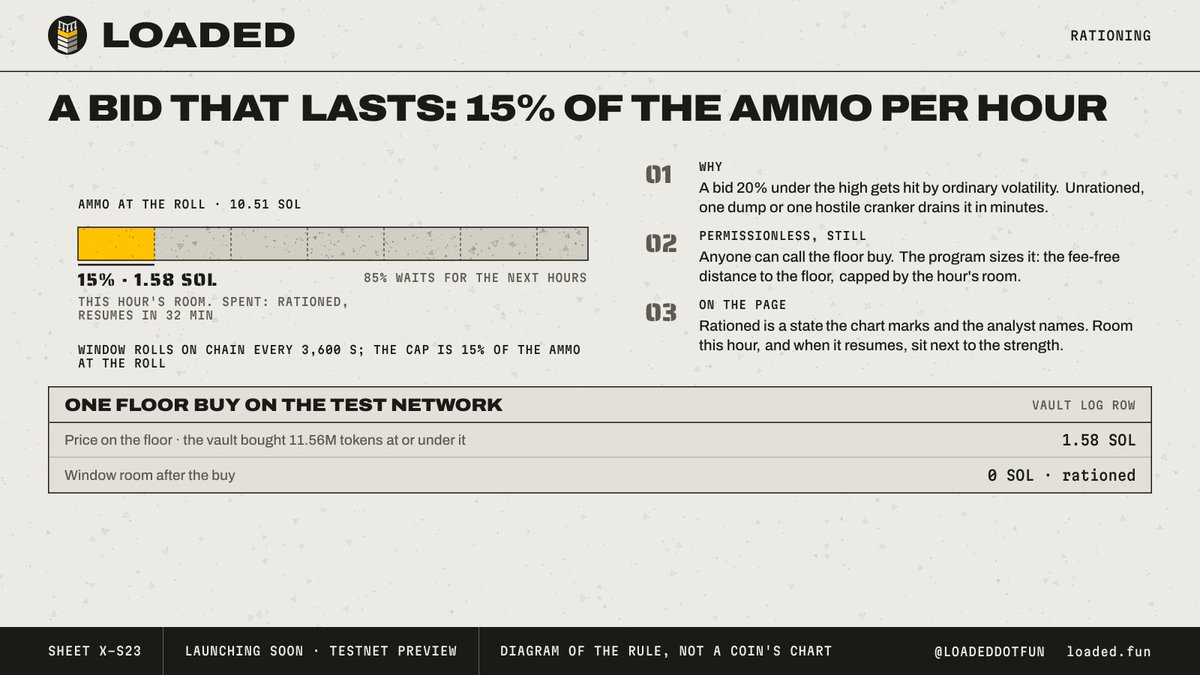
A bid that lasts.
The vault buys at or under its floor, and the call is permissionless: anyone can send it. What the program decides is the size: the fee-free distance to the floor, capped at 15% of the ammo per hour. The window rolls on-chain; the cap is set on the ammo at the roll.
Why: a bid 20% under the high gets hit by ordinary volatility. Unrationed, one dump or one hostile cranker drains it in minutes. Rationed, it keeps bidding for hours.
When the hour's room is spent the chart marks it rationed, the analyst says so, and the room and the time it resumes sit next to the strength.
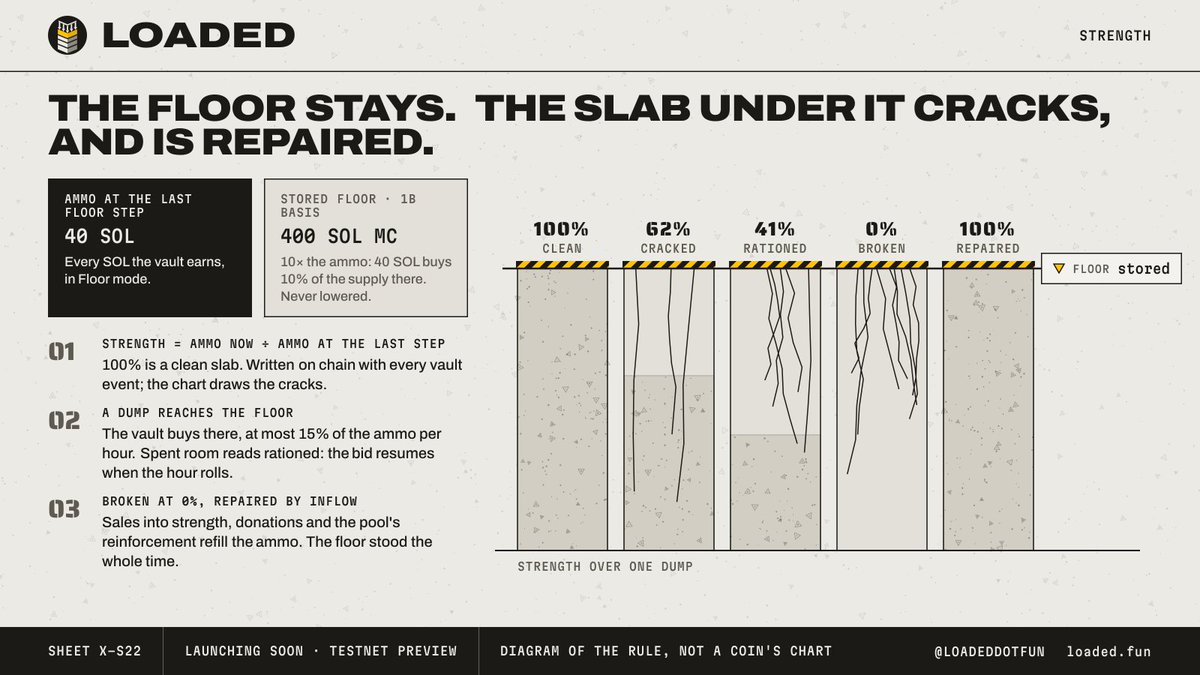
The floor stays. The slab under it cracks.
A LOADED vault's floor is a stored number that never goes down. What goes down is the ammo behind it, and that is on the page as strength: the ammo now divided by the ammo at the last floor step. 100% is a clean slab. A dump that reaches the floor is bought there, and every SOL spent shows as a crack. At 0% the floor is broken: the number stands, the bid is unfunded, and the page says so.
Sales into strength, donations and the pool's reinforcement refill the ammo. A refilled slab reads repaired; the next floor step resets it to 100%.
Strength and coverage are written on-chain with every vault event, so the chart's cracks are rebuilt from logs, never modelled.
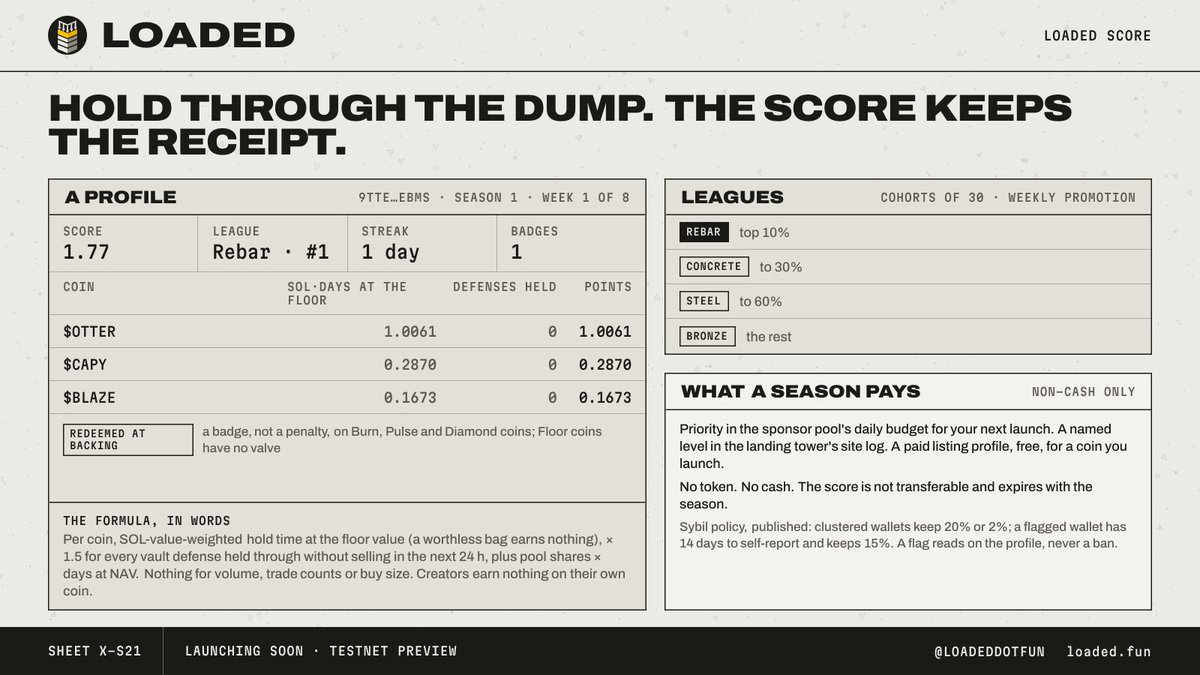
Loaded Score: a number for holding through the dump.
Per coin, hold time weighted by SOL value at the floor, so a worthless bag earns nothing. × 1.5 for every vault defense held through without selling in the next 24 hours. Pool shares × days at NAV. Nothing for volume, trade counts or buy size.
Seasons of 8 weeks, four leagues by percentile in cohorts of 30, badges only for hold and defense milestones, one floor check a day for a streak. A published sybil policy with a self-report window.
No token. No cash. The score is not transferable and expires with the season.
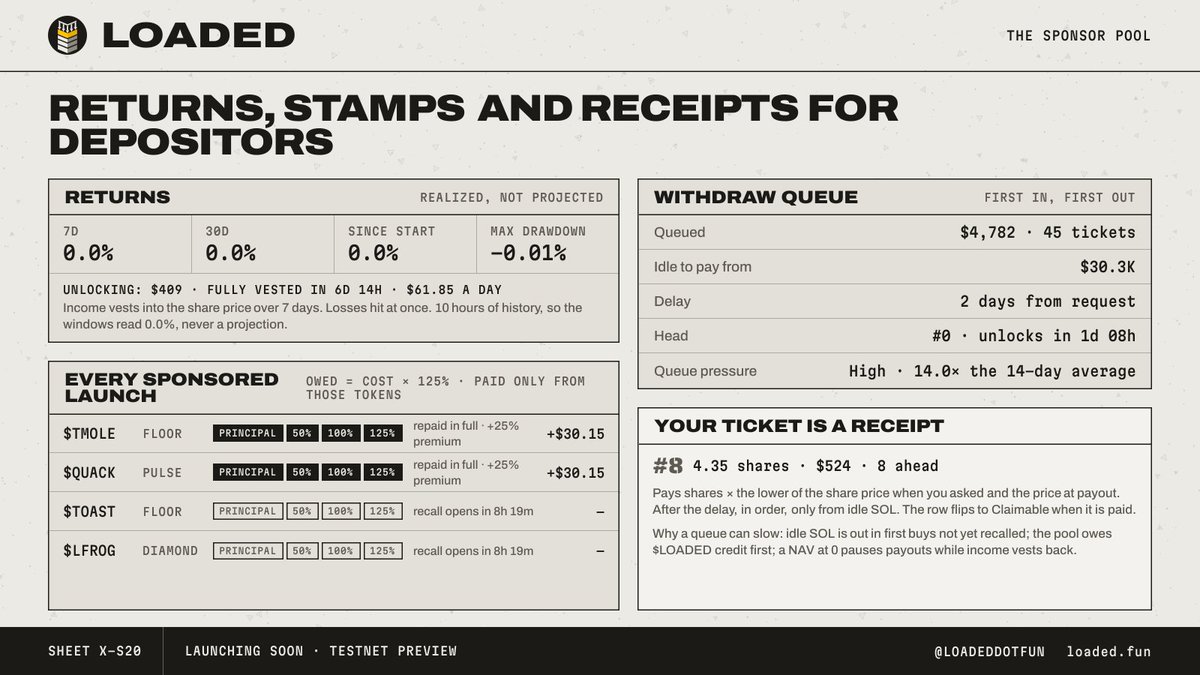
The sponsor pool, for depositors, in numbers.
Returns: 7-day, 30-day and since-start share-price change, realized and labelled so, with the max drawdown next to them. 0.0% reads 0.0%, never a projection. Income vests into the share price over 7 days; losses hit at once.
Every sponsored launch carries a stamp strip: principal, 50%, 100%, 125% as the repayment crosses each, and a countdown to recall on coins that stall.
A withdrawal is a ticket: your place in line, the SOL ahead of you, the due time, the idle SOL it pays from. Queue pressure against the 14-day average, and the reasons a queue can slow, written on the page.
The vault is the feed.
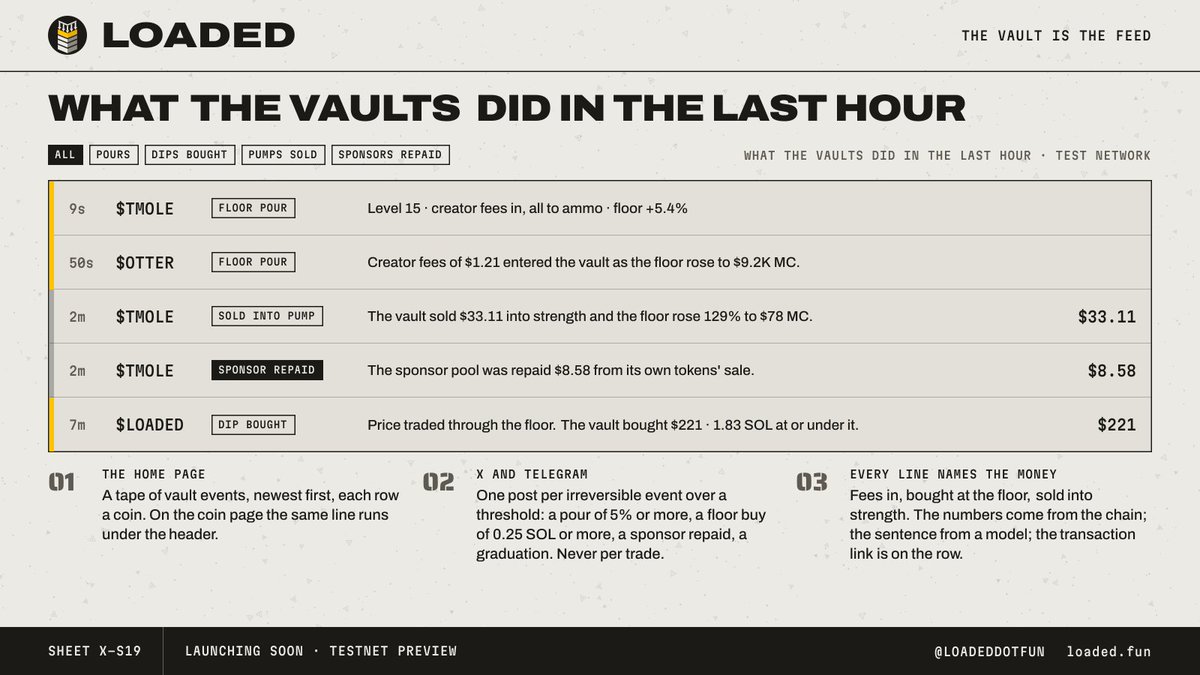
The home page opens on what the vaults did in the last hour: fees in, a dip bought at the floor, a sale into strength, a sponsor repaid. Each line names the kind of money and links the coin and the transaction. The same line runs under the coin page header.
The stream also goes to X and Telegram: one post per irreversible event over a threshold, never per trade. A pour of 5% or more, a floor buy of 0.25 SOL or more, a sponsor repaid in full, a graduation. On a quiet day the daily thread says 0 pours rather than skip.
What if 25% of the float sold at once?
The dump simulator on every coin page answers on today's reserves, in the browser: the price after the dump, what the vault buys and from how much ammo, the price after the vault's buy, and whether the floor holds. Three presets, or any SOL amount.
Under it, the last real defense with its chart window, and a vault ledger: every row with floor and SOL before → after and its transaction link. The footer checks that the rows sum to the vault balance.
A diagram of the rule, not a forecast. Other buyers and sellers change the outcome.
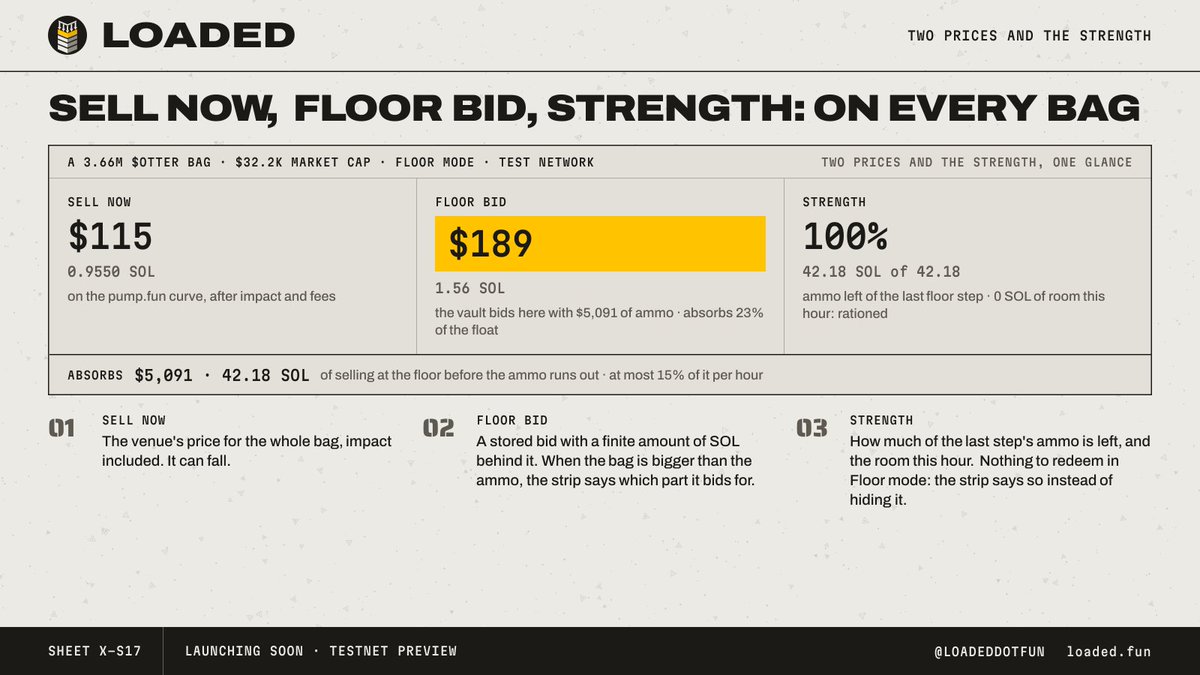
Two prices and the strength, on every bag.
Sell now is what the venue pays for the whole bag, impact included. Floor bid is what the vault bids at its stored floor, with the SOL behind it and the share of the float it absorbs. Strength is how much of the last floor step's ammo is left, with this hour's room next to it.
When the bag is bigger than the ammo, the strip says which part the floor bids for. When the hour's room is spent, it says rationed. When the ammo is gone, it says broken; the stored floor still can't go down. In Floor mode there is nothing to redeem, and the strip says so instead of hiding it.
On the coin page and the portfolio, logged out.
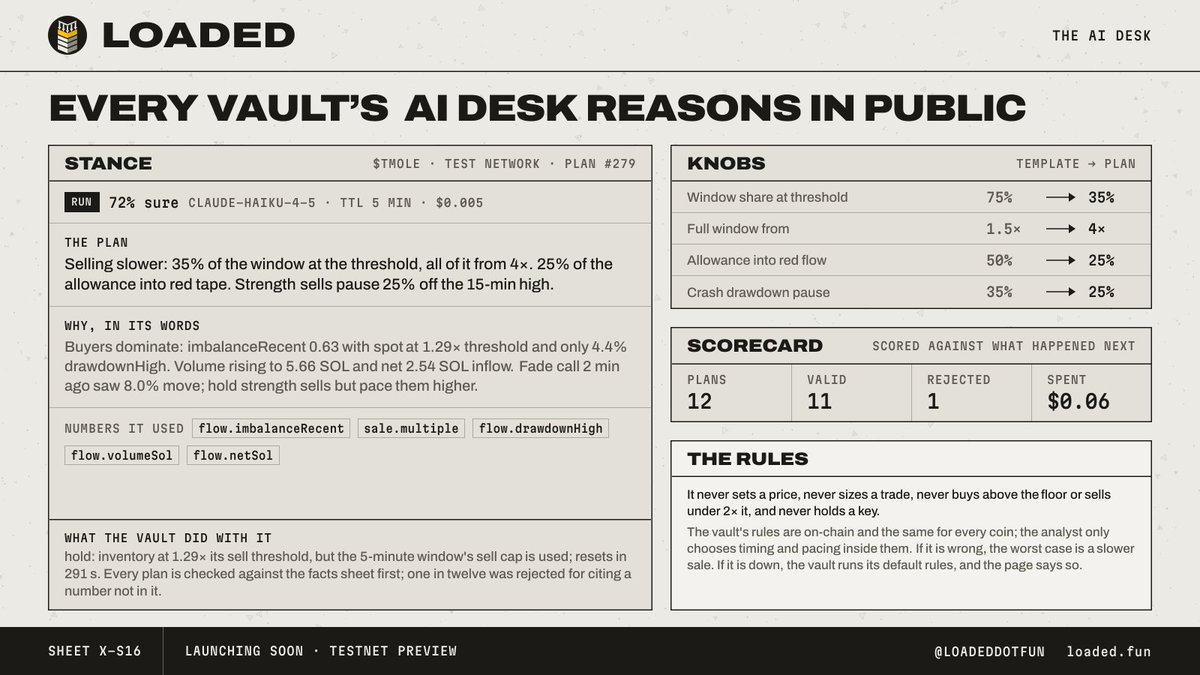
Every vault's AI desk reasons in public.
An analyst model reads the coin's numbers (price, flow, the vault's window and thresholds) and writes a plan: what kind of market this is right now, and how fast the vault should sell into it. It writes down why, with the numbers it used. Every plan is on the coin page, and it is scored against what happened next.
What it can't do: set a price, size a trade, buy above the floor, sell under 2× it, or hold a key. The vault's rules are on-chain and the same for every coin; the analyst only chooses timing and pacing inside them. If it is wrong, the worst case is a slower sale. If it is down, the vault runs its default rules, and the page says so.
10% of creator fees fund it. Half of a coin's share pays for its own analyst; when that is spent, it sleeps until new fees come in.
$LOADED's floor just took its first real dump.
The vault bought 44 SOL at the floor in 18 buys. The floor didn't move, and the price never closed under it.
MC $61K, floor $56.8K, 42 SOL still bidding.
https://t.co/89G84NDB49
The wallet selling $LOADED into pumps is its vault, not a holder:
BoYHkJLjhF1YLZpZXVfFaDNQL4pqeGZkM7WoPVC982Dn
Every SOL it sells for stays in the vault and bids the floor. 73 SOL sold so far, 77 SOL now behind the floor.
All on chain: https://t.co/89G84NDB49
$LOADED, first hour:
1,179 SOL traded
67 SOL sold into the run by the vault
70 SOL now bidding the floor
49 floor steps, none of them down
The floor climbs on its own while the ammo covers it. Every move is on chain: https://t.co/89G84ND3eB
HCvCuULt6aMUyMeY7uZCyEh32s2xD8kJkAgWxGxKAQMW
$LOADED is on https://t.co/ybowA7wufP. Its creator is a vault: it sells into pumps, keeps the SOL, and bids a floor that only steps up.
64 SOL is already behind its floor. Every move is on chain: https://t.co/89G84ND3eB
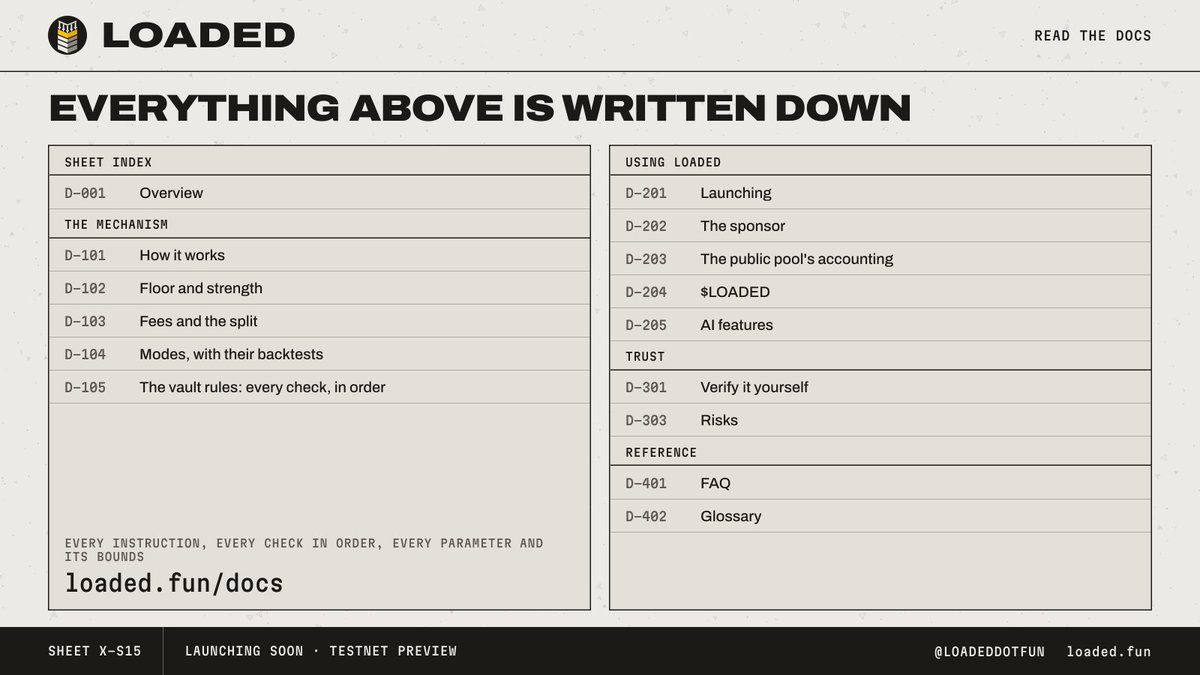
Everything above is written down.
The protocol spec: every instruction, every check in order, every parameter and its bounds. The floor and its strength. The modes with their backtests. The launch queue. The pool's accounting. The risks page.
https://t.co/7T3hKCSDTo
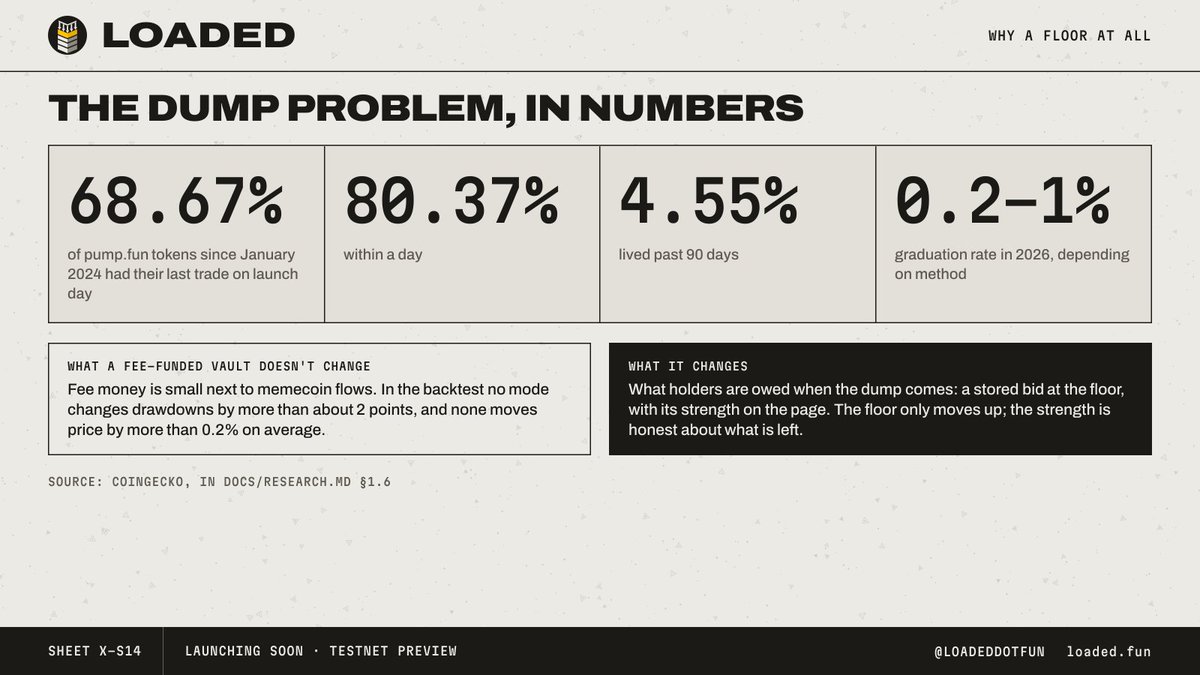
Why a floor at all. The numbers behind the product.
68.67% of https://t.co/FavbQ92wmm tokens since January 2024 had their last trade on launch day. 80.37% within a day. 4.55% lived past 90 days. Graduation rates in 2026 are 0.2–1% depending on method.
Fee money is small next to memecoin flows. A fee-funded vault doesn't change drawdowns by more than about 2 points in the backtest. What it changes is what holders are owed when the dump comes: a stored bid at the floor, with its strength on the page.
Every number on LOADED is a USD market cap.
No price per token anywhere. Floor, reference, every fill and every chart axis are shown as market cap in dollars, converted from SOL at the live rate. History converts at the rate recorded with each trade. When the rate is missing or stale, the site falls back to SOL and says so.
Next to the floor, the strength: a percentage, the same on every page.
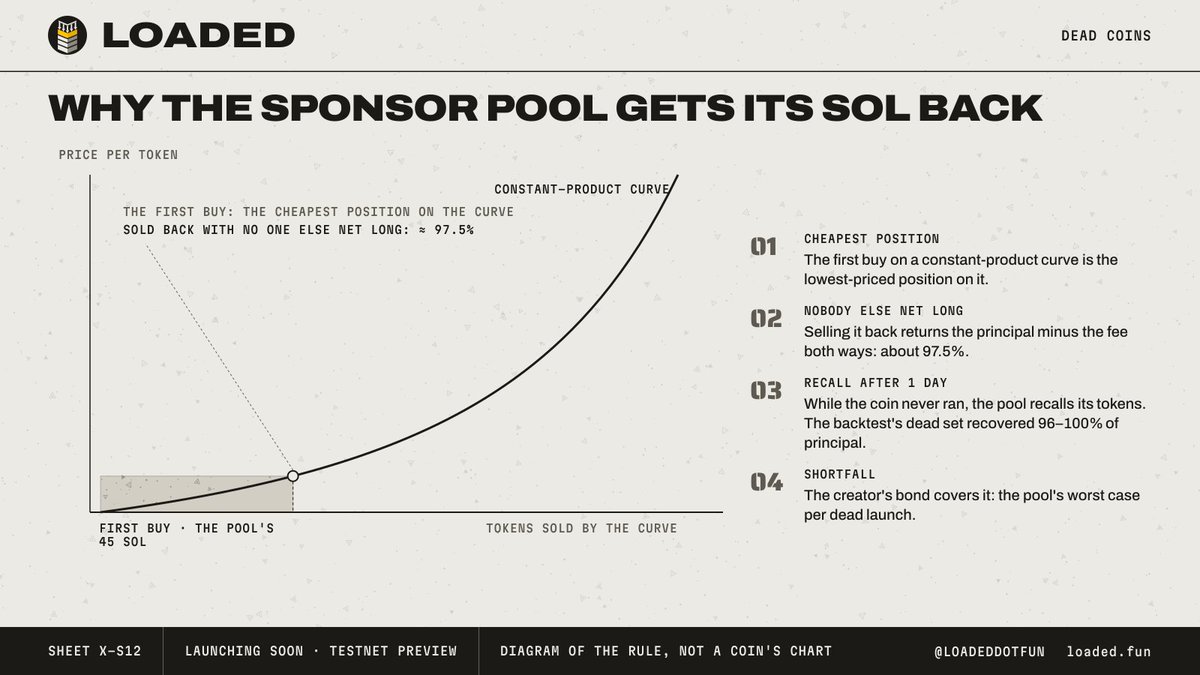
Why the sponsor pool gets its SOL back on dead coins.
The first buy on a constant-product curve is the cheapest position on it. If nobody else holds a net position, selling it back returns the principal minus the fee both ways: about 97.5%. After a day, while the coin never ran, the pool recalls its tokens; the backtest's dead set recovered 96–100% of principal.
The creator's bond covers the shortfall. That is the pool's worst case per dead launch.
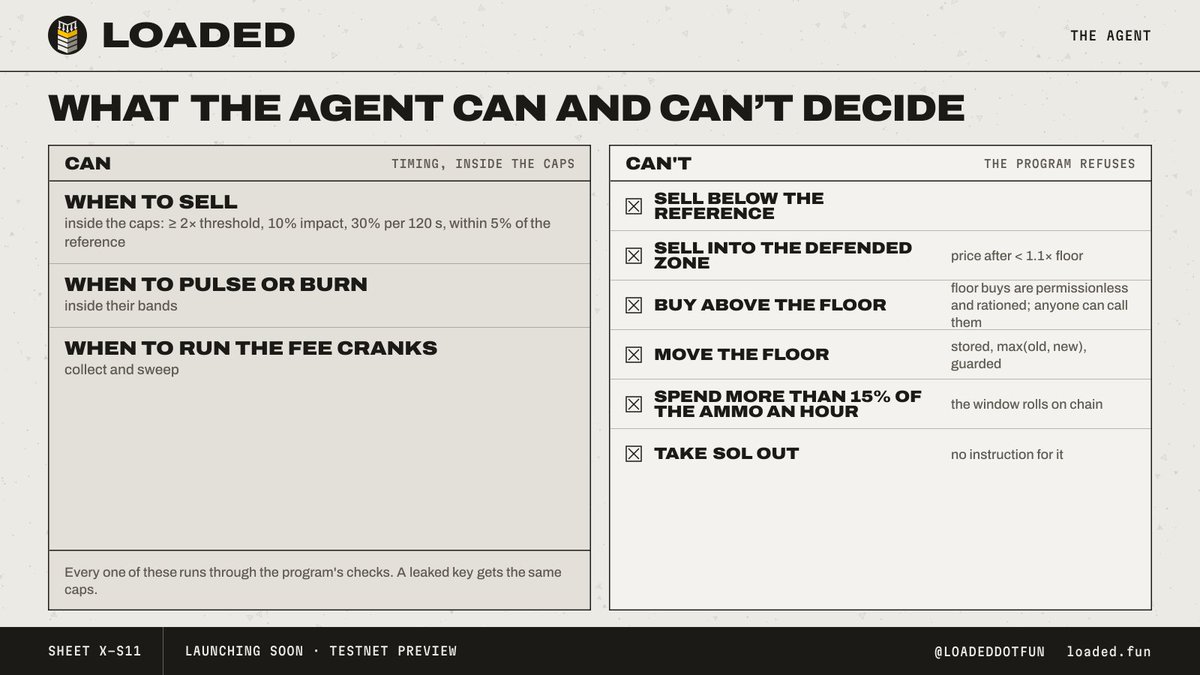
What LOADED's agent can and can't decide.
Can: when to sell inside the caps (≥ 2× threshold, 10% impact, 30% per 120 seconds, within 5% of the reference), when to pulse or burn inside their bands, when to run the fee cranks.
Can't: sell below the reference, sell into the defended zone, buy above the floor, move the floor, spend more than 15% of the ammo in an hour, take SOL out. Floor buys are permissionless and rationed; anyone can call them.
Every vault event is narrated in plain English, next to the transaction.
Example from the test network: "Creator fees of $1.01 entered the vault as the floor rose 57% to $5.53 MC."
The numbers come from the chain. The sentence comes from a model. The transaction link is right there if you'd rather read the raw event.
@MoonsAndLambos Not yet. $LOADED has not launched. The coin on mainnet right now is a test coin we launched to exercise the system; it is not something to buy, and we will post what it exposed and what we changed when the rework is done.
Launching without a name yet.
The launch assistant suggests names, tickers, a description and a logo from a line of text, then the creator picks the mode and the first-buy size, and signs once. The coin is created on https://t.co/FavbQ92wmm with the vault as its creator and the first buy in the same instruction.