Gen X remains a major force in today’s housing market. Buyers ages 46–60 made up 25% of recent home buyers and 23% of sellers, showing their continued influence on housing trends.
https://t.co/1FAWs4CuIG
Existing-home sales decreased by 2.4% in June, while the average 30-year fixed-rate mortgage moved slightly higher to 6.49%. Learn more: https://t.co/zeDXgcl2nW
Why does listing exposure matter? In the latest episode of “NAR REALTOR® News Change Agents” podcast, Shelley Specchio, CEO of @MIBORBoard, discusses how transparency and cooperation keep real estate markets efficient.
Listen now to her full conversation with NAR CMCO @bennettrich that also explores marketplace fragmentation, buyer access challenges, and the importance of consumer education. https://t.co/7WSgznQVhM
Millennials (27-45) should be in peak buying years, but headwinds persist. They made up 26% of buyers in 2025 (down from 29%). About 25% received family help to buy, while older Millennials lead with $132,700 median incomes—showing a widening divide. https://t.co/Siz3bBc1vX
Could the median home price one day hit $1 million? NAR Chief Economist Lawrence Yun shares his prediction & breaks down what could drive home prices to that milestone.
What's on your mind about the real estate market? Submit your questions by emailing [email protected]
First-time buyers rose to 35%, the highest since June 2020, as inventory opened entry points. Demand remains competitive with 25% of homes selling above list price, but sentiment cooled and homes averaged 2.3 offers.
NAR Data shows that 35% of single women 18-26 are buying homes compared to just 18% of single Gen Z men. However, the age group is struggling to keep up with others when it comes to owning a home. Dr. Jessica Lautz joined "The Daily Report" to discuss: https://t.co/hhqD4t36Tp
Housing supply is growing, and affordability is improving. However, the U.S. housing market continues to face a structural mismatch between the homes available for sale and what buyers can afford. Too much of the inventory available today remains concentrated at higher price points, leaving a shortage of options for entry-level and middle-income buyers. Learn more in a new report from NAR and https://t.co/8e9Pw07KIM®: https://t.co/mf81JJaEAw
Gen X purchased the highest share of multigenerational homes at 19%, according to the 2026 Home Buyers and Sellers Generational Trends report. The top motivations for combining households across all age groups were to care for aging parents, to save on costs, and because adult children were moving back home. Explore the report: https://t.co/7ALKJKg5wg
Tax refunds are hitting the housing market, giving some a timely boost. Nadia Evangelou, NAR principal economist and director of real estate research, breaks down what this means for today’s buyers.
Have a question for our economists? Email [email protected].
Many retirees look to escape state income taxes on their 401(k), IRA, pension, and Social Security payments by moving to one of the 13 states that don't tax retirement income. But the search for a tax-friendly destination can backfire. Some of those states come with high property taxes and soaring home insurance premiums that can wipe out any savings entirely.
Read: https://t.co/20gjpBVdma
NAR recently joined a coalition of housing and industry organizations to oppose a MA rent control ballot measure. Director of Legal Advocacy Caitlin Vannoy explains why.
Read more here: https://t.co/vqXx3oPDAu
Baby Boomers remained the largest generational group of home buyers this year, while the share of first-time buyers fell to the lowest level on record, according to the 2026 Home Buyers and Sellers Generational Trends report from NAR.
https://t.co/iDvtd0fVPD
Buying your first home without a 20% down payment? NAR Deputy Chief Economist Dr. Jessica Lautz breaks down the loan options available and what first-time buyers should know.
Have a question for NAR's economists? Submit your questions by emailing [email protected]
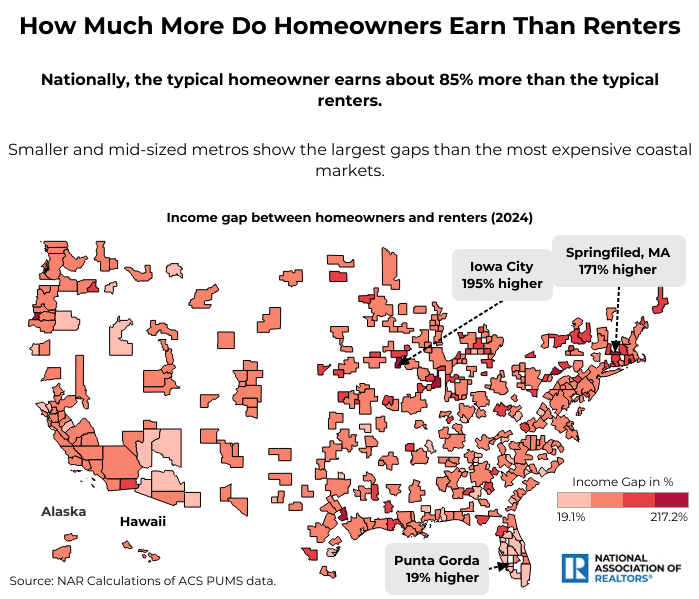
In high-income markets like San Jose and San Francisco, the gap between homeowner and renter incomes is large, but smaller in percentage than in smaller markets. College towns show the biggest gaps due to student renters.
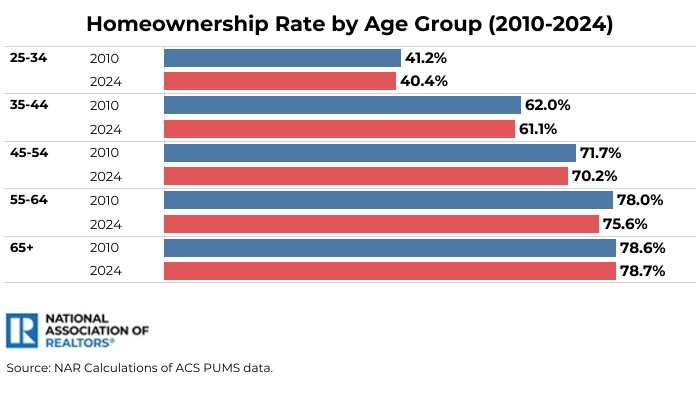
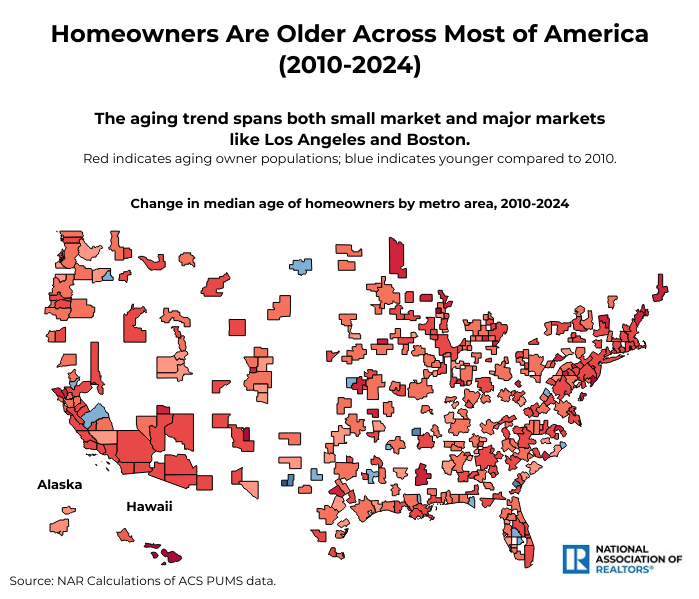
The homeownership rate has stayed nearly the same from 2010 to 2024, but homeowners have aged significantly. Younger buyers are entering the market later, while older homeowners stay longer, reshaping the housing landscape.
🏘️ @OhioRealtors built a scalable infill housing model to boost homeownership and expand housing supply, from policy to tools now being adopted by communities statewide. https://t.co/tEj39nZeQU
We're proud to share how the @SWMTREALTORS, in partnership with the Billings, Great Falls, and Helena Associations of REALTORS®, made a real difference for homeowners facing rising property taxes. 🏡💼
Read more here: https://t.co/TLa55xFK8M
The Qualified Business Income deduction was one of the core provisions that made last year’s tax reform such a win for real estate businesses and investors. It’s NAR’s ongoing monitoring and advocacy that make such meaningful legislative progress possible. https://t.co/DXWMzzvnTJ