Today is my last day at Buckeye. On Monday, I will begin my new role as the Director of Technology Policy at @consumerpal. I am thankful that my career has led me to such great organizations, and I am excited for the next chapter to begin.
NEW from me. A short blog post walking through how the CBO's (already scary) budget baseline likely under-estimates the 30-year debt projection by 68% of GDP.
That means the federal debt outlook is $62 trillion(!) worse than is commonly-reported. 🧵
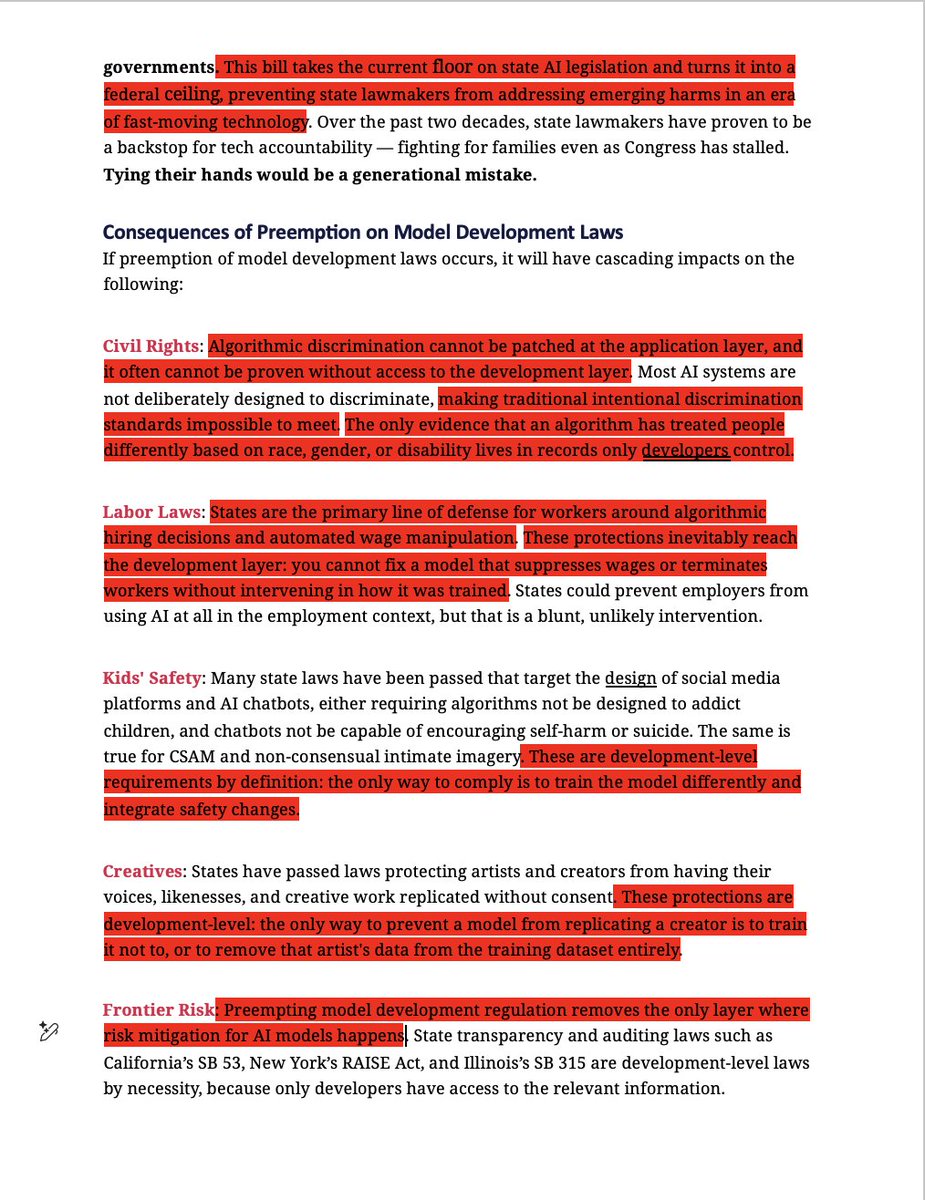
@americans4ri Every red-highlighted sentence in the below @americans4ri two-pager, which discusses @JayObernolte and @RepLoriTrahan's AI bill in red is either overbroad, misleading, partly false, or false. Full explanations in next post.
SCOOP: US officials have had talks about having government acquire shares in AI giants, sources say
Altman has discussed w/ senior officials, including Trump. Did again recently
May be *ceding* shares to USG - not a purchase
Shares could go 2 dividend
https://t.co/ks2Yzgr2W0
NY's last big "moratorium" was on fracking. The "study" took 4 years. It was originally about the (considerable) water use. The moratorium turned into a ban.
When the industry came up with a waterless method, Albany banned that too.
The point has been made that one non-voluntary aspect of the most recent AI EO is identifying frontier AI models. The definition and interpretation of this term could have a significant impact on the development of AI.
I didn't like the Biden EO. I still don't like the now dead Biden EO. And I agree this is far more dangerous.
All this talk about AI transparency for what? Just for the government to make decisions in the shadows?
No thanks.
This EO sets up a bad outcome in frontier AI governance: the government regulating AI models you aren’t allowed to use in a way you aren’t allowed to know about. That outcome is not here yet, but the direction of travel is apparent.
If Biden had done this, every libertarian would be panicking. This is considerably more intrusive than the much-maligned Biden EO. To be clear, I think regulation above the Biden EO is now necessary, given the capability of today’s frontier AI systems. But anyone who pretends like the Biden EO was massively intrusive but this EO is somehow less intrusive is wrong, IMO.
this *potential* AI bill has not even been floated and yet a pro-regulatory lobbying group is already running irresponsible, highly inaccurate ads based merely on the idea that there *might* be an effort to formulate a national policy framework to help bring some consistency to the confusing and costly patchwork of AI laws proliferating today.
It is just insultingly clownish to suggest that even thinking about such a bill would undo decades of civil rights law. That is a complete lie. Shameful behavior.
@RedsDaily4 I drove to Philly to watch the Reds play the Phils. Then got blacked out for the next game I wanted to watch on my phone because I was temporarily considered "in market." Annoying.
People who don't follow cancer research often ask me why we haven't cured cancer. That perception masks a wonderful reality: We make amazing, stepwise progress every year, and the result is that many people live much longer today than they would have previously.
Right now we're in the thick of the annual meeting of the American Society of Clinical Oncology, the biggest research meeting on new cancer medicines, and this morning a bunch of really important studies dropped. I'm going to review them here.
This first image is the result for daraxonrasib, a treatment for pancreatic cancer that is generating consdirable excitement. The green line is the probability of living for patients who got the new drug; the gray one is the chemo control group.
If you follow cancer drugs, a chart like this will make your breath hitch a little. I'm going to review these and some other data here.
If we let in Chinese cars and they saved consumers a ton of money, that would not show up in lower CPI growth or higher real wage growth except to the extent it caused other companies to lower prices
You know what other tools know better than most instructors? Coursera and YouTube courses from top faculty, *the internet*, books from the library. How many students used those tools instead of formal ed? Very very few. How many will use Claude independently to learn the material? Probably the same amount.
I know it doesn’t sound glamorous, but the primary role of faculty is to get students in the seats and create incentives to actually absorb the information. This is your job. AI can help as a tool, I’ve seen some great harnesses of AI for education, but it will not do this.
New @DOTMARAD Jones Act waiver data is out. More jet fuel has now been moved by water from the Gulf Coast to the West Coast in 73 days (917,000 barrels) than the combined total from 2004-2025 (817,000 barrels).
Of course California's billionaires have a lot of money. That reflects how absurdly productive the state is.
But 38 percent of the state's billionaire wealth has already left, @JaredWalczak wrote for @CityJournal earlier this month (https://t.co/BFX19nTz2a). That's already cost the state nearly $3B per year.
That number is likely to climb over the long run, to as much as $4.5 billion per year. That's because California's wealthiest are disproportionately in the tech sector, meaning they're highly mobile.
In theory, the wealth tax is a one-time charge. Proponents, including Zucman, project that it will raise about $100B over five years. As @Shawn_Regan wrote for us, that figure is probably closer to $40B accounting for the billionaires who have already left (https://t.co/cViI9qouOW).
Even assuming the higher figure, though, the long-term harms to the tax base of chasing highly mobile taxpayers out of the state will almost certainly offset the short-run gain. California's wealthiest pay a fifth of all its income taxes (never mind sales, property, etc. tax). What happens when they're not there?
That will either leave California in worse fiscal condition in the long run *or* force another round of punitive taxation—starting the cycle of flight over again.