One of the most extraordinary Gothic façades in Spain belongs not to a cathedral, but to a college.
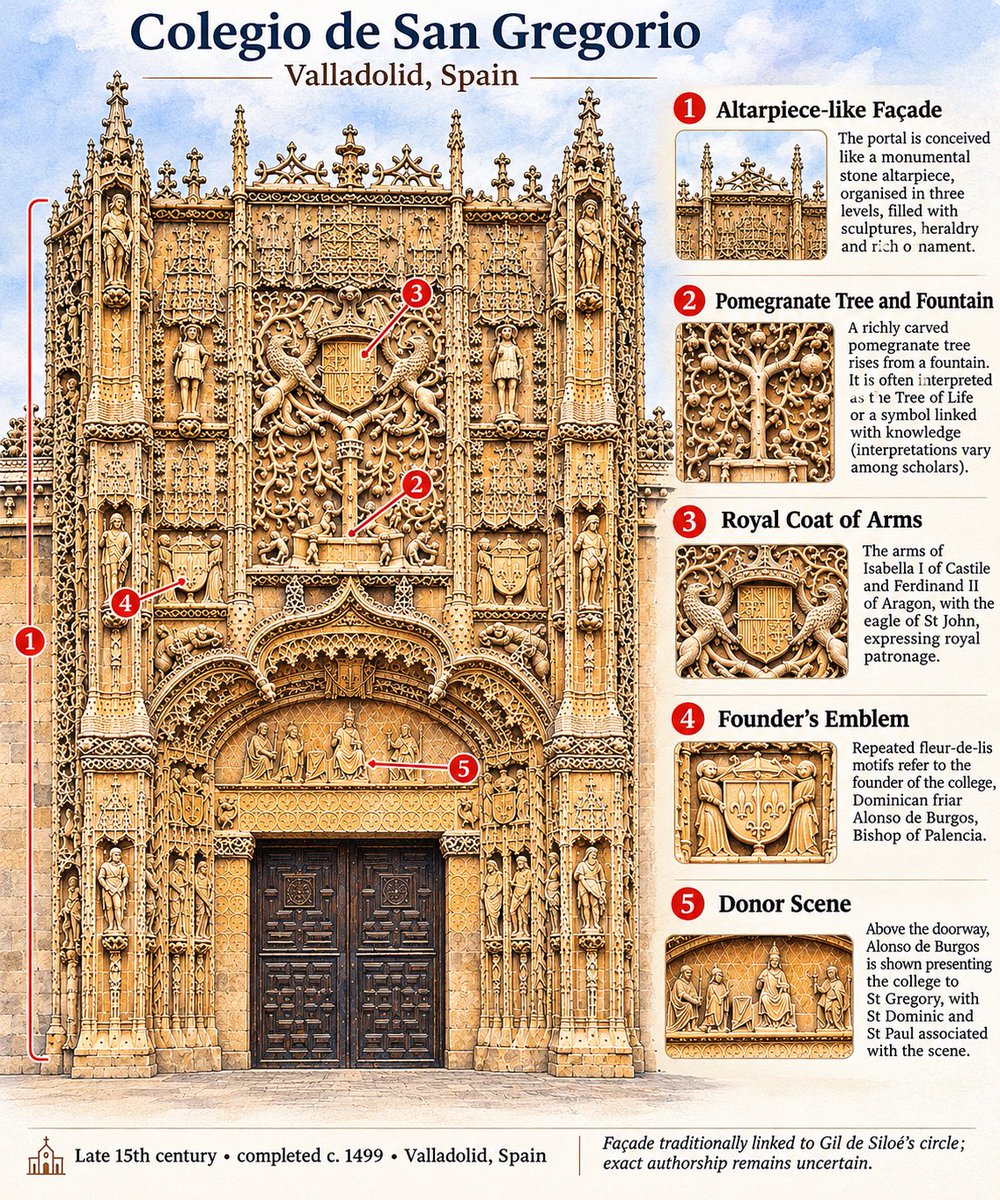
The Colegio de San Gregorio in Valladolid was built in the late 15th century and completed around 1499. What makes it remarkable is how almost every part of its entrance has been transformed into an elaborate work of sculpture.
Look closely at the central section. A beautifully carved pomegranate tree rises above a fountain, surrounded by twisting branches, mythical creatures and intricate foliage. Above it, the royal coat of arms of Isabella I of Castile and Ferdinand II of Aragon reflects the political authority of the Catholic Monarchs.
The entire façade is arranged almost like a monumental stone altarpiece, with human figures, heraldic shields, delicate tracery and layers of religious imagery.
It was commissioned by Dominican friar Alonso de Burgos as part of a theological college. Today, the building houses Spain's National Museum of Sculpture.
What fascinates me most is the sheer amount of patience and craftsmanship involved. More than 500 years ago, artisans transformed an ordinary entrance into an extraordinary architectural statement of faith, knowledge, power and artistic ambition.
No modern machinery, no shortcuts — just remarkable human skill carved into stone.