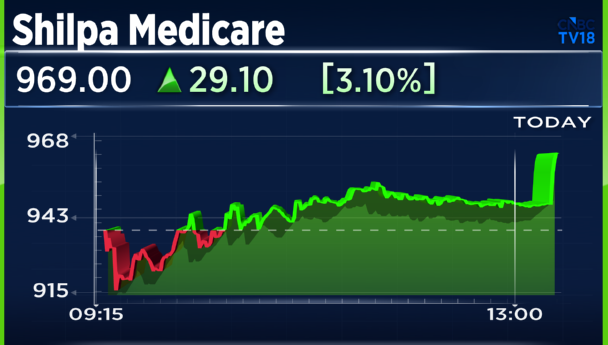
Shilpa Medicare hit a 10-year high a few months ago. I'd been reading the company for a while by then, so I paid attention.
The thing that actually got me interested wasn't the pipeline - NorUDCA, Rotigotine, the ADC platform, all of it sounds good in any pharma deck. It was the ROCE. 4% in FY23, then 9.3%, then 15%, then 17.4% in FY26. That's five years of heavy capex - ₹1,175 cr on biologics, transdermal, albumin - finally converting into returns instead of promises.
Whether the pipeline itself delivers is still a story until the revenue shows up. I can't verify that from outside the company. But the stock breaking out while I was still reading the annual report told me people with money on the line had already reached a similar conclusion.
Bought around ₹530. It's roughly doubled since.
I still track every result. Not to time the exit, but to know whether a price move means something or nothing. Price without context is just noise. The sell decision itself, though, comes from the price, not the spreadsheet.
Disclosure: I hold this stock. Not a recommendation.
Ganesh Chaturthi has a small ritual worth borrowing.
Ganesha is prayed to first, before starting anything new - a business, a journey, a house. Not halfway through, not after. The idea is to clear the obstacles before you begin, not while you're already in the middle of it.
I think that's actually good investing practice too. Before opening a position, it's worth asking what's clouding your judgment right now - a recent loss you're trying to recover, a story you want to be true, pressure to be doing something. Clear that first. Then look at the company.
Most obstacles in investing aren't in the market. They're the ones we carry in before we've even opened the chart.
Ganpati Bappa Morya 🙏
I keep relearning this one.
You can build the cleanest thesis in the world. Margins expanding, moat intact, management doing the right things. Doesn't matter what the market decides to pay for it today.
Price is not your opinion. Price is everyone else's opinion, all at once, with money behind it - including people who know the company better than you do.
So when a stock keeps ignoring my thesis for months, I've stopped assuming the market just hasn't caught up yet. More often it means there's a hole in my thesis that the price already knows about.
I still do the work. I've just stopped arguing with the price when it disagrees with me for long enough.
Everyone covering Filatex is writing about the Ecosis story. First commercial textile-to-textile recycling plant in India, Decathlon MoU, circular economy. Good story, mostly true.
Two things about it nobody seems to have checked.
The plant's economics are ordinary.
₹300 cr of capex for 26,750 TPA. Management guides ₹80-85 cr of EBITDA at steady state. Strip out depreciation and you're around ₹64 cr of EBIT. Capital employed isn't ₹300 cr either — this plant buys and sorts end-of-life fabric, and that supply chain doesn't exist in organised form in India yet. Add working capital and you're near ₹360 cr.
Roughly 18% ROCE. Filatex already earns about 15%.
So the marquee project, on management's own guidance, with everything going right, is only modestly better than the commodity yarn business it's meant to transform.
For contrast, there's a steam distribution project sitting in the same capex plan. ₹85 cr for a guided ₹60-65 cr of EBITDA, selling surplus steam from a power plant they already own. No new technology, almost no working capital. That one clears 60%. Nobody mentions it.
But the capex number is the interesting one.
Ecosis works out to about ₹1.12 lakh per tonne of capacity.
Circ, the best-funded Western player, is building 70,000 tonnes at Saint-Avold in France for €450 million. That's roughly ₹6.4 lakh per tonne. Five to six times higher.
It's not a clean comparison - Circ is cracking polycotton, which is a harder problem than depolymerising polyester, and it's building in Europe. But halve the gap and it's still enormous.
That's the actual moat. Not the patent. Not being first. Being able to build capacity at a fraction of what everyone else pays, in a business where the eventual game is tonnage.
On the competitive window.
Circ targets operations in 2028. Syre's blueprint plant is at commercial sales this year but that's qualification volume, with gigascale still ahead. Ecosis commissions in October, stabilises over three to five months, ramps through FY28.
So Filatex isn't years ahead. It's roughly a year ahead, at a fifth of the capital cost.
And on regulation, since the usual version is wrong.
The story people tell is that the EU will mandate recycled content and demand appears. Those quotas are still being drafted under ESPR, delegated act due 2027. If that's the thesis, it's a 2029 thesis.
The mechanism that actually bites is quieter. Separate textile collection has been mandatory across the EU since January 2025. Large brands are already banned from destroying unsold stock. And from around 2028, EPR fees get eco-modulated — the levy per garment scales with how recyclable it is. A poly-blend that can't go fibre-to-fibre costs the brand more, per item, indefinitely.
No quota needed. Just a cost that rises with bad design. Brands redesign two or three years ahead of a cost they can see coming, which is roughly what a Decathlon trial in 2026 looks like.
So what's the actual bet?
Not technology. Several people have made this work at pilot scale.
It's whether Filatex has a commissioned, stabilised, brand-qualified plant running when orders land — and whether the capex advantage survives contact with a real plant.
Which makes the thing to watch completely unglamorous. Steam and the PFY brownfield expansion are both due September. Easy projects, no new chemistry. If those slip, the October date on Ecosis doesn't mean much.
Depreciation and working capital figures are my estimates. Capex-per-tonne comparison is mine too, and the processes aren't identical.
Not investment advice. Just how I think about businesses.
AVT Natural did ~230% PAT growth in Q1 FY27.
Ignore that number.
Q1 last year was the bottom of the cycle. Two drought years on marigold, plus the US tariff hit on decaf tea. Anyone grows 230% off a trough.
The number I actually care about is smaller and duller.
Q1 FY27 revenue: ~₹245 cr.
Q4 FY26 revenue: ₹226 cr.
This is a crop-cycle business. Q4 is supposed to be the strong quarter and Q1 the weak one. Q1 printing above Q4 isn't a seasonal bounce.
Five straight quarters of sequential growth, and it's broad-based. Marigold, spice oleoresins, instant tea, animal nutrition all moving together.
That last one is the part I find interesting.
This used to be a marigold company - 60%+ of revenue pre-2014. Today marigold is under 42%. Animal nutrition grew 76% last year and now has a co-development tie-up with a global feed additive player. There's an agri-inputs division launching, plus dermocosmetics and nutraceuticals in trials.
The honest caveat: animal nutrition is still only ~8% of revenue. At that size, 76% growth doesn't move the earnings profile yet. It's a direction, not a result. The question is whether any of these new verticals gets big enough to matter before the next drought year.
What would make me wrong on the whole thing: FY26 receivables went up ~₹84 cr.
If revenue holds and receivables come down, the growth is cash-backed and real. If receivables keep climbing faster than sales, part of this is just credit being extended to hold volumes.
That's the line I'm watching in the next two quarterlies.
Not a buy or sell recommendation. Just how I think about businesses.
Did Solara find a qualified buyer for the commodity Ibuprofen business ?
Looks like something is cooking. Some strategic resolution was expected by end of Q2FY27.
Agree, In a bull market you are flooded with lot of Stage 2 stocks. A well defined process to narrow down, decide allocation and build a portfolio with proper risk management is what determines your long term equity performance.
Stock ideas is not the problem
In today's world of AI and social media, there's no shortage of interesting stock ideas.
Quite the opposite — we're flooded with them.
But do you have a well-defined process - One where you take these hundreds of ideas, narrow them down to five, ten, fifteen where you believe the risk-reward is genuinely good —
and then actually build sizable positions in those stocks, so your portfolio can compound over time.
That process — distilling a hundred ideas into five or ten concrete, sizable positions with proper risk management — is what most people lack.
I've seen this again and again.
Everyone who asks me for stock names or ideas.
If your performance isn't up to your expectations, It's not because you don't know interesting stocks.
It's because you lack a proper process to turn those ideas into actionable, sizable positions that actually drive your equity curve.
..............
Ibuprofen Prices increasing...
Will be interesting for Solara, considering they want to sell their Ibuprofen business.
Structurally it is still a commodity business, but might help them in short term.
Ibuprofen | Iso Butyl Benzene | Regulated Market Share
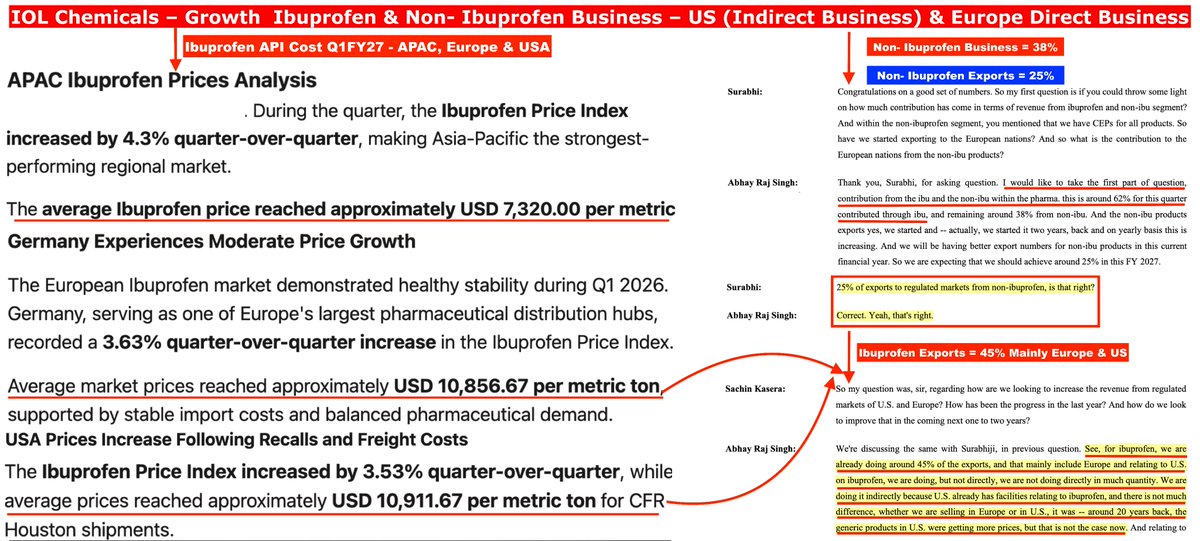
📸1: Change in Ibuprofen Prices in Europe, India & USA in Q2FY27
USA - Q1FY27 to Q2FY27 - $10,911.87/MT to 11,730.00/MT
Europe - Q1FY27 to Q2FY27 - $10,856,67/MT to 11,666.76/MT
India - Ibuprofen price index rose by 12.83% q-o-q, export-led reorders tightened spot availability
📸2: IOL Chemicals - Growth in Ibuprofen - US Indirect Business & Europe Direct Business
See, for ibuprofen, we are already doing around 45% of the exports, and that mainly include Europe and relating to U.S. on ibuprofen, we are doing, but not directly, we are not doing directly in much quantity. We are doing it indirectly because U.S. already has facilities relating to ibuprofen, and there is not much difference, whether we are selling in Europe or in U.S., it was -- around 20 years back, the generic products in U.S. were getting more prices, but that is not the case now.
📸3: Vinati Organics IBB Business Decline FY25 & FY26
Vinati Organics - IBB declined by 20% in FY26 - Due to Iran War
Vinati Organics - IBB declined by 27% in FY25 - Operational Efficiency Issues
I resigned from Anthropic today. I spent the last three years doing pretraining research at both OpenAI and Anthropic. Neither company is acting responsibly. They are racing straight to self-improving superintelligence and gambling with our lives. More thoughts below.
Did Solara find a qualified buyer for the commodity Ibuprofen business ?
Looks like something is cooking. Some strategic resolution was expected by end of Q2FY27.
@ChaseLochmiller@OpenAI GPT-6 Astra, trained on ~100K+ NVIDIA Grace Blackwell NVLink72. From ChatGPT to o1 to Astra in 4 years.
AGI has arrived. Congratulations @OpenAI team.
400K GPUs coming online next.
Bull markets have a way of making you forget risk management.
Writing this mostly as a note to self - the part I keep forgetting is that knowing your stop-loss and sizing the position right, before entering, matters more than the entry itself.
Conviction in the thesis isn't a substitute for having an exit plan.
Risk doesn't disappear when the market is green. It's just quieter.
Know your SL. Size it right. Then take the position - not the other way round.
Shivalik Bimetal Controls is buzzing. Several investors I respect are genuinely convinced on the business.
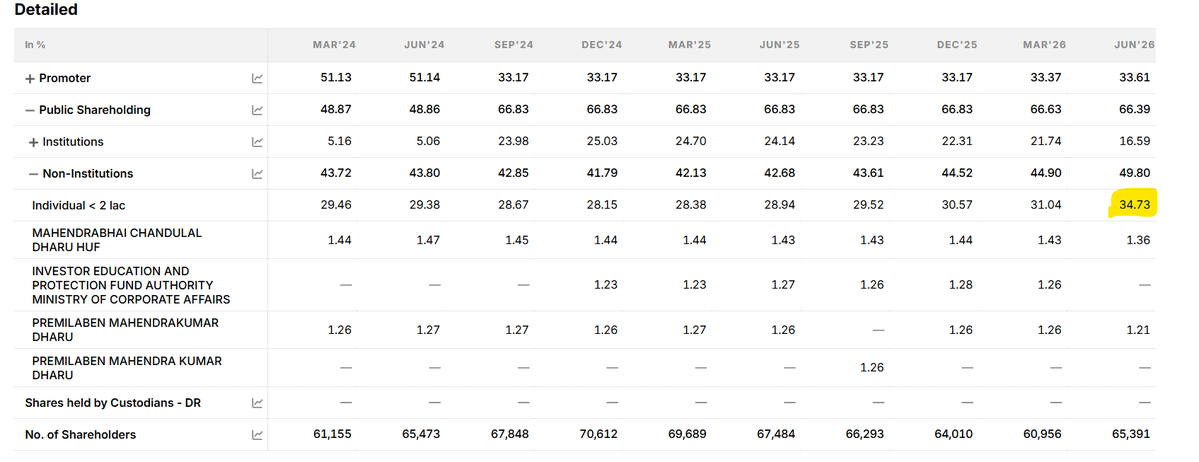
But worth flagging: Retail <2L investment holding is ~35% and has been increasing. In my experience, that's usually not a great sign.
Could be wrong here. Just sharing the pattern I've noticed.
Can AVT natural products do 120cr PAT in FY27?
Historically H2 has been better than H1 in both revenue and operating margins.
120cr is assuming same runrate as Q1FY27.
Current Mcap around 1300cr.
Started tracking this when it showed up in my Stage 2 screen a couple of weeks back. AGM tone was surprisingly bullish for an otherwise conservative management.
If Q1FY27 is any indication, FY27 should see similar growth. The interesting part is the transition from a mature marigold and spice extract business into multiple verticals: animal nutrition, tea capacity, botanicals.
Years of accumulated process learnings in extraction is not something a new entrant replicates quickly. That’s the real moat here