✅ Challenge accepted.
The Quran, considered “perfect, divine, and free of contradictions” by Muslims, is nevertheless a contradictory work containing glaring human errors. Here is just ONE SINGLE EXAMPLE (which, incidentally, involves no fewer than three contradictions!), a more in-depth analysis of which can be found in my book 100 Contradictions and Scientific Errors in the Quran.
In the Quran, Allah sometimes recounts the same historical event twice, in two different surahs, as when He describes, in two different places in the Quran (Surah 3 and Surah 19), the moment when He has His angels announce to Zechariah that he will have a son: John. However, the human author hiding behind Allah's pen made the mistake, in each of these two surahs, of describing this event using verbatim quotations, that is, dialogues, and more specifically, statements made in the first person. Indeed, a perfect God who knows everything—and therefore knows the exact words spoken during a specific historical event—should not present TWO CONTRADICTORY VERSIONS OF ONE AND THE SAME FIRST-PERSON STATEMENT, which He should quote identically whenever He reproduces it in different surahs of the Quran.
So, what did Zechariah reply when Allah conveyed to him the announcement of John's birth? According to verse 40 of Surah 3, Allah states that Zechariah, surprised, replied: “My Lord, how will I have a boy when I have reached old age and my wife is barren?” Yet, in verse 8 of Surah 19, Allah states that Zechariah, at that very same moment, said: “My Lord, how will I have a boy when my wife is barren and I have reached extreme old age?” These two Quranic quotations, from Surahs 3 and 19, supposedly reproduce the same words spoken by Zechariah during one single, specific historical event. They should therefore have been identical, word for word. Yet these two quotations reverse the order of the two arguments, while also differing by an adjective that appears in one version but is absent from the other.
You must answer these three simple and binary questions to demonstrate that Allah does not contradict Himself in the Quran:
➜ 1. When Zechariah, surprised by the announcement Allah had conveyed to him, replied, did he say “I have reached old age” or “I have reached EXTREME old age”?
➜ 2. And did Zechariah mention his old age BEFORE or AFTER mentioning his wife's barrenness?
The factual and historical account presented in Surah 3 contradicts and invalidates the one presented in Surah 19, even though both are supposedly equally divine and truthful.
Furthermore, what answer did Zechariah receive to his request? Here again, there is a contradiction! The divine response that follows is not quite the same in the two accounts. For while, in verse 41 of Surah 3, Allah indicates that the response begins with “Your sign is that you will not be able to speak to the people for three days” (أَيَّامٍ / ayyāmin), the version of the beginning of the response in verse 10 of Surah 19 is “Your sign is that you will not be able to speak to the people for three nights” (لَيَالٍ / layālin). Did Allah therefore have two different recollections of the dialogue with Zechariah recorded in Surahs 3 and 19 of the Quran?
➜ 3. So which was the correct expression addressed to Zechariah: “three days” or “three nights”?
The issue is not whether “three days” and “three nights” are equivalent in duration. These are supposed to be verbatim quotations describing one and the same specific statement. We should therefore find exactly the same words in both versions, in Surah 3 and Surah 19. The human author of the Quran made the mistake of recounting the same historical event multiple times while including first-person dialogue. And I have found other contradictions of the same kind in the Quran: involving Moses, Abraham, Mary the mother of Jesus, and others. I analyze them all in the chapter of my book 100 Contradictions and Scientific Errors in the Quran devoted to narrative contradictions.
Allah, who “neither errs nor forgets” (Surah 20, verse 52), should be capable of remembering His exact words, word for word, and therefore reproducing them word for word. Allah should not be imprecise or have two different recollections of the exact words He heard or spoke during one and the same event.
Madame @Anne_Stambach ! C'est l'occasion rêvée d'aller manifester devant la librairie islamique Tawbah de Toulouse située pile dans votre circonscription et qui vend plusieurs livres appelant à tuer les homosexuels !
📚"Péchés et Guérison" :
🔸"On doit chercher la plus haute construction de la ville et en précipiter sur la tête l'homosexuel puis le lapider."
🔸"Le prophète a dit : "Si quelqu'un agit à la manière du peuple de Loth (homosexualité), tuez l'actif et le passif."
🔸"Les compagnons du messager d'Allah ont été unanimes sur l'exécution de l'homosexuel, sans aucun d'eux ne divergent en cela. Leur propos ne divergent que sur la manière de l'exécuter."
📚"La Voie du Musulman" (qui s'est pris 2 plaintes par @SOShomophobie ) :
🔸"La peine de la sodomie est la lapidation jusqu'à la mort, qu'on soit marié ou non. Le prophète a dit : "Ceux que vous trouvez en train de commettre le crime du peuple de Loth (homosexualité), tuez-les tous les deux." ⬇️
Siraj Hayani, militant arabe athée & anti-islam, avait annoncé son retour à l’islam il y a 2 ans. Acclamé et érigé en exemple par les musulmans, y compris en France, il affirme aujourd’hui n’être jamais revenu à l’islam. Selon lui, tout n’était que du cinéma pour sauver sa peau.
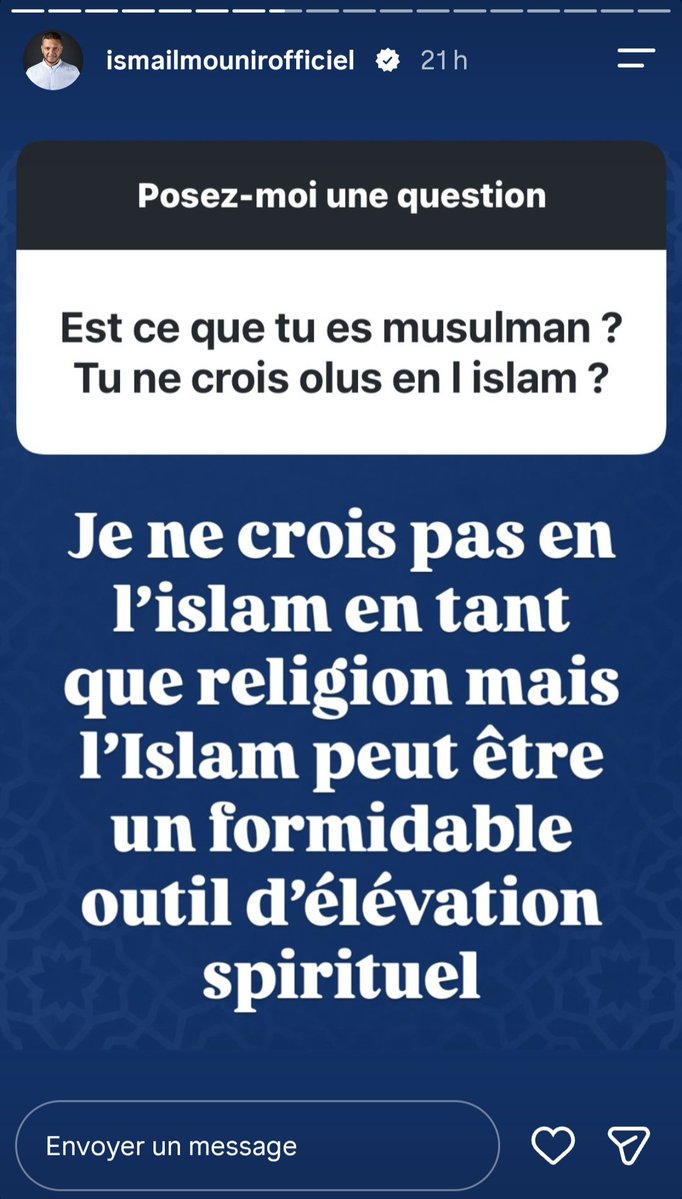
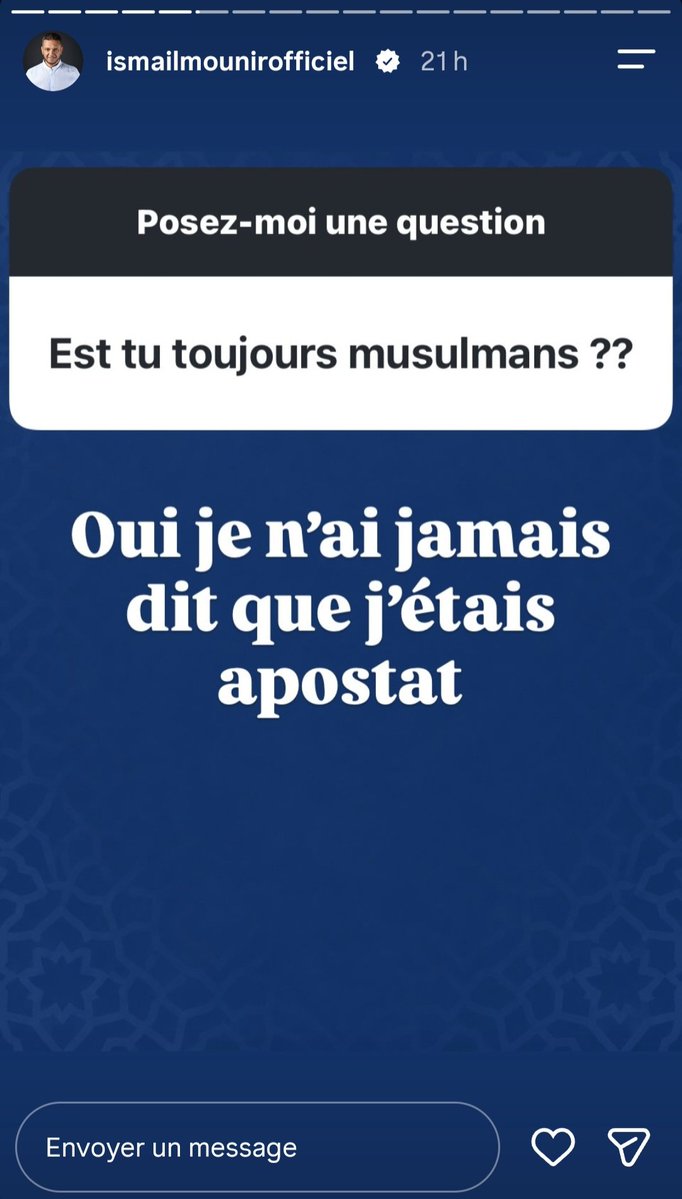
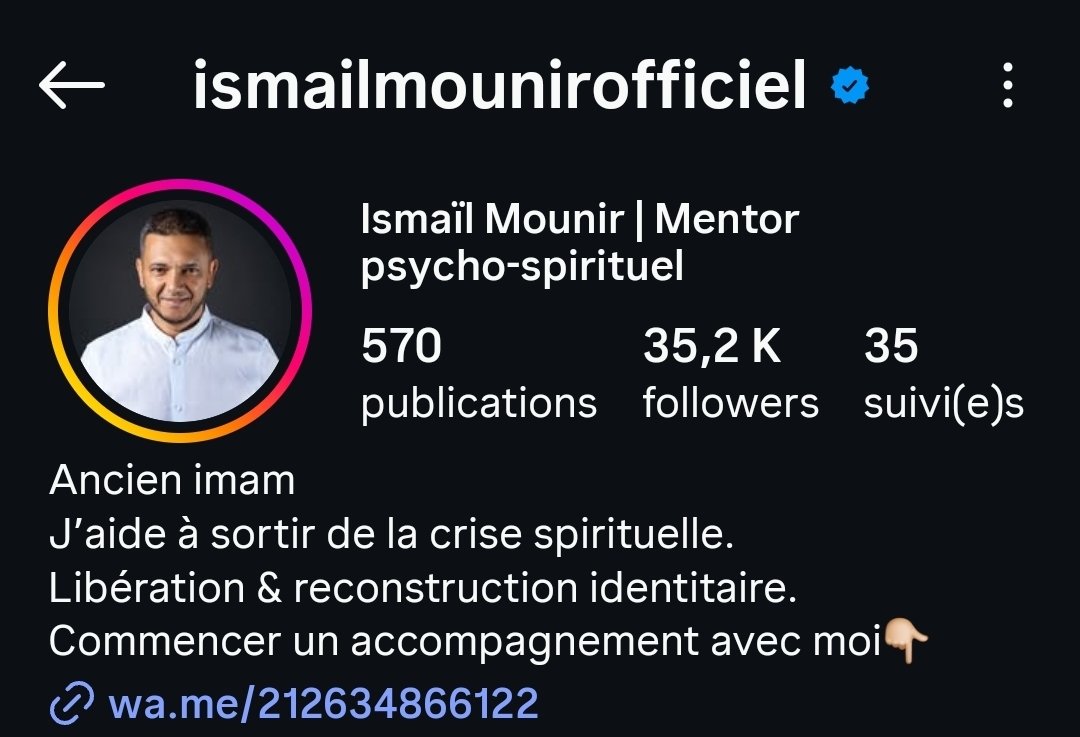
Je ne comprends rien au discours ambigu et flou d'Ismaïl Mounir. Dans ses stories Instagram il dit « Je ne crois pas en l'islam en tant que religion » mais dit aussi que « Oui » il est musulman, il dit « je n'ai jamais dit que j'étais apostat » et dit « J'ai confiance en Allah »
L'imam Ismaïl Mounir vient d'annoncer qu'il ne croit plus en l'islam. Ces dernières années, son discours avait évolué. Il rejetait de plus en plus le rigorisme, le sectarisme et préférait parler de liberté, de doute et de rationnalité. Son annonce publique est un événement rare.
@GoatedPandaa Ces ahādīth ne sont pas daʿīf, et de nombreux savants musulmans, tels qu’Ibn Taymiyya, louent les vertus de la circoncision. Je te laisse avec les propos de ce shaykh contemporain 👇
🔶️ Abd Al-Maligi, cheikh égyptien :
🔸️"Les femmes non-excisées d'Europe sont infertiles. Allah soit loué"
🔸️"Les femmes non-excisées sont sujettes à de nombreuses maladies graves"
🔸️"L'excision c'est de la médecine préventive" ⬇️