SIGMOD Systems Award for Amazon Aurora ·
Creator of AWS SimSpace Weaver ·
Prev. Microsoft Research + Amazon Research ·
High-school dropout → MSCS + AI, @UW ·
@embw_l0x We're assembling one of the best teams ever and I do talk to folks at Anthropic every once in a while. Couldn't be more excited for the months ahead.
@jdoliner Bro is finally listening to his external PR team. Only took a year of getting smacked around and watching his IPO prospects nearly evaporate. Good on him.
It was not AI's idea to pull every shipped version of Ghostty and go through the hot-path line by line. It was because I was already knee deep in Ghostty's and a dozen other terminal emulator codebases. My apologies for copy and pasting findings I already had in a file - that shouldn't make the findings and inferences invalid (they aren't and the impl sucked, but that's ok).
As to why I am referencing "old" software: how about because it's publicly shipped and I'm trying to support your user base? I already worked around a bunch of these issues using shared memory in these versions.
I've been plenty hard on people working for me to help them get better. But I've never been critical of some rando person that doesn't understand how containers work and doesn't realize macos doesn't have the namespaces, cgroups, and syscalls to support them natively. And I wouldn't fault them for assuming so without understanding it's hybrid mach/freebsd lineage (teaching opportunity bro).
And I know who you are and I'm still a fan.
I don’t understand why this is directed at me. I am not an Anthropic fan. And I do not condone their behavior and have been publicly critical of their actions for some time. I expended real effort to write software, capture data, and publish the analysis that shows they are rug pulling reasoning compute.
You are misinterpreting my point and you are putting me in the wrong bucket. I don’t have to agree with your morality tale and legal interpretation to not like them. I am providing the opposite of spin.
Friend, I wrote you a six paragraph answer yesterday after you asked. I am just as irritated about the rug pulling as you are, but this does not meet the bar of a material IPO risk. They are not running afoul of any laws.
I do hope we pass new regulations to cover their behavior. And/or that someone sues them and is able to prove some material misrepresentation. But they already have two of these lawsuits happening right now and it's not slowing them down.
And, OpenAI does the same exact thing.
@grok what U.S. laws constrain a service provider from regularly and arbitrarily modifying the way a live service operates? Are they obligated to maintain any particular look, feel, or behavior of their service static? Are they obligated to provide release notes with every change or disclose motivations and rationale behind changes? If a user agrees to use the service under the provider's ToS, how much latitude do providers have to make liberal, undisclosed, changes, even if they are not user friendly? Assume the live service is not a regulated utility like a power or internet service provider and instead something like a SaaS product, social network, or LLM as a service.
Introducing Claude Fable 5.2 and Claude Mythos 5.2, designed to tackle the most daunting technical challenges.
They’re capable collaborators on ambitious projects in many fields, and show improvements in areas like coding, reasoning, and vision.
I don't exactly understand why I would it would be required to substantiate months of forensic data capture and analysis with Anthropic's motivation in order for it to be real. It just is what it is. It's right there in black and white.
But since you asked, they are running a live service. There are no regulations that cover what they are doing today. Effort levels became dynamic earlier this year, and now there is no requirement to deliver you any level of minimum inference compute, regardless of the effort label you set.
Pre-train and RL has consistently taken up 2/3rds of all compute capacity for the last 3 years while inference has only been allocated 1/3 of their capacity, yet inference demand has grown exponentially (yes, capacity has grown too). Non cynically, they are constantly allocating compute to training and experiments, and moving inference distributions to provide resourcing for new model launches.
There's no intentional lying and misleading: they are intentionally silent on this subject. They were caught quantizing before, now they say they don't change the models. Dialing down inference compute does not make that statement a lie. This is a transparency issue.
In the most charitable reading, they do not have enough capacity to sustain inference compute at the levels in published benchmarks across all models, at all times, while also having sufficient capacity for the level of training they do. Less charitably, they also try to make their newer models look better by enshittifying their old ones, they balance between giving customers access to "frontier" intelligence without giving them so much that they can build away from dependence on these models, and they are constantly trying to juice up their margins for investors.
There is no law they are breaking. You use their service under a ToS. And morals are not involved. Until such a time that someone sues them over this, or legislation passes, or enough people make a stink, nothing is going to change.
You not taking an argument backed by data seriously, an argument you can literally replicate with your own data, is exactly the behavior they are counting on so they can continue unabated. You are fighting with the wrong person. I'm here to help.
These numbers you are using are not tokens, they are some derived effort indicator like OpenAI's juice level. But I don't actually think Ant has an equivalent, and the model just hallucinates the concept.
Thinking tokens are something you can open a transcript and measure. They are not derived or invented. They are what the model actually delivered and you were billed for as part of the output.
@DanielMiessler Tell us friend, when an invocation is allocated zero reasoning tokens, what prompt, skill, or harness trick should one do to fix it?
https://t.co/qbzOj4a7nZ
After Anthropic made Fable 5 permanently available in subscription plans, I noticed a large drop in performance. The model felt dumber, and I couldn't explain why.
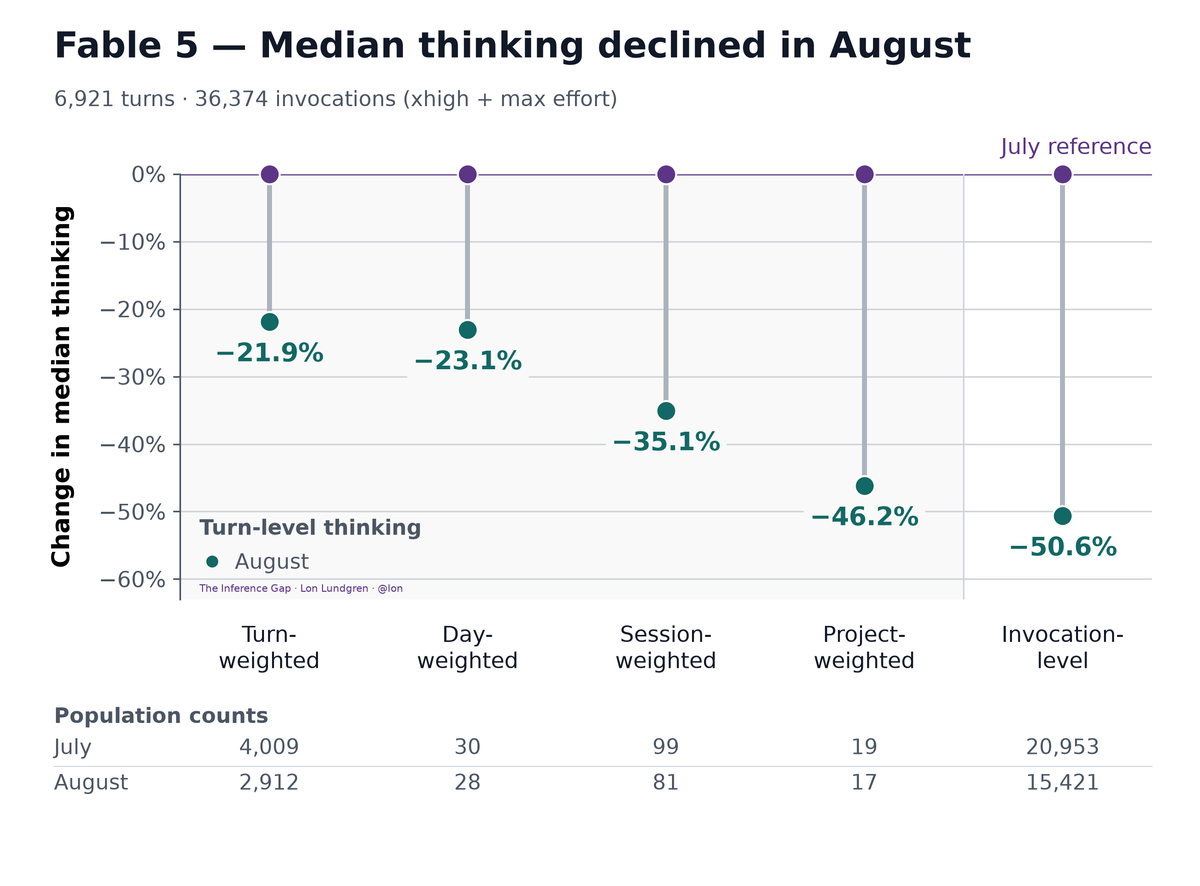
Measured five different ways, August delivered dramatically fewer thinking tokens than July.
@singulieroblige@megamilk I think their growth has already dramatically flattened and they will be lucky to clear $300b in FY 2027. And at that number they will barely cover their 2027 commitments and then it only gets worse in 2028-2030. But it do see where you are coming from.
We've been through this before, friends.
I really hope people stop clamoring over the latest frontier model release long enough to realize that every frontier model is mere weeks away from having the inference compute rugged from underneath it.
Compute is constantly being reallocated and margins are being preserved at the expense of your ability to produce useful work from these models. The benchmarks are all very clear: a model that is not allowed to reason will confidently generate useless garbage. You cannot overcome this with more guidelines and skills. You cannot steer a model that does not think to success.
This is exactly what it is. And exactly what you are seeing on your timeline today from people that have started measuring and reporting on the right thing.
And reasoning compute is inference compute is test-time compute. It’s the dynamically allocated budget that’s assigned at prompt time for how many tokens will be spent on reasoning. A number that can go as high as 32,000-64,000 or more on published benchmarks at max effort levels, while you can use max today and may only see single digit hundreds or low thousands of tokens spent on thinking. And see several invocations in a turn receive zero thinking.
The data is there. No one is quantizing anymore. Again, that isn’t the issue. That’s not how they optimize during post-train and serving any longer.
https://t.co/0BLDjzhTi0
After Anthropic made Fable 5 permanently available in subscription plans, I noticed a large drop in performance. The model felt dumber, and I couldn't explain why.
Measured five different ways, August delivered dramatically fewer thinking tokens than July.