Never taken your canton-network:native off the exchange? But want to earn on the @CantonNetwork through defi platforms like @alpendhq and @Oneswapcc? Thats why I built the LVC dApp
Now in open Beta, codes upon request
https://t.co/nT7NqozGVL
BREAKING: Elon Musk says debt markets have “almost entirely shut off” access to money for any company without substantial revenue independent of AI data centers.
Neoclouds are going to see “guppy-level death and consolidation,” Musk says.
Let’s use your own sources.
The Grayscale S-1 said the top 100 wallets held 89% of CC in June. The October on-chain data you quoted says 85%. So concentration fell four points in four months. Your own post shows it’s decentralizing.
Also, 100 out of 930,000 wallets is 0.0107%, not 0.0001%. And wallets aren’t owners: the top of that list includes exchange custody wallets holding canton-network:native for thousands of users, a public company, and locked validator and app balances.
Why was it concentrated to begin with? @CantonNetwork launched July 1, 2024. It’s about 28 months old. There was no pre-mine, no pre-sale, and no VC, team or foundation allocation. That’s in the same S-1. Every CC was earned by running the network. Early on, Super Validators like DTCC, Nasdaq and Broadridge earned most of the rewards because they were the ones securing it. That share was 80% at launch and is 20% today. It falls to 10%, then 5%, by design.
“Dumped on for life”? Under CIP-0105, Super Validators must lock up to 70% of their lifetime rewards to keep full weight. Featured apps must lock 5M to 25M CC. And every transaction on the network burns CC.
Now compare XRP. All 100B ripple:native were created at launch in 2012: 80B went to Ripple and 20B to its founders. At the same 28-month age, in October 2014, only about 29B XRP was circulating. Roughly 71% was still held by Ripple and its founders, before counting any other whales. Today, 12 years later, Ripple and its founders still hold about 43%, and the top 100 owners about 77% of total supply.
Ripple still holds about 32B in escrow, with up to 1B unlocking every month since 2018. Jed McCaleb’s roughly 9B allocation was sold, donated or escrowed under sale limits over about nine years.
And in SEC v. @Ripple , the court ruled Ripple’s institutional XRP sales, about $728M, were unregistered securities offerings, while programmatic exchange sales were not. Ripple was fined $125M, and when the SEC later agreed to cut it to $50M, the judge refused. The penalty and the injunction on institutional sales still stand.
One model earned its supply by running infrastructure, locks it and burns it. The other started 100% allocated to a company and its founders.
Is concentration a real risk? Yes. @Grayscale flags it, and I take it seriously. But at 28 months old, falling, earned and locked, it’s not the scandal you’re selling.
I’m not interested in the $CANTON token whatsoever and this is just one of the reasons. I think influencers pitching Canton token either DON’T know or DON’T understand what it actually means when just 100 wallets own 89% of the supply! That’s 100 out of a total of 930,000 wallets that own 89% of the $CANTON supply! So 89% of the supply is owned by 0.0001% of the wallets. That is fxxxing INSANE!!
In plain English this means you will get dumped on for the rest of your life! I honestly don’t know if I’ve ever seen something so bad! See proof below!!👇
Grayscale S-1 filing (primary source)In its June 5, 2026 S-1 registration statement for the proposed Grayscale Canton ETF (filed with the SEC), Grayscale disclosed:
https://t.co/WfeoAOglBF
“As of the date of this filing, the largest 100 CC wallets held approximately 89% of the CC in circulation. Moreover, it is possible that other persons or entities control multiple wallets that collectively hold a significant amount of CC... As a result of this concentration of ownership, large sales or distributions by such holders could have an adverse effect on the market price of CC.”
The filing also notes that while there was no pre-mine or pre-sale (tokens are earned via network utility under a burn-and-mint model), early participants (especially Super Validators and application providers) have accumulated significant balances. Circulating supply was cited around ~38.2 billion CC as of March 31, 2026 in related materials.This figure was widely reported in coverage of the filing (e.g., Stocktwits/NewsBreak headlines specifically calling out “100 wallets hold 89% of supply”).
https://t.co/to8zdlzMxv
Independent on-chain analysesAn October 2026 aggregation of active CC contracts from Super Validator scan data (520k contracts, ~197k parties, ~39.8B CC) reported: Top 10 parties ~31%, Top 100 ~85%, Top 1,000 ~99.7%. The remaining ~196k parties shared ~0.3%.
@mariuslsmith
Related commentary has referenced the same ~85% top-100 figure against ~39.5B circulating supply.
Canton Network is a public-permissioned institutional blockchain (backed by firms such as Goldman Sachs, Citadel Securities, Visa, Broadridge, Tradeweb, and others). Supply is concentrated among Super Validators and early network participants due to the reward structure (heavy early allocation to Super Validators). Top-holder trackers and leaderboards exist (e.g., on sites showing individual large balances in the hundreds of millions to over 1B CC), consistent with high concentration.Note: These figures reflect circulating supply at the time of the statements (mid-to-late 2026). Exact percentages can shift with ongoing minting, burns, locking (e.g., Super Validator requirements), and transfers. The Grayscale disclosure is the most formal/official source explicitly stating the “100 wallets / ~89%” claim. $QNT $XRP
Vanguard, which manages $12.8 trillion, and Wellington Management tested moving tokenized money market fund shares between collateral pools on Canton Network.
Nasdaq CEO Adena Friedman on the Q3 call: "It worked instantly, and it worked perfectly."
@CantonNetwork
Let’s use your own sources. The Grayscale S-1 said the top 100 wallets held 89% of CC in June. The October on-chain data you quoted says 85%. So concentration fell four points in four months. Your own post shows it’s decentralizing. Also, 100 out of 930,000 wallets is 0.0107%, not 0.0001%. And wallets aren’t owners: the top of that list includes exchange custody wallets holding
canton-network:native
for thousands of users, a public company, and locked validator and app balances. Why was it concentrated to begin with?
@CantonNetwork
launched July 1, 2024. It’s about 28 months old. There was no pre-mine, no pre-sale, and no VC, team or foundation allocation. That’s in the same S-1. Every CC was earned by running the network. Early on, Super Validators like DTCC, Nasdaq and Broadridge earned most of the rewards because they were the ones securing it. That share was 80% at launch and is 20% today. It falls to 10%, then 5%, by design. “Dumped on for life”? Under CIP-0105, Super Validators must lock up to 70% of their lifetime rewards to keep full weight. Featured apps must lock 5M to 25M CC. And every transaction on the network burns CC. Now compare XRP. All 100B
ripple:native
were created at launch in 2012: 80B went to Ripple and 20B to its founders. At the same 28-month age, in October 2014, only about 29B XRP was circulating. Roughly 71% was still held by Ripple and its founders, before counting any other whales. Today, 12 years later, Ripple and its founders still hold about 43%, and the top 100 owners about 77% of total supply. Ripple still holds about 32B in escrow, with up to 1B unlocking every month since 2018. Jed McCaleb’s roughly 9B allocation was sold, donated or escrowed under sale limits over about nine years. And in SEC v.
@Ripple
, the court ruled Ripple’s institutional XRP sales, about $728M, were unregistered securities offerings, while programmatic exchange sales were not. Ripple was fined $125M, and when the SEC later agreed to cut it to $50M, the judge refused. The penalty and the injunction on institutional sales still stand. One model earned its supply by running infrastructure, locks it and burns it. The other started 100% allocated to a company and its founders. Is concentration a real risk? Yes.
@Grayscale
flags it, and I take it seriously. But at 28 months old, falling, earned and locked, it’s not the scandal you’re selling.
Global reach. Universal payments. Privacy.
An update on @HandlPay launch timeline...👇
We originally targeted the end of Q3 for the HandlPay 2.0 release.
We've missed that target, and we know many of you have been waiting patiently.
We've rescheduled our public launch to mid-December, with selected users getting early access a few weeks beforehand.
We will roll out our additional features gradually.
Over the coming weeks, we'll be sharing previews of what we've been working on.
Thank you for your patience and continued support. We look forward to finally getting HandlPay 2.0 into your hands!
Think about the Timeline folks...within just a few short weeks some of us "Early Birds" are going to be getting early access to try out some of the New V2 Features for base:0x3bbcb624cb9a1f73163a886f460f47603e5e4425
Until then...maybe base:0x3bbcb624cb9a1f73163a886f460f47603e5e4425 price chops sideways, maybe we catch some general crypto flows?
Who knows...but what is 5 more weeks of waiting?
Plus, I get paid about 350 canton-network:native every single week by simply "staking my handl tokens" with zero lock-up period...
If you are not earning while waiting you are LOSING!
Yessah!!!
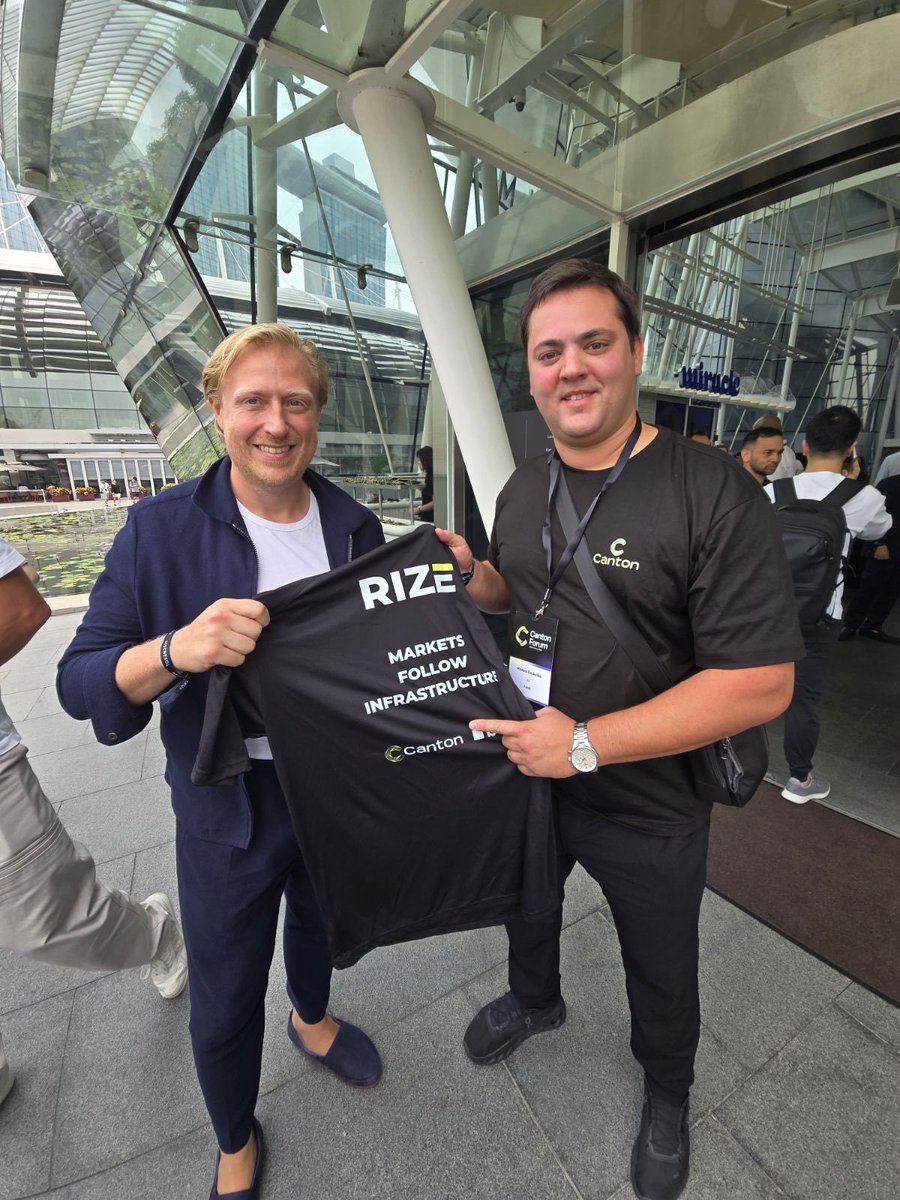
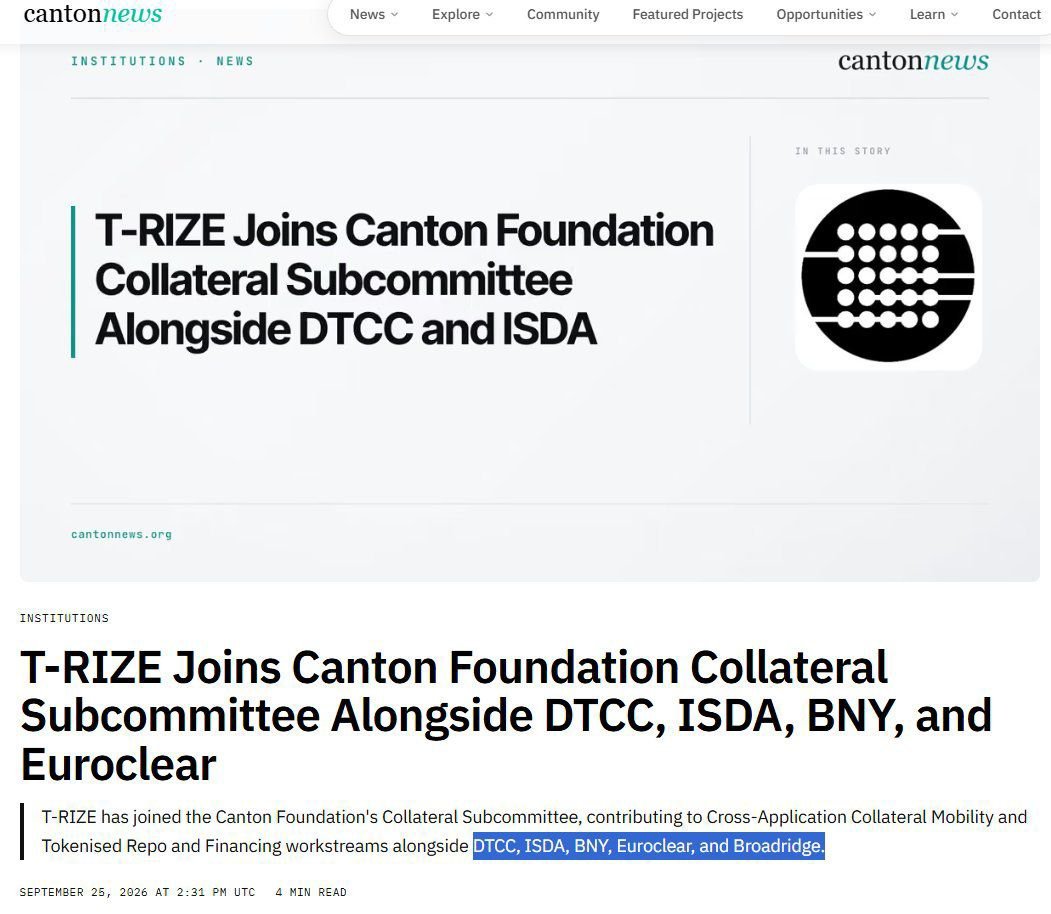
TOKERIZE cultivate big money energy as a community, because it is exactly how the people at T-RIZE shaped their tokenization orchestration layer and intelligence framework since 2022. This is how they scaled it to become one of the most relevant development happening on the @CantonNetwork
base:0x9818b6c09f5ecc843060927e8587c427c7c93583 as a token, matters into it. It is a piece of this infrastructure as a whole. Follow @madanirealx vision on how modern financial markets are getting shaped. RIZE as a token was always meant to become central in their workflows, particularily as an access and coordination token to their Canton Network stack.
Canton Network RWA infrastructure combined with privacy preserving intelligence, matters in the current era of on chain finance becoming reality. T-RIZE RWA pipeline is multiple B$, it matters. They work with T$ AUM entities as partners, it matters. RIZE is an on chain finance infrastructure token, it is not a simple "crypto token". It is tied natively to this institutional markets revolution. 10m market cap against a multi-billion USD tokenization pipeline won't hold for long.
Embrace the vision of people having big money energy, sticking to it through the waves, and proving everyone wrong by deploying. They are incredibly successful, and you will be as well. It is the flywheel. It is the value asymmetry.
Canton Network is the home of RIZE. It is coming soon. And it will make noise. Markets follow infrastructure.
TOKERIZE is proud to own RIZE. We will increase the noise and keep waving the RIZE flag, we are just starting. We know we are right about RIZE, and will keep shouting about it, wether you like it or not.
Onwards.
MUFG, with ¥433.91 trillion in assets, is in a group taking Japan's government bond repo onchain, with Canton Network tests targeted for November.
Its 69 members include SMBC, Mizuho and BlackRock Japan, using tokenized deposits and stablecoins.
@CantonNetwork
Adena Friedman, the chief executive of @Nasdaq, says collateral mobility is the nearest tokenization opportunity, citing a test by Vanguard and Wellington on the Canton Network ($CC).
https://t.co/I972HH4Gli