Effective contract correspondence decreases the risk of misunderstandings that can result in disputes. This article offers simple guidelines to help both experienced and novice contract administrators deepen their expertise in contract correspondence: https://t.co/Exarm1wxoe
The first step in resolving #construction claims is to identify the problems that cause project cost, quality, and schedule issues. Computerized document databases are often helpful in this phase. Learn more about our #constructionclaims methodology: https://t.co/9WP4RoWszN
This blog post defines directed and constructive acceleration, the 5 key elements that courts traditionally examine to determine if a contractor's work has been accelerated, the types of costs that are typically allowed for acceleration claims, and more: https://t.co/VxA0FHKs2Q
This article lays out a #riskanalysis maturity model that allows organizations to determine where they are today on the scale from “not aware” to “advanced integrated cost-schedule #risk analysis” and where they want to be: https://t.co/YclyV2yaVd
#riskmanagement#construction
Our schedule delay analyses typically focus on comparing as-planned, updated, and as-built schedules to identify and quantify delays to a project’s critical and near-critical paths. Learn more about our schedule #delayanalysis services: https://t.co/mEL2OJ0Nol
#construction
Successful commissioning and start-up phases are typically indicative of the future success of ongoing operations. This article offers a high-level overview of typical commissioning and start-up activities and their associated key considerations: https://t.co/2F9aAY5vGP
When estimating costs and executing work on EPC projects, certain commodities or scopes of work are easier to estimate and execute than others. Scaffolding is one of the more difficult scope items to forecast, estimate, and track. Check out our blog post: https://t.co/1qfjGg1x85
The concepts of concurrent delays and pacing delays are similar. This article defines, researches, and analyzes pacing relative to owner-caused delays and explains how to show that pacing is not a concurrent contractor-caused delay: https://t.co/VTyDNc41z6
#construction
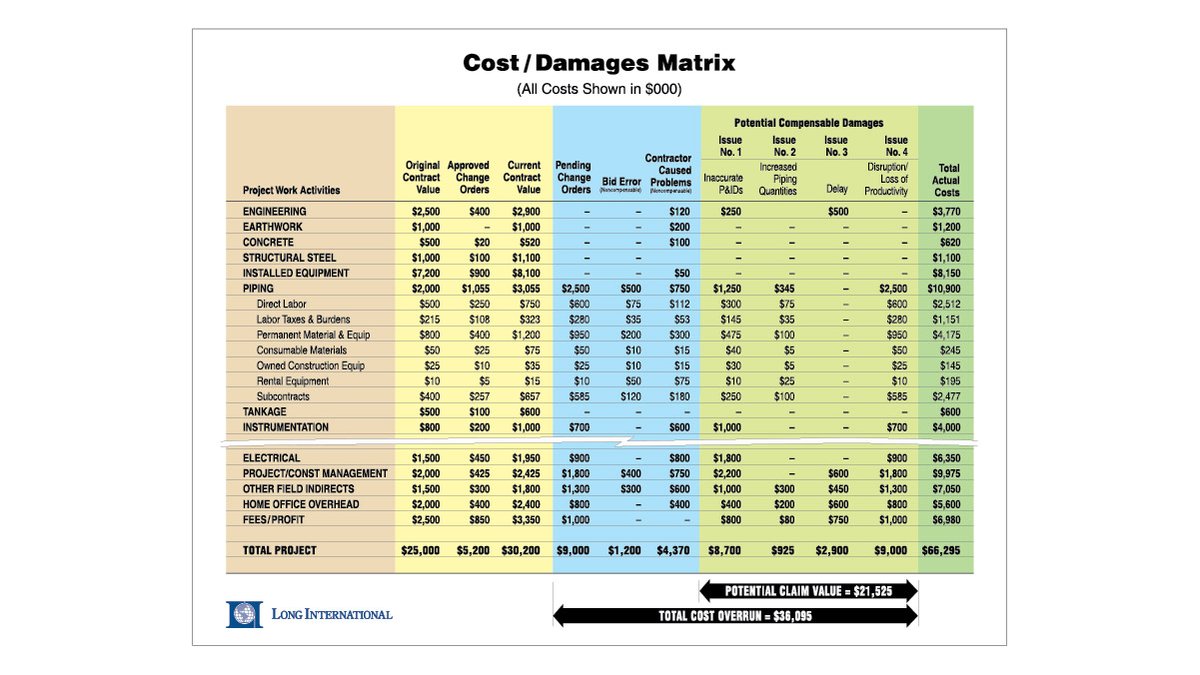
Cost-based #engineering and #construction#claims address increased time and performance costs resulting from unresolved change orders, disputed specifications, delays, and other causes. Learn how our quantum/damages experts approach these claims: https://t.co/frX4i9QiTv
Today's blog post explains how some experts invoke AACE RP 29R-03 as a credibility shield without actually following the standard. Discover what questions every #construction attorney should ask before relying on a delay expert's report: https://t.co/SmvcdAilNQ
#constructionlaw
This article discusses the 7 steps involved in a discrete damages/cost variance analysis method, plus the development of cost analysis databases, control budget calculations, actual cost calculations, a cost variance calculation, and more: https://t.co/elAgzjImMI
#construction
Several foundational issues are key to conducting successful quantitative cost risk, schedule risk, and integrated cost-schedule risk analyses. This post includes best practices for addressing the specific challenges that risk analysts face: https://t.co/dtwFUps2P1
#construction
For large, complex EPC projects, it can be difficult to identify, summarize, and evaluate the critical and near-critical paths. This article discusses steps to consider when identifying and analyzing critical and near-critical paths: https://t.co/8YclfSzfPu
#construction
Last week's blog post discussed float ownership for lump-sum turnkey EPC projects and offshore and mega-infrastructure projects. Today's post covers collaborative NEC projects and contractor-driven fast-track projects.
https://t.co/bAoTZtszuR
#constructionlaw#construction
The article "The Impact of Poor Contemporaneous Project Records on Claims Preparation and Expert Analyses" discusses the impacts of deficient documentation on project performance and retrospective analyses: https://t.co/cTzyZ9zS79
#construction#projectmanagement
Cost-based #engineering and #construction#claims address increased time and performance costs resulting from unresolved change orders, disputed specifications, delays, and other causes. Learn how our quantum/damages experts approach these claims: https://t.co/Cre0PY44Y9
This blog post discusses float ownership for lump-sum turnkey EPC projects and offshore and mega-infrastructure projects. The next post in this series will cover collaborative NEC projects and contractor-driven fast-track projects.
https://t.co/aqXJfKJ2Ar
#constructionlaw