And now… the rest of the story.
August 8, 1975.
High above the Montana–Idaho border, a 26-year-old man was searching for mountain goats.
And before that day was over, he would find himself fighting for his life.
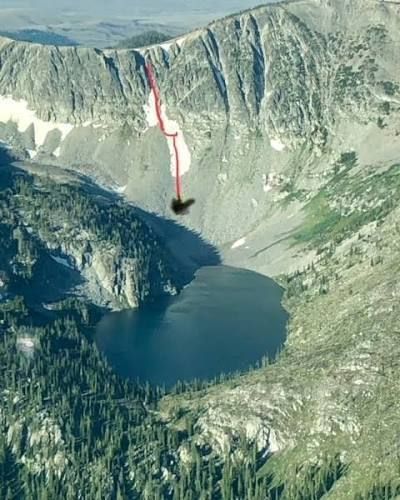
He was climbing Ajax Peak with local guide Dick Willey and Willey’s young son. They had reached an elevation of nearly 10,000 feet when he attempted to cross a snowfield.
Then the snow beneath him gave way.
He plunged down the mountain—tumbling end over end for hundreds of feet through a steep chute.
His fall ended when he struck a boulder… face-first.
The injuries were devastating.
His skull was fractured. His jaw, nose, and teeth were shattered. One eye was forced from its socket. A hole had been torn into his forehead.
He later said his head swelled to the size of a watermelon.
But he was alive.
Barely.
His companions tried to keep him talking while help was summoned. They knew that if he lost consciousness, he might never regain it.
The rescue took nearly six hours.
A helicopter could not land close enough to reach him. Rescuers first had to carry the broken singer about a quarter of a mile across the mountain before he could be flown to a hospital in Missoula.
Doctors did not expect him to survive.
But Hank Williams Jr. had already spent much of his life struggling beneath the weight of his father’s name.
Now he would struggle simply to keep his own.
When Hank finally awakened in the hospital, two familiar faces were reportedly among those waiting for him:
Johnny Cash and June Carter Cash.
Over the next two years, Hank endured operation after operation as surgeons reconstructed his face and skull. Accounts differ on the exact number, but there were many.
He lost his teeth.
He had to learn to speak again.
And then… he had to learn to sing again.
The scars would never completely disappear. To conceal some of the damage, Hank grew a full beard. He began wearing dark glasses and a cowboy hat.
It became one of the most recognizable images in country music.
But something else had changed on that mountain.
Before the fall, Hank Jr. had been marketed largely as the son of Hank Williams—a young man expected to sing his father’s songs and preserve his father’s sound.
The man who came down from Ajax Peak was no longer willing to live that way.
His music became harder.
Louder.
More rebellious.
Traditional country collided with blues, Southern rock, and outlaw attitude. In the years that followed came songs such as “Family Tradition”—records that announced Hank Williams Jr. was no longer merely carrying a famous name.
He had found his own voice.
The mountain had nearly taken his face, his music, and his life.
Instead, it gave country music… Bocephus.
And now you know… the rest of the story.
@hankjr
The image shows Hank's path down the mountain.