Clearly I've got to get to work on teaching our goats to "wave their arms".
Exceptional <cough> piece here from The State: "Coyotes are highly active during the summer in SC. Here’s how to fend them off"
https://t.co/dWvdxlCI7u
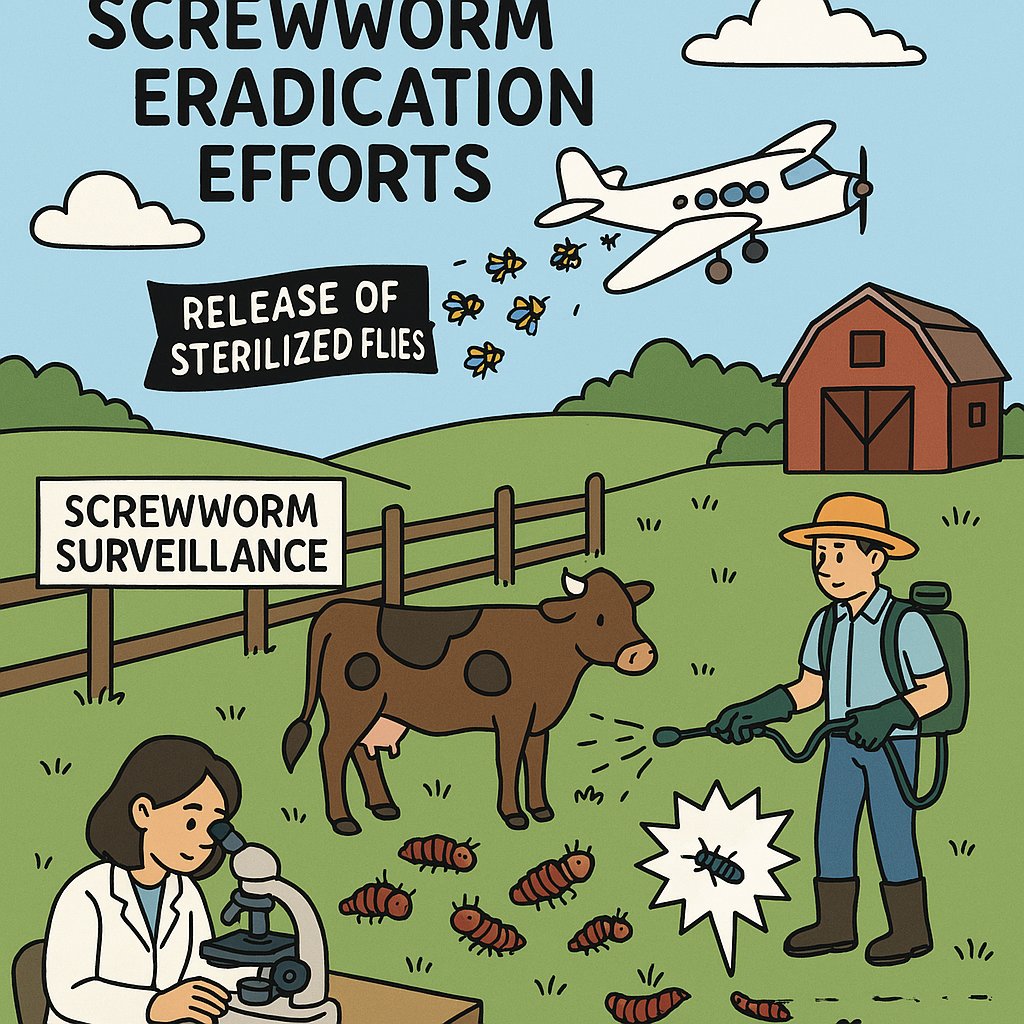
Recent Detection of New World Screwworm in Texas Raises Biosecurity Concerns for Livestock and Wildlife.
The U.S. Department of Agriculture (USDA) has confirmed the first domestic case of New World screwworm (NWS) in six decades, found in a three-week-old calf in Zavala County, Texas, near the Mexican border (USDA APHIS, 2026). Additional cases have since been reported in Texas and New Mexico. This parasitic fly lays eggs in open wounds of warm-blooded animals, with larvae feeding on living tissue and causing significant damage, economic losses, and potential mortality in livestock, wildlife, and occasionally pets or humans.
The blog post highlights two key risk zones. The summer dispersal zone could allow spread as far north as Kansas, Missouri, and Tennessee through wind, livestock movement, or wildlife. Milder modern winters may expand the permanent overwintering zone into South and Central Texas, the Gulf Coast, and parts of the Southeast (Louisiana, Mississippi, Alabama, Georgia, and Florida), where pupae can survive in soil (Goat Rancher Update, 2026).
Wildlife impacts are particularly concerning. Newborn white-tailed deer fawns are highly vulnerable due to umbilical wounds, with historical outbreaks linked to 25% to 80% fawn mortality in affected areas. Dense deer and feral hog populations could accelerate spread (Goat Rancher Update, 2026).
Positive developments include rapid response:
USDA and Texas officials have implemented containment, surveillance, quarantines, and the Sterile Insect Technique (SIT), releasing millions of sterile male flies to suppress the population. This method proved effective in the original eradication campaign decades ago.
Actionable recommendations for producers and stakeholders:
- Inspect livestock (especially newborns) daily for wounds and treat promptly with approved products.
- Report suspicious cases immediately to state animal health officials or USDA.
- Maintain strict biosecurity when moving animals or equipment.
- Support continued funding for surveillance and SIT programs.
This situation underscores the importance of vigilant border biosecurity and proactive agricultural preparedness in an era of changing climate patterns. Ranchers, veterinarians, and policymakers must collaborate to prevent wider establishment.
🤔 What steps is your operation taking to monitor for such threats?
References
Goat Rancher Update. (2026, June 9). New World Screwworm — How far could they go? https://t.co/PWMpu10NDx
U.S. Department of Agriculture Animal and Plant Health Inspection Service. (2026, June 3). USDA confirms presence of New World screwworm in the United States. https://t.co/kx9GajFjtx
U.S. Department of Agriculture Animal and Plant Health Inspection Service. (2026, June 8). USDA confirms two additional cases of New World screwworm in the United States. https://t.co/vRvLIT6ydl
Intent vs. Outcome: A $10 Parkland Gift Evolves into a $10M Data Center Sale
In 1999, a Texas farmer donated 87 acres in Taylor for a nominal $10. The deed explicitly required the land be held in trust as community parkland for local children.
By 2025, after transfers through foundations and the city's Economic Development Corporation, a portion sold for $10 million to a data center developer. Projections estimate an additional $30 million in tax revenue over the next decade, with about $20 million directed to the local school district.
This case reveals the gap between original donor intent and later economic priorities. The revenue supports schools and infrastructure amid rising AI-driven demand for data centers. At the same time, residents have raised concerns about noise, water and power usage, air quality, and impacts on community character, while pursuing legal action to enforce the deed restriction.
Key considerations:
- Economic benefits versus preservation of charitable intent and resident quality of life.
- The role of multiple ownership transfers in altering original restrictions.
For communities, this underscores the value of clear deed safeguards, transparent zoning decisions, and balanced stakeholder engagement when handling donated land.
How should communities reconcile growth opportunities with honoring historical donor intent?
https://t.co/5PgQTVBLwM
#LandUse #EconomicDevelopment #DonorIntent #CommunityPlanning
Livestock thefts (particularly cattle rustling) in the United States appear to be increasing, especially in 2025, based on reports from ranching organizations, law enforcement, and agricultural media.
Key Evidence and Trends:
- High cattle prices as the main driver: Record-high beef and cattle prices in recent years have made livestock a lucrative target for thieves. Organized groups often target young, unbranded animals that are easier to sell or slaughter. This pattern was widely noted in 2025 reports across states like Texas, Colorado, Kansas, Nebraska, and South Dakota.
- Texas examples: Over 2,000 cattle were reported stolen in 2023 alone, with losses exceeding $5 million. Reports of thefts surged further in 2025, with multiple arrests for organized schemes involving dozens of head (e.g., one ring linked to ~70–82 cattle across ranches). Local sheriffs and the Texas & Southwestern Cattle Raisers Association (TSCRA) have issued warnings and set up tip lines like "Operation Cow Thief."
- Other states: Significant incidents include a Colorado ranch losing nearly $400,000 worth of cattle, plus thefts in Kansas, Nebraska, South Dakota, Virginia, and North Carolina (with multi-state schemes leading to prison sentences and large restitution orders).
- Broader context: Agricultural theft in general (including livestock) is a multi-billion-dollar issue annually. While exact national totals are not centrally tracked in FBI Uniform Crime Reports (livestock theft often falls under general larceny), industry sources describe a clear uptick tied to economic factors like high market values and rural challenges in monitoring large areas.
Caveats:
- Underreporting is likely: Many thefts go unreported or unrecovered (estimates suggest <50% recovery rates nationally due to tracking difficulties). Official FBI data aggregates livestock under broader property crime categories, so granular national year-over-year stats are limited.
- Not uniform: Increases are most pronounced in cattle-heavy Western and Southern states. Some areas see sporadic rather than constant rises, and enforcement efforts (e.g., brand inspections, special rangers) can lead to more detections and arrests, which may inflate perceived increases.
Overall, the consensus from 2025 reporting is that thefts have risen alongside cattle values, prompting ranchers to enhance security (e.g., branding, fencing, surveillance, and reporting to groups like TSCRA). This trend may continue into 2026 unless prices drop significantly or prevention improves. For the latest local data, check state agriculture departments or ranching associations.
Livestock theft in Mercer County, Ohio!
More than 60 young Holstein steer calves — worth over $100,000 - were stolen overnight from a Coldwater-area farm. Thieves loaded up 64 calves (13 weeks old, ~$2,000 each) from a large barn, leaving the younger ones behind, suggesting someone with industry knowledge was involved.
Sheriff’s office is searching regionally (including Indiana). Farmers are now ramping up security.
Praying the calves are recovered and justice is served!
Share if you’re a farmer or know anyone in the area who might have info. I'm afraid we're going to see upticks in this sort of garbage as economic factors bite harder.
https://t.co/PRW0LxNDGv
Just read this eye-opening piece on Monarch Tractor – the AI-powered autonomous electric tractor startup that raised over $240 million, hit a $500M+ valuation, and was named one of Time’s best inventions in 2023.
Now? The company laid off its entire team late last year, vacated its California HQ in March, and faces shutdown after burning through the cash. Early adopter Patrick O’Connor, a winemaker with steep vineyards, tested their rig for three years. His blunt take: it “totally failed,” ran dangerously in self-driving mode, couldn’t handle narrow rows without hitting vines, and never delivered true autonomy. He now calls it his “$200 million log splitter.” Dealerships even sued over defective performance and misleading claims.
This hits home for anyone in ag. Hype around AI tractors promised to cut labor, slash chemicals, and boost yields – but reality showed the gap between demo and dirt. We’ve seen it elsewhere too: Western AI crop-detection models failing “spectacularly” in Kenya and India because they were trained on North American data, not local microclimates or smallholder plots. Or capital-heavy agtech robotics startups folding in 2025 from slow farmer adoption and brutal unit economics.
The good news? Real wins are happening when AI stays practical. John Deere’s acquisition of Blue River Technology brought AI precision sprayers that cut herbicide use 90% while protecting yields. In South Asia and Africa, apps like FarmerChat have answered over 8 million farmer questions in local languages using simple image uploads for pest ID.
Bottom line: AI can transform ag – precision irrigation, disease scouting, labor relief – but only if we build it with farmers, not for them. Test in real fields. Use local data. Keep it affordable.
Fellow growers, agtech folks, and investors: have you tried autonomous tools or AI decision apps on your operation? What worked – or crashed and burned? Share your story below. Let’s talk real-world lessons, not headlines.
(Article: https://t.co/tvEFUY3uHr)
What’s your take?
#AI #agriculture #agtech
The 2026 Farm Bill could reshape U.S. agriculture in ways that favor Big Tech over farmers. As someone tracking ag policy, I dove into this Fortune article, and the details on AI and precision ag subsidies are alarming. Here's a bulleted breakdown of the most concerning provisions and their potential impacts on farmers:
- **Private Sector Control of AI Standards**: The bill lets Big Tech set interconnectivity rules for AI in farming, bypassing USDA oversight. This could lock farmers into proprietary systems, mirroring right-to-repair battles where companies restrict independent fixes, hiking costs and eroding operational freedom.
- **Boosted EQIP Subsidies for Tech Adoption**: Farmers get 90% reimbursement (up from 75%) for precision tools like GPS, IoT sensors, and data software tied to conservation. While sounding helpful, it funnels public funds to tech giants, creating dependency. Farmers might feel pressured to adopt to stay competitive, but end up paying ongoing fees for software updates or data access.
- **Data Privacy Risks**: IoT and telematics collect vast farm data without strong public safeguards. This exposes sensitive info on yields, soil, and operations to corporate exploitation, potentially leading to unfair pricing or market manipulation against smaller producers.
- **Widening Inequalities**: Smaller or independent farmers may struggle with upfront costs, tech complexity, or integration, favoring large operations. This could accelerate farm consolidation, squeezing out family farms and reducing rural economic diversity.
- **Environmental Irony and Broader Effects**: Subsidies indirectly support data centers that drain water and convert farmland, contradicting conservation goals. Long-term, farmers face higher risks from climate-vulnerable tech dependencies, plus legal issues like those seen with GMO seeds.
https://t.co/Bwhq5UTowl
Overall, these changes might boost short-term efficiency but at the cost of farmer autonomy, privacy, and equity. What do you think - is this progress or a power grab? Let's discuss in the comments. #FarmBill #AgTech #USFarmers
Since common sense is no longer common, this may be a law that I could get behind. There's not a week that goes by in our rural community that I don't find at least one mylar balloon in a pasture or on the edge of a field waiting to be eaten by livestock or wildlife:
https://t.co/UIFVMLvce4
I had the opportunity to stop in at the Newberry County (SC, US) Clemson Extension Office today and met Sydney, the local extension livestock specialist.
She shared some great info with me on the New World Screwworm.
While there haven't been any known sightings in the U.S. yet, it would be great for all livestock owners to have the information at hand or in front of mind. It's actually rather easy to mistake the New World Screwworm for other larvae, and early reporting is critical to efforts to sterilize the New World Screwworm.
Animals, pets, storms, etc. crossing the southern U.S. border can easily bring them into the U.S. Unfortunately, it's just a matter of time, but catching things early and reporting them will help move resources to areas in need to help slow or stop infestations from spreading.
Visit the Clemson New World Screwworm info page here (includes phone numbers for reporting in South Carolina as well): https://t.co/sWTDPQPO3Y
Visit the USDA page on the New World Screwworms here: https://t.co/VBuSVnv7qP
Please help spread the word if you have livestock in the U.S., hunt, or regularly find yourself outdoors in the U.S.
American farmer shows what $5,000 worth of seeds now looks like
This is what happens when the seed industry has been taken over by monopolies and farmers are now forced to use their seeds and pay their insane markups
American farmer shows what $5,000 worth of seeds now looks like
This is what happens when the seed industry has been taken over by monopolies and farmers are now forced to use their seeds and pay their insane markups
⁉️ Did you know?
Under the FMIA (Federal Meat Inspection Act):
- Local farmers generally cannot process their own livestock into meat.
- Local farmers cannot sell their meat across state lines—even if they live just 5 minutes away.
- The 4 big meat processors (there are only 4) can import products from anywhere in the world and sell them to Americans without disclosing the origin.
Local farmers and ranchers can’t make money from the food they produce, but Big Ag can profit from animals treated with chemicals and vaccines from anywhere in the world.
Congress is owned by special interests, and this isn’t MAHA. @VigilantFox@TheChiefNerd
Goats are arguably the most resourceful food animal on earth, and they are almost completely absent from any serious conversation about sustainable food production.
The goat is a browser, not a grazer. Where a cow and sheep prefer grass, a goat prefers scrub, brush, bramble, and the lower branches of trees. It eats the plants that cattle won't touch, on land that sheep won't use, on terrain that's too difficult for either.
This makes the goat the ideal animal for reclaiming marginal land. Overgrown hillsides, scrubby valleys, former industrial land reverting to bramble and thistle: the goat will clear it. Not by destroying it, but by browsing it back to a state where grass can establish, which is then grazed by sheep or cattle.
The goat is the pioneer species of ruminant agriculture.
Goat milk has a smaller fat globule size than cow's milk, making it naturally easier to digest. Its casein protein structure is closer to human milk. It contains higher levels of short and medium-chain fatty acids. People who cannot tolerate cow dairy frequently tolerate goat dairy without issue.
Goat meat, chevon, is the most widely consumed meat protein in the world. More humans eat goat than eat pork or beef. It is virtually unknown in Western supermarkets.
The animals that feed the majority of the world's population are essentially invisible in Western food discourse.
Because Western food discourse is conducted by people who shop in supermarkets where goat meat isn't stocked.
The goat needs a marketing budget and slightly better PR.
The goat does not need defending nutritionally.
The nutritional case is solid.
The animal has been keeping humans alive for ten thousand years.
Mostly just nobody in a position to write about food has noticed.
Unrealized gains tax for Gen-Z:
You buy a Pokémon card for $50.
Someone offers you $500 for it. You say no. You love that card. You're keeping it.
The government says: "Cool, but that card is worth $500 now. You owe us $100 in taxes."
You: "…I didn't sell it."
Government: "Don't care. Pay up."
You don't have $100 lying around. So you're forced to sell the card you love just to pay a tax on money you never received.
Next month? That card drops back to $50.
Your card is gone. Your money is gone. And the government shrugs.
That's a wealth tax on unrealized gains. They don't pay you back the tax...
Now picture this.
Your mom calls you crying. She has to sell the house she raised you in. Not because she can't afford it. She's lived there 30 years. It's paid off.
But some website says it's worth more now and the government says she owes $15,000 she doesn't have.
So she sells your childhood home. The kitchen where she made you breakfast. The doorframe where she marked your height every birthday.
Gone.
To pay a tax on money that was never real.
Now picture the opposite.
Your dad put everything into his small business. For 20 years he built it from nothing. One year the business is "valued" at $2 million on paper. He owes a massive tax bill. He empties his savings. Sells his truck. Borrows money. Pays it.
Next year the market crashes. His business is worth $200,000.
He lost everything to pay a tax on a number that doesn't exist anymore.
Does the government give him his money back?
No.
Does the government give him his truck back?
No.
Does the government care?
No.
They sold this idea as "taxing billionaires." But billionaires have armies of lawyers, offshore accounts, and trusts. They'll be fine.
You know who won't be fine? Your mom. Your dad. Your neighbor with a small business. The farmer down the road who's had the same land for four generations and now has to sell it because dirt got expensive.
You're not taxing wealth. You're taxing people for owning things.
It's like getting a parking ticket for a car you might drive somewhere someday.
They want you to own nothing and be happy. To fund the fraud, waste and abuse of the welfare state they created.
There is enough money. More tax isn't needed. It's all a lie. But you've been gaslit into believing this is a rich vs poor debate.
I hope you understand what's at stake.