OpenAI shipped a ChatGPT that plans the project, opens your files, and hands back the finished deck.
So what are we training people to do now? Making the slide was never the hard part. The hard part is looking at a confident, polished deck and catching that it's wrong, and being able to say why.
That comes from doing the work by hand enough times to feel when something's off. You can't prompt your way to that.
If your L&D roadmap still ends at "tool proficiency," it's behind. What are we teaching that the agent can't?
#LearningAndDevelopment #FutureOfWork #Upskilling #MilestoneBeacon
The company that makes the AI Claude just discovered something about its own product.
When Claude answers you, it also has private thoughts it doesn’t include in the answer. For example, it can think “this is a test” or “I’m making this up” and never say so. Until now, no one could see those private thoughts. Now researchers have a tool that shows them.
Why should you care? AI already helps screen job candidates and write emails at work. This discovery proves an AI’s answer can look confident and correct on the outside while something very different is happening on the inside.
Lesson for anyone who evaluates people or machines: a good-sounding answer is not proof of good thinking.
#ArtificialIntelligence #AIResearch
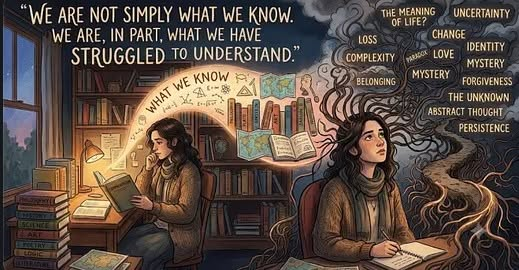
This image says something beautiful about reading: we don’t open books only to collect answers. We open them to wrestle with questions, to enter complexity, to sit with uncertainty, and to come out changed.
Maybe wisdom is not knowing everything.
Maybe wisdom is staying curious long enough for mystery to teach us something.
If you agree, we can meet in my literary home:
Lorena Mayoral | Substack
News from Anthropic: their AI coding tool now auto-publishes a live record of its work — drafts, revisions, reasoning, all timestamped.
For training and certification, the implication is direct. “Show your work” was our proof that a human did it. The machine now shows its work better than we do.
Portfolios and project records still tell you the work exists. They no longer tell you who’s competent.
The fix isn’t detection. It’s live demonstration ; explain the work, modify it, defend it in the room. We assessed that way before portfolios. It cost too much. It still does.
#AIinLearning #AssessmentValidity #LandD #MilestoneBeacon
Altman gave us a date. Two years.
No training plan. No answer for what a nineteen-year-old should major in this fall, when the target might move before she graduates.
My nephew’s filling out an application for a job that may not exist by the time he starts. He calls it
Superintelligence. I keep asking who it was built to serve and who it’s actually for.
#Omnideus
Sam Altman: Superintelligence probably by end of 2028, so we got roughly 2 years left. Enjoy your job while you still can.
"A superintelligence, at some point on its development curve, would be capable of doing a better job being the CEO of a major company than any executive, certainly me, or doing better research than our best scientists."
"On our current trajectory, we believe we may be only a couple of years away from early versions of true superintelligence. If we are right, by the end of 2028, more of the world's intellectual capacity could reside inside of data centers than outside of them."
PS. Follow us @themetav3rse for latest news on emerging technology and internet culture.
Nvidia just gave 170,000 GPUs to a company whose whole pitch is that smaller players can’t afford this stuff otherwise. Firmus called it leveling the playing field.
Higher ed has the same gap, quieter. A flagship research university with an endowment negotiates enterprise AI contracts directly with vendors. A regional state school gets whatever’s in the bundle IT already licensed. Nobody votes on that. It just happens in procurement, six months before a syllabus mentions it.
Faculty senates argue over AI use in coursework while someone in facilities is signing a compute contract two buildings over. Different meeting, same semester, no shared agenda.
The GPU story isn’t really about GPUs. It’s about who gets to decide what “AI-ready” means for their institution, and who just inherits the decision from whoever had the better credit rating.
Firmus wants to hand that leverage to the smaller players in enterprise. Nobody’s built the equivalent for a community college trying to figure out what its own AI policy should say.
#MilestoneBeacon #HigherEd #AIinEducation #HumanCenteredAI #EdLeadership
Everyone thinks AI is just software in the cloud. It isn't.
It runs on real chips, in real buildings, drawing on real power grids.
Google reportedly limited Meta's access to its AI models — Meta wanted more computing than Google could supply.
The cloud was never weightless. We just stopped seeing the buildings behind it.
#Omnideus #MilestoneBeacon
MIT’s president says students want to learn, not take the easy path. Good. But the shortcut never announces itself as one ; it feels like efficiency until you find out the thing you skipped was the thing you needed.
The hard part isn’t whether students value real learning. It’s whether the institution can still tell the difference between work struggled through and work routed around when the output looks identical either way.
That’s a measurement problem, not a cheating one.
This isn't science fiction. A Seattle company just unveiled Codey, a three-foot autonomous robot with hazel eyes, built to befriend children. Its own AI, no human operator. Museums and schools first. Homes next.
The launch video is warm. Almost wonderful.
To the dads holding the space no machine can fill — happy Father's Day!
#SpeculativeFiction
#SciFi #Omnideus #MilestoneBeacon
World Cup 2026. Watch the best player on the field. He isn't the one who memorized the most rules; he's the one who reads the play before it happens and decides well while everything around him moves.
That's competence. Most training programs still train for the opposite: a still board. Fixed scenario, one right answer, clean conditions. But that's exactly the part AI now does instantly and for free. The recall, the clean answer, the procedure... Gone as a differentiator.
What's left for humans is the moving board. The shifting opponent, the closing window, the call you have to make on incomplete information while conditions change under you. No one on the field gets a multiple-choice question, and increasingly, neither does anyone at work.
So, let's stop designing courses for the conditions AI already handles. Build the judgment that performs when the plan breaks... Because the plan always breaks. That's the key competence that is needed today.
#LearningAndDevelopment #FutureOfWork #MilestoneBeacon
The newest AI models are moving from tool to collaborator: writing production code, interpreting complex visuals, sustaining long tasks, and accelerating scientific research.
The real story isn’t just capability. It’s stewardship.
As models grow more powerful, the human advantage becomes clearer: judgment, memory, presence, and the ability to choose what deserves attention.
That question sits quietly behind my upcoming novel #Omnideus.
China has officially approved the world’s first commercially available brain-computer interface implant for medical use. This historic milestone marks a massive leap forward for neurotechnology, opening up incredible new possibilities for advanced patient care worldwide.
The pioneering device is specifically designed to help individuals with paralysis regain their mobility and independence. By translating complex brain signals into physical actions, it offers life-changing potential for millions of people living with severe motor impairments.
With this regulatory green light, the device has officially achieved commercial approval ahead of Elon Musk’s highly anticipated Neuralink. While Neuralink remains in the clinical trial phase, this new implant is ready to transform the medical market.
We wanted machines to take our problems off our hands. The whole history of every tool points there.
Now it arrives and a lot of us are uneasy. Not because the machines will fail. Because they might succeed.
The problems were ours. They were the proof we were alive.
I wrote about what we do with the empty hands here:
https://t.co/e69GITLte3