As college decision week wraps up, I'm going to resurface this. I'd hoped to write another longer piece, but I haven't shipped any software in over a week, which in 2026 means I'm about 6 months behind in pre-2026 time. I wrote that article in January. I think history books will put a chapter break two weeks later, when Opus 4.6 and GPT 5.4 dropped.
In this new chapter:
- I stand by what I said in January
- Isaac committed to UATX; we're tripling down
- President Carvalho gave some STEM clarity: emphasis on Comp. Sci, esp. AI, in the near term
- It's so, so fast to build anything now. A gas turbine or a gas chamber. Discerning *what* to build is the critical skill.
- The reading material for Saturday was opposing sides of AI optimism & AI pessimism. Good stuff. They're aiming students at the right questions.
- There are no constants now, only change. I'm bullish on nimble organizations willing to change their mind when inputs change.
- Externally, responding to change can be indistinguishable from lying ("but last year you said...").
- UATX is comprised of good people. Excellent people. I'll stake my life on that.
Good luck seniors, making your final decisions tomorrow.
Thank you, @uaustinorg, for another wonderful weekend and for teaching our sons.
@nfergus, it was a pleasure meeting you.
Here's the brutal truth: Most college students aren't really students.
The word student comes from Latin words meaning someone who applies himself with focused intensity and painstaking effort.
Does that sound like the average college kid?
The average college "student" spends less than two hours a day on schoolwork. Two-thirds admit they're willing to cheat rather than put in the effort. At Ivy colleges, 80% of all grades are A-minus or above. Does that sound intense or painstaking?
Here's another uncomfortable truth: most so-called "students" are perfectly content with this. They'll happily go into debt, or let their parents foot the $80,000-a-year bill, for glorified daycare with a diploma at the end -- a diploma, by the way, that no longer signals intelligence or ability. Employers know it. "Students" know it.
That's why we started the University of Austin (UATX). We built UATX for those who actually want to learn and be formed. Students who think education should involve effort and challenge. Students who are willing to apply themselves with seriousness and purpose.
We don't inflate grades; our average GPA is low by design. We rank students. We reward hard work. Yes, it's demanding.
It's also deeply liberating. We take liberal education seriously, in its original sense: education that liberates the mind from lazy conformity to reigning orthodoxies. Our students engage with the great books and the great minds to wrestle with the timeless questions every human must face: what gives life meaning? what is justice? what makes us human?
We also train them in science, technology, and the hard skills to build, invent, and tackle the real problems facing our country and our civilization.
We realize this isn't for everyone, and certainly not for "students."
But if you're actually a student -- if you crave challenge over comfort, if you want your mind sharpened rather than soothed -- then you deserve more. You deserve an education that honors what you are: someone willing to apply himself with focused intensity and painstaking effort in pursuit of truth.
@LeadingReport OR: incredible life hack.
If your test scores are high enough, tuition has fallen **infinity** percent since 2023.
Zero dollars. Ten-minute application. Same-day acceptance.
@uaustinorg
(The craziest part: it's also excellent)
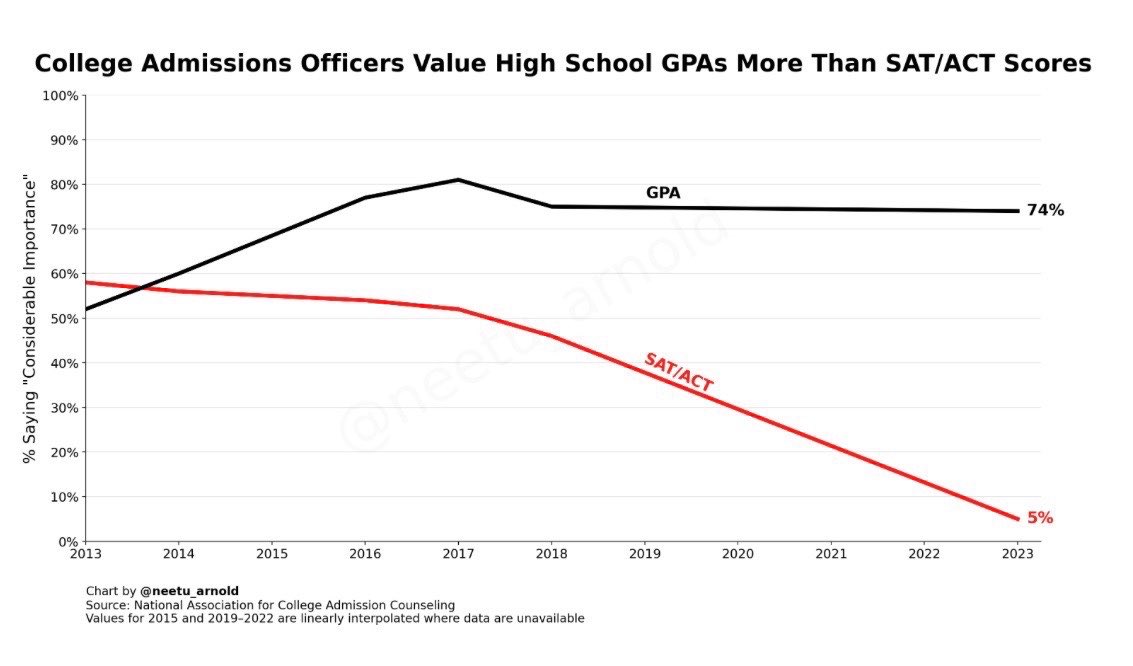
Amid grade inflation, look at this striking shift in how college admission officers rate the importance of high school GPAs & SAT/ACTs in decisions
2013: both equally matter
2023: 74% rated GPAs of “considerable importance” while only 5% said the same for SAT/ACT scores
What a fantastic weekend. Life is wild. One minute you’re taking a 3200-mile roadtrip on a lark.
Next thing you know, your kids are talking to @nfergus. So, so grateful for @uaustinorg. It was great meeting new parents for dinner and coffee. And great to catch up with so many parents we met last year.
The parent community here is an underrated and under-advertised joy. I meet new excellent people with every visit.
That’s to say nothing about the events themselves. Both incoming Freeds loved the Admitted Students day and are even more excited for fall. Yesterday deserves its own space, and this fake extrovert needs a nap.
Just say “yes” to adventure.
Thanks @plodinec for the photos!
We are proud to announce Sir Niall Ferguson (@nfergus) as the 2026 honoree of the George F. Will Award for the Advancement of Liberty and the Free Society.
Inspired by Liberty Fund founder Pierre F. Goodrich, this award reflects a deep commitment to advancing our understanding of a society grounded in freedom and responsibility. Named for George F. Will, America’s foremost columnist and a steadfast champion of liberty, it recognizes individuals whose work deepens our understanding of the free society, individual liberty, and the human condition.
If you just got into an Ivy League college (or your kid did), you really ought to read this excellent post from @uaustinorg. There really are better ways to spend four formative years of your life.
Here are a three reasons to apply to UATX right now.
Admitted students get:
1. An invite to a full day with Palantir on campus April 25, including a hands-on session with their team.
2. An invite to hear Ben Shapiro speak on April 26.
3. Up to $500 reimbursed to visit Austin.
No commitment to enroll is required. And if you do enroll -- tuition is free, for all four years.
To: Admitted Students on Ivy Decision Day
From: UATX
Congratulations. Getting in was hard and you should be proud. Now here’s some unsolicited advice so you don’t waste the next four years.
Go to class. We know this sounds obvious. But as the New York Times reported recently, Harvard students routinely skip class, rarely speak up when they're there, and focus on their devices instead of the discussion. Faculty say few students do enough preparation to contribute meaningfully. The average college student spends about 20 hours a week on class and studying combined. At UATX, we aim for 50. That’s the difference between a part-time commitment and a full-time job. You (or your parents) are about to spend upwards of $90K a year. If you don't show up, you're paying roughly $250 per skipped lecture for the privilege of sleeping in.
Read the books yourself. Your generation is the first to arrive at college post-literate — raised on short-form video, dependent on algorithms, and increasingly incapable of sitting with a difficult text long enough to let it change your mind. Ninety percent of college students use AI academically. This makes you more reliant on the authority of others. Most professors will also stand between you and the text. They’ll tell you what Marx “really meant,” what Aristotle “failed to see,” as though an academic in 2026 has outsmarted minds that shaped civilizations. The good professors do the opposite: they put you in front of the book and they work with you to find what a great mind has to teach us directly. Find those professors, and read everything yourself.
Say what you actually think. Seventy-three percent of conservative students report withholding their political views in class out of fear their grades will suffer. Our advice isn't political; it's intellectual. If you spend four years learning to say what's expected instead of what's true, you’ll graduate roughly where you started — just older, more credentialed, and more practiced at self-censorship. One study finds that nearly half of students show no measurable gains in “critical thinking” after two years in college. Keep this in mind as you make decisions about which professors to take and how to do your assignments. Taking a small hit on your paper to gain integrity and wisdom is usually worth it.
Ask for real grades. Sixty percent of Harvard undergraduate grades are now A’s. Twenty-five years ago, it was 20%. It got so bad that the legendary Harvard professor, Harvey Mansfield, started giving students two grades: the official one for their transcript, and a private one reflecting what they actually earned. He called the official grades “ironic.” So here's a suggestion: Take your A, but also ask your professors for a “Mansfield grade” so that you know where you stand. And don’t avoid difficult courses to keep your transcript clean for law school.
Get work experience before you graduate. Forty-two percent of recent college graduates are working jobs that don't require a degree. Many employers are projecting the next few years to be the worst college grad job market in years. A degree alone — even from an Ivy — is not a job guarantee. Seek out apprenticeships, internships, and real work starting freshman year. The students at UATX are connected with entrepreneurs and business leaders from day one. Many will graduate with four years of work experience alongside their degree. You can build something similar at your school, but you'll have to do it yourself.
Understand how debt shapes your life. If you're paying full freight or even half, do the math with your eyes open. Your decision to take on debt will quietly reshape the trajectory of your adult life through countless small surrenders: the job you take because it’s safe instead of starting the company. The city you choose to live in. The relationship you delay and the kids you don’t have. For women, a $1,000 increase in student loan debt lowers the odds of marriage by 2% per month in the first four years after graduation. None of that shows up in the college brochure. If you're going to take on debt, treat it like the constraint it is from day one: save aggressively and make sure every dollar is buying something that will actually compound in your favor.
Find the people who take school seriously. The best thing about a great school isn't the lectures or the library. It's the handful of professors and students who are genuinely there to learn — who read ahead, argue in good faith, and push you to be sharper. Find them. UATX is a small community of those who seek a serious education. At a larger university, you have to build this community yourself.
*
The most dangerous thing about an elite university is that it is very easy to do nothing for four years and still come out looking successful. The transcript will say you excelled. The diploma with the fancy crest will open certain doors. Your parents will be proud. And yet you will have coasted — through inflated grades, unread books, and borrowed opinions.
Getting in is an accomplishment. Making the next four years worth it will be harder, and the right decisions will change everything.
We wish you luck.
Write on the Declaration of Independence for a $2,500 scholarship to UATX’s Summer Fellowship.
Advanced high school and college-aged students eligible. Essays evaluated starting April 1.
Ben Shapiro is coming to the University of Austin (UATX) on April 26.
Admitted students get an invitation. Spots are limited.
If you've been thinking about applying, now's the time. @benshapiro
💥 Next week David Bolotin's lecture notes of the legendary 1988 seminar on Plato's Republic at the University of Chicago will be published.
https://t.co/RughL4JGEP
This summer, a group of UATX students are heading to Israel -- meeting with Knesset members and military strategists, hiking Masada at sunrise, touring the Gaza Envelope with survivors, visiting the Weizmann Institute, and joining Prof. JJ Kimche for a traveling seminar on the Jewish State.
The trip is open to current UATX students and students admitted for this fall. If you’ve been thinking about applying, now is a great time.
.@PalantirTech built the software the intelligence community used to hunt terrorists. Today they’re one of the most important defense and AI companies on the planet. On April 25, they’re on UATX’s campus for a day — and you get to work with them.
The lineup: First, a UATX seminar on how the American Founders thought about ambition. A real debate on whether AI should make us optimistic or terrified. Then, a hands-on Palantir session on “The Art of Decomposition” — how their teams break impossible problems into solvable ones. A closing reception will be open to families.
Cost: free.
The catch: it’s only open to admitted and deposited UATX students. Haven’t applied yet? It takes five minutes. We’ll even reimburse up to $500 in travel if you haven’t visited campus.
Space is strictly limited.
“The original Harvard was Puritan Harvard.
I’d like to say that, when the Puritans came here, then the indigenous people, the so-called Native Americans (a misnomer, I think)…didn’t have a university. So the Puritans were forced to make one for themselves.
A startup university like yours, UATX, is something in that situation—except that the surroundings are perhaps more hostile than the Native Americans were to a place like Harvard.” — Harvey C. Mansfield