📍Have a look at our new article on hydrogels : Carboxymethyl Chitosan/Polyacrylamide Hybrid Hydrogels: Preparation, Characterization and Sustained Antibiotic Release Studies
https://t.co/siON6uZYlC
#chitosan#biomaterials#hydrogel
@merlinatomica@LatinXChem@ChemUniPi@UdeLaHabana@Unibo 2)RGD sequence of COL is a cell adhesion motif that improve the biocompatibility by favoring cell proliferation/migration. Indeed, CMCS/Zn/COL significantly increased their viability and showed a wound healing comparable to the control already after 12 h, confirming this + effect
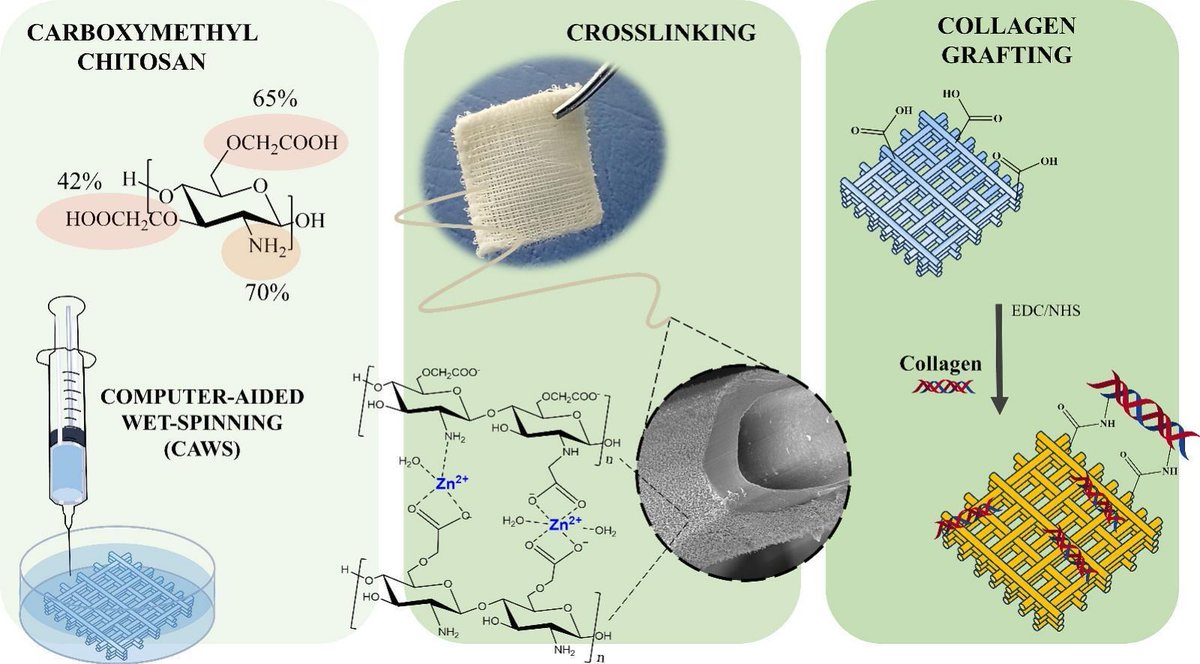
@merlinatomica@LatinXChem@ChemUniPi@UdeLaHabana@Unibo Hi Mercedes. I appreciate your interest! 1)COL grafting procedure involved amide bonds formation meanly between COL-CMCS but also probably CMCS-CMCS, and COL-COL. Therefore, the scaffolds presented a significantly higher Tg (210 °C) due to an increase in cross-linking density.
@montes_ashanti@LatinXChem Hola Ashanti, muy interesante el trabajo. ¿La liberación de ~90% de Metformina a las 10h es positivo para tu aplicación? La consideras sostenida? ¿Fue posible discutir alguna diferencia significativa de SCG80-20F con respecto al control en el modelo de quemadura? Muchas gracias!
Hi!! @LatinXChem .This is our work "Design an in situ gelation system for the prolonged release of a gonadotropin releasing hormone analogue."
A promising prolonged release system for the treatment of prostate cancer.
#LatinXChem24#LatinXChemNanoMat#NanoMat031
@MelaniePal52209@LatinXChem Hola Melanie, interesante el trabajo. Con respecto a la estabilidad del péptido¿Creen que su degradación en el tiempo está relacionada más con el pH del medio o con una contaminación bacteriana?¿El contenido de azida explorado sería seguro incorporarlo en la formulación? Gracias!
Happy to share our new article published in Carbohydrate Polymers journal: Ionically-crosslinked carboxymethyl chitosan scaffolds by additive man... https://t.co/5AOcgsMBLg
Happy to share our new article published in Carbohydrate Polymers journal: Ionically-crosslinked carboxymethyl chitosan scaffolds by additive man... https://t.co/5AOcgsMBLg
Imagine growing a miniature version of the human intestine in the lab to study gut biology in great detail and test medicines before clinical trials? We are happy to share our latest publication on bioengineered human mini-intestines: https://t.co/0AvDkk9R3S Let’s dive in!
Have a look at this new article on bacterial polyester-based composites by our research group: Additive Manufacturing of Wet‐Spun Poly(3‐hydroxybutyrate‐co‐3‐hydroxyvalerate)‐Based Scaffolds Loaded with Hydroxyapatite - Macromolecular Bioscience - https://t.co/fYEtKl8Fa8
1/3 🔝Need where to start on bioprinting and tissue engineering?🚀 https://t.co/n8VTVRWUNa by @REGEMAT3D
🆕New method 🧬3D printing anatomical models using chitosan hydrogels🔬
https://t.co/T6nvd1thAx
Are you a #PhD student who is about to write your first paper?
Here's a great summary on 'first manuscript' by the editors of ACS Phys. Chem. Au:
Prof. Gemma Solomon, Prof. Jin Zhong Zhang, Prof. Tanja Cuk.
I quote the paragraphs that I loved the most:
1. "You might be in the fortunate situation of having a mentor who is training you in this process or even formal courses as part of your studies. But even if you do not, there is nothing to worry about ─ there are many resources available to help you get started."
2. "Write the kind of papers you LOVE to read. All readers will be grateful for every effort you make to explain your ideas in a clear and informative fashion."
3. "... keep the writing concise! You want to provide the clearest presentation of your science in the simplest style."
4. "You might read for 3 h to write one sentence. You might plot your data three different ways before you understand the clearest, most effective way to show your results. You might take a whole day to make a single figure or 20 min to write a figure caption. "
5. "... write the paper your results support, NOT the paper you hoped to write at the start of the project."
6. "You need to manage your coauthors’ expectations and make sure you work in a way that minimizes the chances that you end up with rewriting the paper because your coauthors are not satisfied."
7. And finally:
"Write a paper you are proud of."
"This paper is the lasting mark of your research in the world."
▫️
Myself, I would put it as:
DON'T hunt for the number of papers.
Publish fewer but those you’ll love.
Be thorough and deep in your research.
Then translate it into your manuscript.
▫️
#AcademicTwitter #phdchat
Interested in the immune response to biomaterials? Our new paper out in @Nature_NPJ Regenerative Medicine shows that mast cells play a role in the pro-regenerative response to decellularized ECM biomaterials https://t.co/3Aw7vhP77Y
I had the pleasure of working with excellent professionals. I can not be more grateful to @DarioPuppi, BIOLab Group, @iila_org, and all those who supported me during my stay at @ChemUniPi 🇮🇹
Interesting results on #3Dprinting of polymeric #scaffolds for #biomedical applications.
The registration form for the #LatinXChem23 edition is now open on our webpage https://t.co/lFgSxtPTJ8 or through the following link: https://t.co/74KvPvR9V6. We remind you that the deadline to register is Sep. 30, 2023. Don't miss out, and help us spread the word!
Excited to share this Chapter: "Working Principles and Use of Chitosan for Food Component Encapsulation". In "Materials Science and Engineering in Food Product Development"-Wiley Online Library
#Encapsulation#Biomaterials
https://t.co/h5saVQBe0Q