A more updated take on the current sexual mating choices.
I agree with everything outside of the age he mentions (40 onwards)….it is more 30-35 here in Europe, with full panic mode 35-40 - after 40, it is quiet acceptance, or comfortable with their choice as they did not want to have kids to begin with.
Curiosity is stronger than love.
A reporter asked him, “How so?”
“I’m 94 years old, and I got married at 23.
But at 46, my wife left me.
She told me that she had become invisible now…
that I was working too much and I wasn’t paying enough attention to her anymore.
I told her that it wasn’t possible, that I loved her more than everything, and it was true but…
that’s when she asked me:
do you know when was the last time you came to see me play bridge?
I didn’t know how to answer, and she said…
‘It’s normal. You never came.’
And she left.
So I made a decision…
In the months that followed, I signed up for bridge lessons and…
I learned how to play, I practiced, I researched, and one day…
I saw there was going to be a tournament near our home. So I signed up and…
She was in the other team. I was seeing her for the first time in nearly a year…
Of course, she beat me.
But I saw a feeling in her eyes that I hadn’t seen for a long time.
Gratitude.
So at the end, I went to see her and I told her…
‘If you agree to give me a second chance, I’ll never miss any of your competitions again.’
I kept my word.
She passed away 8 years ago but…
She taught me the most precious of the lessons:
“Love isn’t enough, you have to know how to show it.”
My good people,
In anticipation of the pre-launch of Endimacy, I am sharing a small section of the book’s introduction.
List members will be given access the entire introduction later today.
I have thought long and heart about how best to bring this book to life, and I have decided, in community, it is where it sits.
More very soon.
For now if you are interested in a social, psychological and personal analysis of love, and can recognise the critical point we have reached, you may find this excerpt, from the Endimacy: The Crisis of Love in a Changing world useful.
“Why Love, Why Now?
I did not leave with my marriage in flames. There was no betrayal that could be easily narrated or pinned down to a specific set of acts or omissions.
There was no clear responsible party to indict, though I remained resolute to end things in the absence of a crime scene.
Yet, in the evenings, when my children slept and the house rested, there were moments when my body remembered the passage of love in this space and the imprint of intimacy on my body.
M’s hand resting just long enough in the small of my back as our bodies brushed. The instinct to reach for him in my sleep, which lasted a second or two until it hit me that this would not be again.
My body turning towards his breathing to soothe my own before my mind could try to break the habit.
The stolen kisses in the kitchen, given absentmindedly while cooking dinner. The autopilot of love, we could say, now devoid of fiery passion, yet full of gentle recognition.
The way my body felt it was missing a body part upon our separation. A kind of phantom love. A physical craving for familiar smells, sounds, and touches.
This was the hardest language to unlearn.
Not because I was stuck. Not because I regretted ending things or wanted to turn back our clock.
But because the body does not move at the speed of a mind’s decision.
It has its own timing for letting go.
It’s own logic.
It can lag, when habituated to intimacy’s rhythm.
No matter how quietly the door is shut, how slowly the weight of the other is lifted from the bed, inhabiting new routines is not something that can be hurried at one’s will.
At least not hurried kindly. And certainly not after decades together.
This is why I am writing this book now. Because love’s most consequential movements are often silent and mundane.
Because what is felt viscerally is so often missing from the story.
Because we lack the grammar to narrate the ending of love.
We are taught to recognise love through its excesses. Through grand gestures, intensity, sacrifice, and endurance.
We are not taught how to recognise when love gradually no longer allows us to breathe freely. We are not taught to pay minute attention to what happens to our body as it exits intimacy.
We are not taught how to leave without hatred or chaos, or how to say goodbye without disavowing what was good. How to relearn the world and to enter it anew with a version of ourselves that is both child-like and more mature and ever so attuned to the new ways love moves.
I am not interested in exposing intimacy for spectacle. I am interested in telling the truth about the changing nature of love”
Guilaine Kinouani
If you’re interested in this book, look like to read the entire introduction join the list below.
My good people,
In anticipation of the pre-launch of Endimacy, I am sharing a small section of the book’s introduction.
List members will be given access the entire introduction later today.
I have thought long and heart about how best to bring this book to life, and I have decided, in community, it is where it sits.
More very soon.
For now if you are interested in a social, psychological and personal analysis of love, and can recognise the critical point we have reached, you may find this excerpt, from the Endimacy: The Crisis of Love in a Changing world useful.
“Why Love, Why Now?
I did not leave with my marriage in flames. There was no betrayal that could be easily narrated or pinned down to a specific set of acts or omissions.
There was no clear responsible party to indict, though I remained resolute to end things in the absence of a crime scene.
Yet, in the evenings, when my children slept and the house rested, there were moments when my body remembered the passage of love in this space and the imprint of intimacy on my body.
M’s hand resting just long enough in the small of my back as our bodies brushed. The instinct to reach for him in my sleep, which lasted a second or two until it hit me that this would not be again.
My body turning towards his breathing to soothe my own before my mind could try to break the habit.
The stolen kisses in the kitchen, given absentmindedly while cooking dinner. The autopilot of love, we could say, now devoid of fiery passion, yet full of gentle recognition.
The way my body felt it was missing a body part upon our separation. A kind of phantom love. A physical craving for familiar smells, sounds, and touches.
This was the hardest language to unlearn.
Not because I was stuck. Not because I regretted ending things or wanted to turn back our clock.
But because the body does not move at the speed of a mind’s decision.
It has its own timing for letting go.
It’s own logic.
It can lag, when habituated to intimacy’s rhythm.
No matter how quietly the door is shut, how slowly the weight of the other is lifted from the bed, inhabiting new routines is not something that can be hurried at one’s will.
At least not hurried kindly. And certainly not after decades together.
This is why I am writing this book now. Because love’s most consequential movements are often silent and mundane.
Because what is felt viscerally is so often missing from the story.
Because we lack the grammar to narrate the ending of love.
We are taught to recognise love through its excesses. Through grand gestures, intensity, sacrifice, and endurance.
We are not taught how to recognise when love gradually no longer allows us to breathe freely. We are not taught to pay minute attention to what happens to our body as it exits intimacy.
We are not taught how to leave without hatred or chaos, or how to say goodbye without disavowing what was good. How to relearn the world and to enter it anew with a version of ourselves that is both child-like and more mature and ever so attuned to the new ways love moves.
I am not interested in exposing intimacy for spectacle. I am interested in telling the truth about the changing nature of love”
Guilaine Kinouani
If you’re interested in this book, look like to read the entire introduction join the list below.
I’m letting go of personal pieces to help bring the Heartbreak Sanctuary to life, a space in the French countryside, offered free of charge to women navigating difficult transitions. If you love fashion and wish to show solidarity… check out my collection
https://t.co/44idHN6lbV
This is a hilarious story except …in which standard (annulment) proceedings, can one party bring unsuspected evidence and witnesses to make their case without the court or the other side knowing?
Great story though.
On Endimacy
We have never been more connected, yet many of us have never felt more unmet in love.
What does love look like with new glasses on? From the vantage point of the end of a relationship that lasted almost a quarter century? In a world transformed by new technologies, new rules, and new expectations, what state is love in now?
In this book I argue that intimacy as we know it is on the way out. This is what I call Endimacy™.
Endimacy describes the gradual disappearance of genuine connection and closeness in a society reshaped by technology, shifting cultural norms, fraught dating strategies, and changing expectations of love.
It captures the paradox of feeling both connected and isolated, guarded yet yearning, and the collective fear of the vulnerability needed to sustain intimacy in uncertain times.
In Endimacy: The Crisis of Love in a Changing World, I explore these questions through my own lived experience as a divorced woman, alongside my professional training as a psychotherapist and psychologist.
I examine not only the ending of love, but the state it is in today, how intimacy itself has shifted, and why connection so often feels elusive.
More about the book pre-launch very soon.
Good morning.
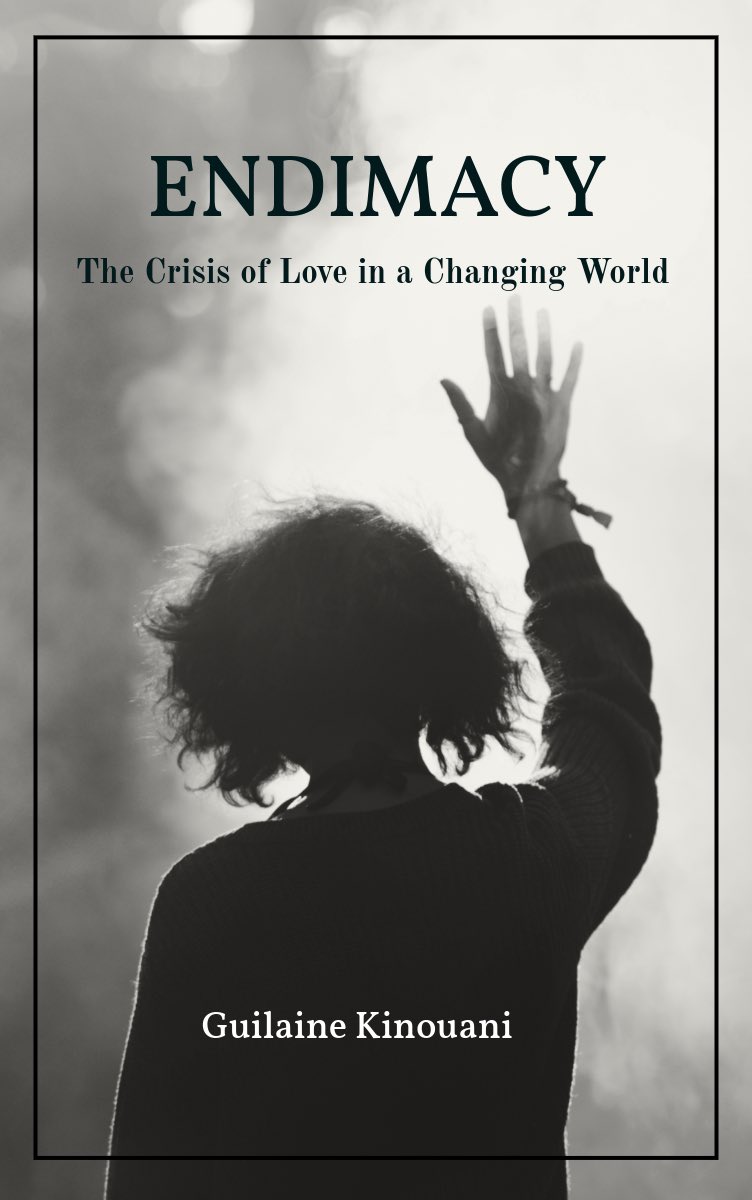
Today I’m excited to share the cover of my new book, my most intimate, reflective and vulnerable writing to date.
Pre launch details coming soon.
What does the cover evoke for you? What do #Endimacy and #TheCrisisOfLove mean?