Adventures developing @UK_SKARC digital research infrastructure & communities to harness @SKAO data to enable researchers to explore the early universe
Being able to walk away from a change initiative (often something we have invested huge personal effort in and feel passionate about) is a defining capability for leaders of change.
In change work, we celebrate the leaders who “push through resistance” and “never give up”. We talk less about the leaders who know when to stop – or walk away – from a change initiative altogether.
Sometimes that decision is about the work itself:
- The initiative is no longer aligned with organisational priorities.
- The context has shifted so much that the original case no longer holds.
- The effort required now far outweighs any likely benefit.
But sometimes, the decision is about the toll on the person leading the change:
- Sponsors are absent, inconsistent or obstructive, leaving us carrying the risk but not the authority.
- We’re repeatedly asked to “spin” the story or sidestep hard truths in ways that clash with our values.
- The behaviours rewarded around the initiative (blame-shifting, pressurising, tolerating poor behaviours) are the opposite of the culture we’re trying to build.
Walking away will rarely be applauded. It may look to some people like a lack of resilience or loyalty. Yet it can be an act of deep responsibility: to our own wellbeing, to our credibility, to the people we lead & to the people we are seeking to create better outcomes for.
Actions to reduce the risk of having to stop or walk away:
1) Name the conditions we need (sponsorship, resourcing, psychological safety) and pay attention when those conditions are chronically missing.
2) Build regular check‑ins with sponsors to test commitment, reset expectations and surface misalignments early, rather than absorbing them alone.
3) Set the change process up from the start as a series of “experiments” with clear hypotheses and time‑boxes, so we can make decisions about what to do next based on real data, not assumptions.
4) Hold structured learning huddles as a change team, focusing on “What are we learning? What needs to change in our approach? What should we stop?”.
5) Invite voices from outside the core project team (frontline staff, service users, partner organisations) into periodic reflection sessions to test whether the change still makes sense in their reality.
6) Create reflective space with others (coaching, mentoring, peer support) to notice when the work is eroding your own energy, integrity or wellbeing. The first rule of being an effective change agent is that “you can’t be an effective change agent on your own”.
As leaders of change, our legacy isn’t just the initiatives we drive to completion. It’s also the ones we have the courage and strategic insight to stop. Sometimes the best move is not to push through, but to step away.
See, for instance, @AdmiredLeaders on reactive quitting versus strategic quitting: https://t.co/piWZNM7DoA.
The graphic is by the brilliant @milanicreative.
🌐 Curious about the Federated Computing Frameworks in #Europe?
Join the upcoming @Etp4HPC Webinar
🗓️ 24 Oct | 🕚 11:00 - 12:00 CEST
📍 Interactive session + live feedback via Mentimeter!
🔍 Explore models, deployments & challenges
📍 Register here: https://t.co/lxZGrCykmn
Want to shape the UK’s approach to AI and biosciences?
We're seeking insight from the UK engineering biology community on the use and adoption of AI to shape policy.
What's more, for every 100 responses, we'll donate £200 to @CR_UK.
The survey closes Friday 20 June, 11.59pm: https://t.co/a9524BvAHr
⛓️💥Resisting Digital Feudalism.
How can policymakers ensure that #AI serves the public interest and the common good? @IIPP_UCL Professor @MazzucatoM advocates for a different approach prioritizing public value over extraction.
✍️Read more here: https://t.co/O1k3W4L7NV
🎆It's launch day! Check out our brand new @wellcometrust funded platform to explore over 1,600 datasets from across the world. Find the Atlas of Longitudinal Datasets here -> https://t.co/sTBE7WbncW
#AtlasLongitudinalDatasets
We will host the JUNIQ Spring School on “Quantum Computing – Applications on Gate-based and Annealing Systems” from March 31 to April 04, 2025.
Further information and the registration form can be found at:
https://t.co/sq9oMsRg3J
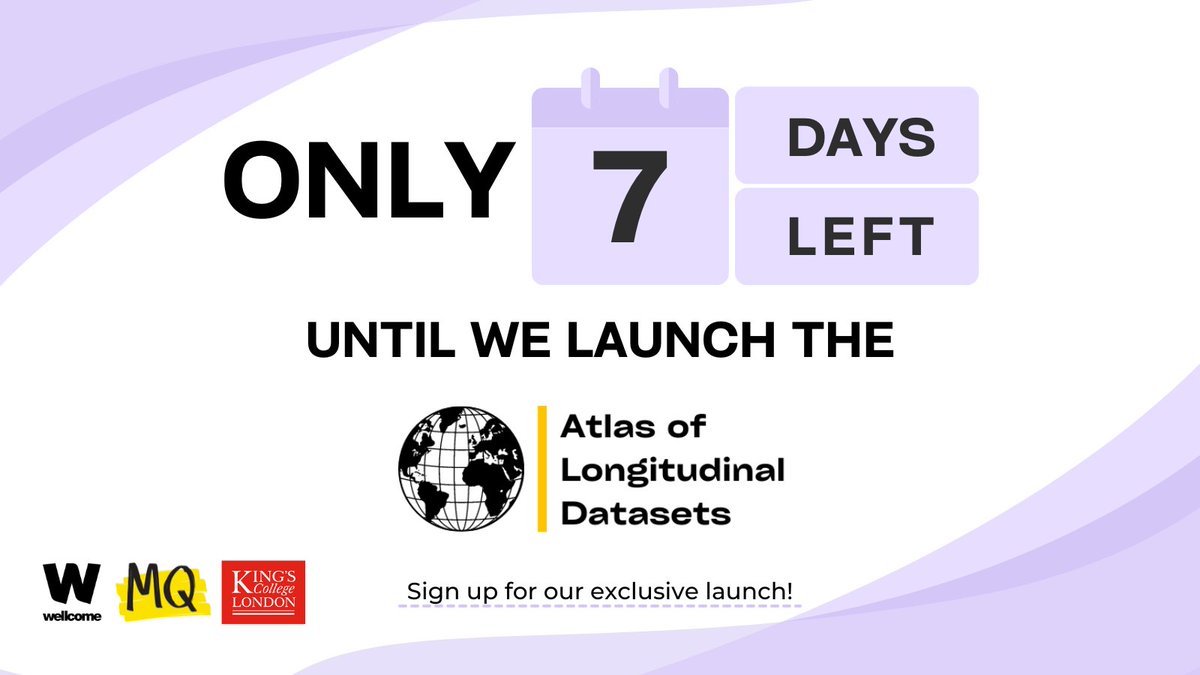
Only 7 days until we launch the Atlas of Longitudinal Datasets! The launch will include a presentation, live demonstration, & panel discussion with multi-sector participants, including lived experience advisors. Sign up here-> https://t.co/wjw9uBgosJ
@wellcometrust
1/ Today the Prime Minister published my AI Opportunities Action Plan for the UK and committed to implement all its recommendations. A quick thread on why this is important, what we need to do now - and how you can help
the third cohort of the No10 Innovation Fellowship launched last week as part of CDLs speech on public sector reform ... https://t.co/JaSZDqRsIL don't TALK about rewiring government DO IT!
Scientists in Europe: FENIX 2024 Call for proposals is open!
Cloud computing & archive services for your research. Europe-based researchers from any field can use FENIX services for free. Evaluation follows PRACE peer review. Apply: https://t.co/8uqhhjdvQK
I would LOVE to hire someone awesome to lead UKRI’s work on data and how we use it to understand the R&D system.
Great opportunity for someone with strong data skills who cares about technology, research and progress!
https://t.co/pItvynXWfn
📑New resource for policy organisations alert!
"Areas of Research Interest: A Practical Guide" will walk you through the stages of creating Areas of Research interest, to articulate your evidence needs and engage effectively with the academic community
➡️https://t.co/nR2WBYgU6e
🍕 ARC Tech Socials
Join us on 13th Nov at 4 PM for our Teach & Code Social! Dr. Mark Smith will share insights on LHCb experiments, software training, & collaboration efforts.
👉 Details & register: https://t.co/EmzubUWsx4
#TechSocial#Coding#ResearchComputing#ARC
Are you a UCL social science ECR with an interest in collaborative research such as research methods, collaborative practice, careers support, etc.? If so, join our ECR Coordinating Group and formulate a x-disciplinary activity programme @UCLResearch
https://t.co/tFT8i2rS0B
'Identity Negotiation and Professional Development in the Context of Digtal Transformation of Research Communities'. Research by @FDurandelfierro@allisonl@eileenkennedy01 with @Lou_Chisholm identifies barriers to data sharing in research communities https://t.co/68YwT3yUAt
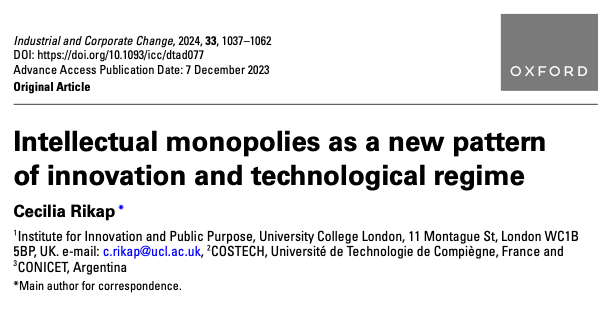
💊IIPP's Head of Research @CeciliaRikap’s paper on Intellectual Monopolies for @OUPAcademic reveals how #BigPharma influences innovation systems & appropriates rents from co-produced knowledge in the health sector.
🔗Read the paper here: https://t.co/GAdLF6yVX6
🗞️UK National Data Library!
@wellcometrust and @ESRC have launched a Technical White Paper Challenge inviting experts to submit ideas for a future NDL to benefit the research community and the UK population.
Find out more below👇
https://t.co/wGP7YRQS8A
The adoption of technology is a more powerful driver of growth than either capital investment or increases in the labour force.
Visiting Professor Paul Ormerod (@uclcs) calls for technical progress as a contributor to economic growth in City AM ⬇️
https://t.co/zG5pQhDyK9