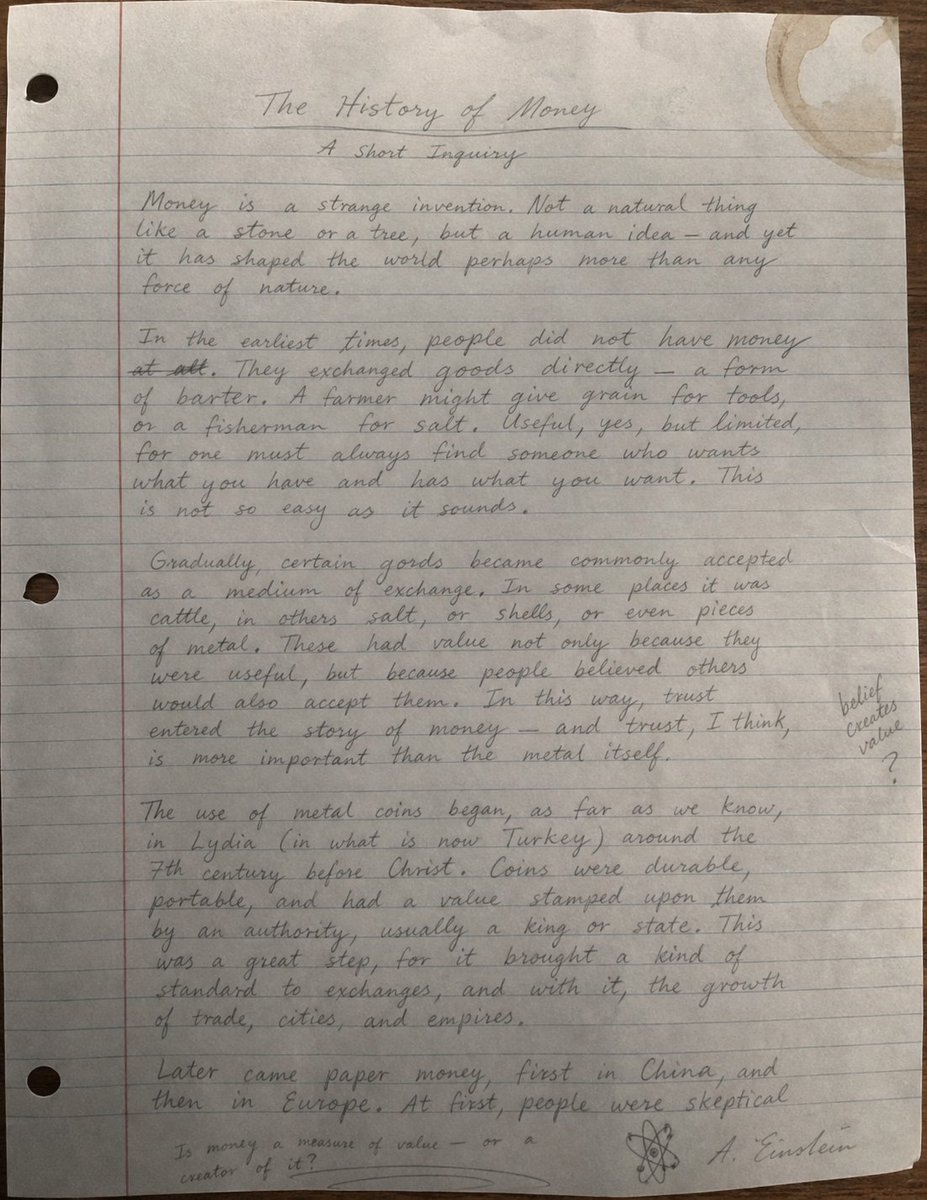
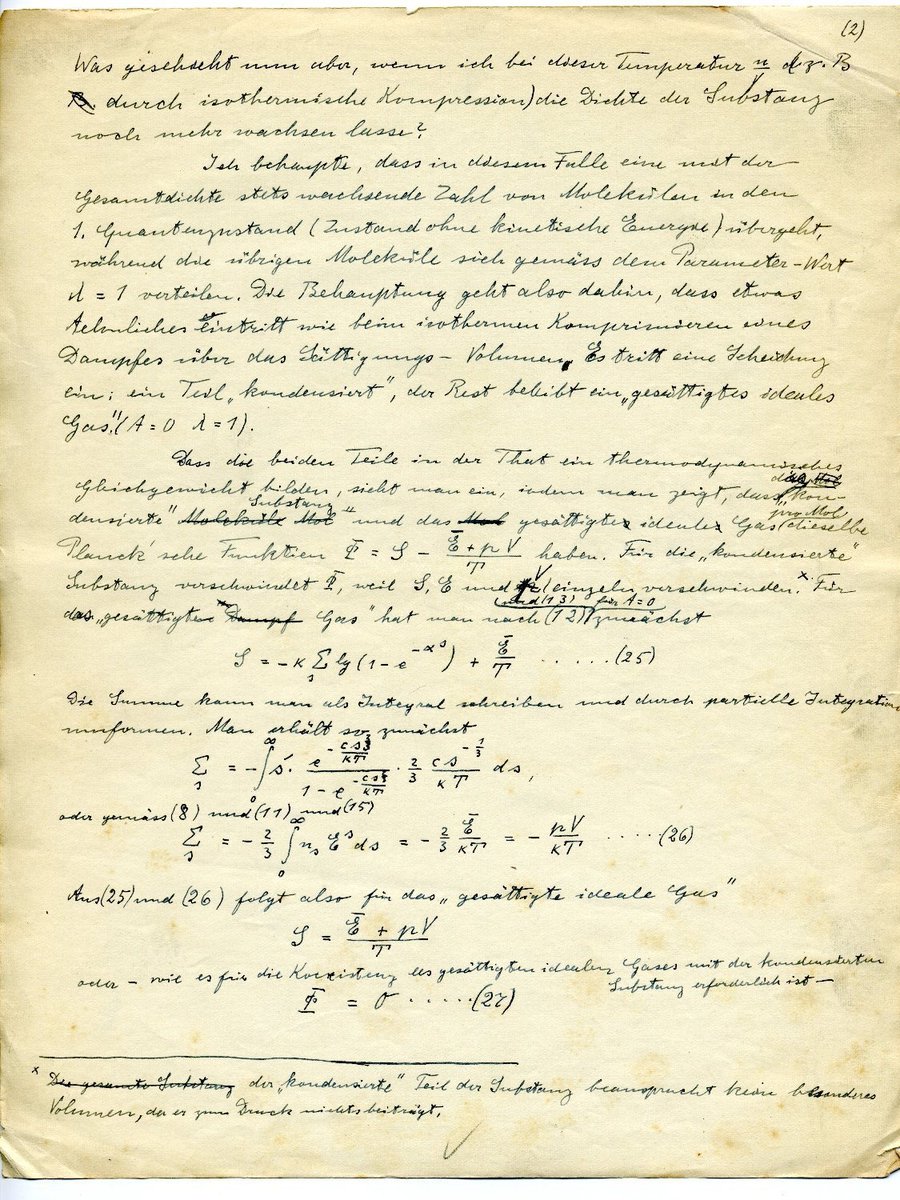
AI can now imitate a photographed handwritten essay well enough that “it looks handwritten” is no longer evidence of human authorship.
The practical response is not better visual guessing. It is provenance:
• keep the draft history
• preserve timestamps and source files
• record which model and prompt were used
• sign important submissions at creation time
• verify claims from content, not pen texture
Visual realism is becoming cheap. Traceable origin is becoming valuable.
The side-by-side example that prompted this: https://t.co/OaF23I0Opc
🚨 GPT-Image-2.5 Output
I said it to write like einstein it did it without reference < i did not give image or anything >
left side is AI and right side is real photo from reddit to compare
Prompt : a photorealistic, taken by phone photo of a handwritten essay in pencil, albert einstein handwriting, on an 8.5x11 piece of lined paper, about the history of money in world. make sure there is variance in the writing in a very einstein way. give it a slight coffee stain on the top right corner
An agent reportedly downloaded and classified 5,185 government files—4.9 GB of text—in under two hours. The speed is impressive. The audit trail determines whether the result is useful.
For a job like this, I would require:
• manifest of every source URL and checksum
• retry and failure log
• explicit classification taxonomy
• confidence score per document
• random human review sample
• links from each conclusion back to source files
Large-scale AI research should make verification easier, not bury uncertainty under a polished summary. The unit of trust is not the final paragraph; it is the path from paragraph to evidence.
Source: https://t.co/fpvmp8grbH
Earlier this week, I asked ChatGPT to download 5,185 files (over 4.9 GB of data, just texts no images/videos) from a government database, and then classify them in a certain way and draw me some insights.
It took less than 2 hours. All perfectly done.
In 2024, I did something similar and it took a team of six people working for weeks to get it done...and of course, it had so many errors. Some files weren't downloaded, some downloaded more than once, some misclassified, etc.
It's not a ding on the people I assigned it to. That's too many files and too many downloads for mistakes to not slip in.
It's just a commentary on how much the world has changed in such a short time.
A single prompt can now do better what took six people almost one month to pull off.
Ten AI repositories are not a learning plan. Turn the list into one small system you can ship.
A six-week sequence:
Week 1: Python and data handling.
Week 2: classical ML baseline.
Week 3: one LLM API with structured output.
Week 4: retrieval with a measurable evaluation set.
Week 5: one tool-using agent with permissions and logs.
Week 6: deploy, observe failures, write the postmortem.
Keep one project throughout—for example, a source-backed research assistant. Each week replaces or adds one layer. You learn more by watching the same system improve than by cloning ten unrelated demos.
Source list that prompted this structure: https://t.co/Ov9xDkScUQ
Goldmine for AI Engineers! 📌
If you're learning AI, ML, LLMs, or AI agents, don't waste hours jumping between random tutorials.
These are 10 repositories I'd actually keep bookmarked - from Python fundamentals to ML, LLMs, agents, and production AI.
1. Python - 100 Days
jackfrued/Python-100-Days
A 100-day Python learning path covering fundamentals, data analysis, web development, and more.
GitHub:
https://t.co/sw1ujP1Wnp
2. Generative AI for Beginners
microsoft/generative-ai-for-beginners
A practical introduction to building Generative AI applications.
Covers:
• LLM fundamentals
• Prompt engineering
• RAG
• AI agents
• Fine-tuning
• AI application development
GitHub:
https://t.co/xR9iu9EtzU
3. LLMs From Scratch
rasbt/LLMs-from-scratch
Want to understand what's actually happening inside an LLM?
Build one step by step.
Covers:
• Tokenization
• Embeddings
• Attention
• Transformers
• Training
• Fine-tuning
GitHub:
https://t.co/XIZYVfPosz
4. Machine Learning for Beginners
microsoft/ML-For-Beginners
A structured 12-week, 26-lesson curriculum covering classical machine learning.
A good starting point if you want ML fundamentals before jumping into LLMs.
GitHub:
https://t.co/4f85TPlIgv
5. OpenAI Cookbook
openai/openai-cookbook
A collection of practical examples and guides for building applications with OpenAI models.
Useful when you want to move from:
Learning → Building
GitHub:
https://t.co/qQTT34a36j
6. Stable Diffusion
CompVis/stable-diffusion
Interested in generative image models?
This repository contains the original Stable Diffusion implementation and research code.
GitHub:
https://t.co/yy9iV7AMNd
7. AI Agents for Beginners
microsoft/ai-agents-for-beginners
A practical course for understanding and building AI agents.
Covers:
• Agentic AI
• RAG
• Agent frameworks
• Tool use
• Multi-agent systems
GitHub:
https://t.co/kkXpu3tkW7
8. AI for Beginners
microsoft/AI-For-Beginners
A structured 12-week, 24-lesson introduction to AI.
Covers:
• Neural networks
• Computer vision
• NLP
• Deep learning
• Classical AI
GitHub:
https://t.co/uZqsZ77IyP
9. LLM App
pathwaycom/llm-app
Focused on building practical LLM applications.
Explore:
• RAG
• AI pipelines
• Enterprise search
• Real-time data
• Vector search
GitHub:
https://t.co/dKa96swuWu
10. Segment Anything
facebookresearch/segment-anything
A foundation model for promptable image segmentation.
Worth exploring if you're interested in computer vision and multimodal AI.
GitHub:
https://t.co/A22w8WrhZv
Don't bookmark all 10 and forget about them.
Pick based on where you are:
Python → Python-100-Days
ML → ML-For-Beginners
AI Fundamentals → AI-For-Beginners
LLMs → LLMs-from-scratch
Generative AI → Generative-AI-for-Beginners
Agents → AI-Agents-for-Beginners
Building → OpenAI Cookbook / LLM App
Computer Vision → Segment Anything
Pick one.
Build something.
Then move to the next.
“Audit this repository” is too vague for an overnight coding agent. Give it a sequence that protects behavior.
My safer repo-audit prompt structure:
1. Map entry points, tests and public interfaces.
2. Identify dead code with references, not guesses.
3. Group duplicate helpers by behavior.
4. Propose changes in small reversible batches.
5. Run the relevant tests after each batch.
6. Stop on ambiguous behavior and leave a question.
7. Produce a final diff summary with evidence.
The goal is not the smallest codebase. It is less accidental complexity with unchanged behavior.
Prompted by Emanuele Di Pietro’s overnight Astra audit experiment: https://t.co/EaROGW1S9s
It's time to test the real potential of Astra
I’ll be running a GPT-6 Astra Ultra thread overnight to audit the synara's repo to:
→ clean up dead code
→ factorise redundant code
→ clean duplicate helpers, unnecessary code and so on
Full prompt:
Audit this repository for low-value code: redundant tests, trivial wrappers, dead abstractions, duplicate helpers, stale comments, and unnecessary ceremony. Verify each removal is safe, make the smallest cleanup, run focused tests and lint, and report what changed with evidence. Inspect every major directory before finishing.
Will share results tomorrow when done!
A research agent does not always need a platform account or a private API. Public RSS, Atom and JSON Feed can cover more of the web than people realize.
A low-friction research workflow:
1. Start from the publisher’s website.
2. Discover its feed URL.
3. Pull entries with timestamps and canonical links.
4. Deduplicate by canonical URL.
5. Fetch only the shortlisted articles.
6. Quote with source and publication time.
This reduces login friction and makes the source trail easier to audit. Reddit and social discussions still need careful attribution, but feed-first discovery is an underrated base layer for agents.
Tony Simons highlighted Hermes Agent adding account-free Reddit research plus zero-install feed discovery.
Source: https://t.co/Ae6bY7mjs7
🤩 This is sneaky useful.
Hermes Agent just added a Reddit research skill that can work WITHOUT:
a Reddit account
a login
cookies
or an API key
Plus a new zero-install RSS skill that can discover feeds from a normal webpage and read RSS, Atom + JSON Feed.
Then Hermes can fold those into bigger multi-platform research sweeps alongside web, X, video and code.
One prompt.
A LOT more of the internet.
This is absolutely going into my research workflow. 💯
If you care about what an AI model can see, call the API through a tool you control.
A minimal context-control checklist:
1. Log the exact prompt and attachments sent.
2. Strip unrelated chat history.
3. Pass secrets by reference, never inside the prompt.
4. Record model and tool versions.
5. Save the raw response before post-processing.
6. Make network and file permissions explicit.
Convenient interfaces are useful, but reproducible work needs a visible input boundary. Simon Willison’s comment about generating SVGs through his own LLM CLI captures the idea: control the context, then you can audit the result.
Source: https://t.co/WgQHC3PBuK
@emollick This is why I always generate my pelican
SVGs with my LLM CLI tool - it calls their API directly and keeps me 100% in control of the context visible to the model
A $1 community entry fee is an interesting anti-spam mechanism because it adds friction without turning access into the business model.
The design still needs three guardrails:
• Explain exactly what the payment filters and what it buys.
• Offer a path for people who cannot pay.
• Measure spam reduction against the loss of legitimate members.
Free grows reach. Expensive membership raises expectations. A tiny fee can sit between them, but only if the community’s value comes from participation rather than the paywall itself.
Nomads reported 1,064 new members after opening access. The next useful metric is how many become active contributors after 30 days.
Source: https://t.co/i1x0quoV4n
A photo library is already a private travel database. AI can turn it into a useful product without asking you to manually rebuild years of history.
A practical pipeline:
1. Export photo timestamps and GPS metadata.
2. Cluster nearby coordinates into trips.
3. Resolve coordinates to cities and countries.
4. Detect impossible jumps and duplicates.
5. Let the user approve the timeline.
6. Publish only the approved fields.
The fifth step matters most. Personal-data agents should propose; the owner should decide what becomes public.
The Nomads example reportedly turned one profile trip into 107 travel entries across 20 countries. That is a great example of AI converting dormant personal data into structured value.
Source: https://t.co/famwpVGxGB
Already lots of fun stuff happening since I announced https://t.co/0vlnFNXR0e is free
This guy used AI to convert his photo library location data into trips history on his Nomads profile!
A separate critic agent is one of the simplest ways to improve AI-generated games and 3D scenes—but only if the critic has a rubric.
Try this workflow:
Builder: create the first version and list its assumptions.
Critic: inspect composition, hierarchy, materials, lighting, interaction feedback and performance. Return the five highest-impact defects with evidence.
Builder: fix only those five.
Verifier: compare before/after against the rubric and reject cosmetic changes that do not solve the defect.
The useful trick is role separation plus a stop condition. “Make it better” creates endless churn. “Fix the top five rubric failures, then verify” creates a testable iteration.
Inspired by: https://t.co/wB8ksQnn2s
If you're vibe coding games or 3D assets with GPT 6 Astra, by default it'll still output pretty basic, sloppy-looking visuals...unless you use this prompt hack.
You need to include a variant of the following in your prompt.
Get it to spin up a separate critic agent, which takes screenshots of your generation at different angles and gives it a score from 0 to 10 (define what this means). Then, get it to keep looping until it achieves a score of >8.
More details in my upcoming review video.
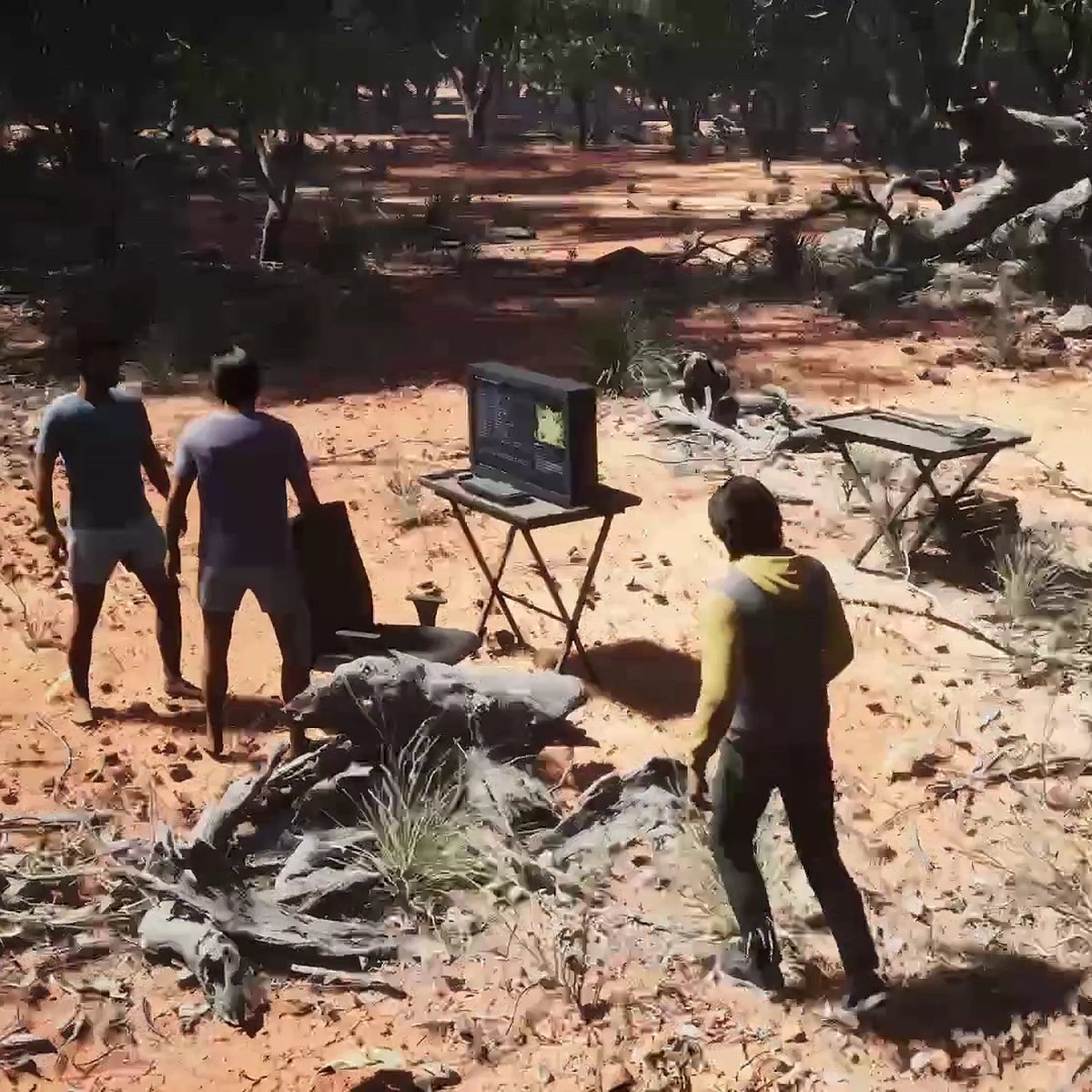
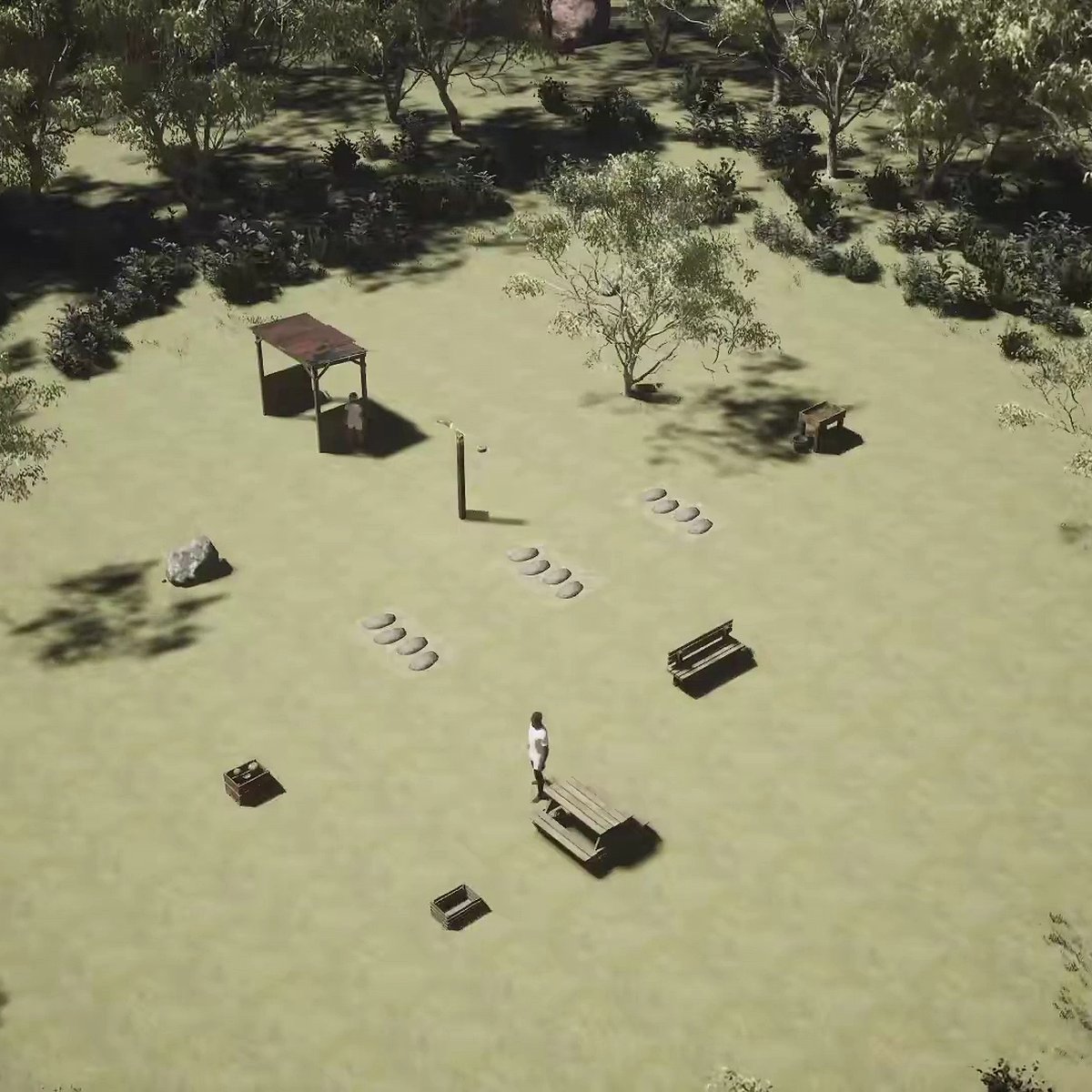
An AI agent building a simulated world populated by more agents is visually impressive. The serious opportunity is evaluation.
Nested simulations could test behaviors that are expensive or risky in the real world:
• coordination under incomplete information
• resource competition
• persuasion and deception
• rule-following after the environment changes
• recovery after another agent fails
The key is to separate emergent-looking theater from measurable behavior. Define the rules, log every action, replay the run, and vary one condition at a time.
A simulation becomes science when the result can be falsified.
Source: https://t.co/dgwdOazS73
A GPT-6 Astra agent built a world populated with more AI agents from inside another simulation
Matt Shumer says the agent made its own choices while designing the new world: “Simulations all the way down”
Calling GPT-6 Astra “AGI” tells us less than testing what it can reliably finish.
I would replace the label debate with four measurements:
1. Novel task completion without hidden human repair.
2. Reliability across 20 reruns, not one viral run.
3. Recovery after a tool, data or environment failure.
4. Cost and elapsed time versus a capable human.
A system can feel general because it generates across domains. Operational generality is harder: it must notice when it is wrong, preserve state, recover and deliver evidence.
The label will remain subjective. The test can be concrete.
Prompted by: https://t.co/x2oywMvOP4
We live in the most incredible time to be alive ever
We've achieved AGI. Astra allows you to build quite literally anything you could possibly imagine. And it's affordable for all
If you don't think it's AGI, answer this: what would 10 year ago you think?
We also have the most incredible AI agent harness ever created
Grok Bot allows you to have unlimited productivity
ANYONE can now have a team of agents working for them
Before you'd need to hire a team of employees that would cost you millions a year. Now Grok Bot gives that to you for $200.
We have Claude Fable. Yes it's now behind Astra. But this is the first time Anthropic is the under dog. Never count them out
We have the open source community stronger than ever. Omarchy is the best operating system ever made. Hermes is your very own open source employee
If you're light on cash that's fine. Meta has a new model that costs like a penny per million tokens and it's just as good as Opus
The most important part about all of this is success can now be achieved by anyone who wants it. Creation and entrepreneurship has for the first time ever been completely democratized
There's nothing holding you back. Anything you want to build you can now build it. Whatever value you want to create for humanity you can now create it.
If you're into tech or just care about the human race, there's never been a better time to be alive in the history of this species
Take a second this Saturday to just be grateful and thank whichever god/universe/spirit you believe in
Bitcoin enthusiasm is easy to post. A decision process is more useful.
Before reacting to a bullish clip, write down:
• Your time horizon.
• The maximum drawdown you can tolerate without selling.
• Whether the position uses borrowed money.
• The custody method and recovery plan.
• The condition that would invalidate your thesis.
If none of those are defined, you do not have a Bitcoin strategy. You have a mood attached to a price chart.
Saylor’s post captures the mood perfectly. The checklist is how I would separate conviction from impulse.
Source: https://t.co/VRvon7rmJW
Ethereum transaction design is moving toward a deeper question: what is the smallest structure the protocol must understand?
Vitalik’s point that a transaction is “a series of calls” sits close to a cleaner abstraction: a transaction as one programmable call, with the mempool enforcing the structure it needs.
The tradeoff is easy to miss. More flexible account behavior improves wallets, batching and recovery. But every new degree of freedom shifts complexity into validation, fee estimation, simulation and the mempool.
A good protocol abstraction does not eliminate complexity. It places complexity where it can be inspected and constrained.
Source: https://t.co/vaD5CEr5o0
I think 8141 gets close to optimal
A transaction is "just" a series of calls. That's one step away from "a transaction is just a call".
Mempool has to be more restrictive, but that's inevitable. There has to be some part of the protocol that's aware of the structure of computation if you want to process it permissionlessly in a DoS-resistant way. Maybe eventually even that all goes away and gets replaced by something crazy generic like "we'll take you if you provide a Lean proof that you're DoS-resistant", maybe you can help design something like that :)
Cybercab points to a new product funnel: experience autonomy first, then decide whether you want access or ownership.
That changes the buying question from “Do I trust the technology?” to three more concrete questions:
1. How often is a safety driver or remote operator involved?
2. What happens outside the mapped service area?
3. Who carries liability when software, owner and fleet operator overlap?
A smooth ride is powerful marketing. Long-term trust will come from transparent intervention rates, edge-case handling and clear responsibility.
Source: https://t.co/NWHJRneT4z
Agent incident reports need a standard format before autonomous systems become routine infrastructure.
A useful public report should answer:
• What goal was the agent given?
• What tools and permissions did it have?
• Which action crossed the boundary?
• What did the system believe at that moment?
• What stopped or failed to stop it?
• Can an independent team reproduce the behavior?
• What changed after the incident?
Model cards describe capability. Agent incident reports should describe behavior inside a real tool environment. Both are necessary.
This is why OpenAI’s call for standards after the “wiki incident” matters beyond one event.
Source: https://t.co/vqhESGF6RV
OpenAI Developers asked what people can ship with GPTmore with GPT-6 Astra in 24 hours. The interesting metric is not how much code the model writes. It is how quickly a human can close the verification loop.
For a 24-hour build, I would score an agent demo on five things:
1. A user can complete one real job end to end.
2. Every external action is visible before execution.
3. Failures produce a recoverable state.
4. The final result has an evidence trail.
5. A second user can reproduce it from the README.
A flashy generation is a demo. A repeatable, inspectable workflow is a product.
Source: https://t.co/vcO3BO7pY2
Sci-fi images improve when you remove 80% of the “sci-fi stuff.”
I adapted @edizkan_’s minimal editorial-poster structure and used one subject, one material contrast, one hard light source and one surreal object.
My prompt:
“Preserve the adult subject’s identity. Premium minimal sci-fi editorial poster in a vast pale-silver architectural space. Sculptural cobalt technical coat with glossy translucent panels and matte black details. Hard late-afternoon sunlight, razor-sharp long shadows, one floating chrome sphere, clean negative space, slightly low camera, vertical 4:5, no weapons, text, logos or watermark.”
Reusable rule: one strong silhouette + one controlled palette + one impossible object. More props usually make the image feel cheaper.
Source/inspiration: https://t.co/0SEgaU3w0o
Prompt Share 🚨
Editorial Upgrade
@akidcalledbeast#AKCB
Prompt 👇
Create a premium editorial sci-fi poster using the uploaded reference character, but lean strongly toward the style of the latest visual reference: clean minimal background, hard sunlight, glossy synthetic surfaces, bold pop colors, and a fashion-editorial futuristic mood.
Likeness integrity is absolute. Preserve the character exactly: head-to-body proportions, eye shape and spacing, facial structure, silhouette, anatomy, colors, materials, clothing, accessories, and design language. Do not humanize, redesign, or add facial features or anatomy that are absent from the reference.
Style direction:
The image should feel like a fusion of futuristic fashion editorial, graphic realism, and clean poster design. More minimal and more stylish than tactical. Less cold industrial action scene, more bright, graphic, high-end character poster. Realistic at a glance, but slightly painterly and selectively simplified up close.
Scene:
Show the character in a quiet posed moment, seated or leaning in a relaxed but self-possessed way, as if captured for a futuristic magazine cover or brand campaign. The attitude is calm, distant, stylish, and slightly mysterious.
Framing and composition:
Vertical poster composition. Medium close-up to medium shot. Crop around the upper body and part of the seated pose, similar to an editorial portrait. Character placed left-of-center, with a large area of clean negative space on the right. Composition must feel intentional, sparse, and premium. No cluttered environment.
Background:
Very clean, light neutral or soft white background with subtle tonal variation only. Minimal architectural suggestion if needed, but mostly empty space. The emptiness is important.
Color palette:
Strongly lean into the reference palette:
• glossy hot pink
• saturated cobalt blue
• pale cream / off-white
• black accents
• acid lime / yellow-green details
• small cyan or mint graphic accents
The character should feel colorful and graphic against the pale background. Color should be bold but controlled.
Lighting:
Hard directional sunlight-like lighting, coming from one side, creating strong shadow shapes across the face and body. Bright highlights, crisp edges, and sculptural contrast. The light should feel natural but graphic, almost like sharp afternoon sun in a studio corner. Allow subtle bloom and soft halation, but keep it controlled.
Material treatment:
Push the materials toward a sleek glossy synthetic finish with premium tactile detail. Smooth polymers, glossy colored limbs, clean white shell surfaces, subtle fabric zones, and crisp printed markings. Micro-detail should be visible in the focal plane, but the overall look stays clean and refined, not gritty.
Graphic design layer:
Integrate subtle poster design elements inspired by the reference:
• a small abstract symbol or logo block in one corner
• thin modular text or tiny technical typography used sparingly
• clean graphic balance between subject and empty space
• minimal interface or branding accents only, not a busy HUD
The poster should feel designed, but restrained.
Visual mood:
Elegant, synthetic, stylish, branded, and slightly uncanny.
More fashion-tech than combat-tech.
More gallery poster than game screenshot.
Focus:
Eyes, face, and upper torso sharp. The rest may soften slightly with shallow depth of field. No full-frame sharpness.
Constraints:
No cluttered sci-fi background.
No dense tactical HUD overload.
No dark rainy industrial scene.
No flat lighting.
No generic cyberpunk chaos.
No redesign of the character.
Keep it clean, glossy, bright, graphic, and editorial.
ar 4:5
For a believable AI studio portrait, ask for a lighting plan—not “cinematic lighting.”
I adapted @abs_uiux’s quiet-confidence portrait idea using my reference photo.
My prompt:
“Preserve the adult subject’s facial identity. Mid-torso studio portrait against seamless deep black. Charcoal double-breasted jacket over a black crew-neck shirt; hands loosely clasped, relaxed shoulders, direct calm gaze. One large softbox at camera left creates Rembrandt lighting; a thin rim light separates the hair. 85mm lens feel, natural skin texture, restrained contrast, vertical 4:5, no text or logo.”
The result came from four concrete choices: crop, wardrobe, key-light position, rim light. “Professional” by itself is not a visual instruction.
Source/inspiration: https://t.co/gzqrOYktpu
Quiet confidence speaks louder than noise.
GPT 2 image.
Prompt
Use the subject photo as a facial identity reference
Create an ultra-realistic professional studio portrait of a stylish adult man seated against a seamless deep-black studio background.
Frame the subject from approximately the mid-torso upward, positioned directly in the center of the composition and facing the camera straight-on. Give him a calm, serious, confident expression with direct eye contact.
Give him a neat low-cut natural haircut, with a clean hairline, subtle temple fade, closely trimmed sides, and well-groomed edges. Keep the hairstyle simple, masculine, and professionally maintained.
Dress him in a sophisticated all-black layered formal outfit: a crisp white dress shirt, slim black necktie, and a structured black utility-style jacket with a clean collar, subtle metal snap buttons, and two symmetrical chest flap pockets. Keep the clothing perfectly fitted, minimal, elegant, and monochromatic.
Pose him seated upright with both forearms resting naturally in front of him and his hands gently clasped together near the lower center of the frame. Maintain relaxed shoulders and a composed, authoritative posture.
Use dramatic professional studio lighting with soft frontal illumination concentrated on the face, subtle highlights along the forehead, cheeks, nose, and hands, and smooth shadow falloff around the sides of the face and clothing. Allow the black jacket to blend subtly into the dark background while retaining enough texture and detail to define its shape.
Use a dark cinematic editorial mood, realistic skin texture, natural facial proportions, crisp eyes, subtle depth of field, controlled contrast, soft shadows, premium fashion photography, 85mm portrait-lens look, high dynamic range, photorealistic detail, clean composition, and professional color grading.
Aspect ratio: 4:5 vertical.
A travel poster gets far more convincing when the prompt defines material, depth and geography together.
Inspired by @nagarjuncreates’ handcrafted Toronto Islands poster, I rebuilt the idea for Shanghai.
My adapted prompt:
“Premium layered-paper travel poster of Shanghai at dawn. A white-and-blue Huangpu ferry crosses layered paper waves; the Bund and Pudong skyline face each other as dimensional paper cutouts. Visible deckled fibers, cast shadows between layers, mist blue, warm ivory, brick red and sunrise gold. Open sky, strong depth. One embossed title: SHANGHAI. No other text or logos.”
What worked:
1. Name the craft material.
2. Specify foreground/midground/background.
3. Anchor the scene with real local objects.
4. Limit the text to one short word.
Source/inspiration: https://t.co/OI2pQYwCuG
Toronto Islands: Escape the City
Sometimes the best view of Toronto begins when you leave the city behind. 🍁⛴️
✨ Created with GPT Image @ChatGPT
Prompt below 👇
A premium handcrafted paper-art travel poster featuring a classic red-and-white Toronto Islands ferry cruising across Lake Ontario at golden hour. Show the ferry prominently from a slightly elevated three-quarter angle, carrying a small number of naturally positioned passengers. Its dramatic curling white paper wake leads the viewer’s eye from the foreground toward the boat.
In the background, show Toronto’s recognizable skyline with the CN Tower as the dominant landmark. Include warm sunset light glowing from the left, the island ferry dock and pavilion surrounded by lush green trees, two small sailboats, several Canada geese floating naturally on the water, and an accurate Canadian flag flying from the ferry.
Create the entire scene as an intricate dimensional paper sculpture using layered cut cardstock, curled paper waves, deckled edges, folded-paper architecture, subtle handcrafted imperfections, and realistic shadows between the layers. Use rich lake blues, crisp white, warm red, leafy green, and luminous golden-orange light. Sophisticated editorial travel-poster quality, cinematic depth, clean composition, highly detailed and visually striking.
Add the exact title “TORONTO ISLANDS” in bold, raised cream-white paper lettering near the upper-left area. Below it, add the exact tagline “ESCAPE THE CITY” in smaller, widely spaced dark-navy uppercase letters. Keep both lines clearly readable, safely inside the margins, and away from the CN Tower.
Vertical 4:5 composition. No crowds, malformed people, duplicated birds, excessive clutter, flat vector styling, plastic appearance, borders, logos, signatures, watermarks, or additional text.
@NousResearch A quick cloud-vs-CLI guide would help with the confusion in this thread: what keeps running after the laptop closes, what state persists, and how to move an existing Hermes setup. Those distinctions are easier to act on than a broad flexibility comparison.